

91 vacancies. 750+ posts. One notification that will change thousands of lives in Andhra Pradesh. Are you truly ready — or just hoping?
Picture this. Two candidates from the same town. Same graduation college. Same subject. One clears APPSC Group 1 in the first attempt. The other sits the exam for the fourth time. The difference? Not intelligence. Not luck. It is how they prepared — and what they focused on.
This guide will show you exactly what that difference is.
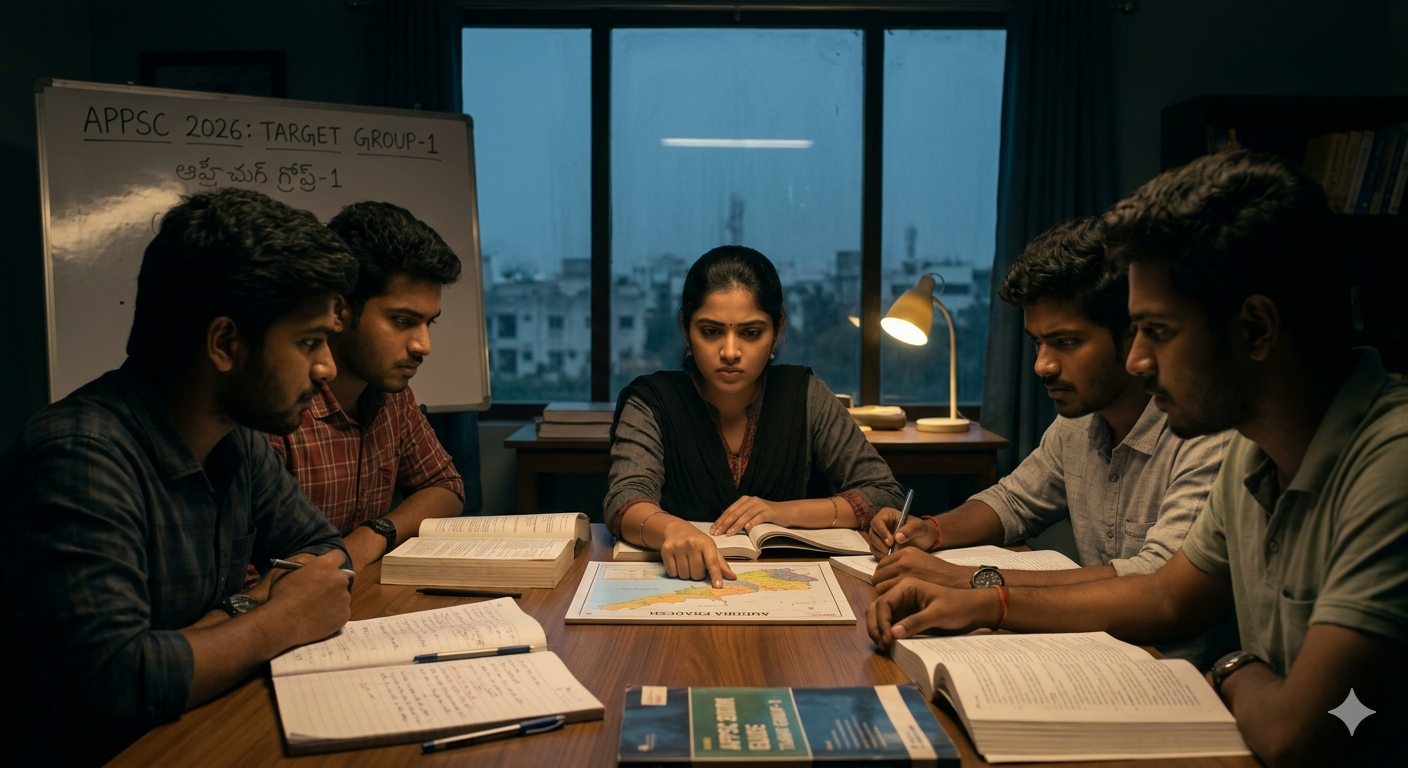
📋 What Is APPSC 2026 — And Why This Year Matters More Than Ever
The Andhra Pradesh Public Service Commission has released its official exam calendar for 2026, and the numbers are significant. A total of 4,755 direct recruitment vacancies are scheduled across Group 1, Group 2, and other services this year alone.
For Group 1 specifically, the notification is expected on 15th August 2026 for 91 vacancies in departments including Finance, General Administration, Law, Legislature, Revenue, and MA & UD. Group 2 notification is expected on 15th September 2026 for over 750 posts including Deputy Tahsildar, Sub-Registrar, Assistant Labour Officer, and Assistant Development Officer.
This means the next 12 months represent one of the biggest recruitment windows AP has seen in recent years. If you are preparing right now, you are ahead of thousands who will start only after the notification drops.
⚖️ APPSC Group 1 vs Group 2: Which One Is Right for You?
This is the first question every aspirant must honestly answer — not based on prestige, but based on your academic background, realistic preparation time, and career goal.
APPSC Group 1 is the most prestigious state civil services exam in AP — comparable to UPSC in its scope and seriousness. The selection process includes Preliminary Examination, Mains (descriptive), and Interview. Posts like Deputy Collector and Deputy Superintendent of Police carry enormous responsibility and salary.
APPSC Group 2 suits candidates who want faster entry into government service without a multi-year preparation marathon. The salary ranges from ₹30,000 to ₹70,000 per month depending on the post, and the selection is primarily objective-based, making it more approachable for working aspirants.
Neither path is easy. But knowing which one fits your current situation prevents the worst preparation mistake: spending three years on Group 1 material when Group 2 was the right target all along.
📚 The Syllabus That Most Candidates Get Wrong
Ask any ranker what surprised them most, and they will say the same thing: the syllabus is not the problem — misunderstanding the syllabus is.
The APPSC exam syllabus covers General Studies across four major areas:
1. History, Culture & Geography of Andhra Pradesh — This is where appscguide.com gives you a serious edge. Ancient AP history is a consistent and heavily-weighted section across both Group 1 and Group 2. Topics like the Satavahana dynasty, Ikshvaku rulers, Vishnukundin cave temples, and Renati Cholas appear almost every year in some form. Most candidates skim this. Toppers master it.
2. Indian Polity, Constitution & Governance — Articles, amendments, Schedules, Fundamental Rights, Directive Principles — these are not just theory. Questions are scenario-based. Learn to apply, not just memorise.
3. Indian Economy & AP Economy — Budget terminology, Five-Year Plans legacy, recent economic schemes, MSME data, agricultural statistics specific to Andhra Pradesh — this section rewards candidates who follow current affairs seriously.
4. Science & Technology — Basics of Physics, Chemistry, Biology, and recent developments in space, defence, and digital India. This section rewards common sense and current awareness more than deep study.
🏛️ Ancient Andhra Pradesh History: The Section Nobody Fully Prepares
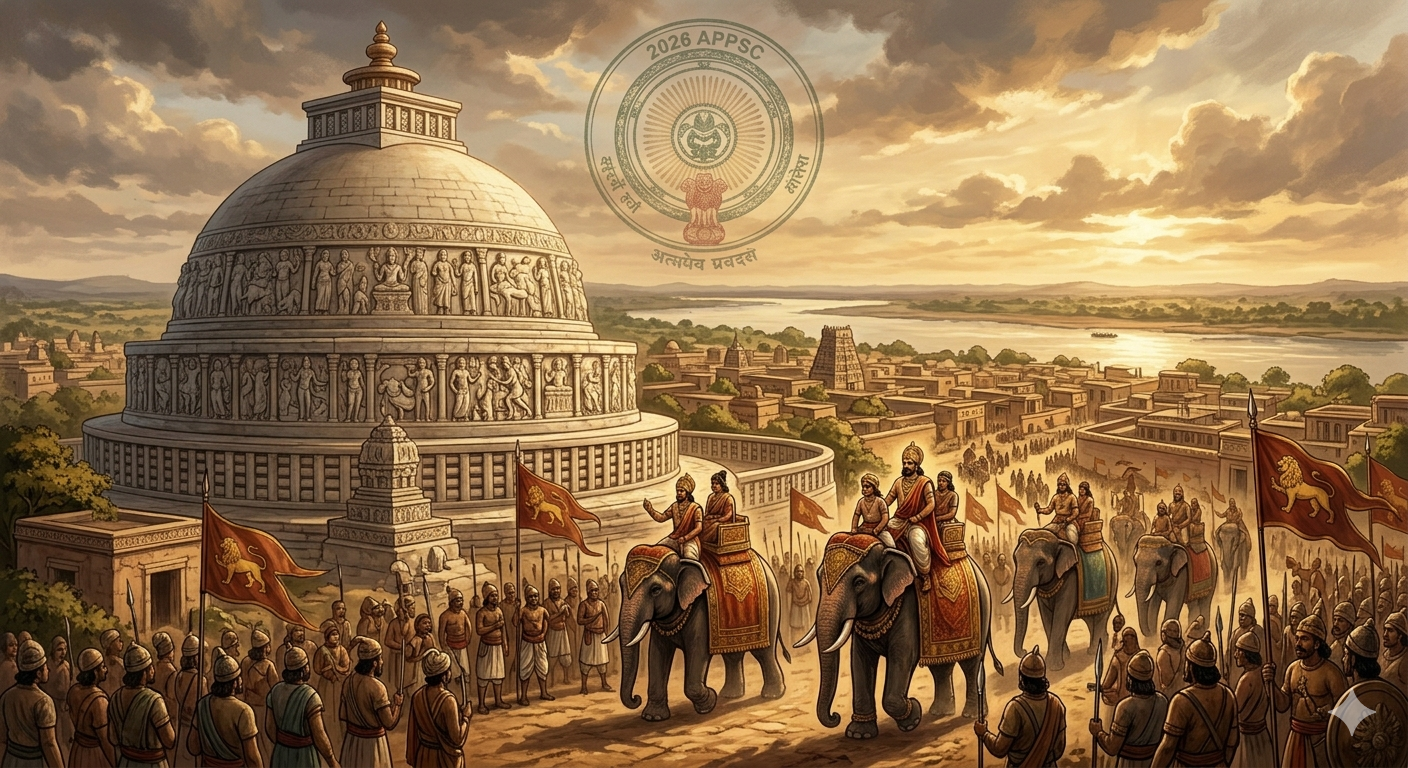
Ancient AP History is consistently underestimated. Candidates spend two hours on it and move on. But in every APPSC exam — from Group 1 Prelims to Group 2 Screening — 8 to 12 questions come directly from this section.
Here is why this matters mathematically. If you score 10 out of 12 in Ancient History and your competitor scores 4 out of 12, that is a 6-mark gap — in a competitive exam where rank differences are often decided by 2 to 3 marks.
What to focus on in Ancient AP History:
The Satavahana dynasty is the single most-tested topic. Know the chronology of rulers, their inscriptions, their capital cities (Pratishthana, Dharanikota), and their connection to Buddhism and trade routes. The Naneghat inscription of Naganika and the Nasik Prashasti of Gautamiputra Satakarni are frequently tested.
The Ikshvaku period (3rd–4th century CE) is next. Four main rulers — Sri Shantamula, Virapurushadatta, Ehuvala Chantamula, and Rudrapurushadatta — and their connection to Nagarjunakonda and Amaravati Buddhist sites. Questions on their inscriptions and patronage appear regularly.
Vishnukundin cave temples are a favourite for one-liner questions — Undavalli, Bhairavakonda, Mogalarajapuram near Vijayawada.
Renati Cholas are often ignored completely. But their rulers, copper plate inscriptions, and unique administrative system — using Telugu in official records, the first known instance — are high-value exam material.
🎯 How to Use MCQ Practice to Actually Improve (Not Just Attempt)
Most aspirants use MCQ practice the wrong way. They attempt 50 questions, check the score, feel good or bad about it, and move on. That is not learning — that is performance measurement without growth.
Here is the method that actually works:
Step 1: Attempt without time pressure first. Read each question carefully. Eliminate options systematically. Choose your answer based on reasoning, not guessing.
Step 2: After marking your answer, read the explanation — whether you got it right or wrong. If you got it right by elimination rather than knowledge, the explanation teaches you the actual concept. If you got it wrong, you learn the correction in context.
Step 3: Flag questions where you were confused. Return to these within 48 hours without looking at the answer. If you still struggle, that topic needs targeted reading, not more MCQ practice.
Step 4: Pattern-track your mistakes. If 70% of your wrong answers are from Ikshvaku period or trade history, you do not have a general history problem — you have a specific topic gap. Fix it surgically.
This four-step loop converts MCQ practice from a confidence exercise into a genuine learning tool.
🗓️ A Realistic Study Schedule That Fits Real Life
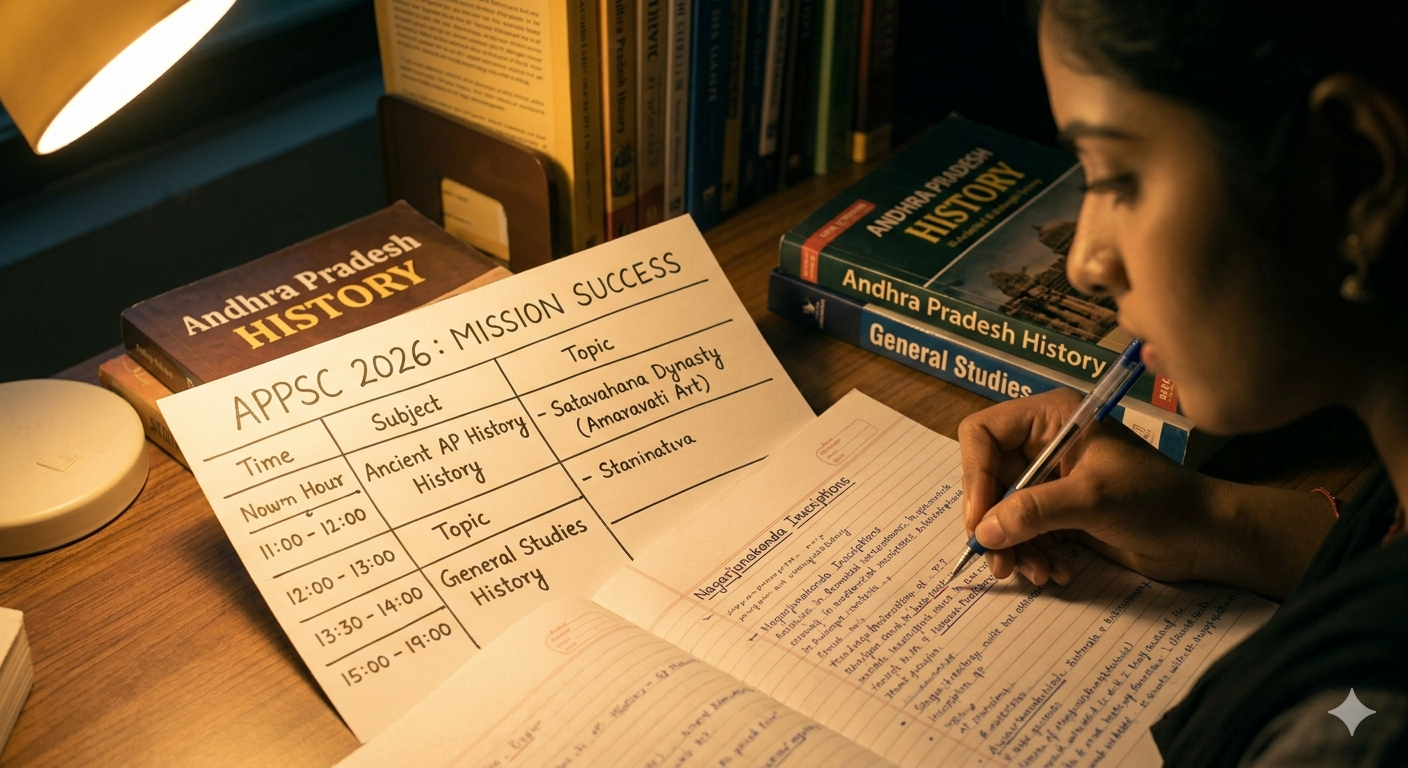
Most study plans you find online are designed for someone who has 10 free hours a day and zero responsibilities. That person does not exist.
Here is a realistic plan for a working aspirant or college student with 4–5 hours available daily:
Morning (1.5 hours) — New Concept Learning: Dedicate this to whichever subject feels most demanding. Fresh brain, difficult material. Do not start with current affairs or easy topics — save those for when you are tired.
Afternoon / Evening (2 hours) — MCQ Practice: Attempt 40–50 questions on yesterday’s topic. This spacing between learning and testing is not laziness — it is called spaced repetition, and research consistently shows it doubles retention.
Night (30–45 minutes) — Current Affairs + Revision Notes: Read one newspaper summary or one government scheme. Keep a running document of important facts. Review it every Sunday.
One full weekend day — Mock Test + Analysis: Sit a full-length timed mock test. Spend equal time analysing results as attempting the test. The analysis is where the marks are made.
📰 Current Affairs: The Section AP Aspirants Consistently Underestimate
Current affairs is not about reading everything. It is about reading the right things with AP focus.
For APPSC specifically, prioritise these areas:
- AP government schemes and budgets — Jagananna schemes have featured heavily in recent papers
- AP economic data — agriculture output, irrigation projects, industrial corridors
- National schemes with state-specific implementation
- Science & technology developments — ISRO missions, digital India initiatives
- Awards, books, persons in news connected to AP
Create a monthly one-page summary. By exam time, you will have a 12-page document covering 90% of what appears in the current affairs section.
🏆 What Toppers Do Differently (That Nobody Talks About)
After studying APPSC toppers’ interviews and strategies, three patterns emerge consistently:
They revise more than they study new content. By the last two months before the exam, toppers spend 70% of their time revisiting known material and only 30% on new content. Most failing candidates do the opposite — always chasing new topics, never consolidating what they already know.
They make peace with the questions they will not get right. Every exam has 10–15% of questions that are genuinely obscure or ambiguous. Toppers do not waste mental energy on these during the exam. They move on, complete what they know, and return later. Time management is as much mental as it is mechanical.
They treat explanation-based learning as non-negotiable. Every wrong answer has a reason. Understanding that reason — not just marking the correct option — is what converts MCQ practice into actual preparation.
✅ Your Action Plan Starting Today

If the notification drops in August or September 2026, you have 2–4 months of preparation time from this point. Here is what to do this week:
- Download the official APPSC exam calendar 2026 from naipunyam.ap.gov.in
- Identify your target exam — Group 1 or Group 2
- Print or save the official syllabus and tick which topics you already know vs which need work
- Start your Ancient AP History revision using the topic-wise MCQ bank — it is the fastest ROI section in the entire syllabus
- Set up a basic daily routine — even 3 hours is enough to start building momentum
The aspirants who start this week will be 60 practice sessions ahead of those who wait for the notification.
❓ FAQs: Questions Every APPSC Aspirant Actually Asks
How many hours of study are truly required to clear APPSC Group 2?
Most successful candidates studied 5–6 hours daily for 12–18 months. The consistency matters more than the daily count. Six months of 8-hour days followed by burnout produces worse results than 15 months of steady 5-hour days.
Can I clear APPSC without coaching?
Yes — and many toppers do. What coaching provides is structure, a peer group, and accountability. If you can create those three things yourself using good study material and online resources, coaching is not essential. Your investment should go into quality study material, not expensive classroom fees.
Which is more important — static GK or current affairs?
For APPSC, static GK carries more weight — especially AP History, Polity, and Economy. Current affairs matters but does not dominate. A 70:30 study ratio (static:current) works well for most aspirants.
How do I stop forgetting what I study?
Write it down in your own words immediately after reading. Do not copy — rephrase. Then review after 1 day, 1 week, and 1 month. This three-review cycle dramatically reduces forgetting.
Is one subject area enough for a topper rank?
No ranker is weak in AP History. It is the one section where full marks are achievable with focused preparation. Make it your strongest subject — it takes less time than you think and contributes significantly to your final score.
🎯 Final Thought: The Exam Is Fair — But Preparation Isn’t Equal
APPSC does not discriminate. The paper is the same for every candidate. What is not equal is preparation quality, strategy, and consistency.
You are reading this article, which means you are already thinking seriously about your preparation. That separates you from the majority of aspirants who are still waiting for “the right time” to start.
There is no right time. There is only right now.
Start today. One topic. One hour. One honest attempt at 20 questions with explanations.
That is how every topper started.
Practice topic-wise MCQs on Ancient Andhra Pradesh History — including Satavahana, Ikshvaku, Vishnukundin, and Renati Chola questions with detailed explanations — at appscguide.com.