|
|
☀ Concept 1: Weather, Seasons and the Climate
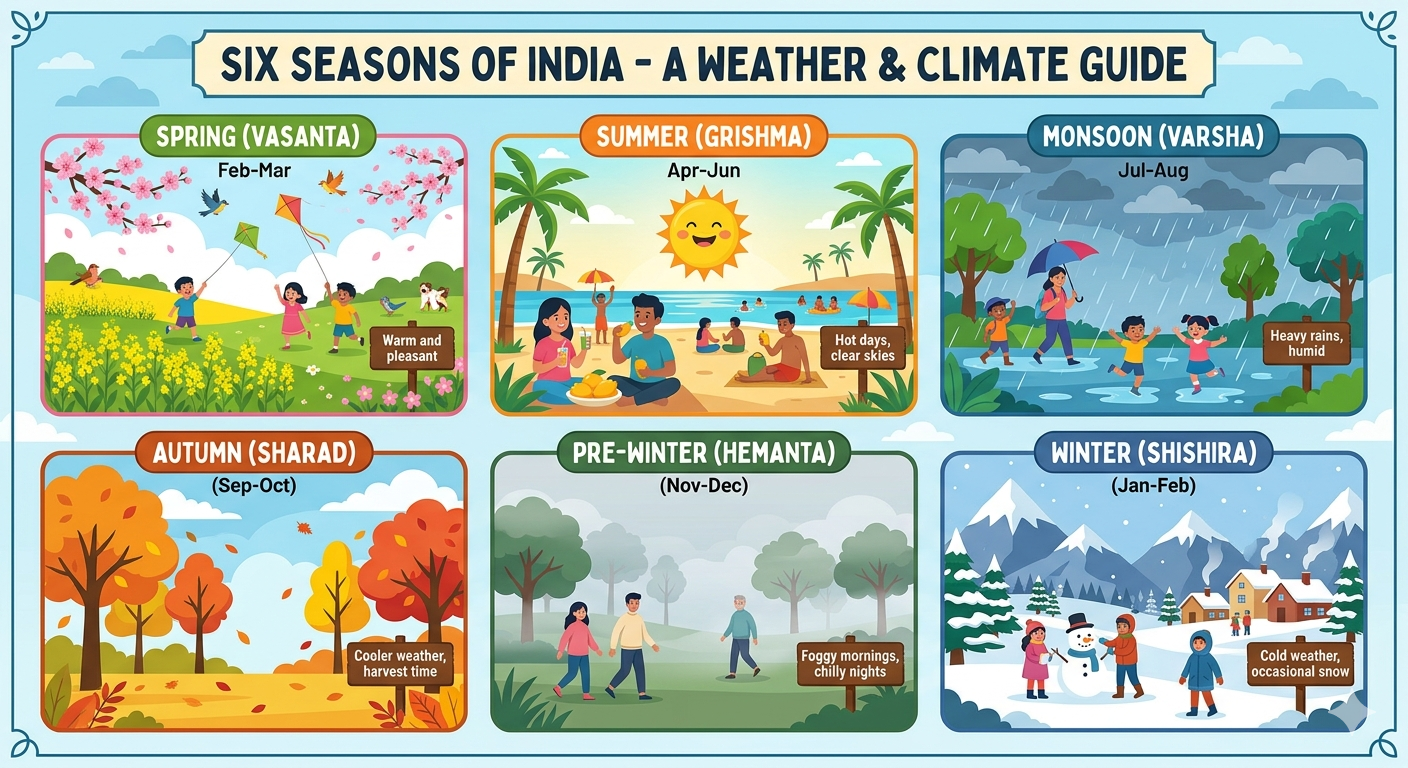
- Weather is what we experience every hour or every day — it may be raining, sunny, windy or cloudy. Weather keeps changing constantly.
- Climate is the long-term pattern of weather that a region experiences over several decades. Climate varies from region to region.
- Seasons occur as the Earth revolves around the Sun. Each season lasts a few months and recurs every year.
- The seasons in a year include spring, summer, monsoon, autumn and winter. The weather changes with each season.
- Traditionally, India recognizes six seasons (ritus): vasanta (spring), grishma (summer), varsha (rainy season), sharad (autumn), hemanta (pre-winter) and shishir (winter).
- Specific rituals and festivals are associated with these six ritus — for example, Vasanta Panchami (spring) and Sharad Purnima (autumn).
- Human, plant and animal life are in rhythm with the seasons. The crops we grow, food we eat and clothes we wear all change with the season.
- Climate normally remains stable over long periods. However, scientists have recorded changes in world climates in recent decades, many caused by human activities.
💡 Remember: Weather = daily change. Season = yearly cycle. Climate = decades-long pattern.
🌎 Concept 2: Types of Climates in India
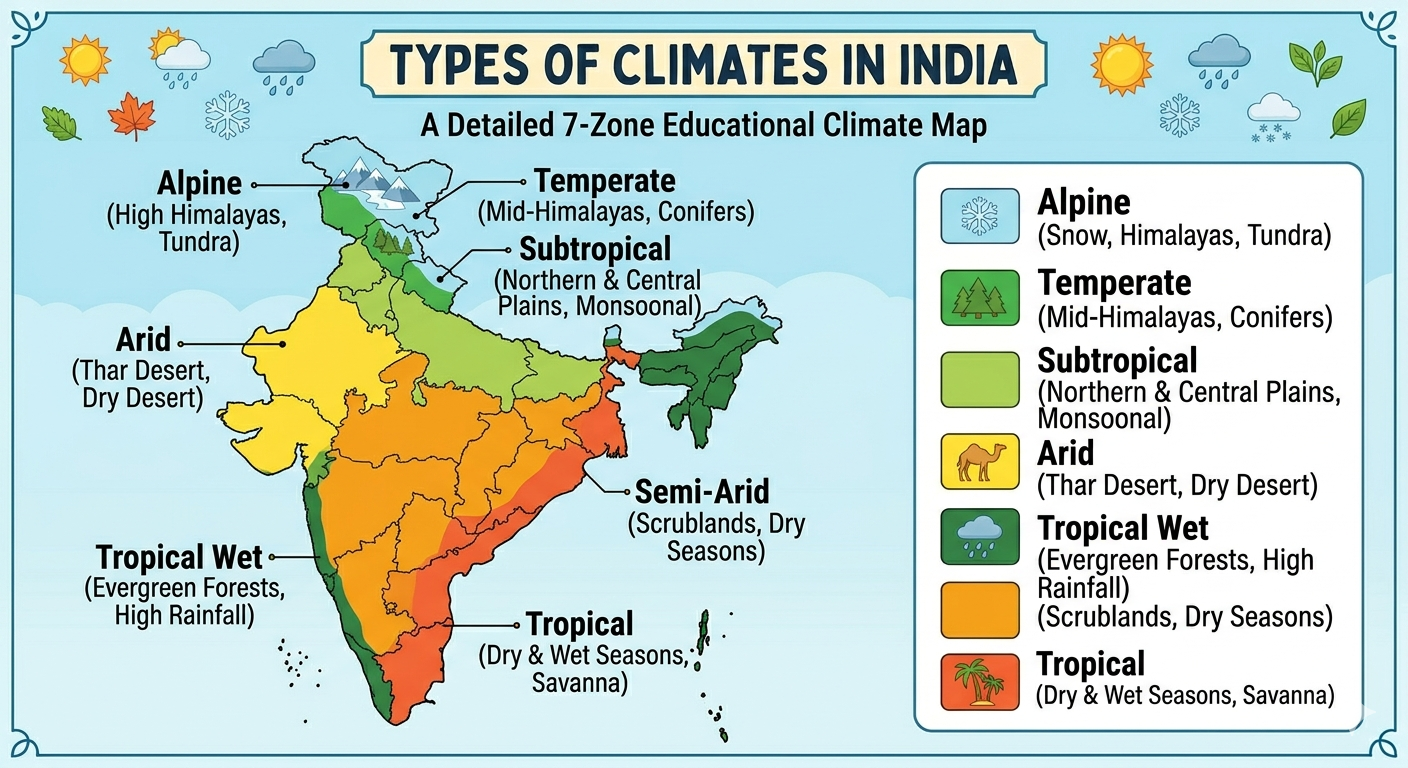
- India is a land of great diversity and this is equally true of its climate — different regions experience very different climates.
- Alpine climate — The Himalayan mountains have cold snowy winters and cool summers. The word alpine comes from the Alps, a mountain range of Europe.
- Temperate climate — Lower Himalayan areas and hilly regions have moderately cold winters and cool summers. Hill stations like Shimla, Ooty, Darjeeling and Munnar fall here.
- Subtropical climate — The northern plains have very hot summers and cold winters. Most of India’s wheat is grown here.
- Arid climate — The Thar Desert has extremely hot days, cool nights and very little rainfall. People developed unique methods to collect and conserve water.
- Tropical wet climate — The western coastal strip receives heavy monsoon rainfall, favourable for growing rice and spices.
- Semi-arid climate — The central Deccan Plateau has hot summers, mild winters and moderate rainfall during the rainy season.
- Tropical climate — Eastern India and the southern peninsula have mild winters with distinct wet and dry periods controlled by monsoon winds.
💡 Note: Tropical and subtropical are terms related to the Tropic of Cancer and Tropic of Capricorn.
🏠 Concept 3: Factors Determining the Climate
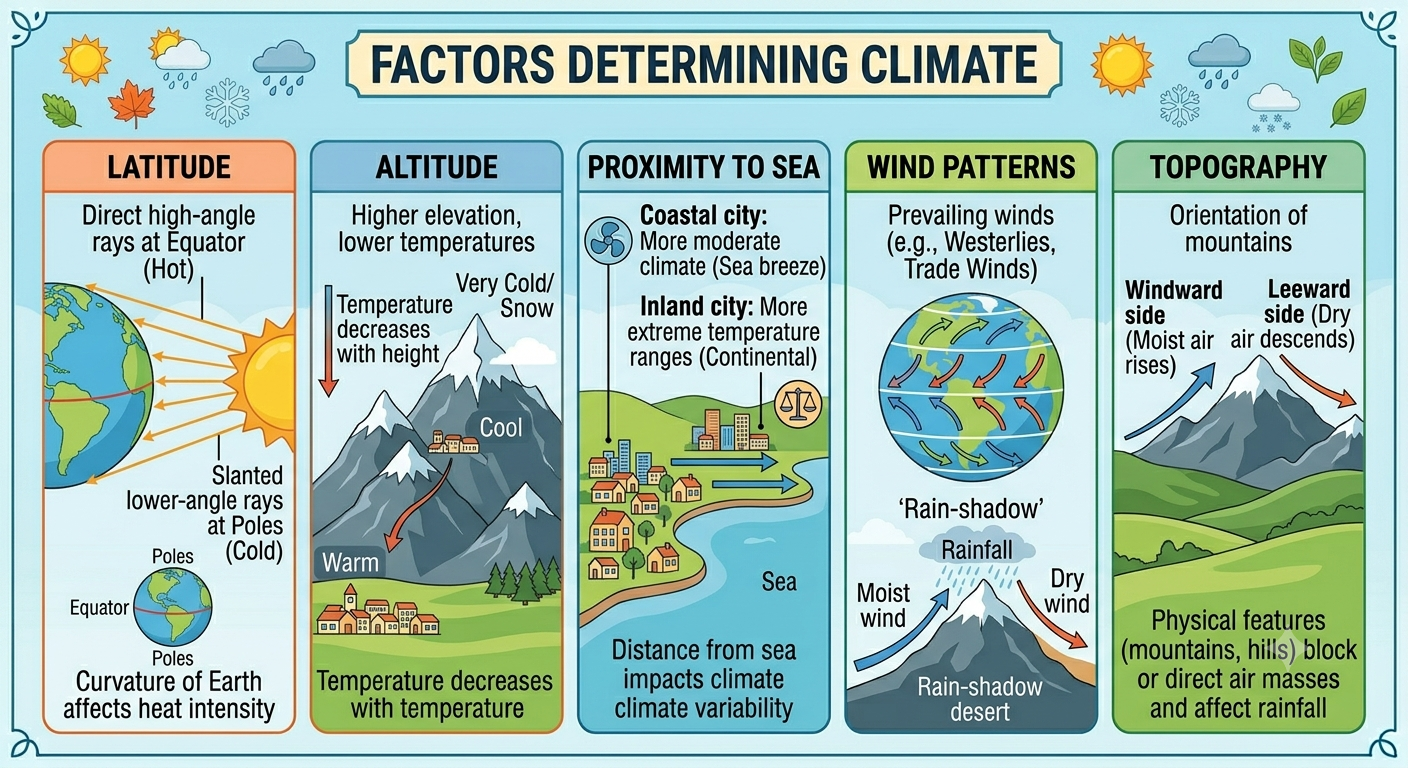
- The climate of a region is determined by several factors — some operate at the planetary scale while others are regional or local.
- a) Latitude: Places near the Equator are warmer; places near the poles are colder. At the Equator, sun’s rays are nearly perpendicular and concentrated on a smaller area. Near the poles, rays are oblique and spread over a larger surface. Example: Kanniyakumari is warm throughout the year; Srinagar is much cooler.
- b) Altitude: Temperature decreases as altitude increases because atmospheric pressure and air density fall, making air cooler. The sun heats Earth’s surface so higher places are farther from the heat source. Himalayan peaks stay snow-covered throughout the year.
- c) Proximity to the sea: The sea acts as a temperature moderator. Coastal areas have mild summers and mild winters. Moving inland, temperatures become more extreme. Mumbai (coastal): summer 32 degrees C, winter 18 degrees C. Nagpur (inland): summer up to 44 degrees C, winter 10 degrees C.
- d) Winds: Winds carry warmer or cooler air masses. Western winds from Arabian and Afghan deserts bring dry hot air causing heat waves in Punjab, Haryana, Rajasthan and MP. Cold Himalayan winds cause cold waves. Sea winds bring moisture resulting in rainfall.
- e) Topography: Physical features affect climate. The Himalayas and Karakoram ranges protect India from cold Central Asian winds. The Thar Desert’s flat topography is exposed to hot dry winds. The Western Ghats influence the southwest monsoon significantly.
- Microclimate: A climate localised in a small area that differs from the surrounding region. Enclosed valleys, forests and urban heat islands have their own microclimates. They influence local plants, animals, crops and human health.
🌧 Concept 4: The Monsoons
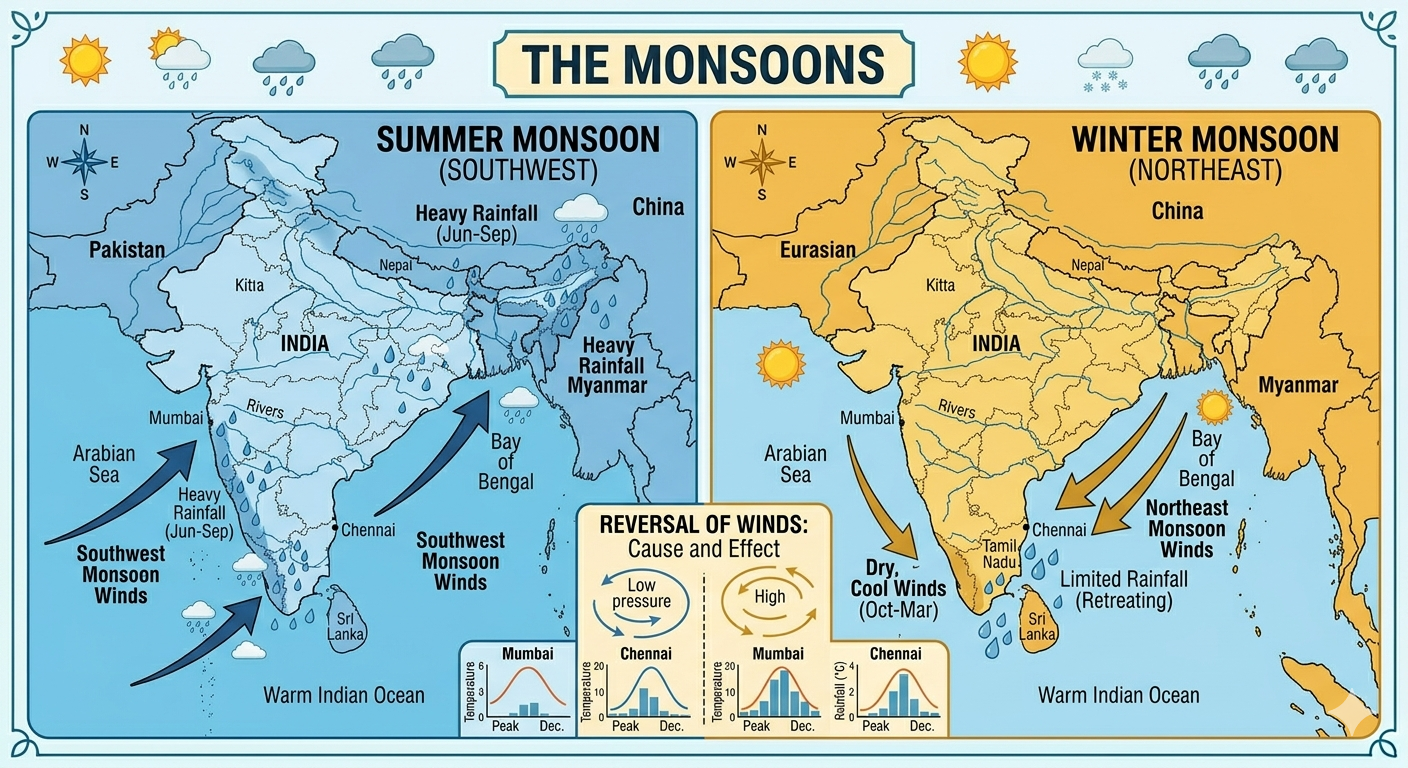
- The monsoon season is central to life in India — rivers fill up, soil is soaked, crops grow and life thrives.
- The word monsoon comes from the Arabic word mausim meaning season. It refers to seasonal winds over the Indian Ocean and surrounding regions including Australia, Africa and South Asia.
- Monsoons are based on the fact that land heats up and cools down faster than the ocean, creating pressure differences that reverse seasonally.
- Southwest Monsoon (Summer): In summer, the Asian landmass heats up creating a powerful low-pressure system. Winds flow from the cooler high-pressure ocean towards the hot land. These ocean winds carry moisture that falls as heavy monsoon rains.
- Monsoon rains advance from the southern tip of India in early June, moving northward, covering the entire subcontinent by mid-July.
- The Western Ghats act as a natural barrier — their western slopes receive very heavy rainfall while the Deccan Plateau to the east receives less, often with interruptions.
- Northeast Monsoon (Winter): In winter, the land cools faster than the ocean. Wind direction reverses from land towards the ocean. A part of these winds, passing over the Bay of Bengal, collect moisture and bring rainfall to parts of east and south India.
- Mawsynram in Meghalaya receives the highest average annual rainfall in the world — about 11,000 mm (11 metres!).
- The monsoons have inspired many ragas in both Carnatic and Hindustani classical music — Meghamalhar and Amruthavarshini are famous examples.
💡 Traditional knowledge: Indian ancestors developed local knowledge to predict monsoons — an important heritage to preserve.
🎉 Concept 5: Climate and Our Lives
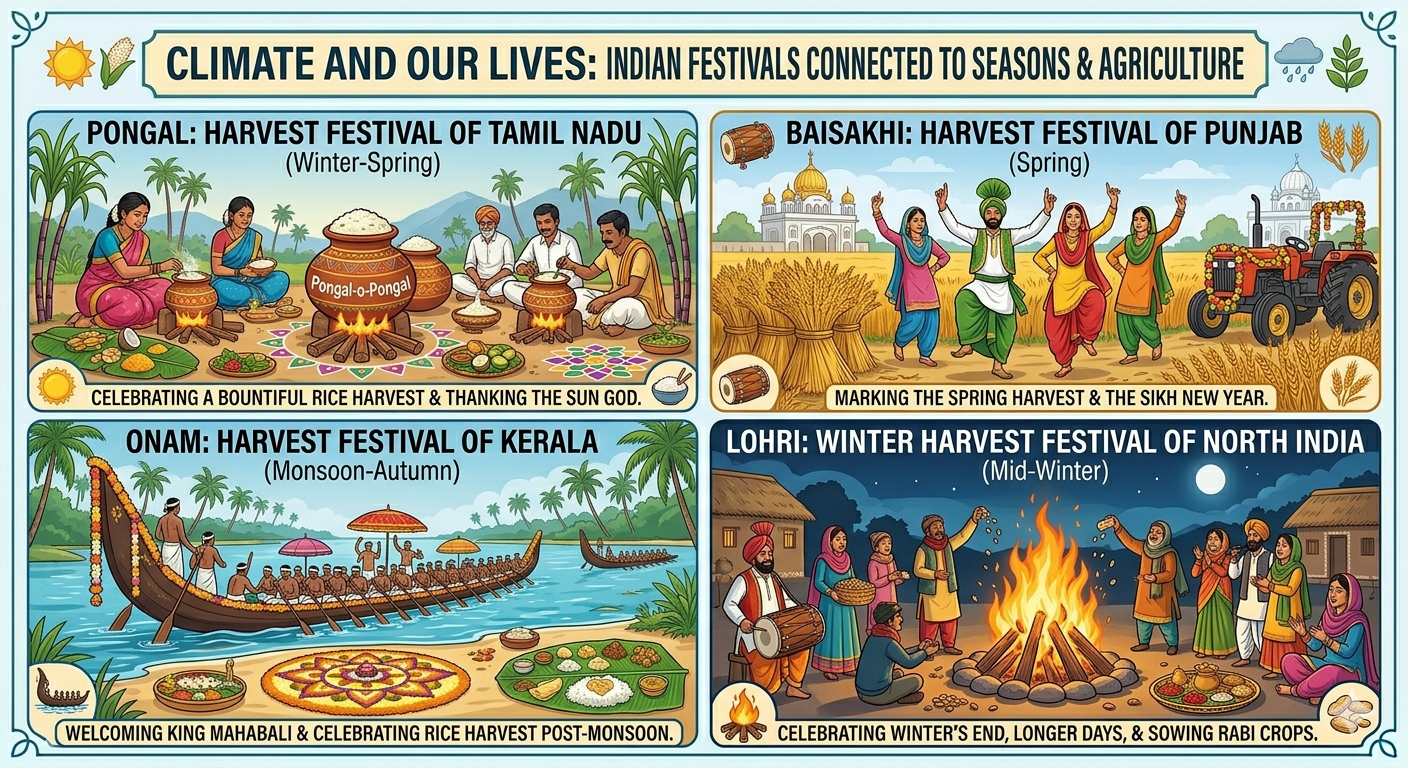
- Human life is deeply connected with and dependent on climate. Its impact is visible in culture, economy and society.
- Culture and Festivals: India has many festivals linked to seasons and agriculture — Pongal (Tamil Nadu, harvest), Baisakhi (Punjab, harvest), Onam (Kerala, harvest), Lohri (Punjab, winter), Bihu (Assam), Chhath Puja, Makar Sankranti and Gudi Padwa.
- Economy: Climate directly impacts the economy. Monsoon failure (poor rainfall during monsoon) causes agriculture to suffer, forces people to walk long distances for water, pushes agricultural labourers to migrate to cities, makes food costlier and fuels inflation.
- Industrial activity also depends on predictable weather and availability of water.
- Connections between climate and socioeconomic conditions are visible worldwide and get especially strained when climate disasters occur.
⛈ Concept 6: Climates and Disasters
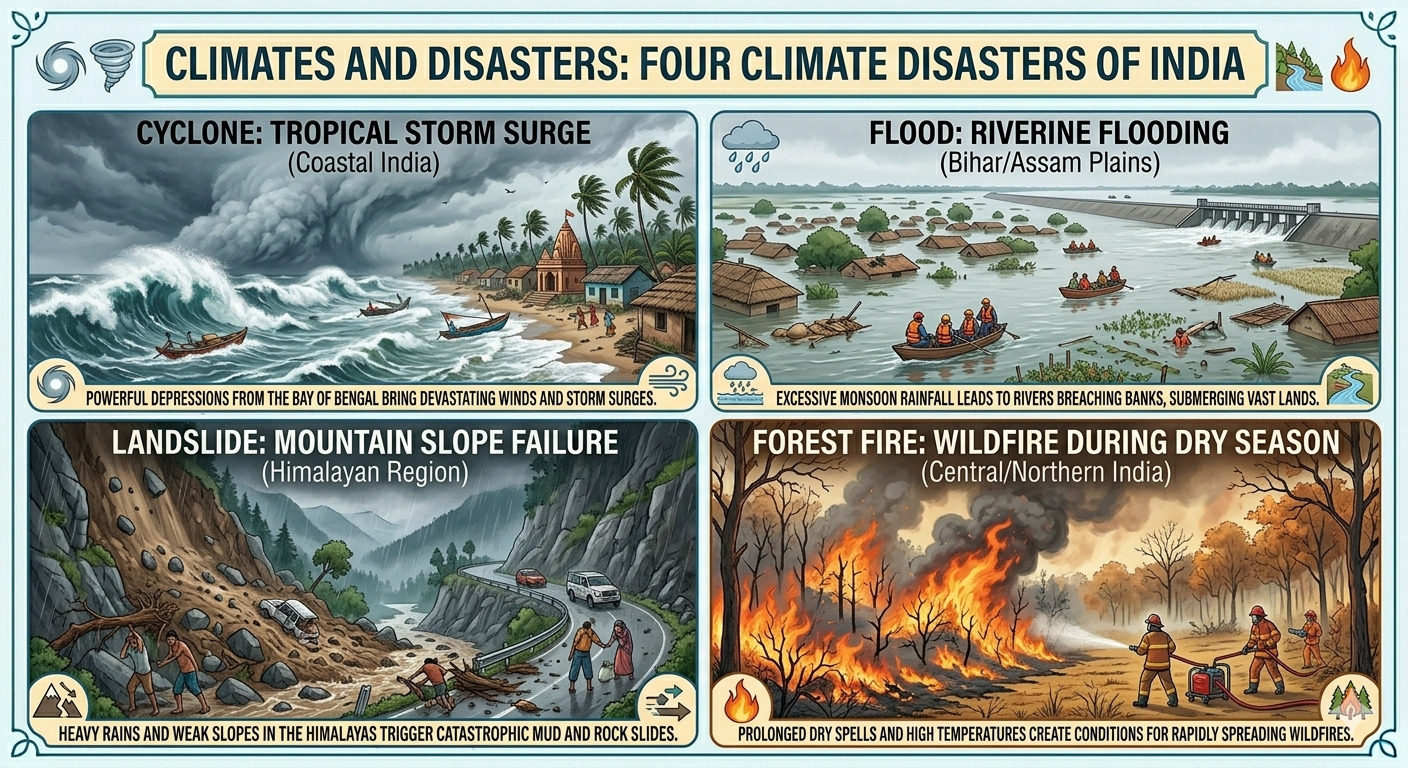
- India’s diverse weather patterns can produce extreme conditions such as cyclones, floods, landslides and forest fires, affecting lives, agriculture, infrastructure and economy.
- Cyclones: The Indian coastline, especially the eastern coast, witnesses several cyclones every year. The India Meteorological Department (IMD) tracks cyclones. The National Disaster Response Force (NDRF), with battalions at 12 locations, plays a key role in rescue and evacuation.
- How cyclones form: When atmospheric pressure near the sea becomes very low, air rushes in from surrounding areas. When the low-pressure system is intense and wind speeds are high, a cyclone forms. Winds collect moisture, form clouds and rotate inward. The cloudless calm centre is called the eye of the cyclone.
- Floods: Occur when water overflows onto normally dry land due to heavy rainfall or rivers overflowing their banks. States like Uttar Pradesh, Bihar, Kerala, Andhra Pradesh and Assam are especially vulnerable.
- Glacial burst: In Himalayan regions, glacial lakes can overflow. If glaciers melt too fast or there is excessive rainfall, water breaks through the rock and ice barrier. In 2013, a glacial burst in Uttarakhand destroyed areas near Kedarnath temple and killed about 6,000 people.
- Urban flooding: Cities experience flooding due to overburdened drainage, poorly planned construction blocking waterways, and concrete surfaces that do not absorb water.
- Landslides: Sudden collapse of rock, soil or debris triggered by heavy rain, earthquakes or volcanic activity. Common in Himachal Pradesh, Uttarakhand, Sikkim, Arunachal Pradesh and the Western Ghats. Deforestation and unplanned construction increase landslide risks.
- Forest fires: Uncontrolled fires fuelled by dry conditions, drought, high winds or human carelessness. Common in Uttarakhand, Himachal Pradesh, Madhya Pradesh, Chhattisgarh and the Western Ghats. They destroy forests, harm wildlife, degrade ecosystems and displace communities.
🌍 Concept 7: Climate Change
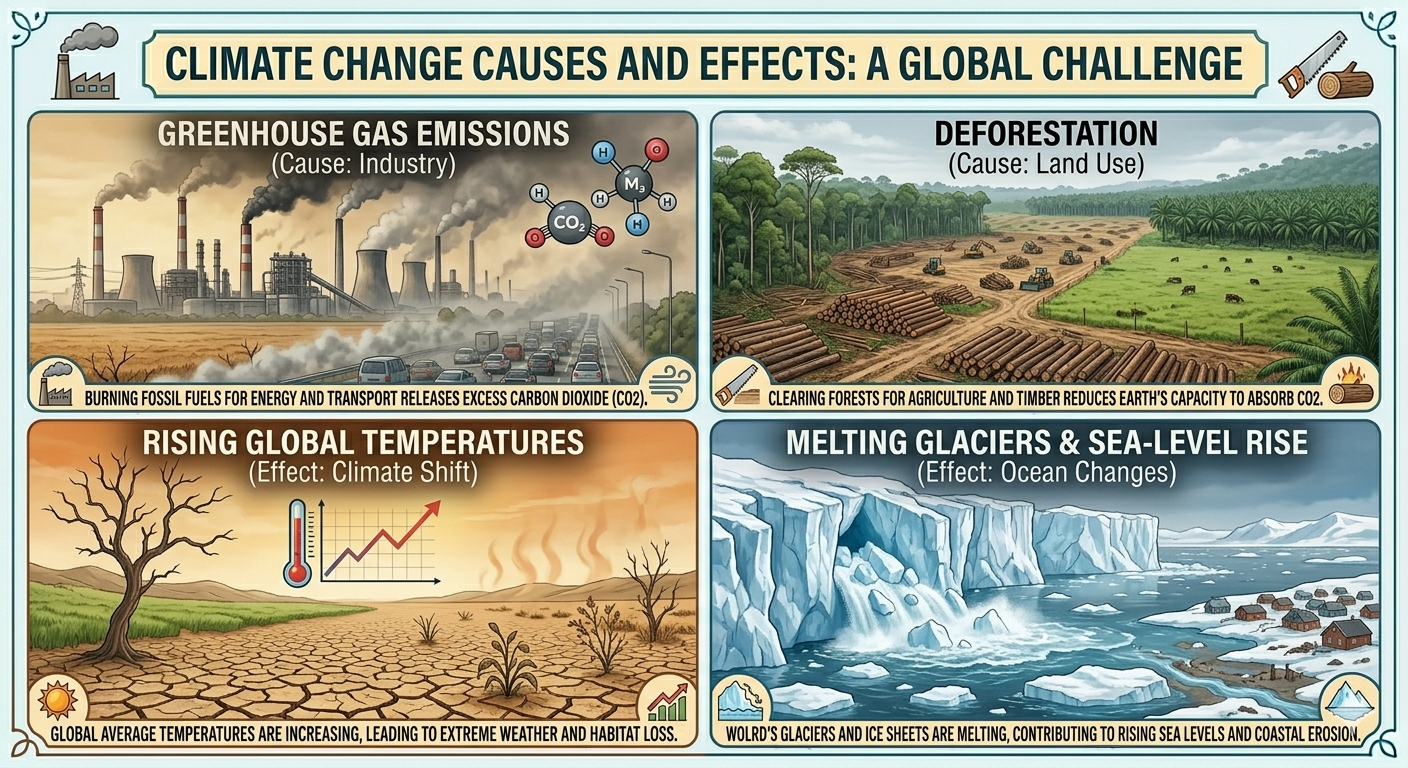
- Climate change refers to significant long-term changes in climate at the planetary or regional scale, involving shifts in temperature, precipitation and weather events.
- In past millennia, natural processes drove climate change. Since the 19th century, it has been largely driven by human activities — burning of fossil fuels, deforestation, harmful industrial practices and excessive consumption.
- Fossil fuels are sources of energy formed from remains of plants and animals that died millions of years ago, buried under soil and rock, slowly turning into coal, petroleum oil and natural gas.
- Greenhouse effect: CO2 and other gases trap heat from the Sun — this natural greenhouse effect warms Earth enough to support life. However, human activities have released enormous amounts of greenhouse gases, trapping extra heat and causing rapid global warming.
- This disrupts climate patterns that plants, animals and human societies have adapted to over thousands of years.
- In India, rising temperatures are visible in many regions. Early in 2025, India’s average temperature was 1 to 3 degrees C above normal, making winter much shorter and milder, affecting agriculture and small-scale industries.
- Mitigation measures: Governments promote cutting greenhouse gas emissions, planting trees, boosting renewable energy, improving energy efficiency and promoting sustainable lifestyles. However, these often clash with desires for economic growth.
- Key terms: Resilience = capacity to recover from difficulties. Mitigation = steps to slow global warming. Sustainable = can be maintained over a long period.
💡 Key Point: Understanding climate change helps communities build resilience and prepare for the future.
|
📄 Concept 1: Weather, Seasons & Climate
LOTS
What is the difference between weather and climate?
Show Answer
Weather is the day-to-day condition (rainy, sunny, hot) while climate is the long-term pattern of weather in a region observed over several decades.
Medium
Name the six traditional seasons (ritus) of India with their English meanings.
Show Answer
Vasanta (spring), Grishma (summer), Varsha (rainy), Sharad (autumn), Hemanta (pre-winter), Shishir (winter).
HOTS
Why is it important to distinguish between weather and climate when studying disasters like droughts or cyclones?
Show Answer
Weather tells us about immediate conditions while climate helps identify long-term patterns and risks. Understanding climate helps in preparedness and policy making.
HOTS
How are festivals in India a reflection of its six seasons? Give two examples.
Show Answer
Vasanta Panchami celebrates the arrival of spring. Sharad Purnima marks the autumn harvest period. Indian traditions are deeply connected to seasonal rhythms.
📄 Concept 2: Types of Climates
LOTS
Which climate type does the northern plains of India have?
Show Answer
Subtropical climate with very hot summers and cold winters. This region grows most of India’s wheat.
Medium
Why are hill stations like Shimla, Ooty and Darjeeling popular tourist destinations?
Show Answer
They have a temperate climate with moderately cold winters and cool summers, providing relief from the intense heat of the plains below.
HOTS
How does the variety of climates in India contribute to its agricultural diversity?
Show Answer
Subtropical plains grow wheat; tropical wet coast supports rice and spices; semi-arid Deccan supports millets and pulses. Climate diversity makes India capable of producing a huge variety of agricultural products.
HOTS
People in the Thar Desert developed unique methods to collect water. What does this tell us about human adaptation?
Show Answer
The Thar Desert has very little rainfall. Water scarcity forced communities to develop step wells and underground tanks showing how humans adapt technology and lifestyle to their local climate.
📄 Concept 3: Factors Determining Climate
LOTS
Name the five factors that determine the climate of a region.
Show Answer
Latitude, Altitude, Proximity to the sea, Winds, and Topography.
Medium
Ooty and Coimbatore are at almost the same latitude but have very different temperatures. Explain why.
Show Answer
Ooty is at a much higher altitude than Coimbatore. As altitude increases, temperature decreases because air pressure and density fall. Ooty has 10-25 degrees C while Coimbatore has 25-38 degrees C in summer.
HOTS
How do the Himalayas and the Thar Desert show opposite effects of topography on climate?
Show Answer
Himalayas block cold Central Asian winds protecting India. Thar Desert with flat topography has no barrier against hot dry winds resulting in extreme arid climate. Same factor works in opposite ways in different regions.
HOTS
What is an urban heat island and why is it a growing concern for Indian cities?
Show Answer
A city much warmer than surrounding areas because buildings, concrete and little vegetation trap heat. As Indian cities grow rapidly more cities develop this microclimate causing health risks and higher energy consumption.
📄 Concept 4: The Monsoons
LOTS
What is the origin of the word monsoon and what does it mean?
Show Answer
The word monsoon comes from the Arabic word mausim meaning season. It refers to the seasonal winds over the Indian Ocean and surrounding regions.
Medium
Explain the mechanism of the southwest monsoon in summer.
Show Answer
In summer the Asian landmass heats up rapidly creating low pressure. Winds flow from the cooler high-pressure ocean towards the hot land, bringing moisture that falls as heavy monsoon rains.
HOTS
Why does the Deccan Plateau receive less rainfall than the western coastal strip?
Show Answer
The Western Ghats block the southwest monsoon. Moisture falls on the western slopes. By the time winds cross the Ghats most moisture is lost creating a rain shadow over the Deccan Plateau.
HOTS
How does traditional ecological knowledge help predict the monsoon and why should we preserve it?
Show Answer
Konkan fishermen note when deep-sea fish surface; Golden Shower tree blossoming signals monsoon in 50 days. These observations are reliable and free of technology — essential where modern tools are not accessible.
📄 Concept 5: Climate & Our Lives
LOTS
What is monsoon failure and what are its immediate effects?
Show Answer
Monsoon failure is poor rainfall during the monsoon season. Effects include poor agricultural output, water scarcity, migration of labourers to cities, rising food prices and inflation.
Medium
Name any four Indian festivals connected to seasons or agriculture.
Show Answer
Pongal (harvest, Tamil Nadu), Baisakhi (harvest, Punjab), Onam (harvest, Kerala) and Lohri (winter, Punjab) — all connected to seasonal agricultural cycles.
HOTS
How does climate affect the socioeconomic conditions of India?
Show Answer
Good monsoon ensures healthy crops, affordable food, employment and economic stability. Poor monsoon leads to drought, unemployment, migration and high food prices, directly influencing GDP and rural livelihoods.
HOTS
Why are women particularly affected by monsoon failure in rural India?
Show Answer
Fetching water is traditionally a responsibility of women. When water sources dry up, women walk long distances for water, reducing time for education and work, deepening gender inequality.
📄 Concept 6: Climates & Disasters
LOTS
What is the eye of the cyclone?
Show Answer
The eye of the cyclone is the calm, cloudless centre of the cyclone — the low-pressure centre around which winds and clouds rotate inward.
Medium
How do human activities increase the risk of landslides in hilly regions?
Show Answer
Cutting forests removes roots that hold soil. Unplanned construction blocks natural water flow. Infrastructure without approved methods weakens hillsides, increasing landslide risk during heavy rains.
HOTS
The 2013 Kedarnath disaster was a combination of natural and human causes. Explain both.
Show Answer
Natural: Continuous heavy rainfall caused a glacial burst triggering floods and landslides. Human: Unplanned construction in fragile zones, deforestation and poor disaster preparedness worsened the impact. About 6,000 people lost their lives.
HOTS
Why are forest fires considered both an environmental and economic disaster?
Show Answer
Environmentally they destroy vegetation, kill wildlife, degrade ecosystems and cause air pollution. Economically they destroy forest resources, displace communities and damage tourism. Rebuilding takes decades.
📄 Concept 7: Climate Change
LOTS
What are fossil fuels? Give two examples.
Show Answer
Fossil fuels are energy sources formed from remains of plants and animals buried millions of years ago. Examples: coal and petroleum oil.
Medium
Explain the greenhouse effect and how human activities have made it harmful.
Show Answer
Naturally CO2 and other gases trap heat from the Sun warming Earth enough to support life. Human activities released enormous extra greenhouse gases, trapping excess heat and causing rapid global warming.
HOTS
Why do mitigation measures for climate change often clash with economic growth goals?
Show Answer
Mitigation requires reducing fossil fuel use and consumption which can slow industrial output and affect employment. Businesses want economic growth making it difficult to prioritize long-term environmental goals.
HOTS
In early 2025, India’s average temperature was 1-3 degrees C above normal. What chain of effects could this cause?
Show Answer
Shorter winter reduces rabi crop yields leading to food price increases. Early heat causes faster glacier melt increasing flood risk. People face health risks from extended heat. Small-scale industries dependent on seasonal raw materials are badly affected.
|