

Right now — as you read this sentence — Artificial Intelligence is deciding what video YouTube shows you next. It is deciding whether your loan application gets approved. It is reading your WhatsApp messages to detect spam. It is powering the Swiggy algorithm that predicts what you want to eat before you even open the app. AI is already running large parts of your life — and most Indians have no idea how it works, what it actually is, or what it means for their job, their children, and their future. India’s AI market is projected to hit ₹1.4 lakh crore by 2027. The question is not whether AI will affect you. It already has. The question is whether you understand it well enough to benefit from it — or whether it will simply happen to you.
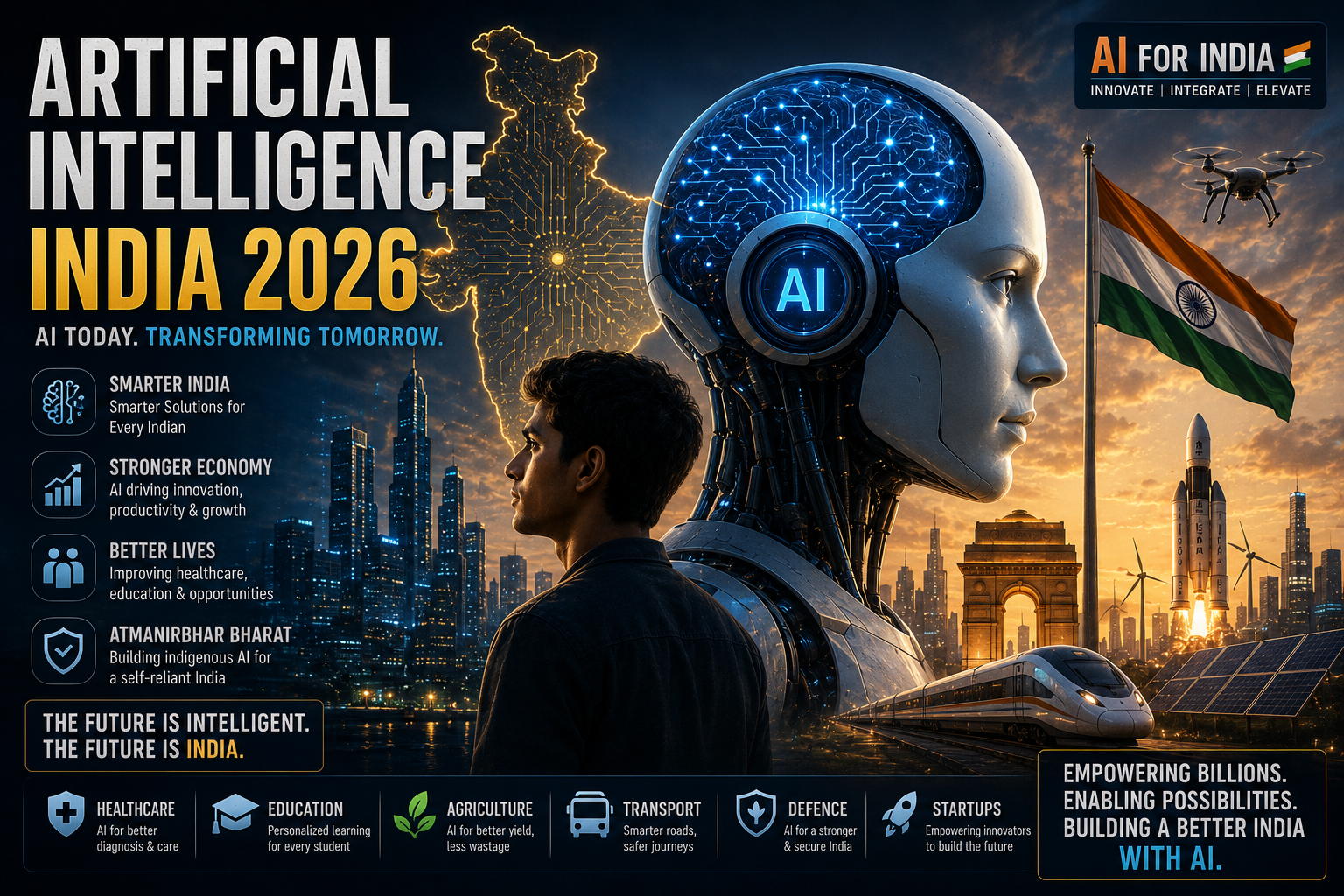
🤖 What AI Actually Is — Explained Without a Single Technical Word
Forget everything you have seen in science fiction movies. AI is not a robot. It is not Terminator. It is not a supercomputer planning to take over the world. Artificial Intelligence refers to computer systems designed to perform tasks that normally require human intelligence — learning from data, recognising patterns, understanding language, making decisions, and solving problems.
Here is the simplest possible explanation: Traditional software follows rules. You tell a calculator that 2+2=4, and it follows that rule every time. AI is different — it learns rules from examples rather than being told what the rules are.
Imagine teaching a child to recognise a cat. You do not give them a mathematical definition of “cat.” You show them thousands of pictures of cats — and thousands of pictures of non-cats — and eventually the child’s brain figures out the pattern on its own. That is exactly how AI works. You feed it millions of examples. It identifies patterns. And then it can apply those patterns to new situations it has never seen before.
🧠 The 3 Types of AI That Actually Exist — Not What Movies Show You
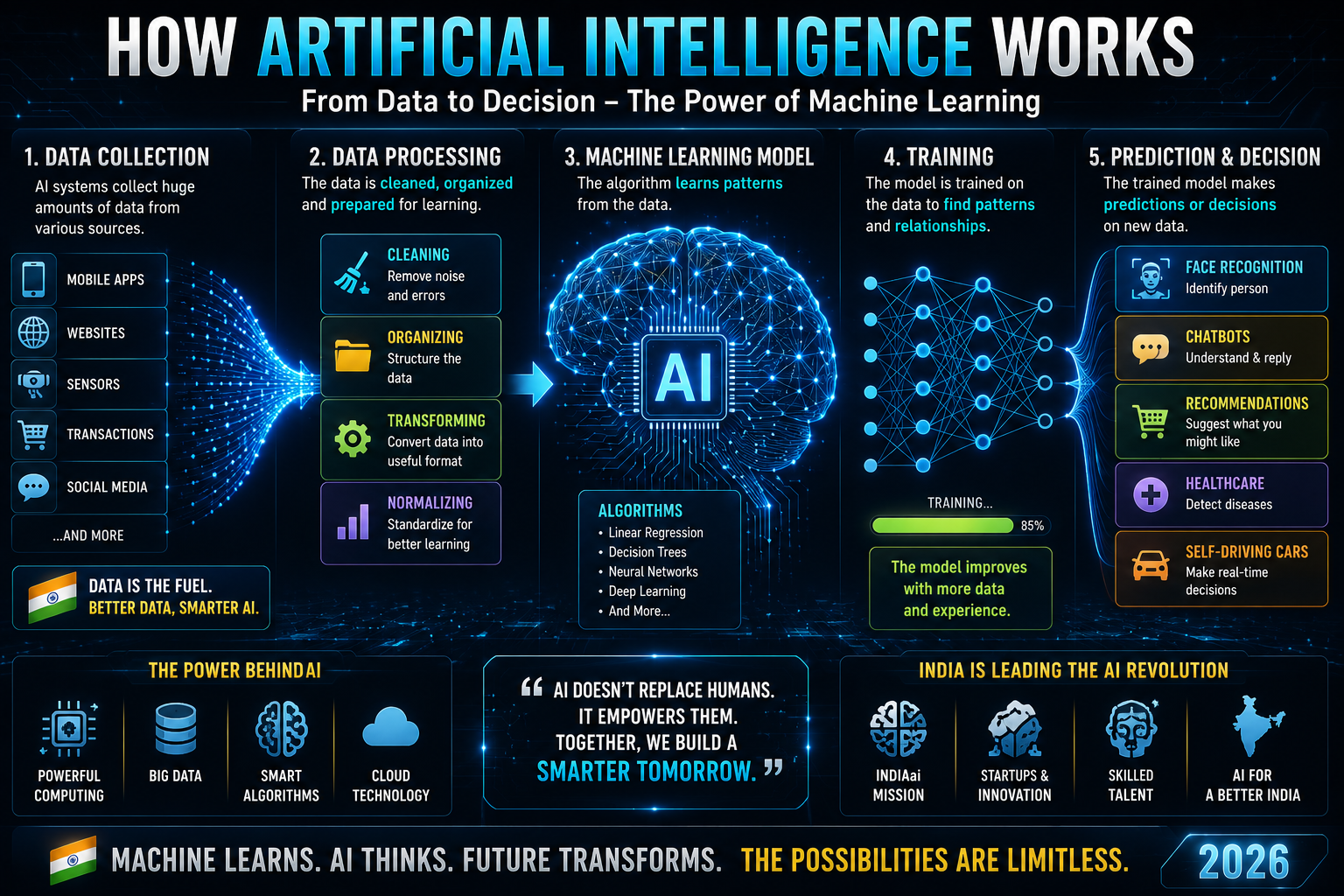
Most people think AI is one thing. It is actually a family of related technologies — each with different capabilities and limitations.
Type 1 — Narrow AI (What Exists Today): Current AI is “Narrow AI” — excellent at specific tasks, but limited to those tasks. ChatGPT is brilliant at generating text but cannot drive a car. A self-driving car’s AI is excellent at driving but cannot write a poem. Every AI system you interact with today — Siri, Alexa, Google Maps, Netflix recommendations, fraud detection in your bank — is Narrow AI. It does one thing extremely well.
Type 2 — Machine Learning (The Engine Behind Most AI): Machine Learning is the most important subset of AI — and the one that powers everything from ChatGPT to Zomato’s delivery time predictions. Machine learning is at the root of all the different ways that artificial intelligence is implemented in the various AI-related things you might use. The system learns from data. The more data it sees, the better it gets — without being explicitly reprogrammed.
Type 3 — Generative AI (The Revolution of 2023-2026): This is the type that has changed everything in the last three years. ChatGPT, Google Gemini, Claude, Midjourney, DALL-E — these are Generative AI systems. They do not just recognise patterns — they create new content. They write articles, generate images, compose music, write code, and hold conversations that feel genuinely human. Generative AI is the technology that is reshaping every industry simultaneously — and it is the one every Indian professional needs to understand right now.
📱 AI Is Already Running Your Life — You Just Did Not Know It
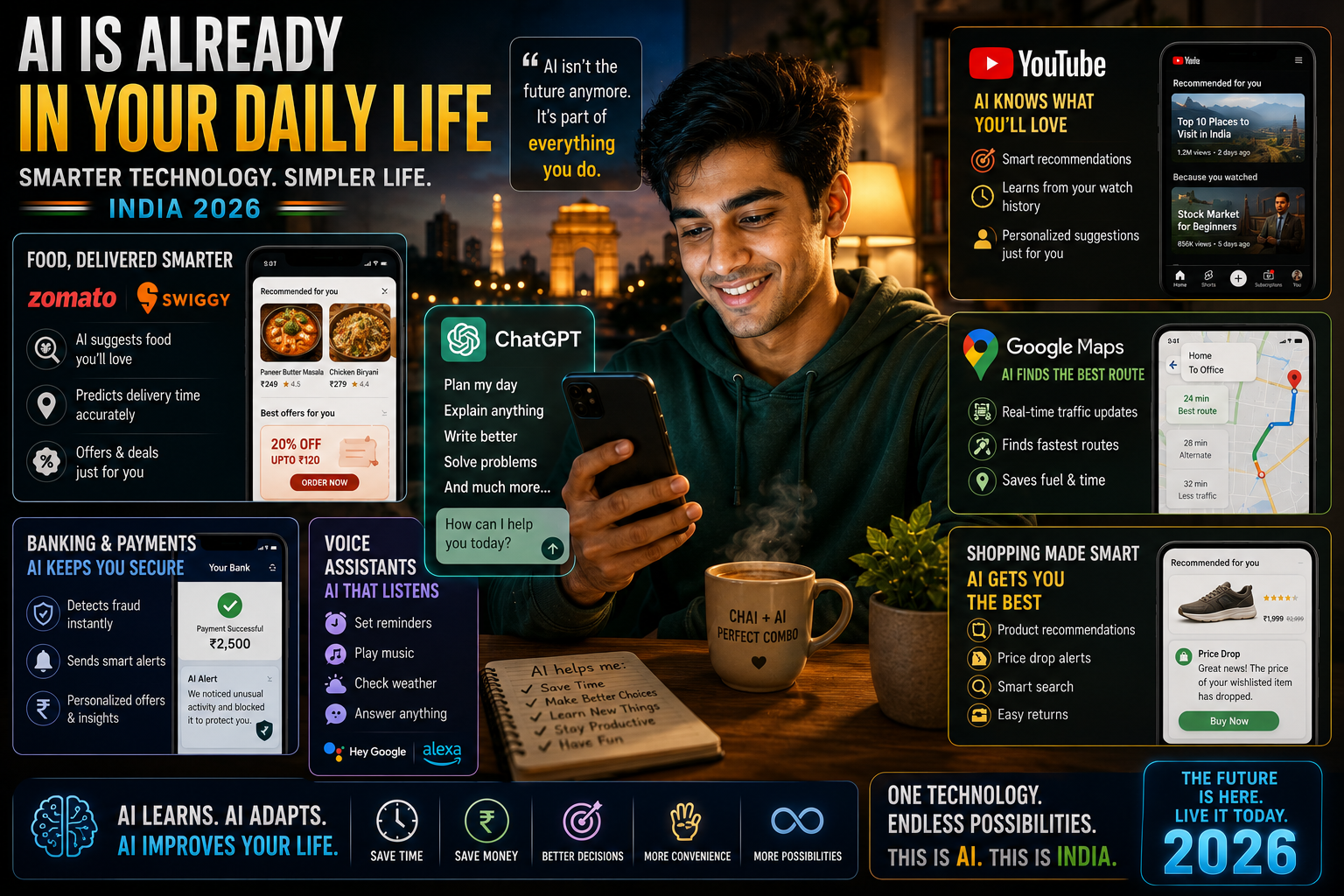
Here is a typical Indian’s day — and how many times AI touches it without them realising:
- 6:30 AM — Your phone alarm: AI analysed your sleep patterns and picked the optimal moment to wake you during light sleep
- 7:00 AM — You open Instagram: AI decided which of 10,000 possible posts to show you in exactly the order most likely to keep you scrolling
- 8:00 AM — You open Gmail: AI sorted your inbox, moved spam to spam, and flagged important emails — reading every message you received
- 9:00 AM — You open Google Maps: AI analysed real-time traffic data from millions of phones to calculate your optimal route
- 12:30 PM — You open Swiggy: AI predicted what you might want to eat based on your order history, time of day, weather, and what people near you are ordering
- 3:00 PM — Your bank sends an OTP: AI fraud detection analysed your transaction against your spending patterns and decided it was legitimate
- 9:00 PM — You open YouTube: AI selected every single video on your homepage — none of it was chosen by a human
AI is not coming to your life. It is already there. It has been there for years. The difference is that now — with ChatGPT and Generative AI — it is visible and interactive in a way it never was before. And that visibility is creating both opportunity and anxiety in equal measure.
🇮🇳 What AI Means Specifically for India — The Hidden Truth
India’s relationship with AI is unlike any other country’s — for reasons that are both exciting and sobering.
The opportunity: India is maintaining a 40% CAGR in the AI sector, positioning it as a top-tier global innovation hub. India’s AI market is projected to hit $17 billion by 2027. The ₹10,371.92 crore IndiaAI Mission is building national compute infrastructure and the “AIKosha” dataset platform. India produces more engineering graduates than almost any country on earth. Its English-language proficiency gives it a massive advantage in working with AI tools that are primarily trained on English data. And its enormous domestic market — 1.4 billion people, a growing middle class, and massive unmet needs in healthcare, agriculture, and education — makes India a compelling laboratory for AI solutions.
The challenge nobody talks about: India has approximately 47 crore workers in sectors highly vulnerable to AI automation — data entry, customer service, basic accounting, routine legal work, and entry-level software testing. The question is not whether AI will displace some of these jobs. It will. The question is whether India’s education and skilling systems can retrain workers fast enough, and whether new AI-enabled jobs will be created at a scale that absorbs the displaced workforce.
The honest answer: nobody knows. What is certain is that the Indians who understand AI — who can use it, work with it, and build with it — will have dramatically better career outcomes than those who do not. The skill gap between AI-fluent and AI-ignorant workers is already measurable in salaries. It will only grow.
💼 Will AI Take Your Job? The Honest Answer Every Indian Deserves
This is the question that keeps millions of Indians awake at night in 2026. The honest answer is nuanced — and more hopeful than the headlines suggest, but more urgent than the government’s reassurances imply.
Jobs most at risk from AI in India:
- Data entry and basic document processing
- Customer service and call centre work that follows scripts
- Basic accounting and bookkeeping
- Routine legal document drafting
- Entry-level software testing and basic coding tasks
- Basic content writing and translation
Jobs that AI cannot replace — and will actually grow:
- Healthcare — doctors, nurses, physical therapists
- Teaching — especially personalised mentorship and emotional support
- Skilled trades — electricians, plumbers, construction
- Creative direction — not the execution, but the vision and judgment
- AI management — people who oversee, audit, and correct AI systems
- Complex human relationships — social work, counselling, negotiation
The most important insight: AI does not replace professions — it replaces tasks within professions. A doctor who uses AI diagnostic tools is not replaced by AI. A doctor who refuses to learn AI tools may be outcompeted by a doctor who does. The same applies to lawyers, teachers, accountants, and engineers. The threat is not AI taking your job. The threat is someone using AI doing your job better than you.
For a complete guide on how to use AI to grow your career, read our article on Career Growth with AI 2026 and our guide on AI for Students in India 2026.
🚀 How to Start Using AI Today — No Technical Background Needed
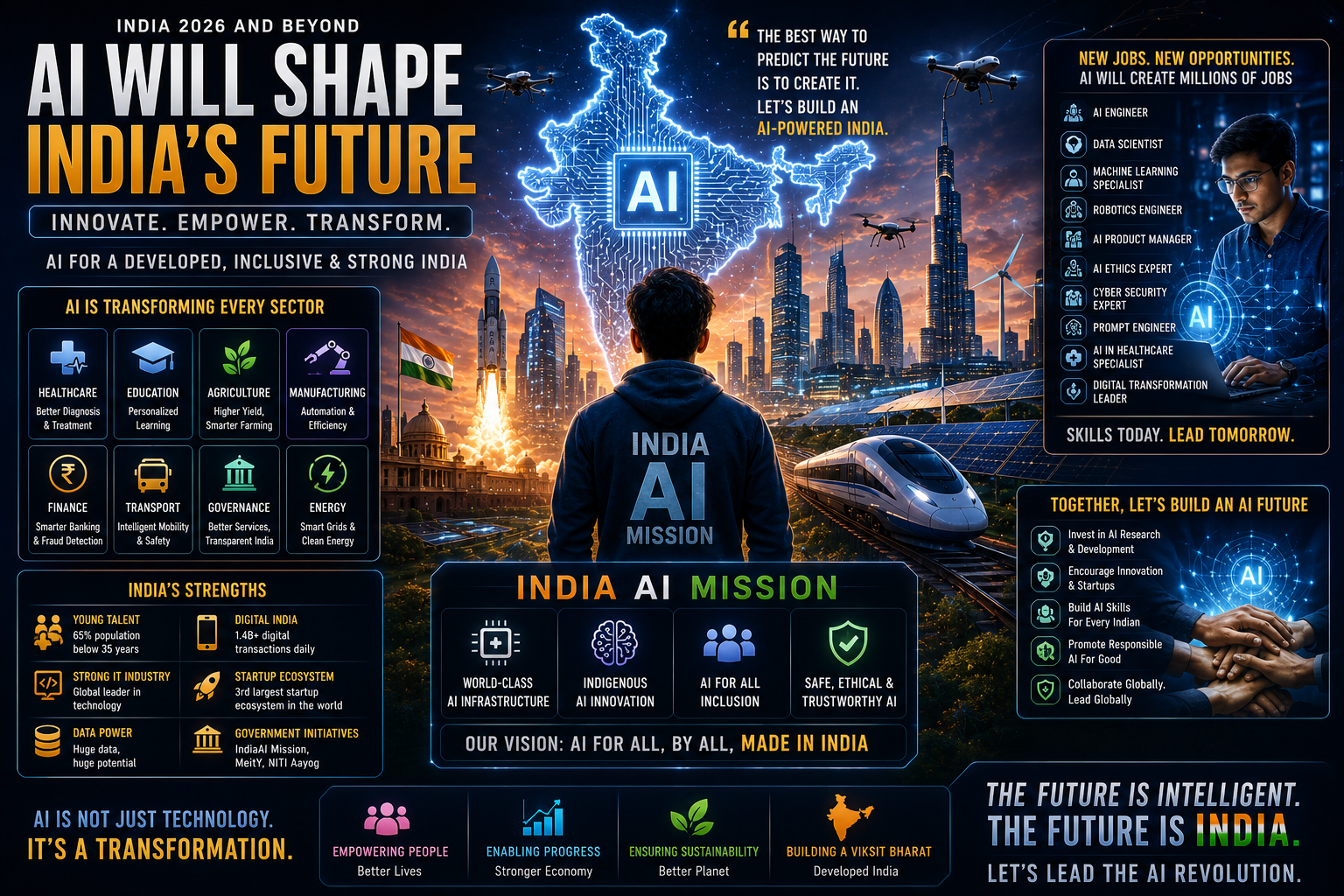
Understanding AI intellectually is useful. Using AI practically is transformative. Here is how to start today — in 30 minutes, for free, with zero technical background:
- Open ChatGPT (chatgpt.com) or Google Gemini (gemini.google.com): Both are free. Both work in Hindi and other Indian languages. Create an account with your email.
- Ask it something from your actual work or life: “Help me write an email to my manager asking for a salary hike.” “Explain compound interest to me like I am 15 years old.” “What are the pros and cons of buying vs renting a house in Hyderabad?” The quality of the response will surprise you.
- Use it for your job this week: Whatever you do professionally — use AI to draft something, research something, or explain something you do not understand. Notice how much time it saves.
- Take one free AI course: DeepLearning.AI (deeplearning.ai) has free courses on AI basics and prompt engineering that take 2-3 hours and require zero technical background.
The barrier to entry for AI has never been lower. ChatGPT requires an email address and an internet connection. Google Gemini works on any Android phone — including budget phones — in Hindi, Telugu, Tamil, and Bengali. The tools are free. The opportunity is real. The only remaining barrier is the decision to start.
❓ FAQs
What is artificial intelligence in simple words?
Artificial Intelligence is technology that allows computers to learn from data and perform tasks that normally require human intelligence — like understanding language, recognising images, making decisions, and solving problems. Instead of following fixed rules, AI learns patterns from millions of examples and applies those patterns to new situations.
What is the difference between AI and machine learning?
AI is the broad field — the goal of making machines intelligent. Machine learning is a specific method within AI — a way of achieving AI by training systems on data rather than programming rules manually. All machine learning is AI, but not all AI uses machine learning. Think of AI as the destination and machine learning as one of the roads to get there.
Will AI replace Indian jobs?
AI will automate specific tasks within jobs — not entire professions. Jobs involving repetitive, rule-based tasks (data entry, basic customer service, routine accounting) face the most disruption. Jobs requiring human judgment, creativity, physical presence, and emotional intelligence are far more resilient. The risk is not AI taking your job — it is someone using AI doing your job better than you.
What is ChatGPT and how is it different from regular AI?
ChatGPT is a Generative AI system — meaning it creates new content (text, code, analysis) rather than just recognising patterns. It was trained on an enormous amount of text from the internet and can hold conversations, write essays, solve maths problems, write code, and explain complex topics in simple language. It is different from earlier AI because it can generate human-quality output across a vast range of tasks.
What is India’s AI Mission?
IndiaAI Mission is the Government of India’s ₹10,371.92 crore initiative to build national AI infrastructure — including computing power (GPUs), datasets (AIKosha), and AI skilling programmes. It aims to position India as a global AI hub and ensure Indian citizens and companies have access to the computing resources needed to build and use AI at scale.
📚 Sources
- Abhyashsuchi — Artificial Intelligence 2026: Complete Beginner’s Guide
- AIBytec — What is Artificial Intelligence: Complete 2026 Guide for Beginners
- TechieGigs — Artificial Intelligence India Guide 2026
- Unified AI Hub — Artificial Intelligence Explained: A Simple Primer for 2026
- CIIM — What is AI: Complete Guide to Artificial Intelligence 2026
- IIT Kanpur — What is Artificial Intelligence 2026