

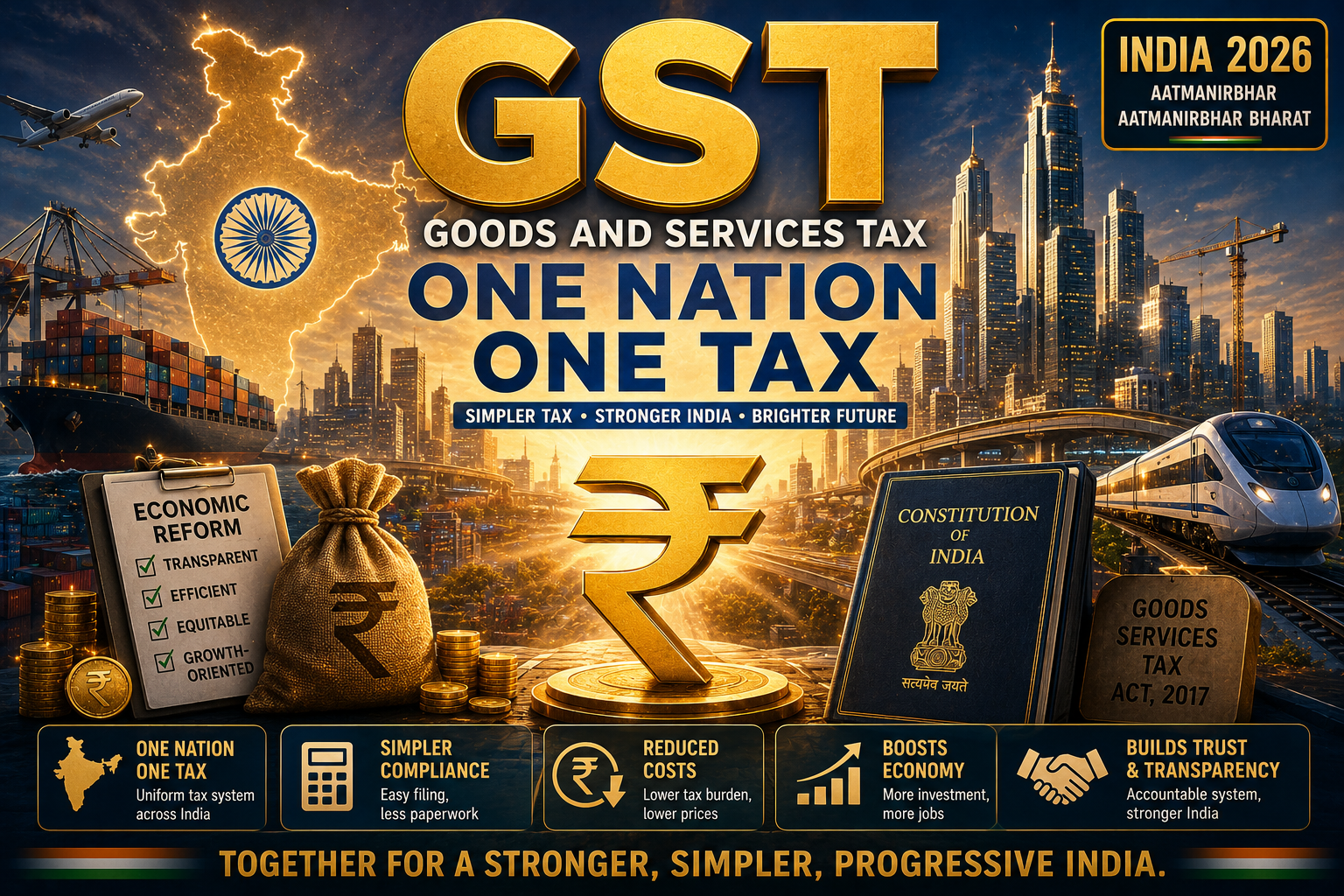
Every time you buy a packet of biscuits, pay your phone bill, eat at a restaurant, or book a flight — you are paying GST. Every single time. And yet most Indians cannot explain what GST actually is, why it replaced the old tax system, how it is calculated, or whether it has made things cheaper or more expensive. GST is the single biggest tax reform in India’s history since independence — a reform that replaced 17 different central and state taxes with one unified system overnight on July 1, 2017. Nine years later, it collects over ₹1.9 lakh crore every single month. This is everything you need to know — explained without a single piece of jargon.
🤔 The Tax Nightmare India Had Before GST — And Why Nobody Talks About It Anymore
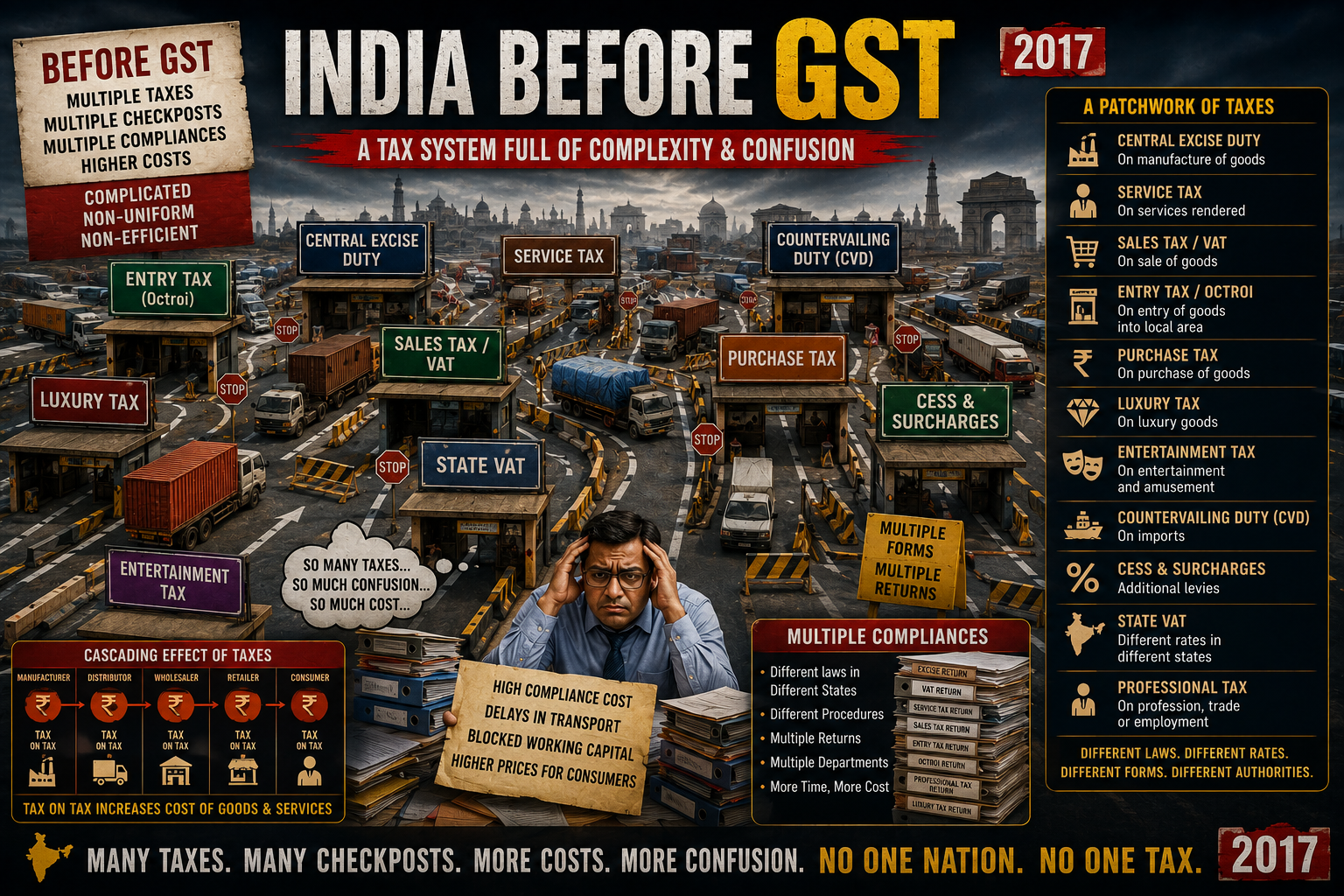
Before July 1, 2017, India had one of the most complicated indirect tax systems in the world.
A manufacturer paid Excise Duty to the central government when producing goods. When those goods were sold, the buyer paid VAT (Value Added Tax) to the state government. If services were involved, there was a separate Service Tax. If goods crossed state borders, there was Entry Tax and Octroi. There were also Customs Duties, Central Sales Tax, Luxury Tax, Entertainment Tax, and more.
The worst problem was the “tax on tax” — what economists call the cascading effect. When a manufacturer paid excise duty on raw materials, that duty became part of the product’s cost. When the next person in the supply chain paid VAT, they paid VAT on a price that already included the excise duty. Tax was being paid on tax. By the time a product reached the consumer, it had been taxed multiple times on the same value.
📖 What GST Actually Is — The Simplest Possible Explanation
Let us break that down with a real example. Imagine a biscuit company.
A farmer grows wheat and sells it to a flour mill for ₹100. The mill pays 5% GST — ₹5. The mill processes the wheat into flour and sells it to the biscuit company for ₹150. The biscuit company pays 5% GST on ₹150 — ₹7.50. But because the mill already paid ₹5 of GST, the biscuit company only pays the difference — ₹2.50. The biscuit company makes biscuits and sells them to a retailer for ₹200. The retailer pays GST — but claims credit for the ₹7.50 already paid. And the retailer sells to you for ₹250 with 18% GST — but only pays the government the difference from the previous stage.
At every stage — the tax paid at the previous stage is credited against the tax due at the current stage. The government always receives the correct tax on the final value. Nobody pays tax on tax. This is the fundamental genius of GST — and why it replaced the cascading mess that came before it.
📊 The GST Slabs — What Is Taxed at What Rate in 2026
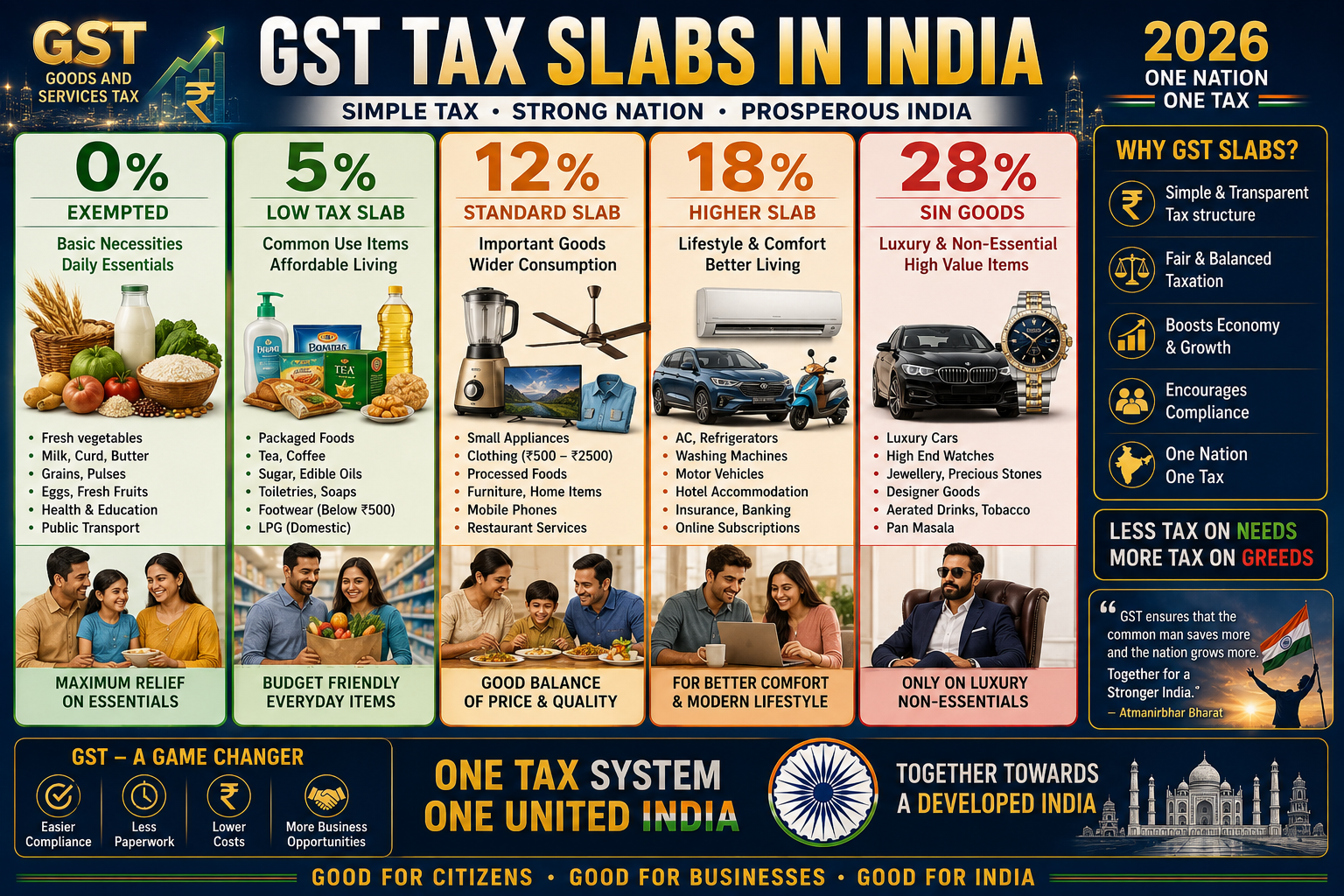
GST in India operates on a slab system — different goods and services are taxed at different rates depending on whether they are essential, standard, or luxury items.
0% GST — Essential goods that the government does not tax: Fresh fruits and vegetables, milk, eggs, curd, salt, unbranded wheat and rice, books and newspapers, educational services, healthcare services, and hotels charging under ₹1,000 per night.
5% GST — Basic necessities with minimal tax: In 2026, toothpaste has been moved from 18% to 5% — making basic items less expensive for the common man. Shampoo, hair oil, economy flight tickets and bicycles also fall in this category. Packaged food items, household essentials, and medicines for chronic conditions.
12% GST — Standard goods: Processed foods, mobile phones (previously), computers, and many manufactured goods fall here. This slab is transitional — goods often move between slabs as the GST Council revises rates.
18% GST — Most services and consumer goods: Common services including telecom, IT services, and restaurants are taxed at 18%. Most electronic goods, financial services, and branded consumer products also fall here.
28% GST — Luxury and sin goods: Automobiles, air conditioners, tobacco products, aerated drinks, and luxury goods. A compensation cess is added on top of 28% for certain sin goods like cigarettes and large cars.
🇮🇳 GST 2026 — The Biggest Changes That Affect Your Pocket Right Now
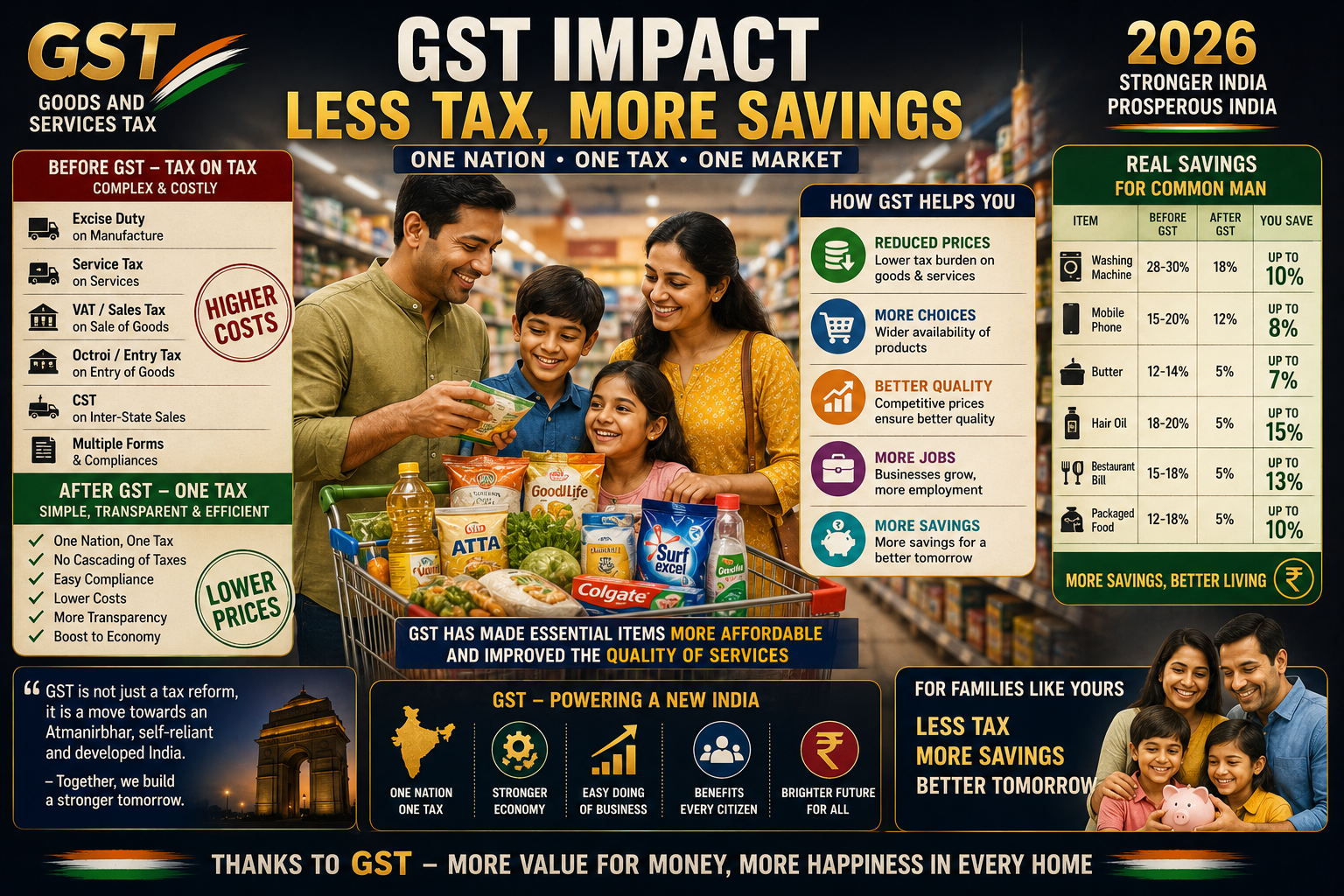
The 56th GST Council meeting approved significant reforms that have been called “GST 2.0” — the most substantial restructuring since GST was launched in 2017.
What became cheaper for you in 2026:
- Health and life insurance premiums — Zero GST on term life insurance and health insurance for senior citizens. Major relief for millions of Indian families.
- Toothpaste, shampoo, hair oil — GST cut from 18% to 5%. Daily essentials are now cheaper.
- Cement — GST reduced from 28% to 18%. This directly reduces the cost of housing construction.
- Electric vehicles — Maintained at 5% to encourage adoption of cleaner transport.
- Economy airline tickets — Reduced GST to make air travel more affordable.
According to the Ministry of Finance, India’s GST collections maintained exceptional growth with average monthly collection surpassing ₹1.9 lakh crore in Q1 of 2026-27 financial year. This consistent performance shows GST has become a stable and growing source of government revenue — funding infrastructure, welfare schemes, and public services.
⚖️ Has GST Helped or Hurt the Common Indian? The Honest Answer
Nine years after GST was launched, the honest assessment is mixed — and anyone who tells you otherwise is either a politician or an ideologue.
What GST got right: It eliminated the cascading tax effect that was making Indian goods artificially expensive. It created a unified national market — a truck no longer needs to stop at every state border for paperwork. It brought millions of businesses into the formal tax net — GST registrations have grown from 66 lakh in 2017 to over 1.4 crore in 2026. It made India’s tax system more transparent and digital — fake invoicing and tax evasion became significantly harder. And it has consistently generated record revenue for the government — money that funds roads, schools, and hospitals.
What GST got wrong: The compliance burden on small businesses has been enormous. A small shop owner filing multiple monthly returns — GSTR-1, GSTR-3B, annual return — faces paperwork that large companies with dedicated accountants handle easily but that breaks small businesses. The multiple slabs created confusion — businesses and consumers often do not know which rate applies to which product. And the classification disputes — is a particular food item a “processed food” at 12% or a “snack” at 18%? — have generated enormous litigation.
The truth is that GST is a fundamentally better system than what it replaced. But its implementation — particularly the compliance burden on small businesses — needed and is still undergoing significant reform. GST 2.0 in 2026 is an attempt to fix what the original launch got wrong.
For more on India’s economy and personal finance, read our guide on How Repo Rate Affects Your EMI and our complete guide on Personal Finance for Indians 2026.
❓ FAQs
What is GST in simple words?
GST (Goods and Services Tax) is a single tax on goods and services that replaced multiple taxes like excise duty, VAT, and service tax. It is collected at every stage of the supply chain — but each business claims credit for tax paid at the previous stage, so the final consumer pays tax only on the actual value of the product.
What are the current GST slabs in India 2026?
GST in India has five main slabs: 0% (essential goods like fresh vegetables, milk, books), 5% (basic necessities like medicines, economy transport), 12% (processed foods, standard goods), 18% (most services, electronics, restaurants), and 28% (luxury goods, automobiles, tobacco). GST 2.0 reforms in 2026 are simplifying this toward two primary rates of 5% and 18%.
How is GST calculated?
GST is calculated as: Final Price = Base Price + (Base Price × GST Rate ÷ 100). If you buy a product worth ₹1,000 with 18% GST, the tax is ₹180 and total price is ₹1,180. Businesses calculate GST on the value they add — not on the full price — because they claim Input Tax Credit for GST paid on their purchases.
Does GST apply to petrol and diesel?
No — petrol, diesel, crude oil, natural gas, and aviation turbine fuel are currently outside the GST framework. These fuels are still taxed under the old system with separate central excise duty and state VAT. Bringing petroleum products under GST has been debated for years but remains politically sensitive because states earn significant revenue from petroleum taxes.
What is GSTIN?
GSTIN (Goods and Services Tax Identification Number) is a unique 15-digit number assigned to every registered GST taxpayer. Businesses with annual turnover above ₹40 lakh (goods) or ₹20 lakh (services) must register for GST and get a GSTIN. This number is used for all GST transactions, filing returns, and claiming input tax credit.
📚 Sources
- Paytm — Understanding GST in India: A Complete Guide
- Tally Solutions — What is GST? The 2026 Guide for Indian Businesses
- IIFL — Latest GST Rates and Tax Slabs in India 2026
- Mundhra Consulting — New GST Rate List 2026: Industry-Wise Tax Slabs
- CAAQ — New GST Rates List 2026: Industry-Wise Tax Slabs and Sector Impact
- Dream Grow Digital — Understanding GST Rules, Slabs and How It Works 2026
- AimIndia — GST Reforms 2026: New Tax Slabs, E-Invoicing Rules Explained