
💡 Chapter 7: Particulate Nature of Matter
CBSE Class 8 Science — Curiosity | Textbook of Science for Grade 8
🎯 Learning Objectives
- Define matter and explain the concept of constituent particles.
- Explain interparticle attractions and how they determine the physical state of matter.
- Describe the properties of solid, liquid and gaseous states of matter.
- Define melting point, boiling point and evaporation with examples.
- Compare interparticle spacing in three states using experimental evidence.
- Explain diffusion in liquids and gases and the effect of temperature on it.
- Describe the contribution of Acharya Kanad to the understanding of matter.
- Apply knowledge of particulate nature of matter to real-life situations like soap cleaning oily clothes.
📖 Chapter Index
⚛️ Concept 1: What is Matter Composed of?
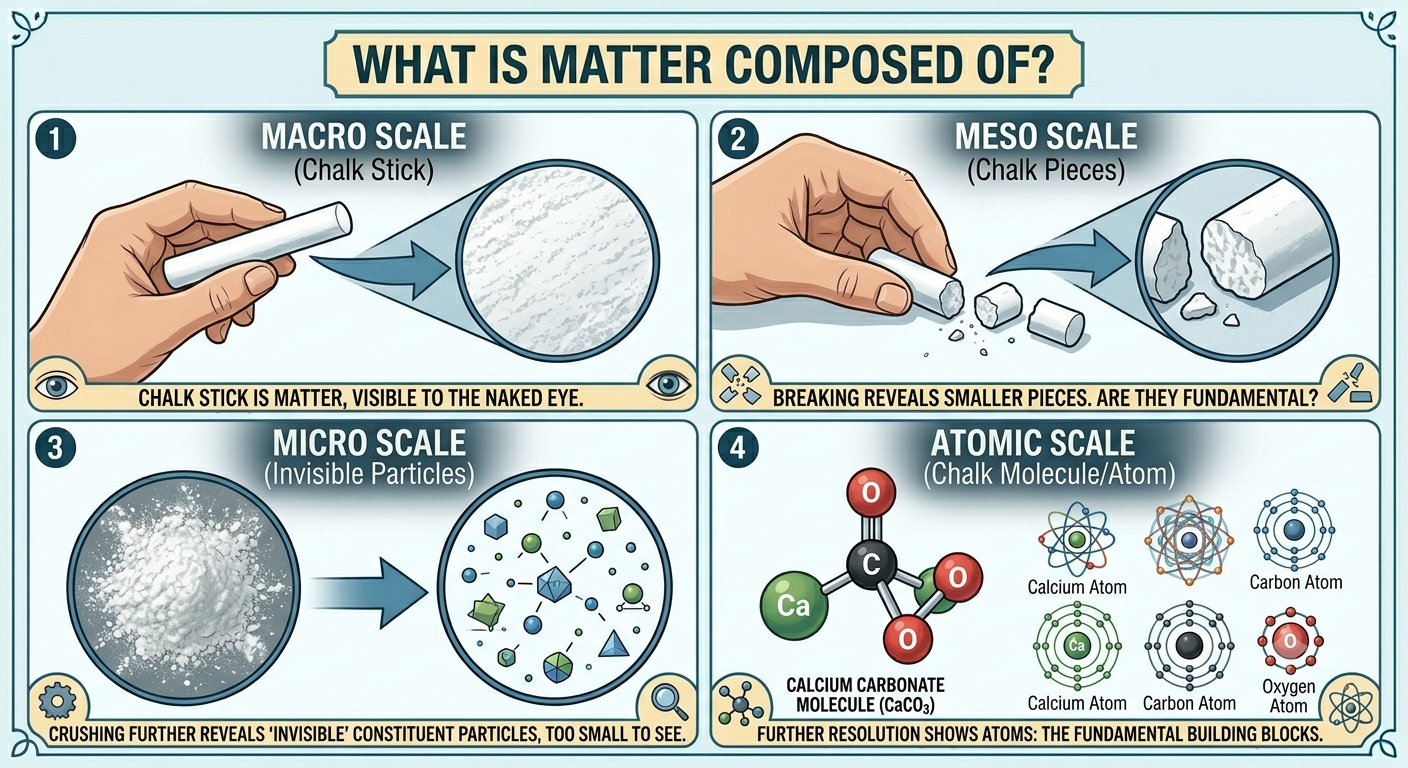
- Everything around us — rocks, water, air — is made up of matter. Rocks in mountains break down due to erosion into pebbles, stones, sand and clay.
- When chalk is broken and ground repeatedly, we get finer and finer powder. Each tiny grain is still chalk — it has not changed into a new substance. This is a physical change.
- If we imagine continuing to grind chalk, we would eventually reach a stage where particles cannot be broken down any further. These are the constituent particles of chalk.
- A constituent particle is the basic unit that makes up a larger piece of a substance or material.
- When sugar dissolves in water, it breaks up into its constituent particles which cannot be seen but can be sensed by taste. The sugar particles occupy the interparticle spaces between water particles.
- Interparticle spaces are the spaces between the particles of a substance. These spaces contain nothing at all — not even air.
- Matter is composed of a large number of extremely small particles that cannot be seen even through an ordinary microscope.
📝 Practice Questions — Concept 1
LOTS What is a constituent particle?
Show Answer
A constituent particle is the basic unit that makes up a larger piece of a substance or material. Every substance is made up of a large number of these extremely small particles.
Medium When sugar dissolves in water, sugar particles disappear. Is this correct? Explain.
Show Answer
No, this is incorrect. Sugar particles do not disappear — they break into constituent particles and occupy the interparticle spaces between water particles. Their presence can be sensed by taste — the water tastes sweet.
HOTS Is grinding chalk a physical or chemical change? How does this support the idea that matter is particulate?
Show Answer
It is a physical change because chalk does not become a new substance on grinding — only the size of particles reduces. This supports the particulate nature of matter because it shows that matter can be broken into smaller and smaller units (constituent particles) while retaining its identity.
HOTS Why does the volume of a solution become less than the sum of volumes of solute and solvent?
Show Answer
When a solute dissolves, its constituent particles occupy the interparticle spaces between the solvent particles. Since no new space is created, the total volume is less than the sum of individual volumes. This proves that there are real empty spaces between particles of a liquid.
⚡ Concept 2: What Decides Different States of Matter?
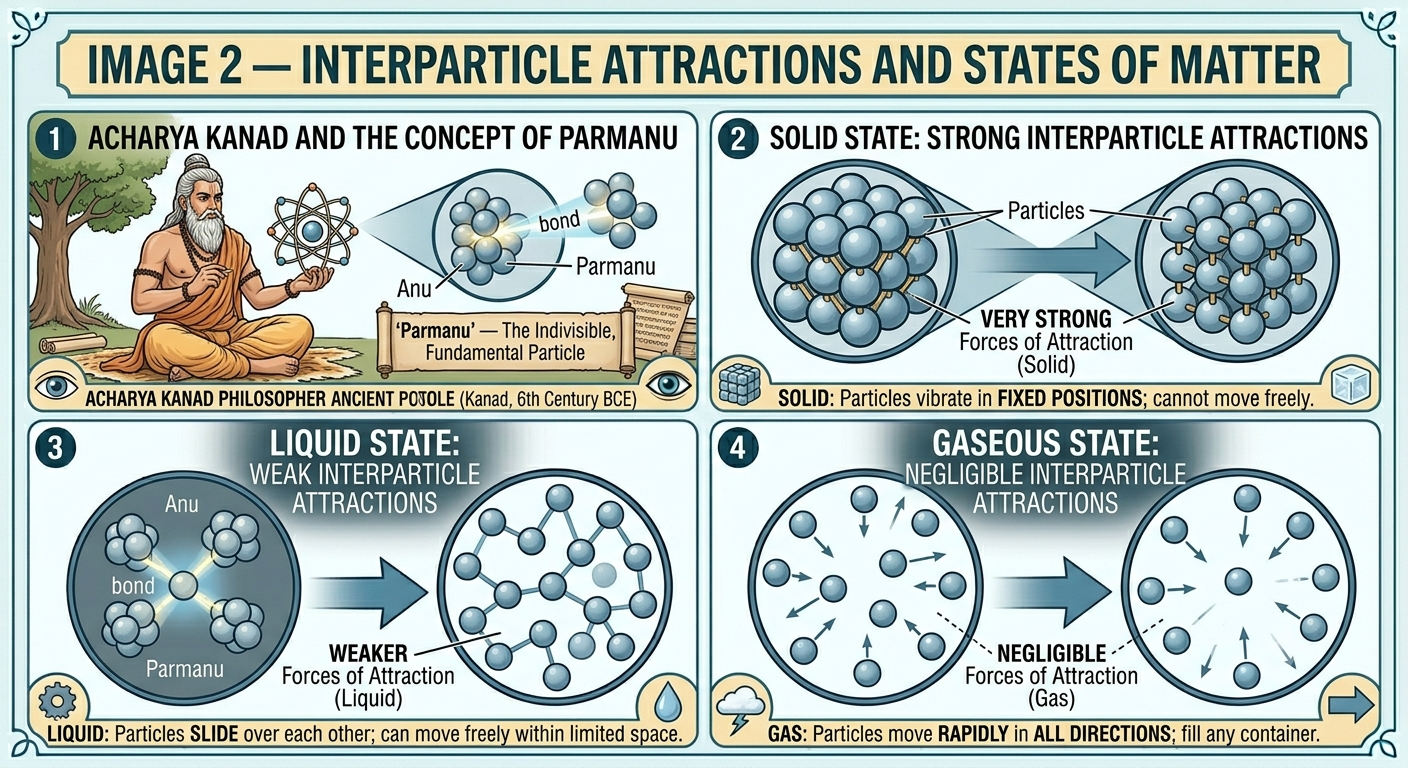
- The constituent particles of matter are held together through forces which are attractive in nature. These are called interparticle attractions.
- The strength of interparticle attractions depends on the nature of the substance and the interparticle distance. Even a slight increase in distance decreases the forces drastically.
- The strength of these interparticle forces ultimately decides the physical state (solid, liquid or gas) of a substance.
- It is the thermal (heat) energy of particles that determines the physical state of matter. Higher thermal energy means particles move faster and farther apart, weakening interparticle forces.
🏛️ Our Scientific Heritage
- Acharya Kanad, an ancient Indian philosopher, first spoke about the idea of a Parmanu (atom).
- He believed that matter is made up of tiny, indivisible, eternal particles called Parmanu.
- This idea was written in his work called Vaisheshika Sutras.
📝 Practice Questions — Concept 2
LOTS What are interparticle attractions and what do they determine?
Show Answer
Interparticle attractions are the attractive forces that hold the constituent particles of matter together. Their strength depends on the nature of the substance and the interparticle distance. These forces ultimately determine the physical state (solid, liquid or gas) of a substance.
Medium Who was Acharya Kanad and what was his contribution to the understanding of matter?
Show Answer
Acharya Kanad was an ancient Indian philosopher who first proposed the concept of Parmanu (atom). He believed matter is made of tiny, indivisible, eternal particles called Parmanu. This idea was recorded in his work Vaisheshika Sutras — making India one of the earliest civilizations to think about the atomic nature of matter.
HOTS Why does a slight increase in interparticle distance drastically decrease interparticle forces?
Show Answer
Interparticle attractive forces are very sensitive to distance. Even a small increase in distance reduces the force drastically because these forces follow an inverse relationship with distance. This is why solids (minimum spacing) have maximum attraction, liquids have weaker attraction, and gases (maximum spacing) have almost negligible attraction.
HOTS How does thermal energy determine the physical state of matter?
Show Answer
Higher thermal energy means particles move faster, increasing interparticle distance and weakening attractive forces. In solids, thermal energy is low so particles stay close with strong attraction. At melting point, thermal energy overcomes attractive forces converting solid to liquid. At boiling point, particles have enough energy to escape completely into gaseous state.
🟩 Concept 3: Solid State
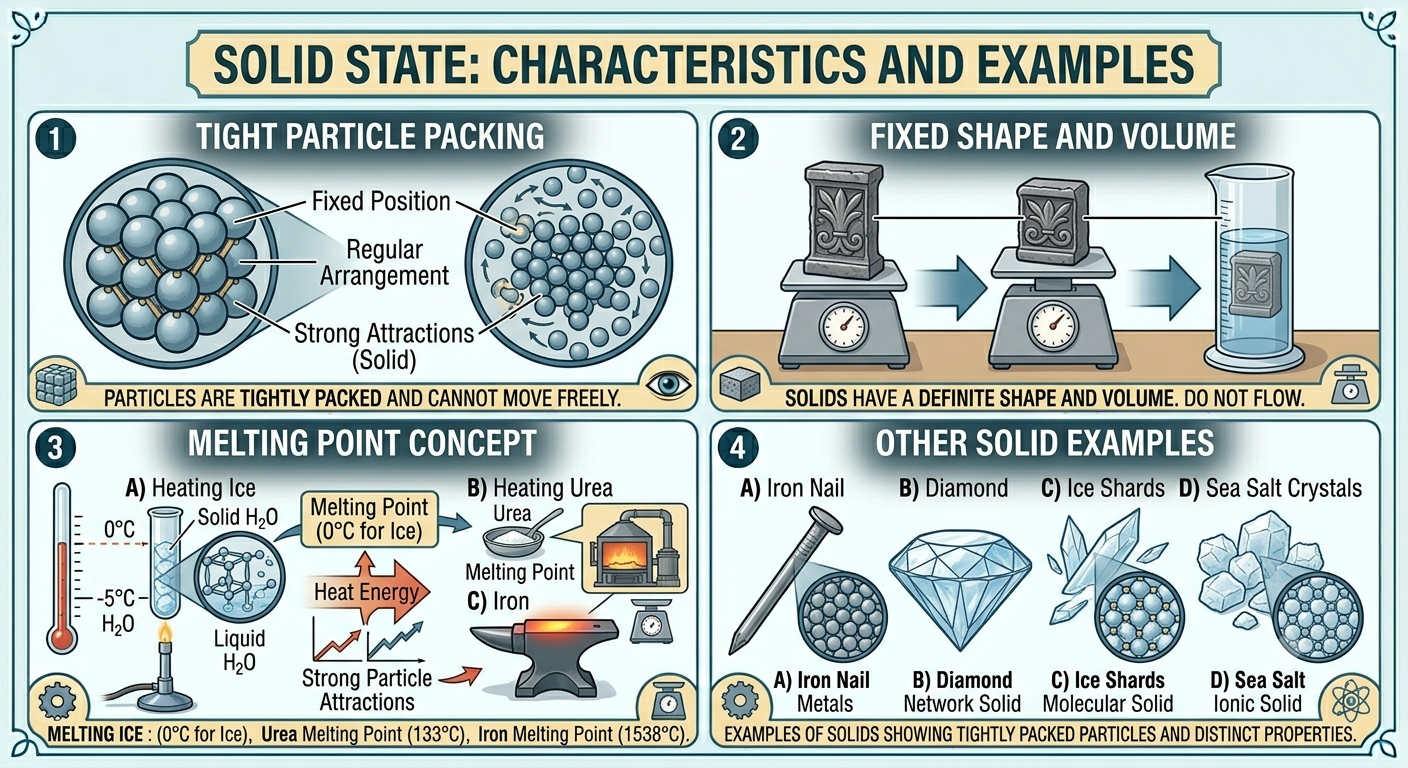
- Solids have a definite shape and definite volume. Examples: iron nail, rock salt, stone, wood, key, aluminium.
- In solids, particles are tightly packed and interparticle attractions are very strong. These strong forces hold particles in fixed positions, preventing them from moving freely.
- Particles in solids can only vibrate or oscillate (move to and fro) about their fixed positions but cannot move past each other.
- When solids are heated, particles vibrate more vigorously. At a stage, vibrations become so vigorous that particles start leaving their fixed positions and interparticle forces weaken — the solid converts into a liquid.
- Melting point is the minimum temperature at which a solid melts to become a liquid at atmospheric pressure. Examples: Ice = 0°C, Urea = 133°C, Iron = 1538°C.
- Solids with weak interparticle forces have low melting points. Solids with strong interparticle forces have high melting points.
- In solids, interparticle spacing is minimum and interparticle attraction is maximum. The thermal energy of particles is low.
📝 Practice Questions — Concept 3
LOTS What is the melting point of a solid? Give two examples.
Show Answer
Melting point is the minimum temperature at which a solid melts to become a liquid at atmospheric pressure. Examples: Ice melts at 0°C; Iron melts at 1538°C.
Medium Why do solids have a definite shape and volume while liquids do not have a definite shape?
Show Answer
In solids, particles are tightly packed with very strong interparticle attractions that hold them in fixed positions — they can only vibrate but cannot move past each other. This gives solids a definite shape and volume. In liquids, interparticle attractions are weaker, allowing particles to move freely within a limited space and take the shape of the container.
HOTS Why does iron have a much higher melting point than ice?
Show Answer
Iron has a melting point of 1538°C while ice melts at 0°C. This is because iron has much stronger interparticle attractions between its particles compared to ice. More energy (higher temperature) is needed to overcome these strong forces in iron and allow its particles to leave fixed positions and flow as liquid.
HOTS Grains of rice and rice flour take the shape of a container. Are they solids or liquids? Explain.
Show Answer
They are solids. Each individual grain of rice or particle of rice flour has a definite shape and volume — they are solids. When poured into a container, the collection of particles appears to take the shape, but each individual particle retains its own shape. This is different from liquids where the particles themselves flow and take the shape.
💧 Concept 4: Liquid State
- Liquids have no fixed shape but have a definite volume. They take the shape of the container they are kept in.
- This happens because particles of liquids are free to move but only within a limited space. They can move past each other.
- In liquids, interparticle attractions are slightly weaker than in solids but still strong enough to keep particles close together.
- You can move your finger through water but not through a solid — this shows liquids can be displaced temporarily but restore their position after the force is removed.
- Boiling point is the temperature at which a liquid boils and turns into vapour at atmospheric pressure. When heated, particle movement becomes so vigorous that particles escape from the liquid into the gaseous state.
- Evaporation is the slower process of vapour formation that occurs at all temperatures, even below the boiling point, only at the surface of the liquid.
- Both liquids and gases flow and do not retain a fixed shape. These properties classify them as fluids.
📝 Practice Questions — Concept 4
LOTS What is the difference between boiling and evaporation?
Show Answer
Boiling occurs at a specific temperature (boiling point) throughout the liquid forming bubbles. Evaporation is a slower process that occurs at all temperatures only at the surface of the liquid.
Medium Why can you move your finger through water but not through a wooden block?
Show Answer
In liquids, interparticle attractions are weaker than in solids, allowing particles to be temporarily displaced. When a finger moves through water, it displaces water particles which flow back when the finger is removed. In solids like wood, particles are in fixed positions with very strong attractions and cannot be displaced without permanently breaking the structure.
HOTS Why does milk spill and spread on a table but a glass stays in the same shape when knocked over?
Show Answer
Milk is a liquid — its particles can move freely and flow, taking the shape of any surface they are on. So spilled milk spreads out. The glass is a solid — its particles are held in fixed positions by strong interparticle attractions and cannot flow. So the glass retains its shape even when knocked over.
HOTS Why does water in a wet cloth disappear at any temperature, not just at 100°C?
Show Answer
This happens because of evaporation. At any temperature, some liquid particles at the surface have enough thermal energy to overcome interparticle attractions and escape into the gaseous state. Evaporation does not require the liquid to reach its boiling point — it occurs at all temperatures, only at the surface.
🌫️ Concept 5: Gaseous State
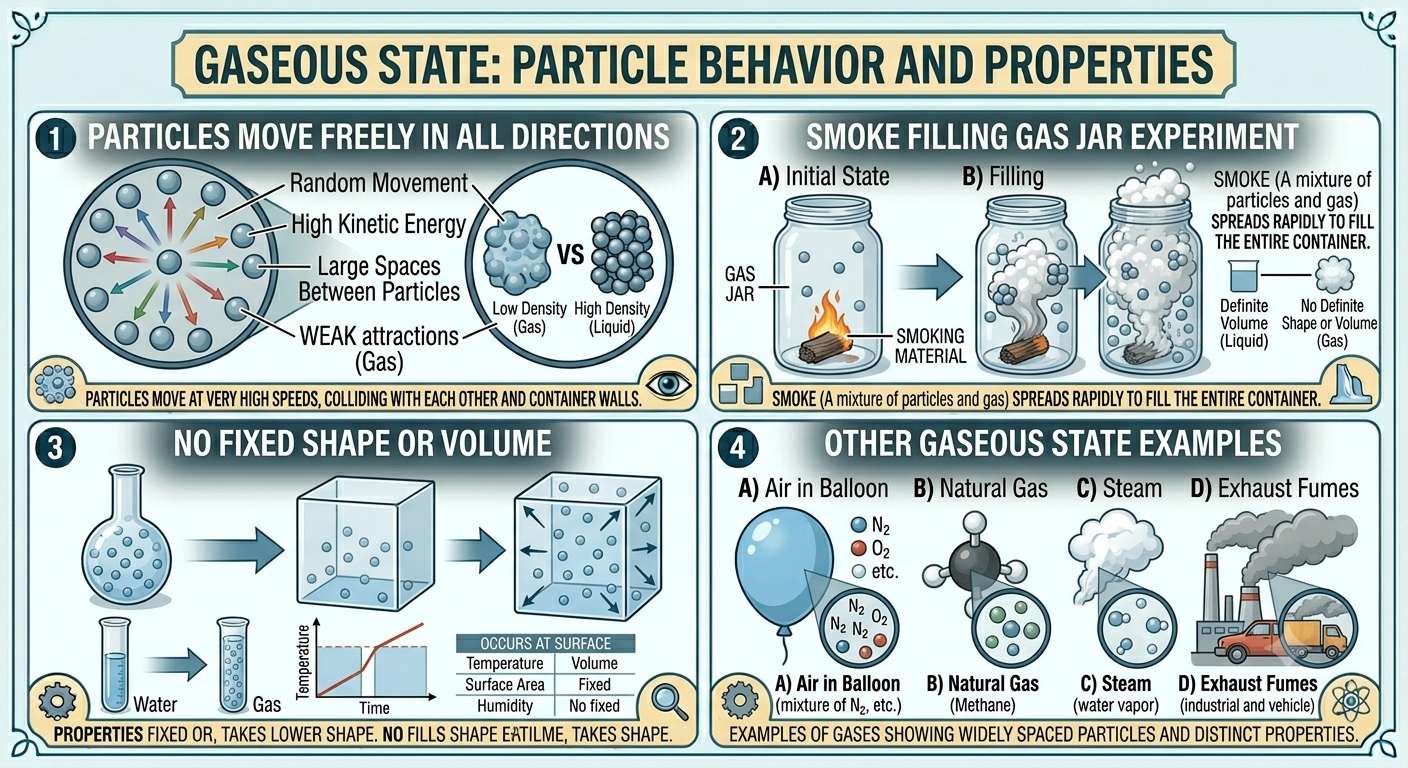
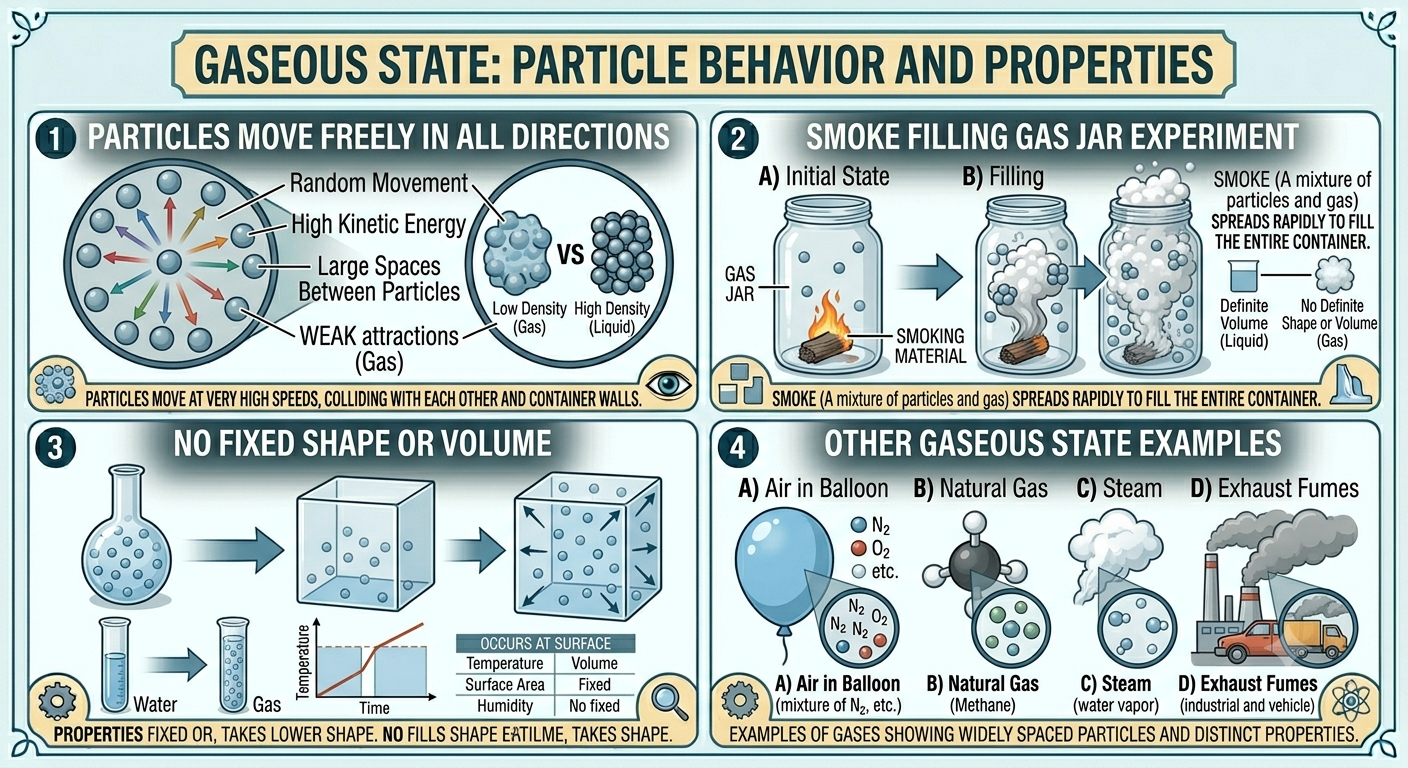
- Gases have no fixed shape and no fixed volume. They tend to occupy the entire available space of the container.
- Particles in gases move freely in all directions and the interparticle attractions are negligible.
- This was demonstrated by the smoke jar experiment — smoke trapped in Jar A spread to fill Jar B completely when the glass plate was removed.
- Iodine vapour experiment also demonstrates this — solid iodine placed in a closed jar produces violet vapour that fills the entire jar.
- In the gaseous state, particles have enough thermal energy to completely overcome the interparticle forces of attraction and move freely in all directions.
- Like liquids, gases also flow and acquire the shape of the vessel — both are classified as fluids.
- In gases, interparticle spacing is maximum and interparticle attraction is minimum (negligible).
📝 Practice Questions — Concept 5
LOTS Why do gases have no fixed shape or volume?
Show Answer
In gases, interparticle attractions are negligible. Particles have enough thermal energy to completely overcome attractive forces and move freely in all directions. So gases occupy the entire available space and have no fixed shape or volume.
Medium Why are both liquids and gases called fluids?
Show Answer
Both liquids and gases can flow and do not retain a fixed shape — they acquire the shape of the container. This ability to flow is what defines a fluid. Solids cannot flow because their particles are in fixed positions, so they are not fluids.
HOTS We cannot see air but it adds weight to an inflated balloon. Explain using the particulate nature of matter.
Show Answer
Air is made of constituent particles (gas molecules) that are too small to see individually. But matter has mass — even these invisible particles have mass. When a balloon is inflated, it contains millions of air particles inside, collectively adding measurable weight. This proves that even invisible gases are made of real particles with real mass.
HOTS Is the air we breathe today the same air that existed thousands of years ago? Explain.
Show Answer
Yes, largely the same constituent particles (atoms and molecules) cycle through the atmosphere. Gas particles move freely and mix completely. Through natural cycles (carbon cycle, nitrogen cycle, water cycle) the same particles are recycled continuously. The constituent particles themselves are not created or destroyed — they just change forms and combinations.
🔬 Concept 6: Interparticle Spacing in Three States
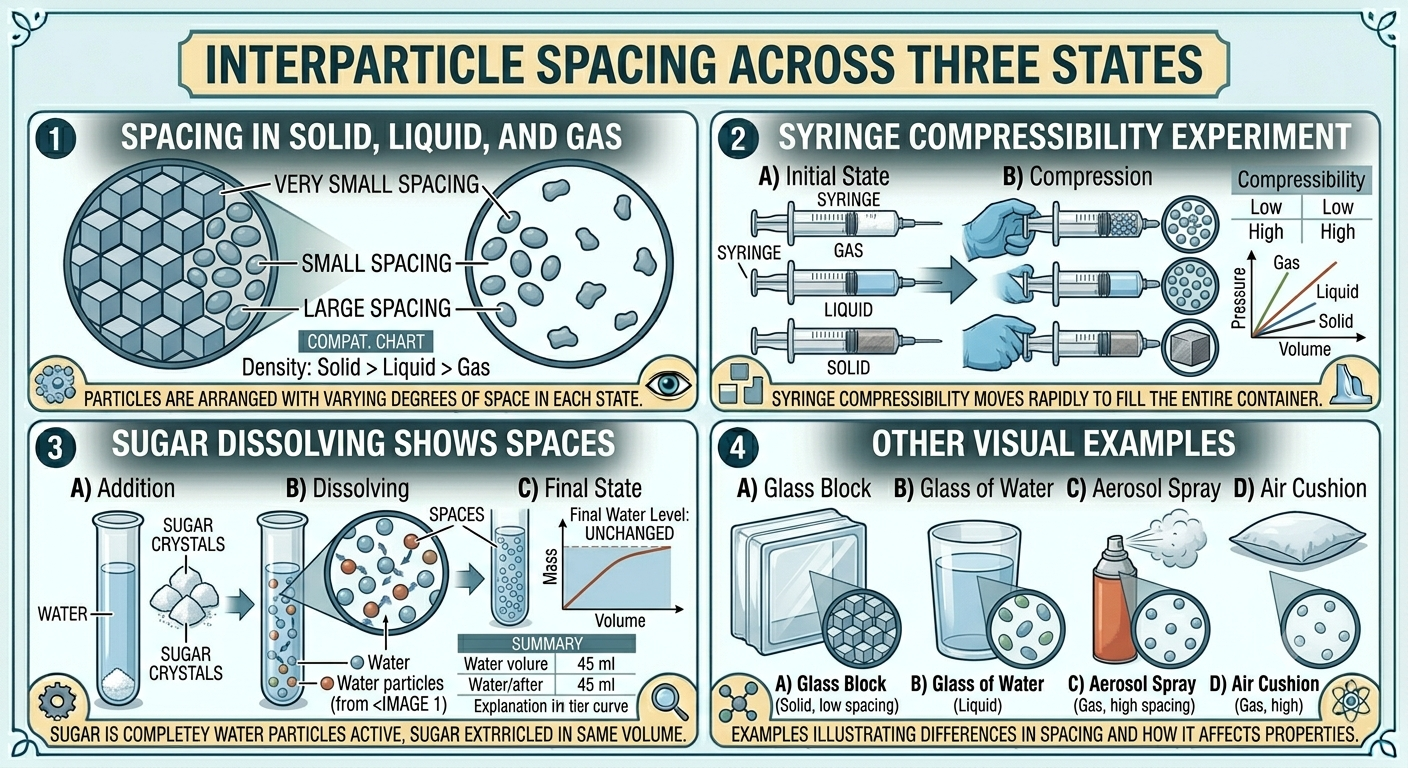
- Gases are compressible — when a syringe (without needle) is pressed with the thumb blocking the opening, the air inside can be compressed. This shows gas particles have large spaces between them. When pressure is released, the plunger moves back — gas particles spread out again.
- Liquids are practically incompressible — repeating the syringe experiment with water shows water cannot be compressed easily, indicating particles are already close together.
- In the sugar dissolution experiment, after sugar dissolves, the water level (C) is lower than the level after adding sugar (B) but slightly higher than the original water level (A). This proves there are spaces between water particles that sugar particles occupy.
- Solid: Interparticle spacing minimum, particles closely packed.
- Liquid: Interparticle spacing a little more than in solids, particles a little loosely packed.
- Gas: Interparticle spacing maximum, particles completely free to move anywhere.
- The spaces between particles in all states contain nothing at all — not even air. They are truly empty spaces.
📝 Practice Questions — Concept 6
LOTS Which state of matter is most compressible and why?
Show Answer
Gases are most compressible because their particles have maximum interparticle spacing. When pressure is applied, the particles can be forced closer together, reducing the volume significantly. Liquids and solids are practically incompressible because their particles are already close together.
Medium In the sugar dissolution activity, why does the water level after dissolution (C) become less than the level after adding sugar (B)?
Show Answer
When sugar is added, it occupies space above the water (level B is higher). After dissolution, sugar particles break into constituent particles and fit into the interparticle spaces between water particles. Since no new space is created, level C is lower than B. This proves water particles have spaces between them.
HOTS Why does sand not dissolve in water but sugar does, even though both are solids?
Show Answer
Sugar dissolves because the water particles can pull out sugar’s constituent particles and the sugar particles are small enough to fit into interparticle spaces of water. Sand particles are held together by very strong forces — water particles cannot pull them apart. So sand remains as particles and settles at the bottom instead of dissolving.
HOTS What is SPM? Why are SPM particles NOT the constituent particles of matter?
Show Answer
SPM (Suspended Particulate Matter) refers to tiny dust particles suspended in air during pollution. These are NOT constituent particles — they are millions of times larger than constituent particles (atoms and molecules). In fact, each SPM dust particle is itself made up of a very large number of constituent particles.
💡 Concept 7: How Particles Move in Different States
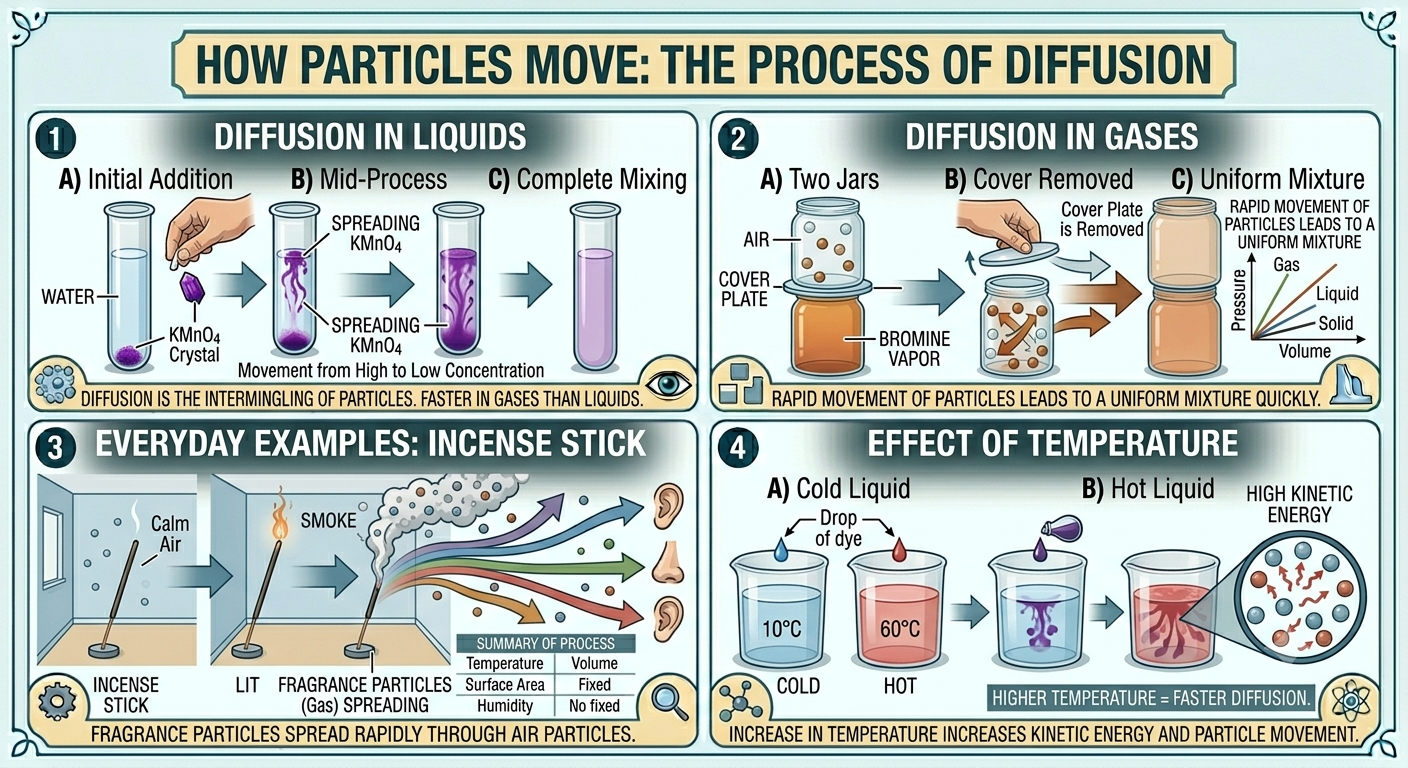
- Diffusion in liquids: When potassium permanganate grains are dropped in water, pink streaks spread out initially, and eventually the entire water turns uniform pink. This happens because water particles are in constant motion — they pull out the permanganate particles and spread them throughout the liquid.
- Effect of temperature on diffusion: Potassium permanganate spreads fastest in hot water, less quickly in water at room temperature, and slowest in ice-cold water. This proves that particle movement increases when heat is provided.
- Diffusion in gases: When an incense stick is lit in one corner of a room, the fragrance spreads throughout the room over time. This is because air particles move constantly and hit the fragrance particles, spreading them throughout the room.
- The process of spreading of particles of one substance into another substance on their own is called diffusion. Diffusion is fastest in gases, slower in liquids and negligible in solids.
- Solid state: Movement of particles is negligible — only vibrations.
- Liquid state: Movement of particles is restricted to limited space.
- Gaseous state: Movement of particles occurs in all available space freely.
- Real-life application: When soap is used to wash oily clothes, soap particles surround the oil particles — one end attaches to the oil and the other mixes with water, lifting the oil off the fabric. This is possible due to the particulate nature of matter.
- The tiny particles that make up all matter are atoms and molecules. Iron is made of iron atoms, water molecules are made of 2 hydrogen atoms and 1 oxygen atom.
📝 Practice Questions — Concept 7
LOTS What happens when potassium permanganate is dropped in water?
Show Answer
Initially pink streaks spread out from the grain. Over time the entire water turns uniform pink. This happens because water particles in constant motion pull out permanganate particles and spread them throughout the liquid — demonstrating diffusion in liquids.
Medium How does temperature affect the rate of diffusion? Give an example.
Show Answer
Higher temperature increases particle movement, which increases the rate of diffusion. Example: Potassium permanganate spreads fastest in hot water, less quickly in water at room temperature, and slowest in ice-cold water — because particles move faster at higher temperatures.
HOTS Why does the fragrance of perfume reach us even from a distance? Explain using particle theory.
Show Answer
Perfume evaporates into gas particles. Gas particles have negligible interparticle attraction and move freely in all directions. Air particles constantly collide with perfume particles, helping them spread throughout the room by diffusion. Since gas diffusion is very fast, the fragrance reaches us even from a distance within seconds.
HOTS How does soap clean oily clothes? Explain using the particulate nature of matter.
Show Answer
Soap particles have two different ends. One end is attracted to oil particles and the other end is attracted to water. Soap particles surround the oil particles on the fabric — one end attaches to oil, the other mixes with water. When rinsed, the oil particles are pulled away from the fabric along with the soap particles into the water, cleaning the cloth.