
🔬 Chapter 2: The Invisible Living World: Beyond Our Naked Eye
CBSE Class 8 Science — Curiosity Textbook
🎯 Learning Objectives
- Understand the structure of a cell and identify its main parts.
- Recognise how the shape and structure of cells relate to their functions.
- Explain the levels of organisation from cell to organism.
- Define microorganisms and describe their types and habitats.
- Explain how microorganisms are connected to our daily lives and environment.
- Describe the role of microorganisms in decomposition, food preparation, and oxygen production.
- Explain why the cell is the basic unit of life and distinguish between unicellular and multicellular organisms.
- Understand the difference between prokaryotic and eukaryotic cells.
📖 Chapter Index2.1 What Is a Cell? |
🔬 2.1 What Is a Cell?
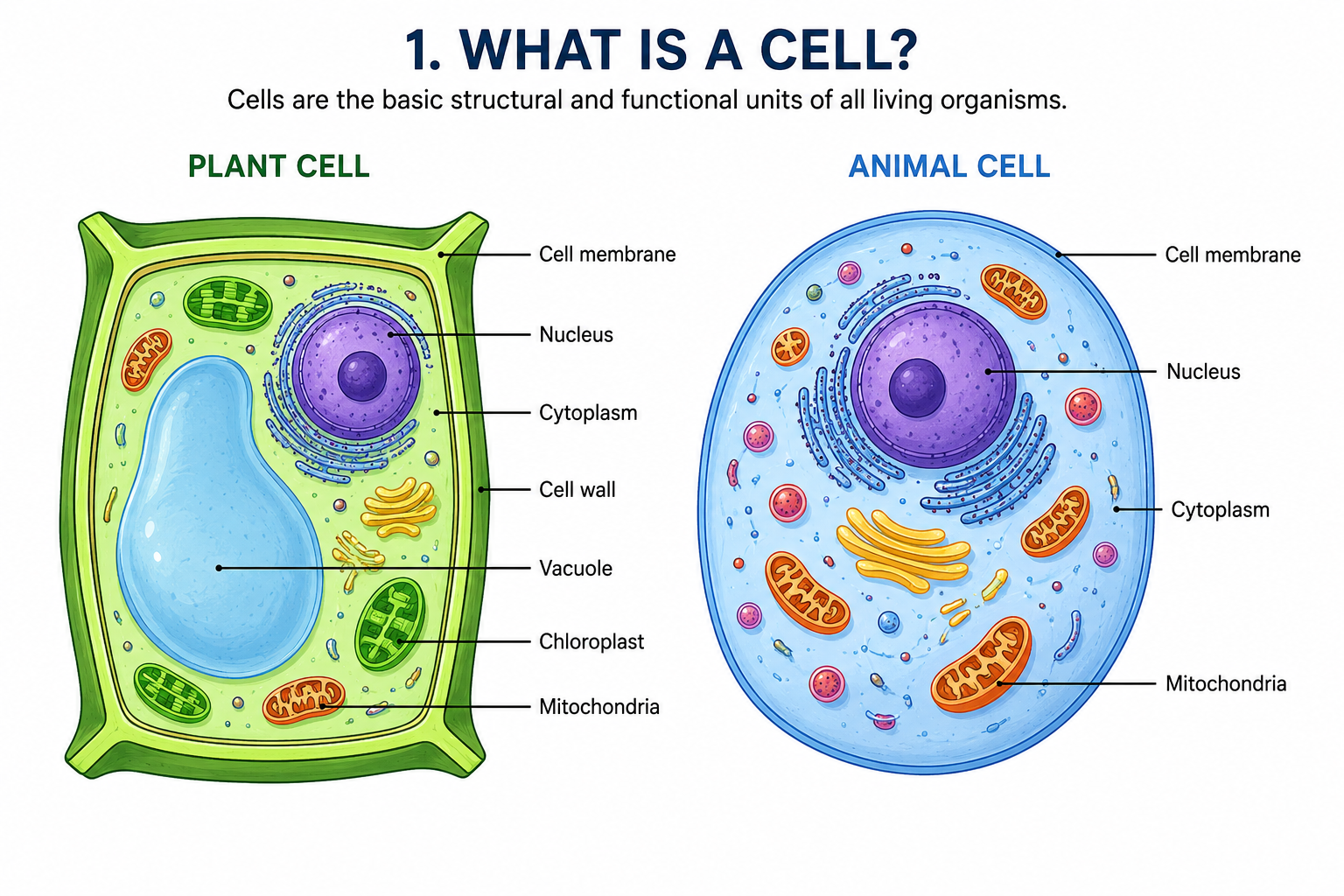
💡 Remember: Cell membrane = boundary. Cytoplasm = life processes. Nucleus = control centre. Cell wall = only in plant cells.
🧠 2.1.1 Variation in Shape and Structure of Cells
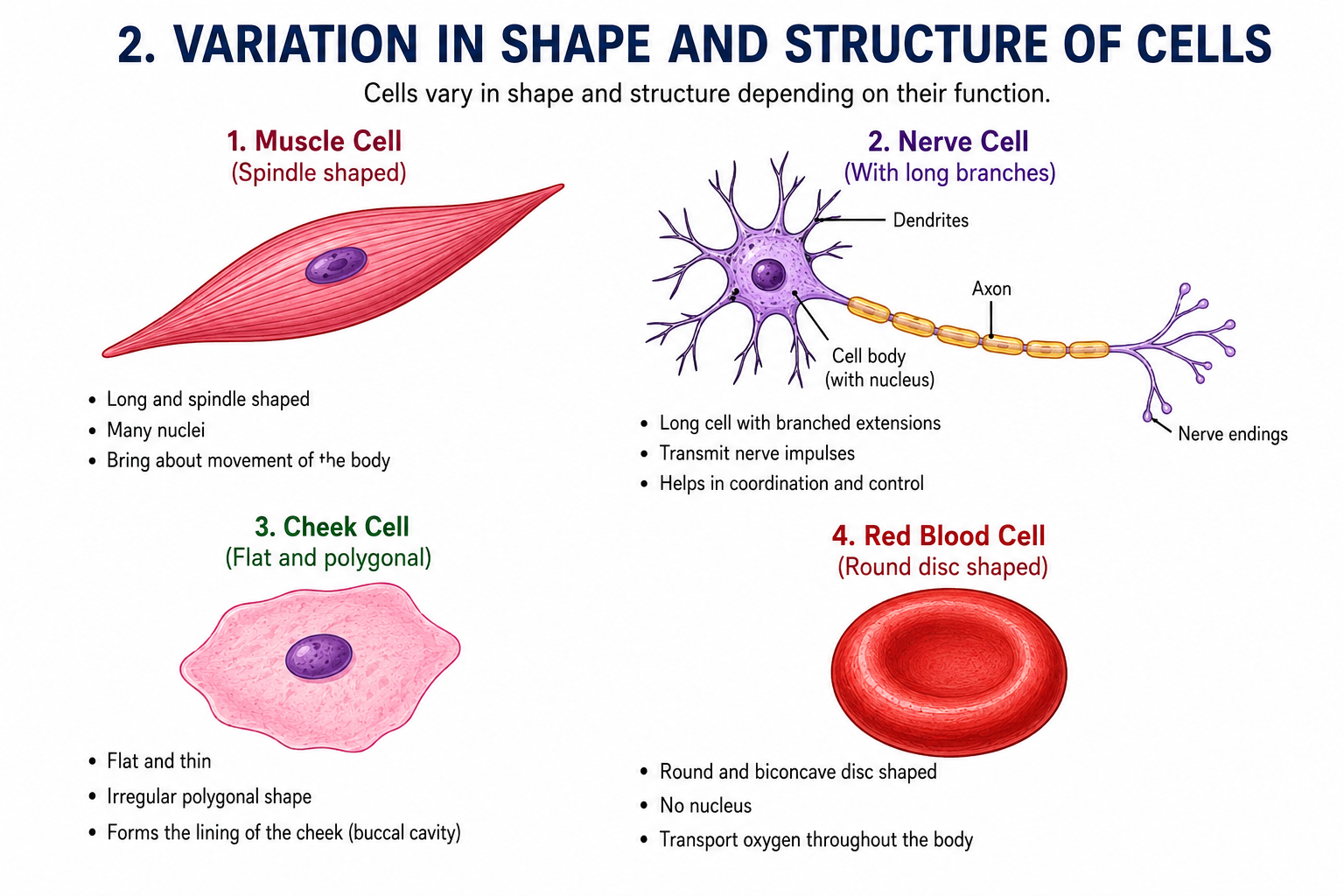
💡 Remember: Spindle = muscle. Long + branches = nerve. Flat = cheek. Shape = function.
🌎 2.2 What Are the Levels of Organisation in the Body of a Living Organism?
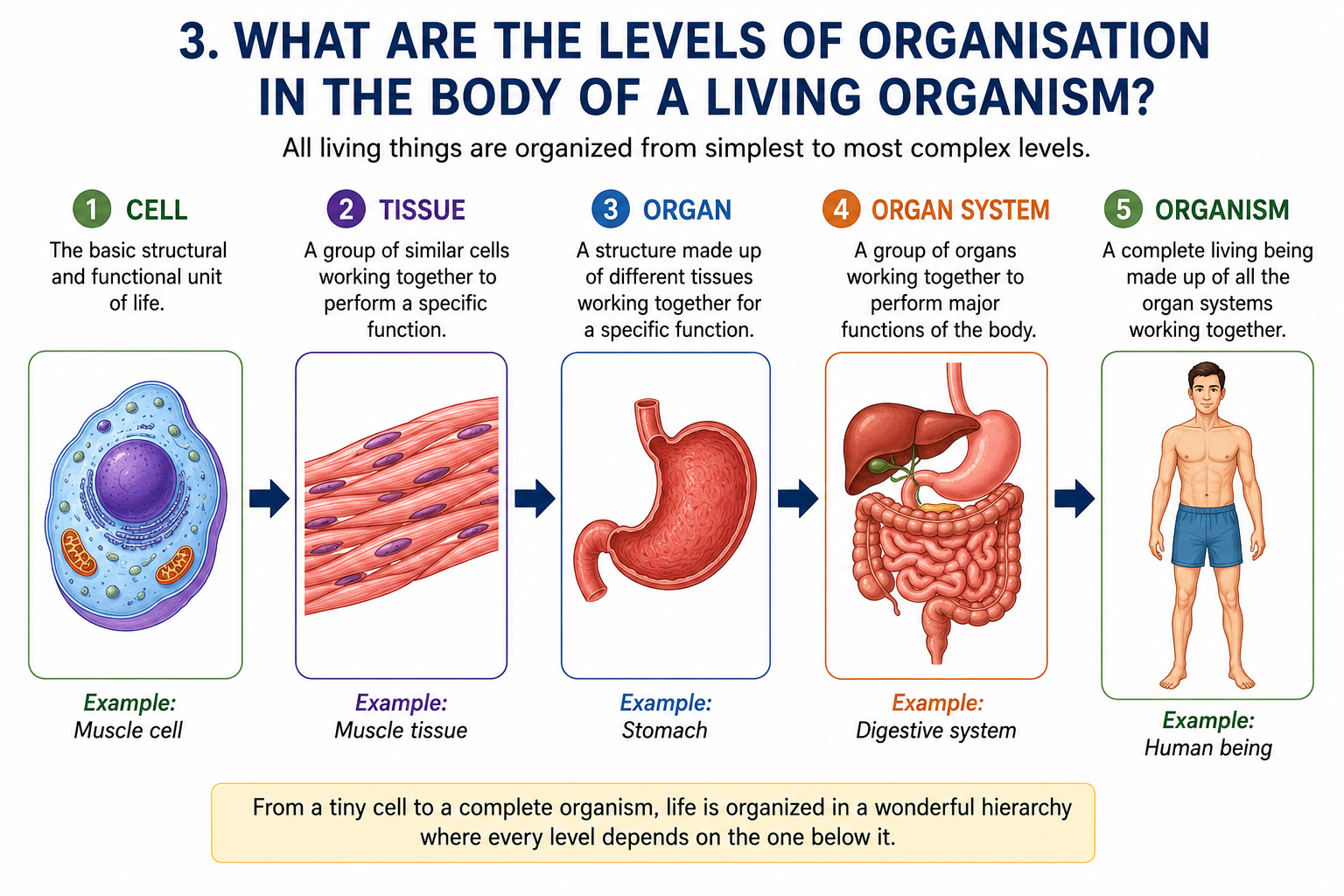
💡 Remember: Cell → Tissue → Organ → Organ System → Organism.
🔬 2.3 What Are Microorganisms?
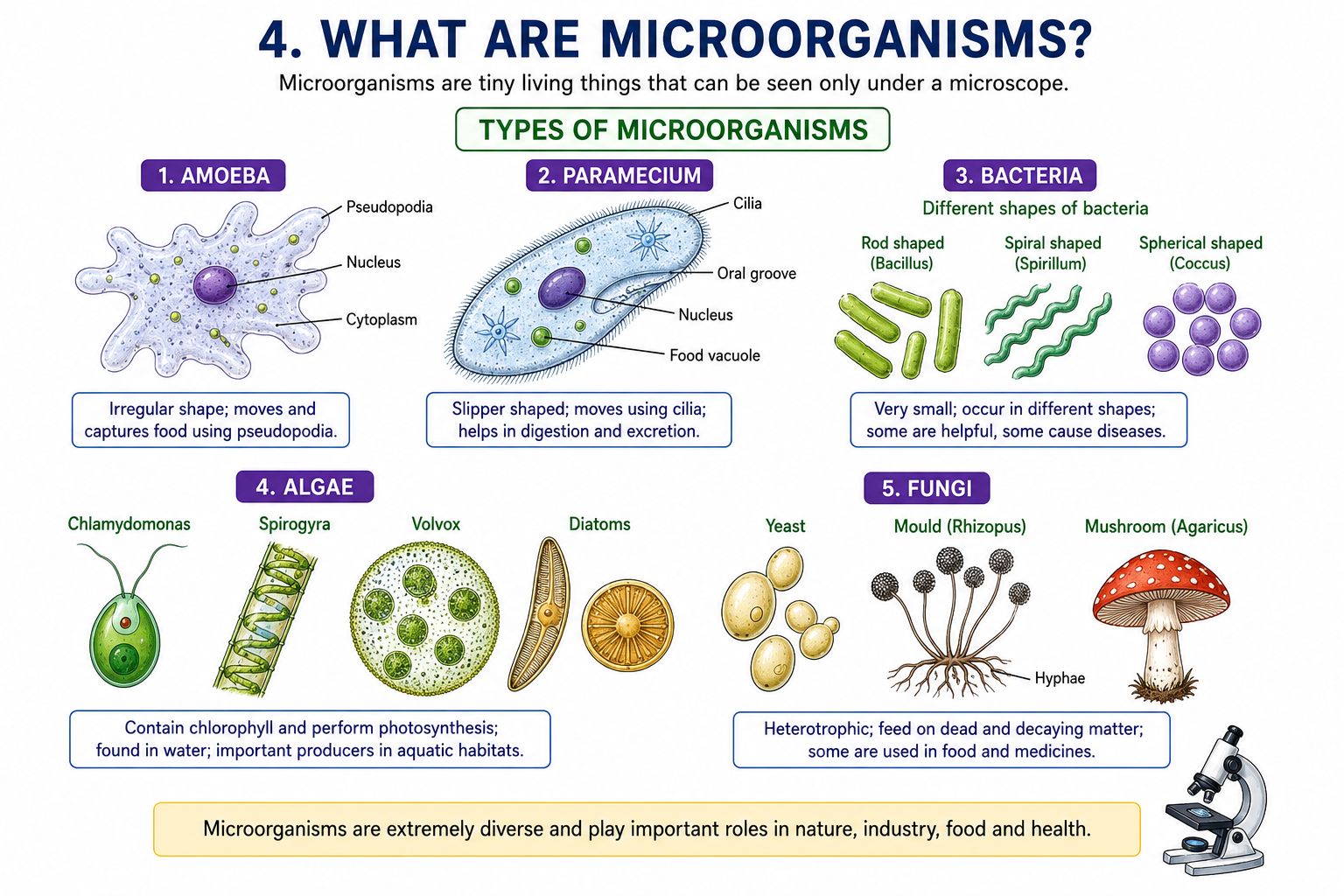
💡 Remember: Viruses are acellular — NOT cells. They need a host cell to reproduce.
🦠 2.4 How Are We Connected to Microbes?
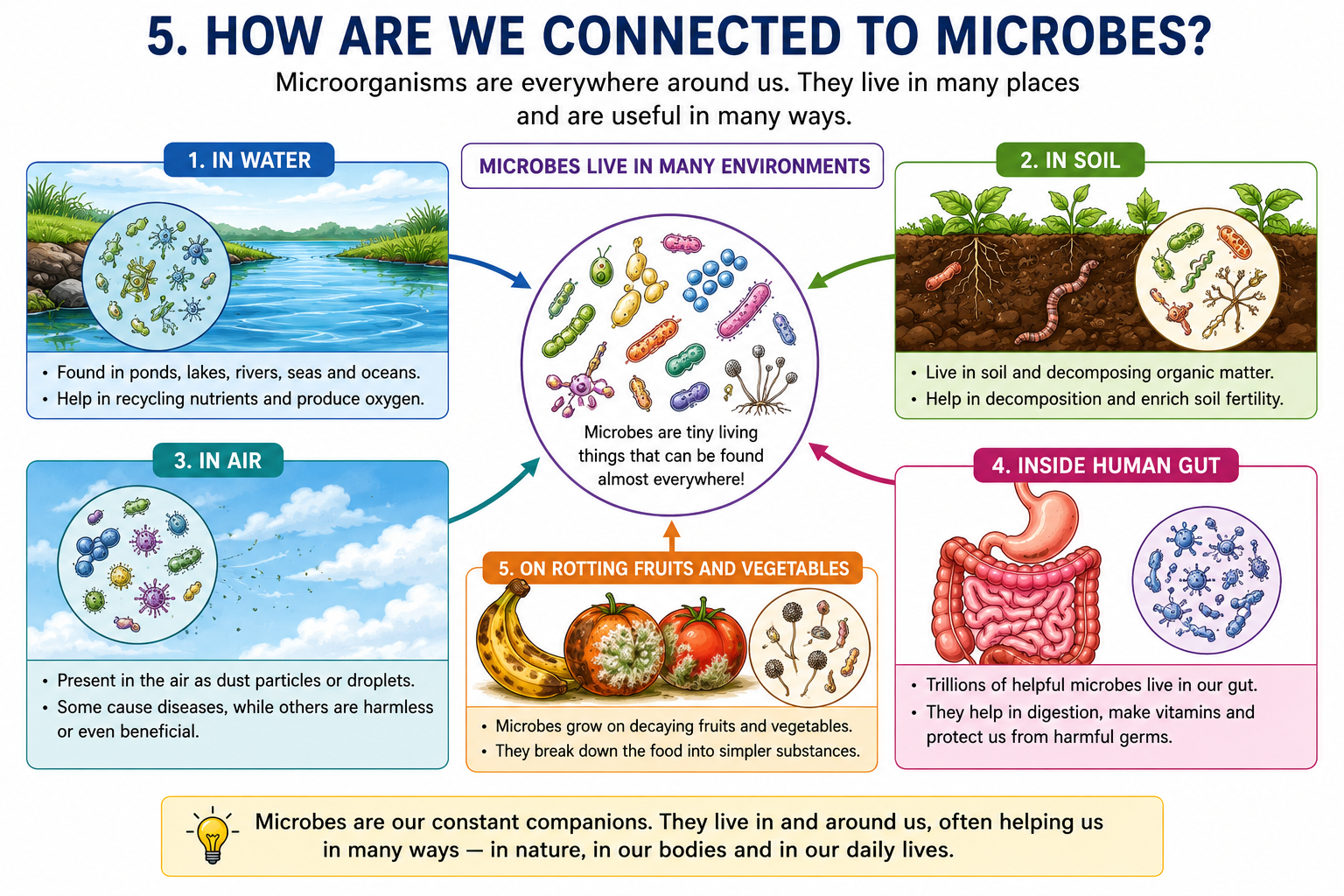
💡 Our Scientific Heritage: The Vedas referred to microorganisms as Krimi — thousands of years before microscopes were invented!
🌿 2.4.1 Key Players in Cleaning the Environment
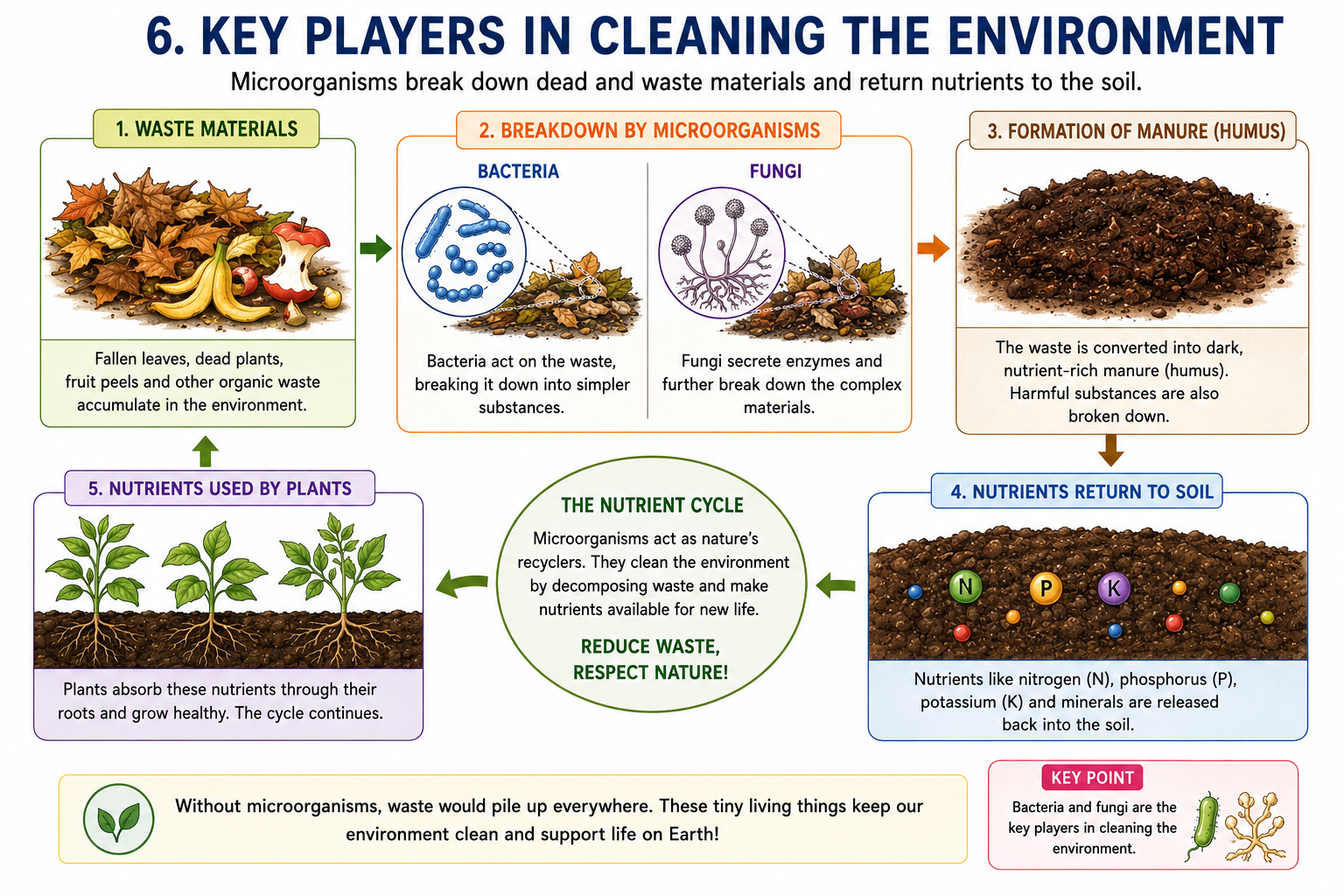
💡 Remember: Decomposers = bacteria + fungi. Nitrogen fixers = Rhizobium (in root nodules of legumes).
🍳 2.4.2 Microorganisms and Food
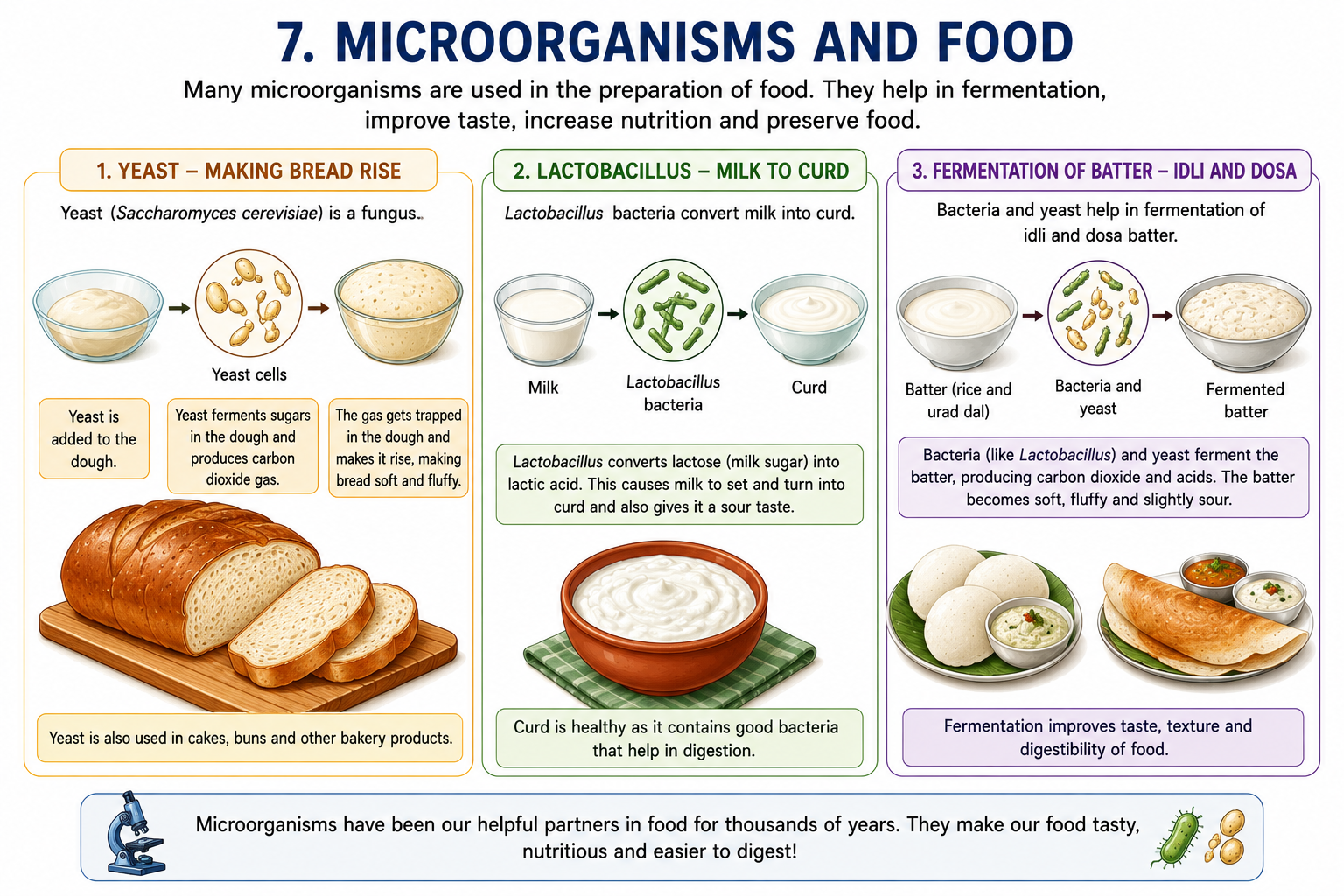
💡 Remember: Yeast = CO² = bread fluffy. Lactobacillus = lactic acid = curd sour.
🌊 2.4.3 Amazing Microalgae: Tiny Helpers in Water
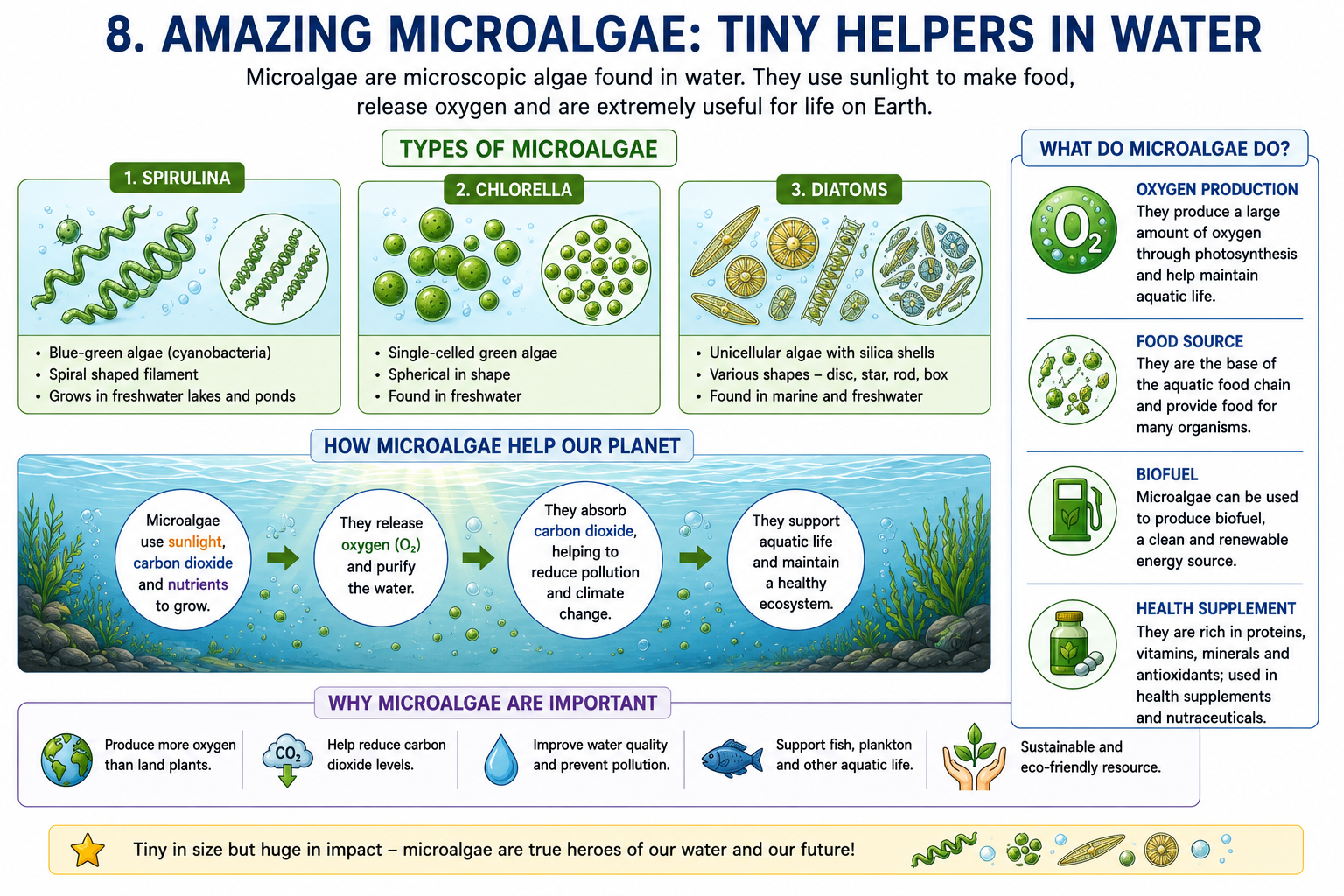
💡 Remember: Microalgae = more than 50% of Earth's oxygen. Spirulina = superfood = 60%+ protein + Vitamin B12.
🔬 2.5 Why Is Cell Considered to Be a Basic Unit of Life?
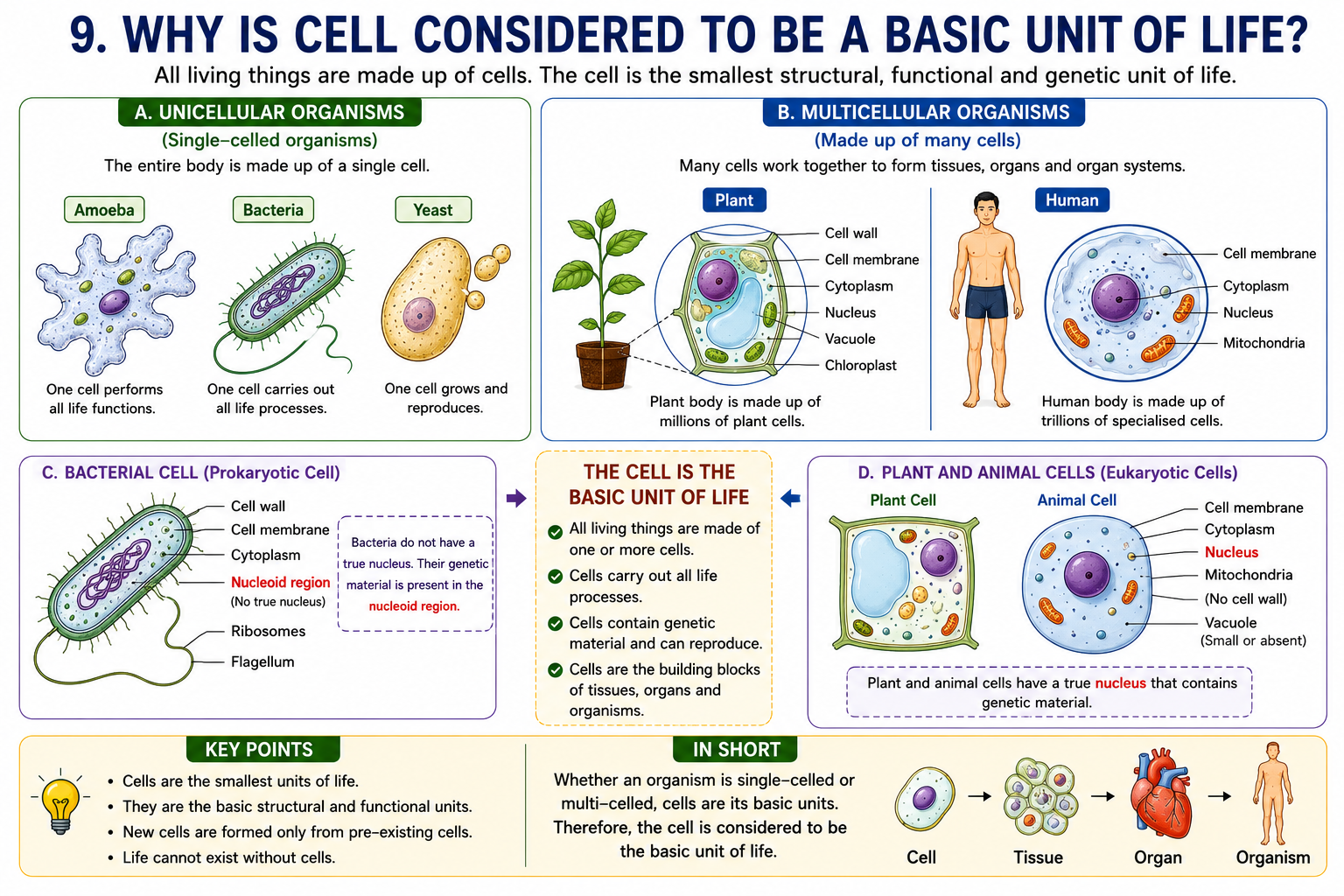
💡 Remember: Bacteria = Prokaryote = Nucleoid. All others = Eukaryote = proper nucleus.
📝 Chapter 2 Practice Quiz — 25 Questions
|
2.1 What Is a Cell?
LOTS
What are the three main parts of a cell?
Show AnswerCell membrane, Cytoplasm, and Nucleus.
Medium
What is the function of the cell membrane?
Show AnswerIt is porous and controls entry of materials needed for life processes and exit of waste. It also separates one cell from another.
HOTS
Why do plant cells have a cell wall but animal cells do not?
Show AnswerPlants need rigidity to stand upright without a skeleton. The cell wall provides structural support. Animals have a skeleton so they do not need a cell wall.
HOTS
What new things can scientists discover using an electron microscope vs Robert Hooke’s microscope?
Show AnswerAn electron microscope magnifies 10,00,000 times vs Hooke’s 200-300 times. Scientists can now see ribosomes, mitochondria, endoplasmic reticulum, and protein molecules in detail.
2.1.1 Variation in Shape and Structure of Cells
LOTS
What is the shape of a nerve cell and why?
Show AnswerNerve cells are very long with branches. This helps them reach different body parts and pass messages quickly.
Medium
How does the spindle shape of muscle cells help them function?
Show AnswerSpindle-shaped muscle cells are thin and flexible, allowing them to contract and relax in a wave-like manner, pushing food through the food pipe.
HOTS
If a nerve cell were shaped like a cheek cell, how would this affect body communication?
Show AnswerA flat round nerve cell could not reach distant body parts. Messages would be slow and short-range, breaking down the entire nervous system communication.
HOTS
Why do different parts of the stomach have different types of cells even though it is one organ?
Show AnswerDifferent parts perform different functions. Churning food needs muscle cells; producing digestive juices needs secretory cells. Each cell type is specialised for its specific task.
2.2 Levels of Organisation
LOTS
Write the correct order of levels of organisation in a living organism.
Show AnswerCell to Tissue to Organ to Organ System to Organism.
Medium
What is a tissue? Give one example.
Show AnswerA tissue is a group of similar cells working together. Example: Muscle tissue in the food pipe pushes food to the stomach.
HOTS
Compare a brick wall to the levels of organisation in a living organism.
Show AnswerBrick = Cell. Section = Tissue. Room = Organ. Floor = Organ System. Building = Organism. Cells are the smallest unit of a living organism, just as bricks are the smallest unit of a building.
HOTS
The ostrich egg yolk is the largest known single cell. Does this make an ostrich unicellular?
Show AnswerNo. The egg yolk is one reproductive cell but the adult ostrich has billions of cells. It is multicellular. The large yolk is an adaptation to nourish the developing embryo.
2.3 What Are Microorganisms?
LOTS
What are microorganisms? Give two examples.
Show AnswerMicroorganisms are tiny living beings that cannot be seen with the naked eye. Examples: Bacteria, Amoeba.
Medium
How are viruses different from other microorganisms?
Show AnswerViruses are acellular and can only reproduce inside a living host cell. Other microorganisms are cellular and carry out life processes independently.
HOTS
Some microorganisms survive in hot springs and freezing zones. What does this tell us about their adaptability?
Show AnswerMicroorganisms tolerate extreme heat, cold, pressure, or salt making them the most resilient life forms on Earth.
HOTS
If all microorganisms disappeared from Earth, what would happen?
Show AnswerDead organisms would not decompose, nutrients would not return to soil, nitrogen fixation would stop, fermentation would stop, oxygen from microalgae would reduce, and food chains would collapse.
2.4 How Are We Connected to Microbes?
LOTS
Why do pickles not get spoiled by microorganisms?
Show AnswerHigh concentration of salt or sugar acts as a preservative and does not allow microorganisms to grow on them.
Medium
Which ancient Indian word referred to tiny invisible entities? Which texts mention it?
Show AnswerThe word is Krimi. The Vedas and Atharvaveda mention Krimi referring to tiny visible and invisible entities and their effects.
HOTS
A fruit in a refrigerator stays fresh longer than one kept outside. Explain why.
Show AnswerIn a refrigerator low temperature slows microbial growth. Outside warm conditions allow microbes to multiply rapidly and rot the fruit.
HOTS
What would happen to a person who takes antibiotics for a very long time?
Show AnswerLong-term antibiotics kill beneficial gut bacteria leading to weakened digestion, nutritional deficiencies, and reduced immunity.
2.4.1 Key Players in Cleaning the Environment
LOTS
What is decomposition?
Show AnswerDecomposition is the process by which microorganisms break down complex substances of dead organisms into simpler nutrient-rich substances that return to the soil.
Medium
How does Rhizobium help farmers?
Show AnswerRhizobium lives in root nodules of legumes and fixes nitrogen from the air naturally increasing soil fertility without chemical fertilisers.
HOTS
Why do gardeners mix dry leaves with fruit peels when making compost?
Show AnswerDry leaves provide carbon-rich material and fruit peels provide nitrogen-rich material giving microorganisms the right nutrients to decompose waste faster.
HOTS
A farmer grows wheat every year and yield falls. His neighbour rotates wheat with beans and maintains good yield. Explain why.
Show AnswerContinuous wheat farming depletes soil nitrogen. Beans have Rhizobium bacteria in root nodules that fix nitrogen back into the soil keeping it fertile.
2.4.2 Microorganisms and Food
LOTS
Which bacterium helps in curd formation and how?
Show AnswerLactobacillus ferments milk sugar and produces lactic acid converting milk into curd. Lactic acid makes curd sour.
Medium
Why does yeast make dough rise and become fluffy?
Show AnswerYeast releases carbon dioxide gas during respiration. This CO2 forms bubbles in the dough making it rise and become soft and fluffy.
HOTS
What would happen if you put curd starter in boiling hot milk?
Show AnswerBoiling hot milk kills Lactobacillus bacteria. Without live bacteria fermentation cannot occur and curd will not form.
HOTS
Yeast produces alcohol during fermentation. Why does baked bread not taste alcoholic?
Show AnswerHigh oven temperature evaporates the alcohol during baking. Only the CO2 fluffy effect remains. Heat also kills the yeast.
2.4.3 Amazing Microalgae
LOTS
Why is Spirulina called a superfood?
Show AnswerSpirulina is rich in protein (more than 60% of body weight), contains vitamin B12, and has very little fat and sugar making it highly nutritious.
Medium
How do microalgae help maintain oxygen balance on Earth?
Show AnswerMicroalgae perform photosynthesis and release oxygen. They produce more than half of Earth’s total oxygen supply.
HOTS
Pollution and climate change are threatening microalgae. How could this affect human life?
Show AnswerEarth’s oxygen would fall by more than half. Aquatic food chains would collapse. Water purification and biofuel production would reduce causing a severe ecological crisis.
HOTS
What advantages does Spirulina farming have over traditional farming?
Show AnswerGrows in water tanks, needs very little land, harvestable in 3-6 weeks, minimal investment, extremely nutritious and high market demand.
2.5 Cell as Basic Unit of Life
LOTS
What is the difference between unicellular and multicellular organisms? Give one example each.
Show AnswerUnicellular = one cell e.g. Amoeba. Multicellular = many cells e.g. humans. Unicellular organisms perform all life functions in one cell.
Medium
How do bacteria differ from plant and animal cells in terms of the nucleus?
Show AnswerBacteria have no well-defined nucleus. They have a nucleoid region instead. Plant and animal cells have a proper nucleus enclosed by a nuclear membrane.
HOTS
Which is more efficient, unicellular or multicellular system? Why?
Show AnswerMulticellular systems are more efficient. Specialised cells perform specific functions better. Division of labour allows greater complexity and longer lifespan.
HOTS
Fungi have a cell wall but no chloroplasts. How does this affect the way fungi get food compared to plants?
Show AnswerPlants use chloroplasts for photosynthesis. Fungi lack chloroplasts so they absorb nutrients from dead or decaying organic matter instead.
|