
Understanding Society: India and Beyond — Grade 9 Part 1
Chapter 2 — New NCERT Syllabus🌍 Shaping of the Earth’s Surface
🎯 The Big Questions
- What shapes the Earth’s surface?
- What is plate tectonics? What are the effects of plate movement?
- How are landforms formed and how are they classified?
- How are humans and other living beings connected to these landforms?
- How do disasters associated with different landforms impact human lives?
📖 Chapter Index
🔑 Key Term — Landforms
- A landform is a natural feature on the Earth’s surface formed by processes, such as weathering, erosion, deposition, and the movement of the Earth’s crust.
- Examples of landforms include mountains, valleys, plateaus, plains, deserts, and coastal features.
- The Earth’s surface is not consistent; it is constantly being transformed by powerful forces acting from within and on the surface of the planet.
- One of the most important ideas that explains these changes is the theory of plate tectonics, which describes how large pieces of the Earth’s crust move slowly over the molten mantle.
- The movement of these plates gives rise to various landforms, such as mountains, volcanoes, plains, and valleys.
- Understanding plate tectonics and landforms helps us explain natural phenomena like earthquakes, volcanic eruptions, and the formation of continents and oceans, and allows us to better appreciate the dynamic nature of the Earth.
🗺️ Plate Tectonics
- Plate tectonics is an important theory, given by W.J. Morgan, in earth science, that explains the movement of the Earth’s crust.
- According to this theory, the outermost layer of the Earth is not one single piece but is broken into several large and small pieces called tectonic plates.
- These plates move slowly over the semi-molten layer beneath them and are responsible for major physical features and natural phenomena, such as mountains, earthquakes, and volcanoes.
- The Earth is made up of three main layers: crust, mantle, and core.
- The crust is the outermost layer on which we live — thickness varies from 30–40 km under continents to 5–7 km under the ocean.
- Below the crust lies the mantle (about 2,900 km) — the mostly solid layer between the crust and the Earth’s outer core, very thick and hot.
- The core is the innermost layer — extremely hot and heavy. The outer core (about 2,200 km) is a fluid layer mainly consisting of iron and nickel; the inner core (about 1,250 km) is a solid, hot spinning metal ball — the densest part of the Earth.
- The crust along with the upper part of the mantle forms the lithosphere (about 100 km) — the rigid outer layer of the Earth, broken into different tectonic plates.
- Beneath the lithosphere lies the asthenosphere (about 200 km) — a hot, mobile layer of partially molten rock, which allows the plates to move.
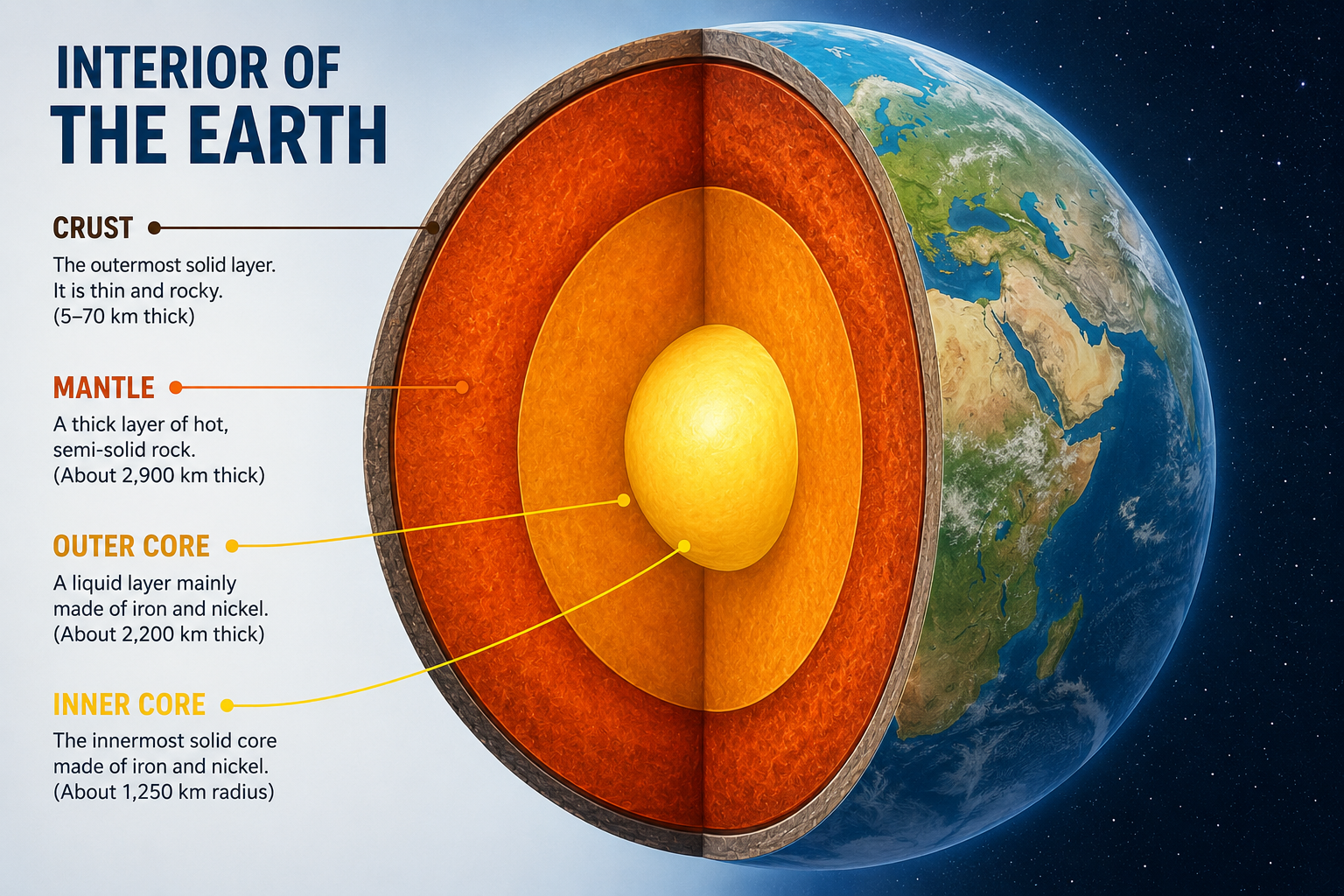
Fig. 2.1: The Earth’s interior (values are approximate)
- Tectonic plates are massive slabs of solid rock that move very slowly — usually a few centimetres per year.
- There are three main types of tectonic plates: continental plates, which carry continents; oceanic plates, which carry ocean floors; and mixed plates, which carry both continents and oceans.
- Some of the major tectonic plates of the world include the Pacific Plate, Eurasian Plate, African Plate, North American Plate, South American Plate, Indo-Australian Plate, and Antarctic Plate.
- The movement of tectonic plates is caused by convection currents in the mantle — heat from the Earth’s core causes molten material in the mantle to rise, while cooler material sinks. This continuous movement creates convection currents that push and pull the tectonic plates, causing them to move in different directions.
- Heat moves from the Earth’s interior through three mechanisms — advection, convection, and conduction — with the crust and upper mantle, lower mantle, and core each carrying a share of the total interior heat flow.
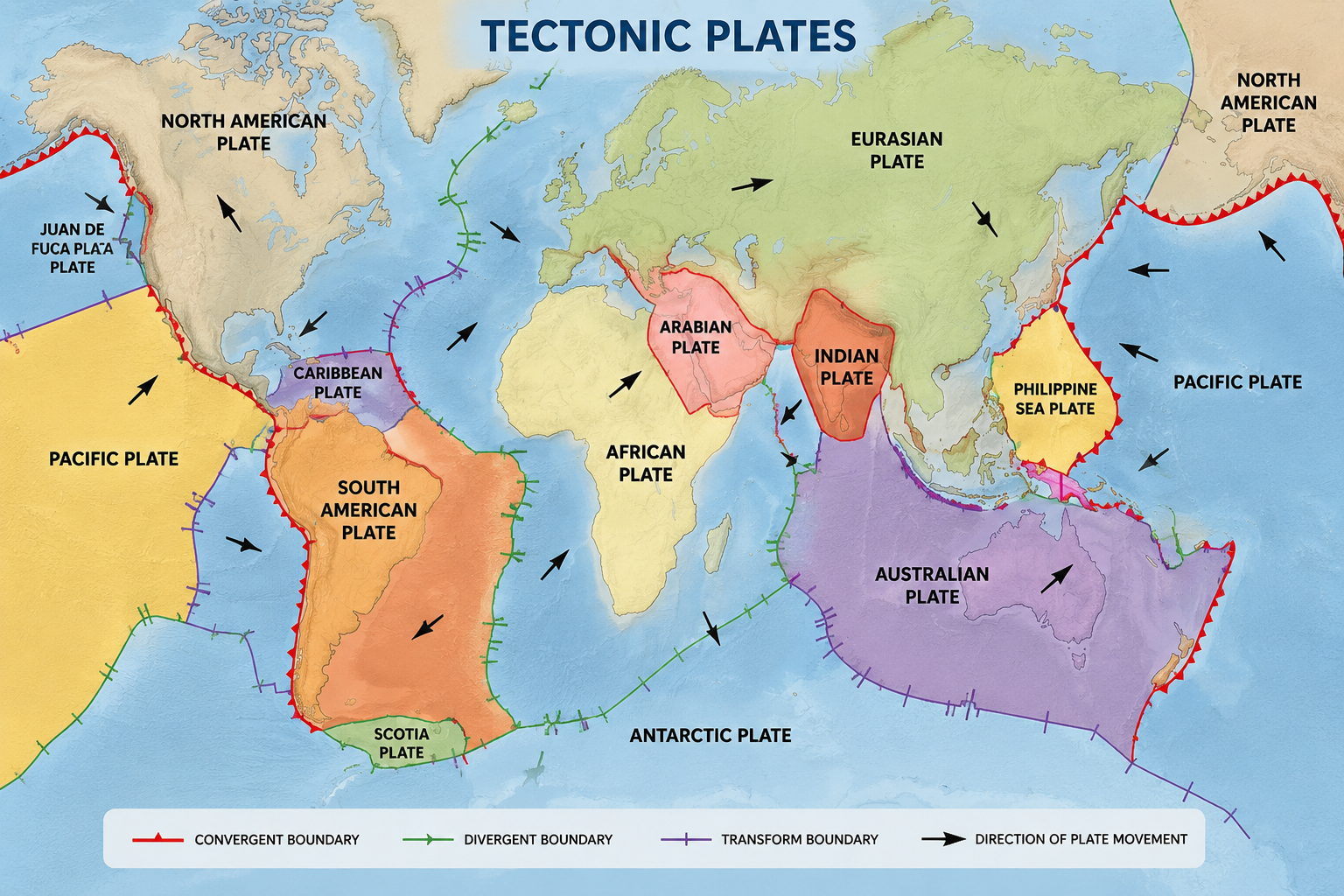
Fig. 2.3: World map showing major plates and their direction of movement
🗺️ LET’S MAP
Pick any two plates from the map above and complete the table given below.
| Name of the plate | Continents | Ocean |
|---|---|---|
| e.g., Indo-Australian Plate | India, Australia | Indian Ocean |
| e.g., African Plate | Africa | Parts of the Atlantic and Indian Oceans |
Plate Boundaries
- The edges where tectonic plates meet are called plate boundaries. There are three main types:
- 1. Convergent boundary — two plates move towards each other. When continental plates collide, they form fold mountains, such as the Himalaya. When an oceanic plate collides with a continental plate, the oceanic plate sinks beneath the continental plate, leading to volcanic activity and earthquakes.
- 2. Divergent boundary — plates move away from each other. Magma rises from below and forms new crust, creating features such as mid-ocean ridges. The Mid-Atlantic Ridge is a good example.
- 3. Transform boundary — plates slide past each other without creating or destroying crust. This mainly causes earthquakes, such as along the San Andreas Fault in the United States.
- Plate tectonics plays a major role in shaping the Earth’s surface — forming mountains, valleys, ocean basins, volcanoes, and earthquakes — and explains the distribution of continents and oceans.
- Most earthquakes and volcanoes occur along plate boundaries, especially around the Pacific Ocean — an area known as the Ring of Fire.
- In conclusion, the theory of plate tectonics helps us understand how the Earth’s surface is constantly changing. It explains the origin of many landforms and natural disasters, and is very important for identification of earthquake and volcano-prone regions and managing disasters arising from them.
🔍 LET’S EXPLORE
Examine the plate map (Fig. 2.3) with the earthquake and volcano map. What correlation do you observe?
Show Answer
Earthquakes and volcanoes are concentrated along the plate boundaries — they occur where plates collide, separate or slide past each other. The strongest concentration circles the Pacific Ocean (the Ring of Fire), matching the edges of the Pacific Plate.
🔍 LET’S EXPLORE
Observe the map showing the distribution of earthquakes and volcanoes. Can you identify which continents and countries are located around the Ring of Fire with the help of an atlas or a globe?
Show Answer
The Ring of Fire touches the western coasts of North and South America (Chile, Peru, Mexico, USA — especially Alaska and California, Canada), and the eastern edge of Asia and Oceania (Japan, Philippines, Indonesia, Papua New Guinea, New Zealand) along with Russia’s Kamchatka peninsula.
🔍 LET’S EXPLORE — Does India have a risk of earthquakes?
- India has experienced some major earthquakes in the past, resulting in thousands of deaths.
- A large earthquake in a densely populated country like India can cause severe damage to life and environment.
- Can you find out which region is more vulnerable to earthquakes? Why do you think human lives are at risk?
Show Answer
The Himalayan belt (Jammu & Kashmir, Himachal Pradesh, Uttarakhand, Bihar border, the North-East) is the most vulnerable, because the Indo-Australian Plate is continuously colliding with the Eurasian Plate there. The Kutch region of Gujarat is also highly vulnerable. Human lives are at risk because of dense population, poorly designed buildings that collapse in shaking, and the difficulty of predicting earthquakes in advance.
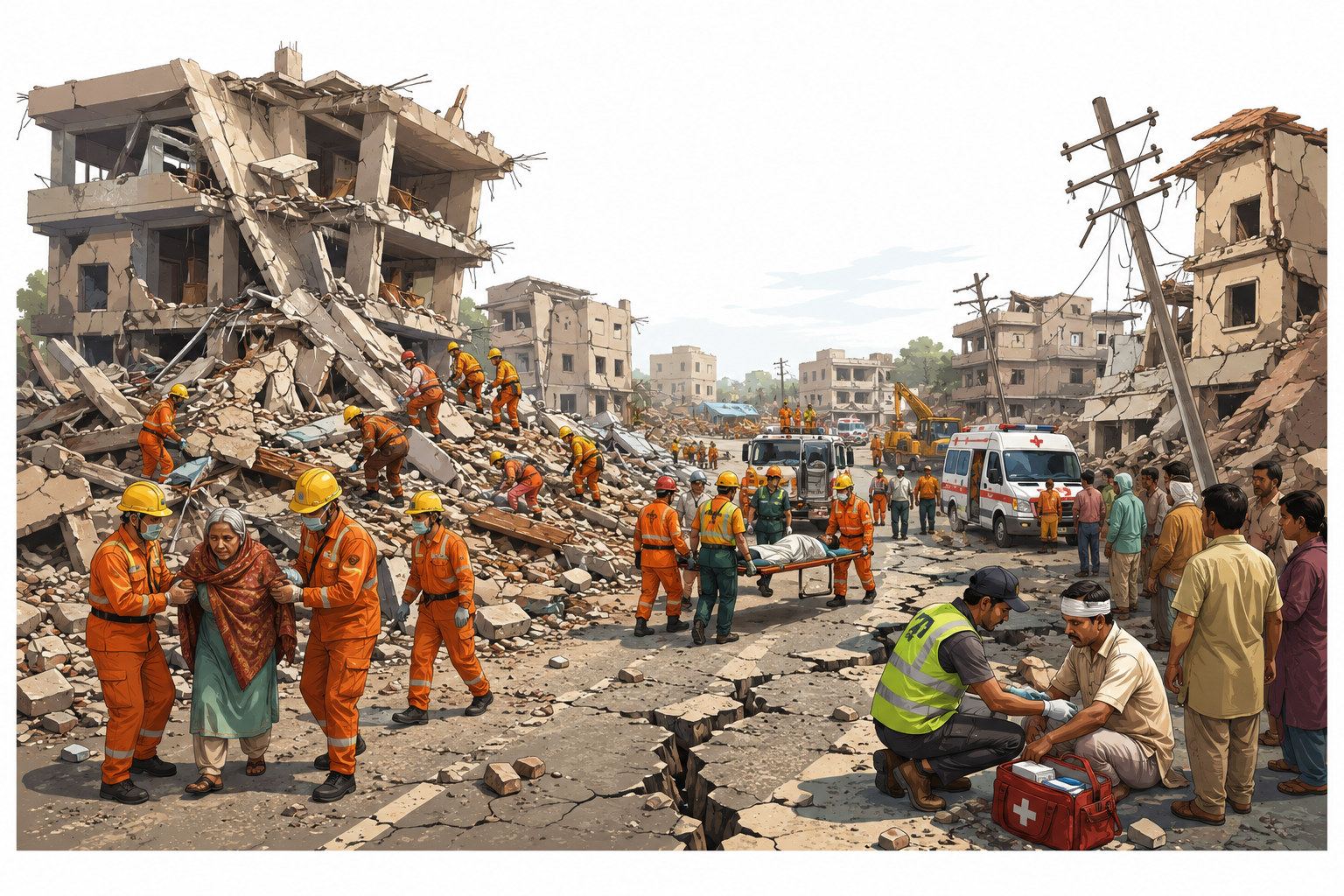
Fig. 2.5: The extensive damage caused by the major earthquake in Gujarat in 2001
⚠️ DON’T MISS OUT
- In early times too, earthquakes were known as ‘bhūkampa’, meaning the shaking of the Earth.
- In the Bṛihatsaṁhitā, Varāhamihira dedicated a section to earthquakes, noting how changes in wind, rain, clouds, animal behaviour, and planetary alignments could signal them.
- He attributed earthquakes to four elemental forces — Vāyu (wind), Agni (fire), Indra (heaven/thunder), and Varuṇa (water) — each linked to specific constellations and regions.
- This reflects an early attempt to blend observations with cosmological reasoning and physical phenomenon in India.
🔍 LET’S EXPLORE
Look carefully at this photograph and answer the following questions:
- What do you think caused this situation?
- What could that grey powder be?
- What does it tell us about the Earth’s internal forces?
Show Answer
A volcanic eruption caused this situation. The grey powder is volcanic ash — fine particles of rock and glass thrown out during the eruption. It tells us that immense heat and pressure exist inside the Earth, powerful enough to push molten material and ash out through the crust and blanket entire landscapes.
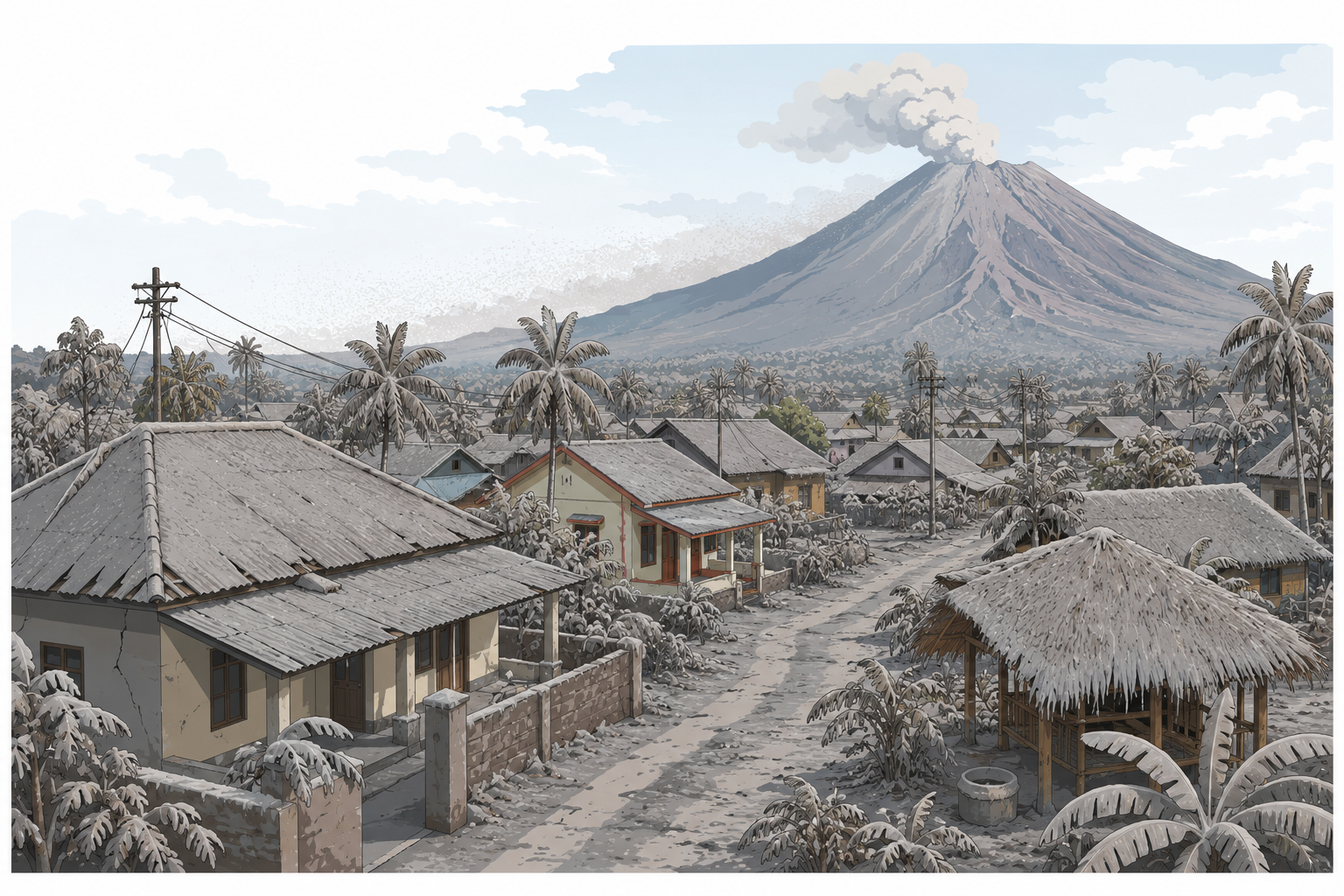
Fig. 2.6: Photograph showing the deposition by volcanic eruption
⚠️ DON’T MISS OUT
- The mud volcano at Baratang Island is a rare natural wonder in India and a unique attraction of the Andaman and Nicobar Islands.
- Unlike fiery volcanoes, here you will find mud bubbling out due to natural underground gases and pressure.
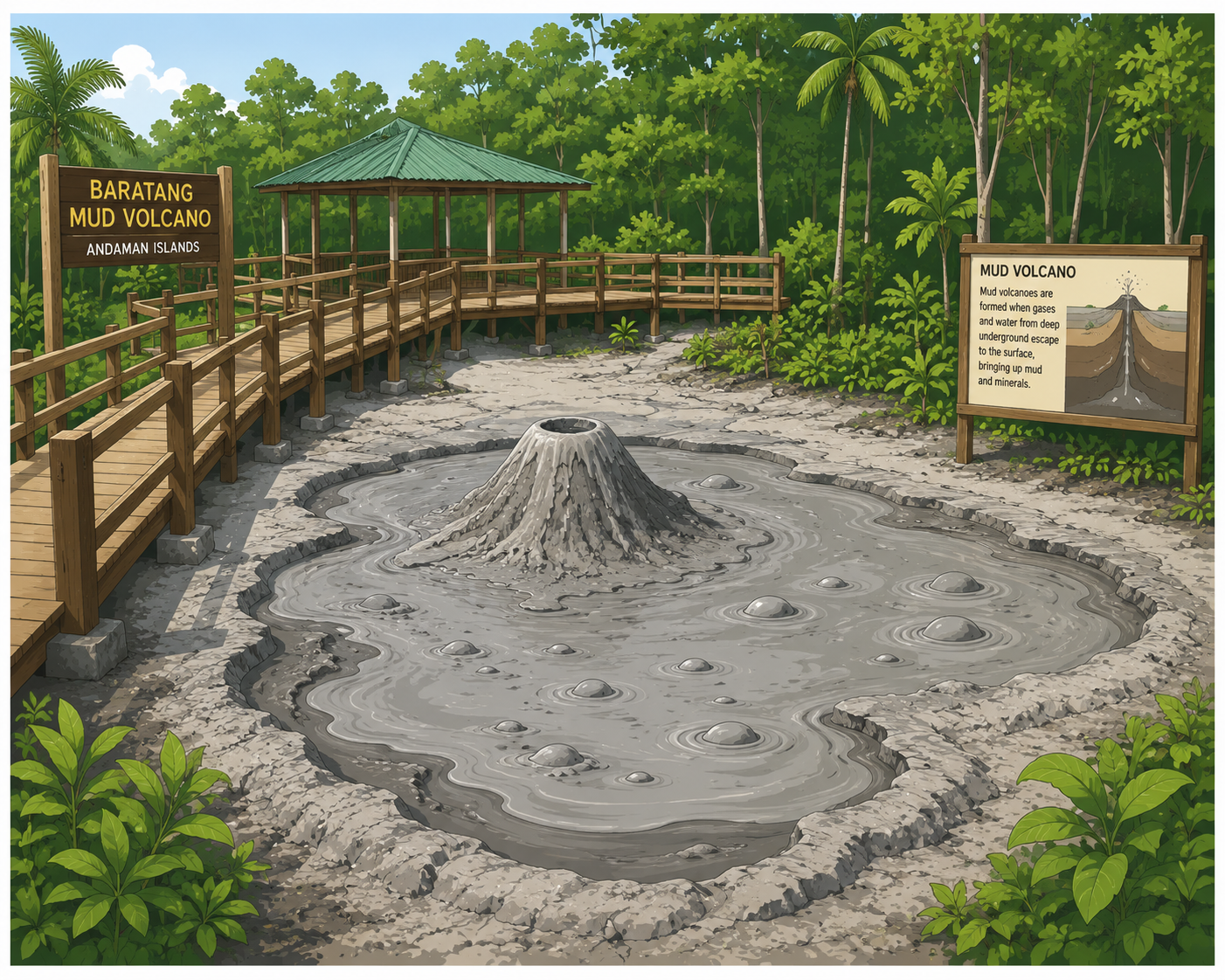
Fig. 2.7: India’s only mud volcano in Baratang in the Andaman and Nicobar Islands
📝 Practice Questions — Plate Tectonics
LOTS Who gave the theory of plate tectonics? Name the three main layers of the Earth.
Show Answer
The theory of plate tectonics was given by W.J. Morgan. The Earth’s three main layers are the crust, the mantle, and the core (divided into liquid outer core and solid inner core).
Medium Differentiate between the lithosphere and the asthenosphere.
Show Answer
The lithosphere (about 100 km) is the rigid outer layer of the Earth that includes the crust and the upper mantle; it is broken into tectonic plates. The asthenosphere (about 200 km) lies beneath the lithosphere; it is a hot, mobile layer of partially molten rock that allows the plates above it to move.
HOTS The Himalaya, the Mid-Atlantic Ridge and the San Andreas Fault represent the three types of plate boundaries. Match each and explain the process at work.
Show Answer
The Himalaya — convergent boundary: the Indo-Australian and Eurasian continental plates collide, folding the crust into mountains. The Mid-Atlantic Ridge — divergent boundary: plates move apart and rising magma creates new crust as a mid-ocean ridge. The San Andreas Fault — transform boundary: plates slide past each other, neither creating nor destroying crust, producing frequent earthquakes.
HOTS Why do most earthquakes and volcanoes occur around the Pacific Ocean’s ‘Ring of Fire’?
Show Answer
The Pacific Plate is surrounded on almost all sides by plate boundaries where it converges with, or slides against, neighbouring plates. At the convergent edges, oceanic crust sinks beneath continents, melting into magma that erupts as volcanoes, while the grinding of plates releases energy as earthquakes. Because these boundaries form a nearly continuous circle around the Pacific, the zone of intense earthquake and volcanic activity is called the Ring of Fire.
⛰️ Process of Weathering and Erosion
- Weathering and erosion play a vital role in the development of landforms by continuously breaking down and reshaping the Earth’s surface.
- Over long periods of time, weathering and erosion work together to wear down mountains, carve valleys, form plains, and create features such as caves, cliffs, and river deltas — gradually giving shape to the diverse landscapes we see on Earth today.
Weathering
- Weathering is the process through which rocks on the Earth’s surface break down into smaller pieces due to various processes.
- It does NOT involve movement of the broken material — only the breaking down.
- There are three main types of weathering:
- Physical weathering — rocks break into smaller pieces due to temperature changes, frost, or wind (heating and cooling, water, wind, and ice expansion).
- Chemical weathering — minerals in rocks change because of reactions with water, air, or acids, leading to new substances (chemical substances in the air and in rain).
- Biological weathering — caused by plants, animals, or micro-organisms; for example, when plant roots grow into cracks of rocks and split them apart.
- Weathering plays an important role in shaping the Earth’s surface and forming soil.
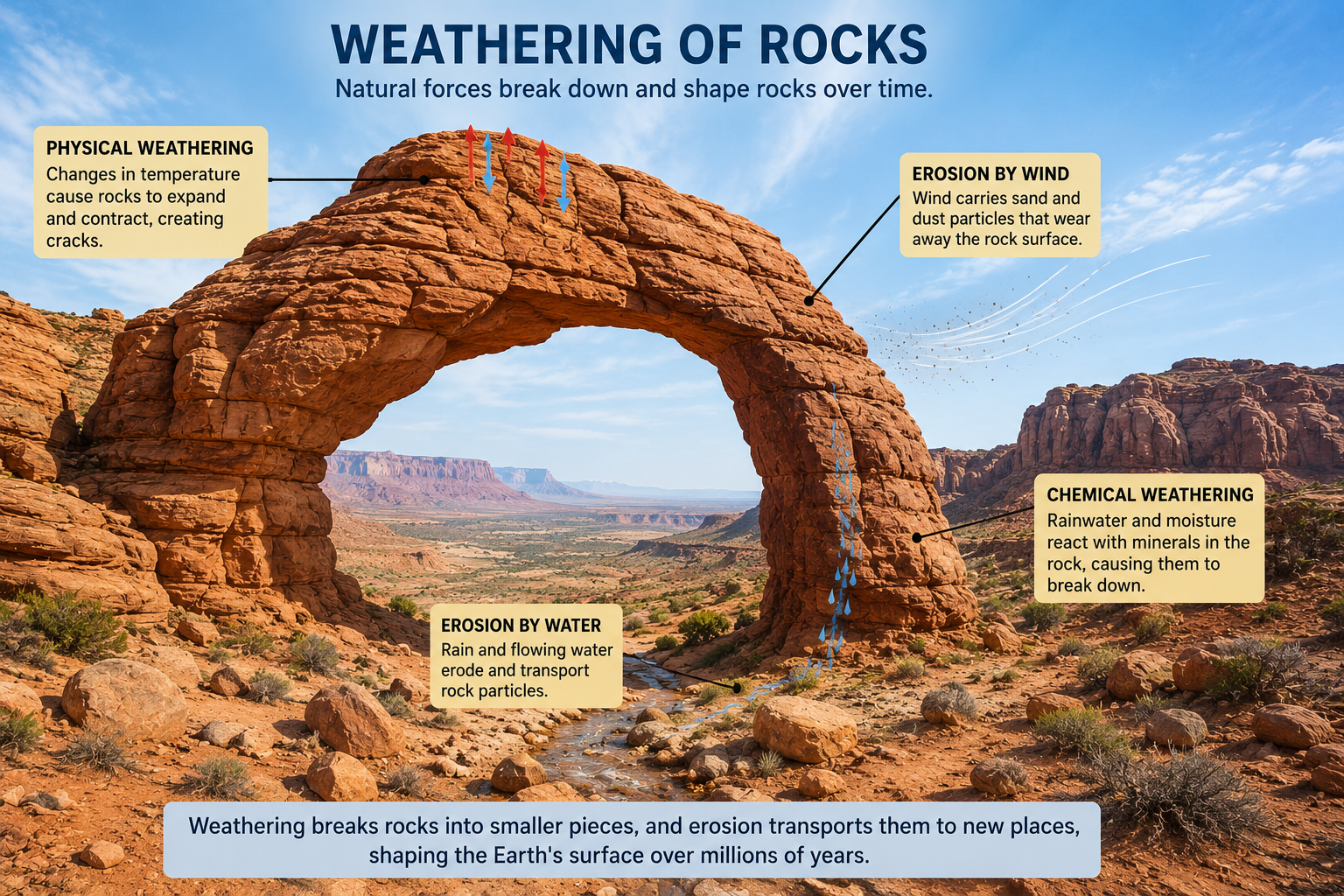
Fig. 2.8: Types of weathering — physical, chemical and biological
Erosion
- Erosion is the process by which soil, rocks, and other surface materials are worn away and carried from one place to another by natural agents like water, wind, ice, or waves.
- Unlike weathering that only breaks down rocks, erosion involves movement of the broken material.
- Types of erosion: water erosion (caused by rivers, rain, or ocean waves); wind erosion (common in dry and sandy areas); glacial erosion (where moving ice scrapes and carries rocks); and coastal erosion (where sea waves wear away the land along the shore).
- Erosion shapes landforms and can both create and destroy features on the Earth’s surface.
- Erosion affects many human occupations by changing the land and soil on which people depend:
- For farmers, erosion removes the fertile topsoil needed for crop growth, leading to lower yields.
- For those living near rivers and coasts, erosion can wash away land, houses, and roads, causing damage and loss of property.
- In construction and mining, erosion destabilises land, posing safety risks.
- Even industries like tourism and fishing suffer, since beaches, rivers, and fertile lands may be destroyed.
- This shows that erosion not only shapes the Earth’s surface but also directly affects human labour and livelihoods.
🔑 Key Terms — Soil & Water Conservation
- Contouring: A continuous contour trench (CCT) is a water conservation technique in which trenches are dug along the contour lines of a hillside to slow down, hold, and infiltrate rainwater, preventing soil erosion and recharging groundwater.
- Bunding: Earthen embankments built along contour lines to slow surface run-off, reduce soil erosion, increase water infiltration and soil moisture.
- Terracing: A soil conservation practice that creates a series of level or gently sloping steps on a hillside to prevent soil erosion.
🔍 LET’S EXPLORE
Observe the photographs of erosion and note the types. How are farmers affected by erosion due to water and wind?
Show Answer
Water erosion (by rain and rivers) washes away the fertile topsoil and can cut gullies through fields; wind erosion blows away dry, loose topsoil in open areas. In both cases farmers lose the nutrient-rich top layer needed for crops, leading to lower yields, degraded land, and sometimes abandonment of farmland.
⚠️ DON’T MISS OUT
- The Sindhu-Sarasvatī civilisation employed sophisticated techniques, including contouring, bunding, terracing, dams, and canals for water management.
- Multiple Sanskrit texts document these practices, including the Vedas, Kṛiṣhiparāśhara, Kauṭilya’s Arthaśhāstra, and specialised treatises like Vṛikṣhāyurveda.
- The Arthaśhāstra contains detailed guidelines on land assessment and categorisation based on fertility and productivity.
- The Zabo system in Nagaland represents an integrated farming approach using earthen bunds on hillslopes for soil and water conservation.
- Check dams were constructed across small streams to reduce water velocity, prevent soil erosion, and allow sediment deposition — designed to slow down water flow and enhance groundwater recharge.
📝 Practice Questions — Weathering and Erosion
LOTS Define weathering. Name its three main types.
Show Answer
Weathering is the process through which rocks on the Earth’s surface break down into smaller pieces without any movement of the broken material. Its three main types are physical weathering, chemical weathering, and biological weathering.
Medium What is the main difference between weathering and erosion?
Show Answer
Weathering only breaks rocks down into smaller pieces in the same place — it does not involve movement. Erosion involves the movement of the broken material — soil and rocks are worn away and carried from one place to another by agents like water, wind, ice, or waves.
HOTS How do contouring, bunding and terracing all fight the same enemy? Explain the common principle behind them.
Show Answer
All three fight soil erosion by slowing down the flow of rainwater on slopes. Contour trenches hold and infiltrate water along the hillside; bunds are earthen walls that block and slow surface run-off; terraces convert a steep slope into level steps so water cannot rush downhill. The common principle: reduce the speed of flowing water so it cannot carry soil away — and let it soak in to recharge groundwater instead.
HOTS The Arthaśhāstra classified land by fertility, and the Zabo system conserves both soil and water. What do these examples tell us about ancient and traditional Indian knowledge systems?
Show Answer
They show that Indians observed, documented and engineered solutions for land and water management thousands of years ago — from scientific land assessment in Kauṭilya’s Arthaśhāstra to practical hillside engineering in Nagaland’s Zabo system. This knowledge was systematic (recorded in texts like Kṛiṣhiparāśhara and Vṛikṣhāyurveda), locally adapted, and sustainable — principles that modern soil and water conservation still follows today.
🌊 Agents of Gradation
- Agents of gradation are natural forces that wear down, transport, and deposit materials on the Earth’s surface, helping to level or smooth it over time.
- The main agents of gradation are running water, glaciers, wind, waves, and groundwater.
- Running water erodes rocks and soils to form valleys and plains; glaciers scrape and carry huge amounts of material, carving U-shaped valleys; wind shapes deserts by eroding and depositing sand; sea waves erode coastlines to form cliffs, beaches, and bays; groundwater dissolves rocks such as limestone, creating caves and sinkholes.
- Together, these agents are continuously modifying landforms — lowering high areas and filling up low areas.
⚠️ DON’T MISS OUT — Landforms and Human Civilisations
- Landforms have played a major role in shaping the history of human civilisations.
- Rivers and fertile plains like those of the Ganga, Nile, Brahmaputra, and Indus gave rise to agricultural societies and early cities.
- Mountains acted both as barriers and protectors — the Himalayas shielded India from invasions but also allowed cultural exchanges through passes like the Khyber pass.
- Deserts such as the Thar limited the development of large settlements but encouraged trade routes, such as the Silk Route.
- Coasts and harbours supported trade, travel, and cultural contacts with distant lands, helping kingdoms like those in south India flourish.
- Even today, history shows that wars, settlements, trade, and cultural growth were all deeply influenced by the land’s physical features.
Running Water
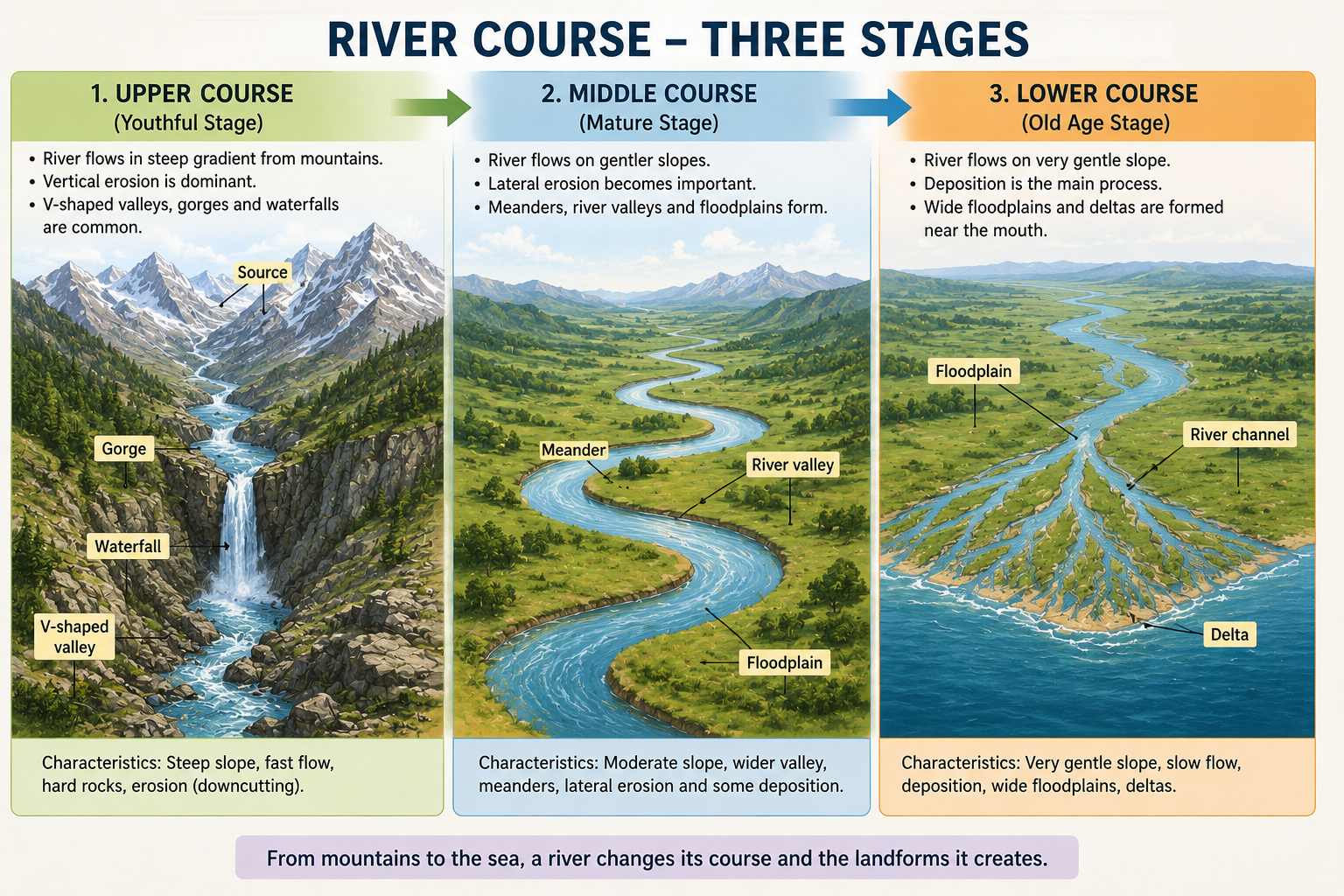
The course of a river — upper, middle and lower stages
- Rivers shape the land through the processes of erosion, transportation, and deposition, creating a variety of landforms along their course.
- Upper course: rivers often form V-shaped valleys, waterfalls, and rapids due to steep gradients and strong erosive forces.
- Middle course: the river starts to meander, forming oxbow lakes and floodplains as it loses energy and begins depositing sediments.
- Lower course: the river slows further and deposits large amounts of sediment, forming deltas, levees, and alluvial fans.
- These landforms are important for understanding river dynamics and play a vital role in agriculture, settlement, and ecosystems.
Waterfall
- A waterfall is a landform where a river flows over a steep cliff or vertical drop, creating a dramatic fall.
- Waterfalls form in the upper course of rivers, where hard rocks resist erosion while softer rocks below are worn away, creating a sudden drop — with a plunge pool at the base.
- Importance for humans: they attract tourists (local tourism and economy), are sometimes used for hydroelectric power generation (the force of falling water is harnessed to produce electricity), provide recreation such as trekking and photography, and often hold cultural or religious significance.
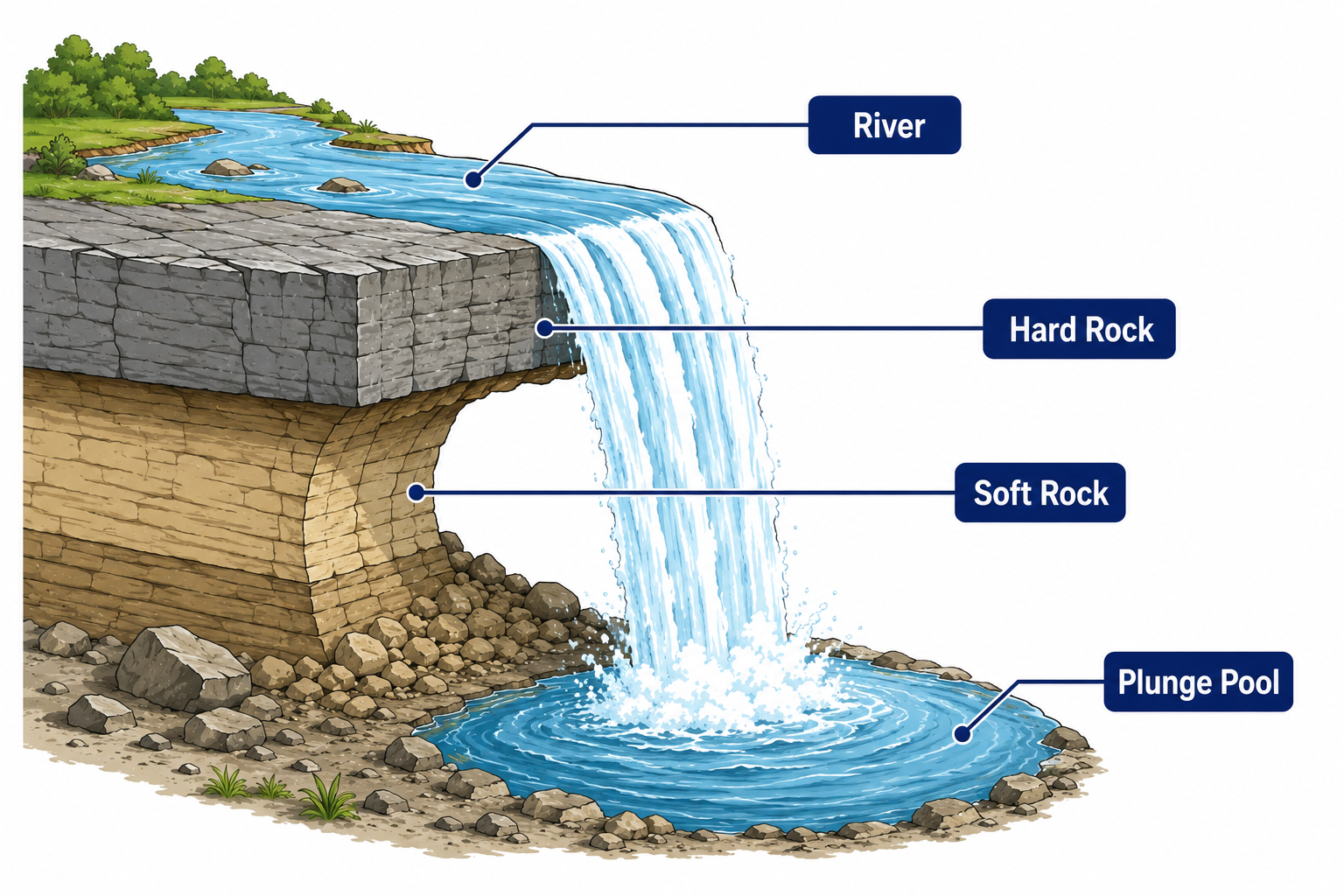
Fig. 2.10: Waterfall — river, hard rock, gap, plunge pool
Meander
- A meander is a winding curve or bend in the middle or lower course of a river, formed due to lateral erosion and deposition of sediments.
- As the river flows, it erodes the outer banks of bends and deposits sediment on the inner banks, gradually creating large loops — a cut-off loop becomes an oxbow lake.
- Importance for humans: fertile soil deposited along the banks supports agriculture; meanders influence settlement patterns (villages and towns develop on the gentle slopes); meandering rivers are used for navigation, irrigation and tourism.
- The Grand Anicut, also known as Kallanai in Tamil Nadu, is an example of the use of rivers for irrigation.
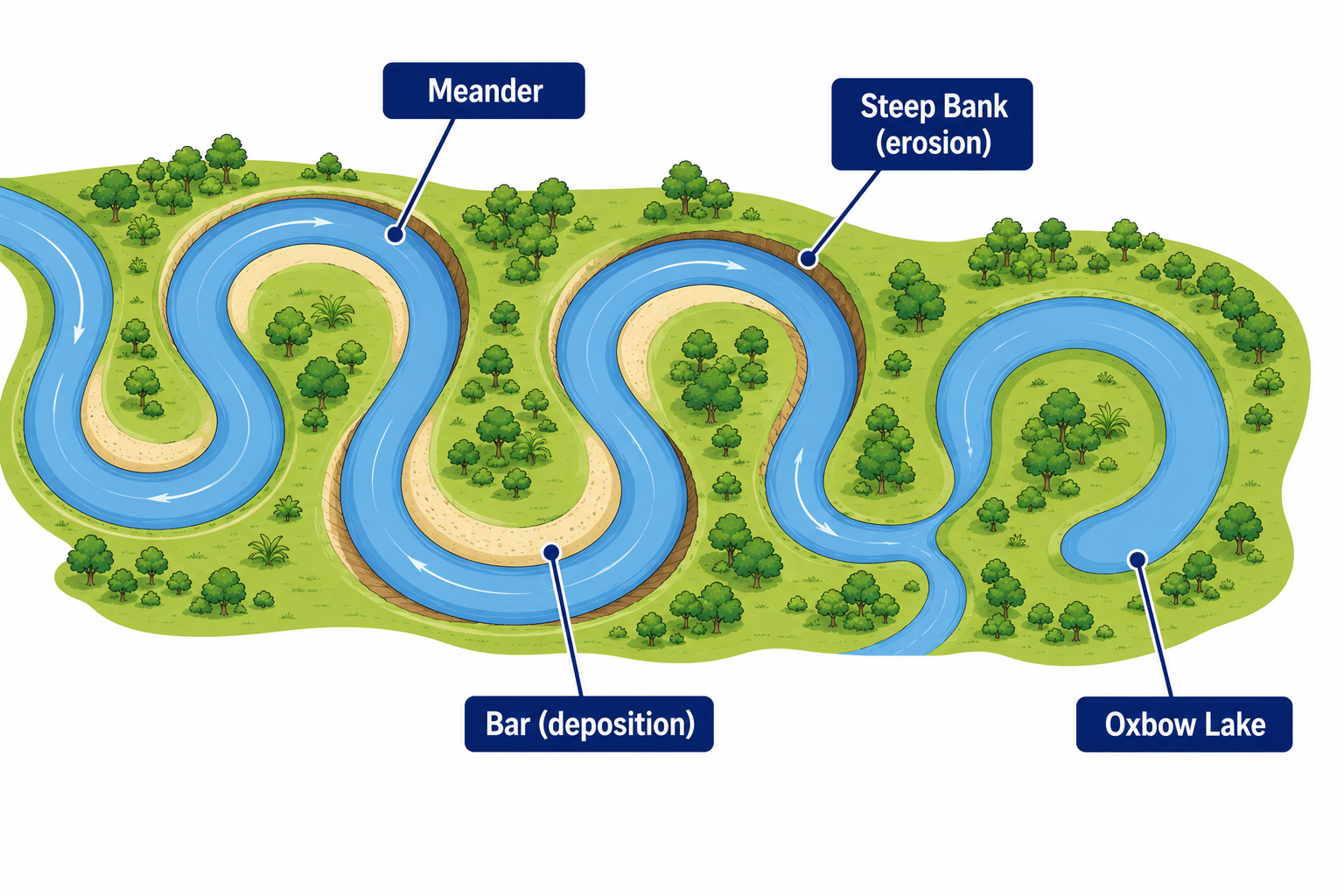
Fig. 2.11: Meander — oxbow lake, steep bank (erosion) and bar (deposition)
Deltas
- A delta is a landform formed at the mouth of a river, where it flows into a sea, ocean, or lake, and deposits the sediments it has carried from upstream.
- Over time, these deposits accumulate to form a fan-shaped or triangular area of land, with the river splitting into distributaries.
- Importance for humans: deltas are highly fertile due to rich alluvial soil — ideal for agriculture, supporting crops such as rice and jute; important for fishing (the mix of fresh and saltwater creates diverse aquatic life); support dense human settlements and are centres of trade and transportation because rivers provide navigable routes.
- However, deltas can also be prone to flooding, which affects human life and activities.
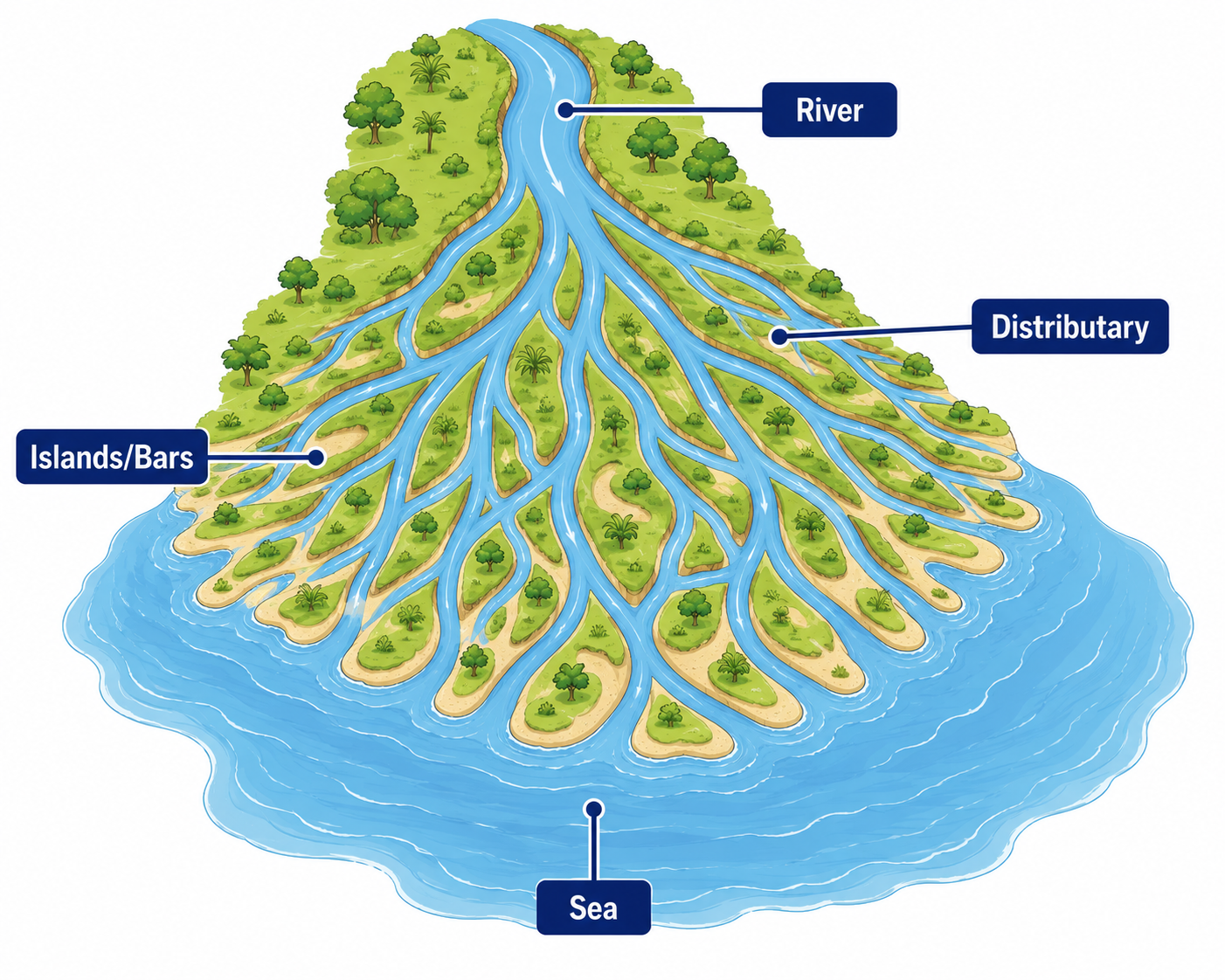
Fig. 2.12: Delta — river, distributaries, islands/bars, sea
🔍 LET’S EXPLORE
Have you heard about the Sundarbans delta? Try and explore its uniqueness and find out why it is popular with tourists.
Show Answer
The Sundarbans, formed by the Ganga-Brahmaputra rivers, is the largest delta in the world and hosts the largest mangrove forest on Earth. It is a UNESCO World Heritage Site and the famous home of the Royal Bengal Tiger. Tourists visit for its maze of water channels, unique mangrove ecosystem, rich birdlife, crocodiles and the thrill of tiger country explored by boat.
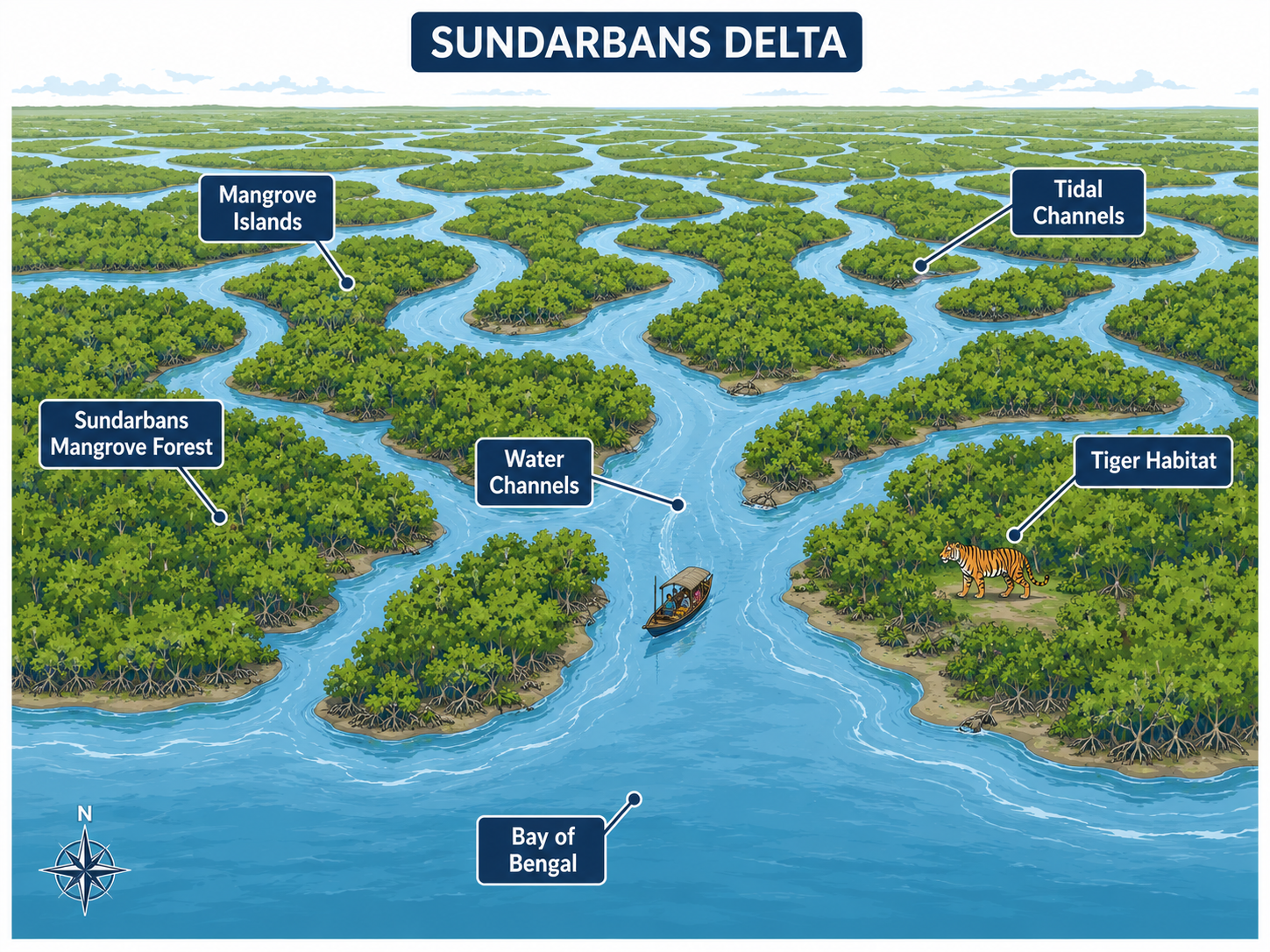
Fig. 2.13: Sundarbans delta
Waves and Currents
- Waves and currents are constantly moving over the oceanic surface. They work in coastal areas and reshape the land along the coastal zone.
- The action of waves and currents creates a range of landforms along the coastline, such as beaches, sand bars, sea cliffs, sea caves, arches, and stacks. (You will learn more about waves and currents in Part 2 of this textbook.)
- A beach is a landform made up of sand, pebbles, or rocks along the shoreline of a sea, ocean, or lake — created by the deposition of sediments by waves, and constantly shaped by wave action, tides, and currents.
- Importance of beaches: popular tourist destinations (boosting local economy); provide fishing areas; some coastal communities rely on them for collecting sand and shells; they act as natural barriers against strong waves and coastal erosion, helping safeguard settlements near the coast.
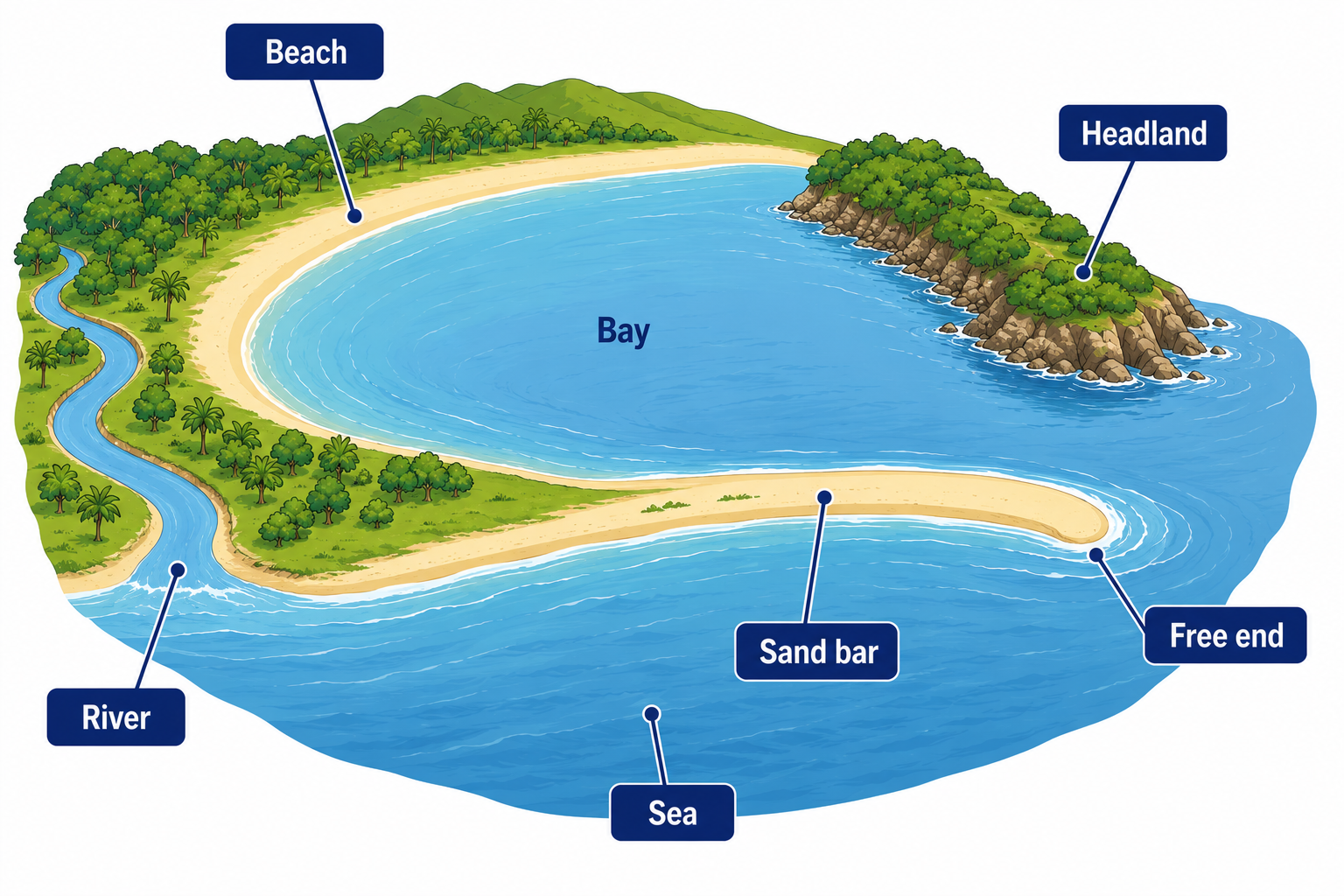
Fig. 2.14: Beach — bay, headland, sand bar, free end and river
- Coastal erosion occurs when waves, tides, and currents wear away the land along the coast, creating unique landforms:
- Cliffs — steep rock faces formed as waves undercut the base of the coast.
- Wave-cut platforms — flat areas left behind as cliffs retreat.
- Caves — formed when waves erode weak parts of the rock.
- Arches — created when caves on opposite sides of a headland meet.
- Stacks — isolated pillars of rock left standing after the arches collapse.
- These landforms shape the coastal landscape and influence human activities — some areas are important for tourism, while others need coastal protection to safeguard settlements.
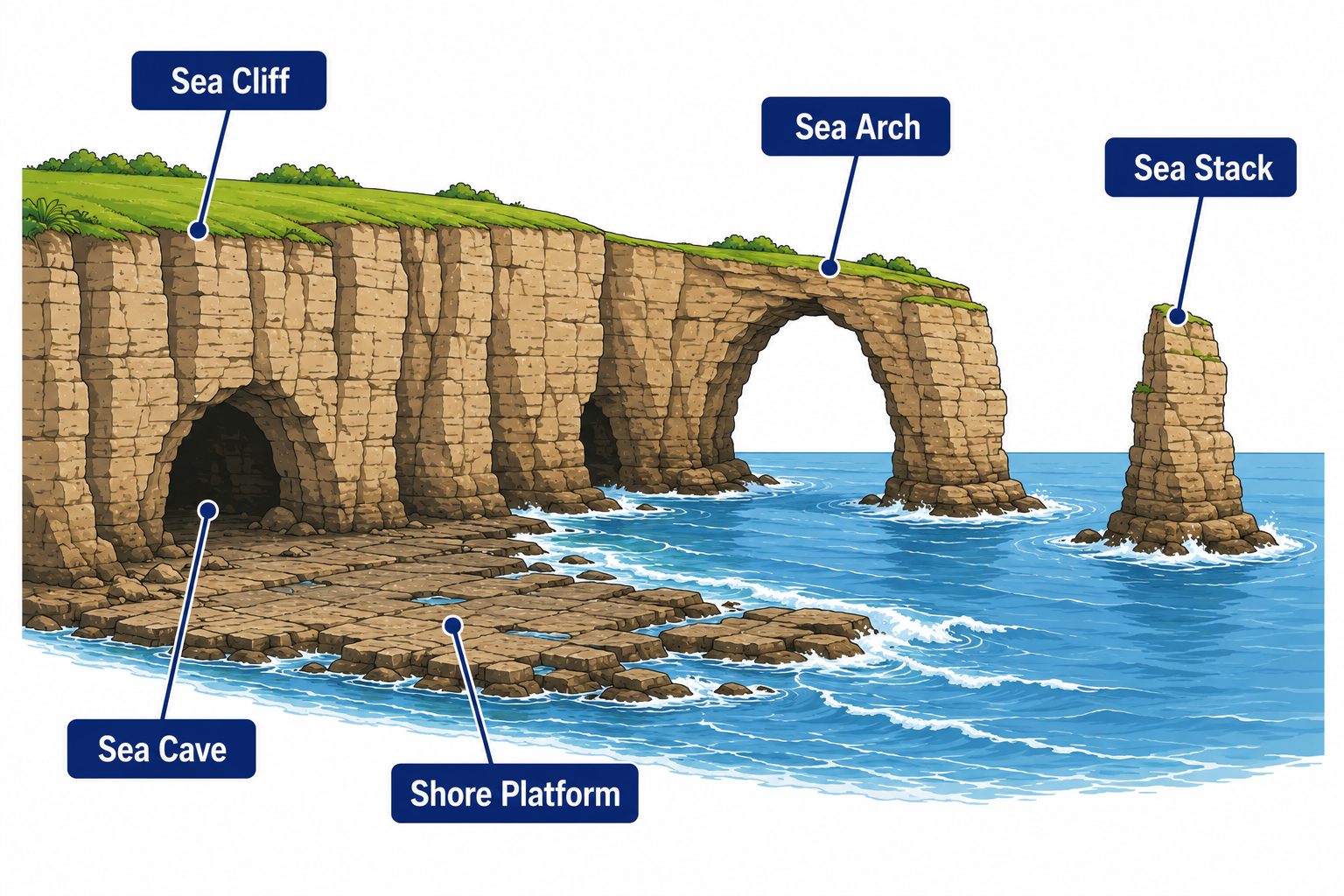
Fig. 2.15–2.16: Sea cliff, sea cave, sea arch, sea stack and shore platform
📝 Practice Questions — Running Water, Waves and Currents
LOTS Name the landforms a river creates in its upper, middle and lower courses.
Show Answer
Upper course: V-shaped valleys, waterfalls and rapids. Middle course: meanders, oxbow lakes and floodplains. Lower course: deltas, levees and alluvial fans.
Medium How is an oxbow lake formed? What is the Grand Anicut (Kallanai)?
Show Answer
As a river meanders, it erodes the outer banks and deposits sediment on the inner banks, making the loops larger. Eventually the river cuts across the narrow neck of a loop, and the abandoned curved section becomes an oxbow lake. The Grand Anicut (Kallanai) in Tamil Nadu is an ancient dam on the Kaveri — an example of using rivers for irrigation.
HOTS Explain the sequence: sea cave → sea arch → sea stack. What single force drives all three?
Show Answer
Waves attack the weak parts of a rocky headland and hollow out sea caves. When caves on opposite sides of the headland meet, the rock bridge above forms a sea arch. Continued erosion weakens the arch until its roof collapses, leaving an isolated pillar — the sea stack. The single driving force throughout is coastal erosion by waves, tides and currents relentlessly wearing away the rock.
HOTS Deltas are among the most fertile yet most dangerous places to live. Justify with reference to human activities.
Show Answer
Deltas are fertile because rivers deposit nutrient-rich alluvium there, supporting rice and jute farming, dense settlements, fishing (fresh–salt water mix) and river-borne trade. But the same flat, low-lying, river-crossed land floods easily during monsoons and cyclones, threatening lives, crops and property. People accept the risk because the fertility and livelihood opportunities are unmatched — which is why dense populations and flood-management systems exist together in deltas.
Glaciers
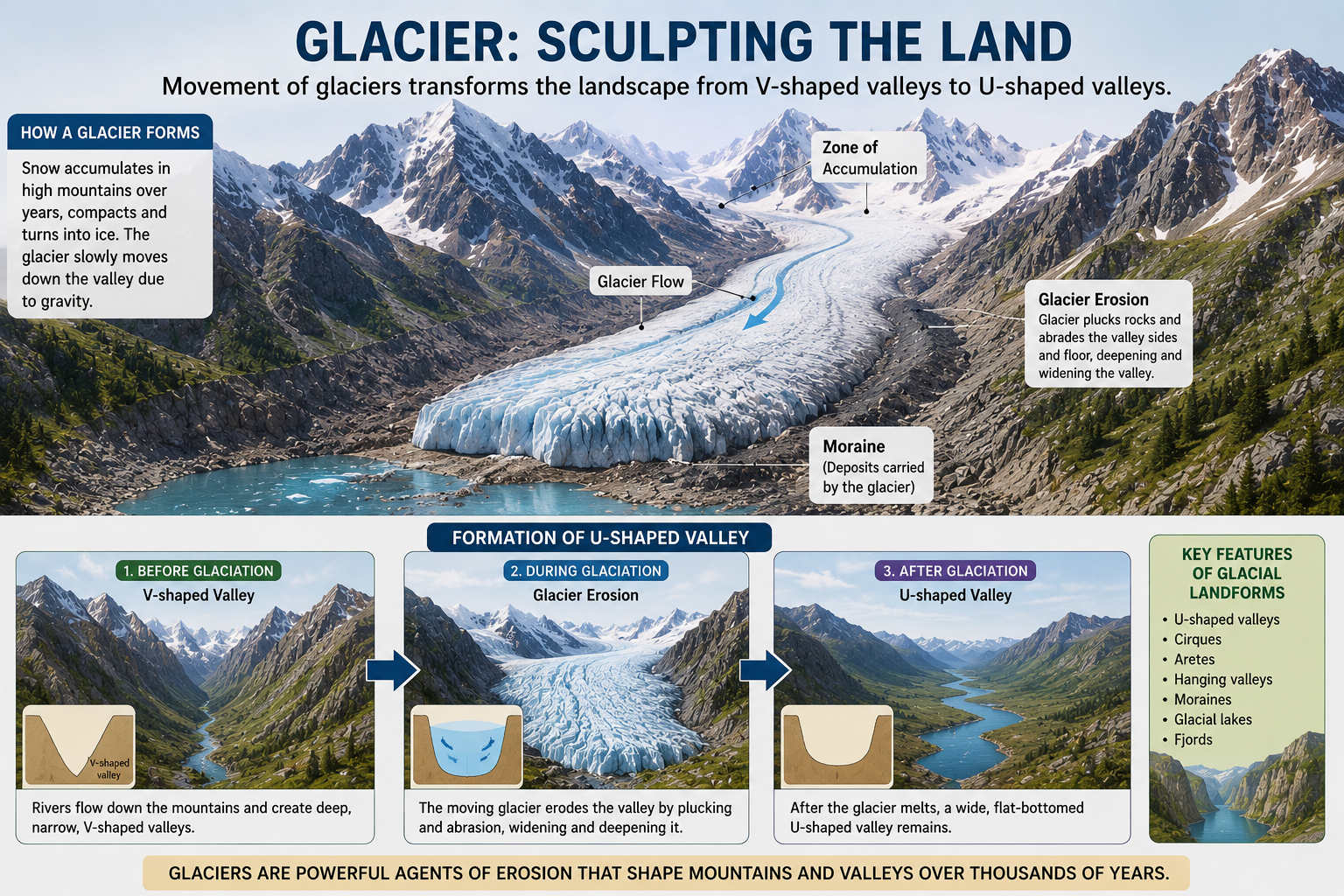
A glacier slowly moving over the land
- Glacial erosion occurs when glaciers slowly move over the land, carving and shaping the landscape.
- Common landforms of glacial erosion:
- U-shaped valleys — formed as glaciers widen and deepen river valleys.
- Cirques — bowl-shaped depressions at the head of a glacier.
- Arêtes — sharp ridges between valleys.
- Hanging valleys — occur where smaller glaciers meet larger ones.
- Fjords — deep, narrow inlets created when the sea floods glacial valleys.
- Importance for humans: U-shaped valleys and cirques provide tourist attractions for trekking, skiing and mountaineering; fjords are used for harbours and fishing; fertile glacial soil in some valleys supports agriculture; and glaciers are crucial sources of fresh water, feeding rivers that sustain human populations downstream.
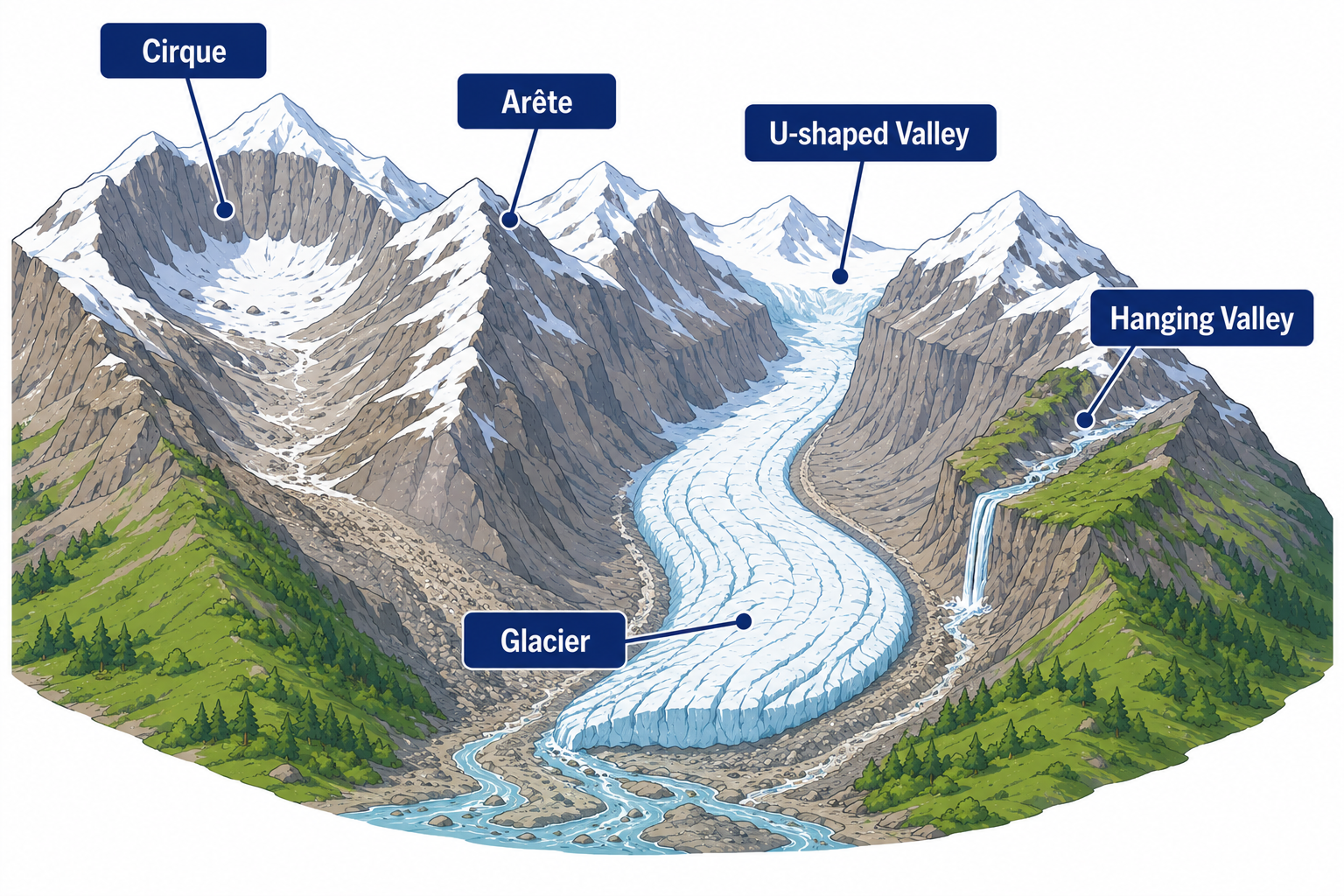
Fig. 2.17–2.18: Glacial landforms — cirque, arête, U-shaped valley, hanging valley
- Moraines are landforms created by the deposition of rocks, soil, and debris (called till) carried along and left behind by glaciers — formed when a glacier melts and deposits the material it has eroded from land.
- Types of moraines: lateral moraines (form along the sides of glaciers), terminal moraines (found at the end of glaciers, marking their furthest advance), and medial moraines (formed when two glaciers meet and their lateral moraines join in the middle).
- Importance for humans: moraines often create fertile soil for agriculture and can form natural dams and lakes used for water supply, irrigation, and sometimes hydroelectric power.
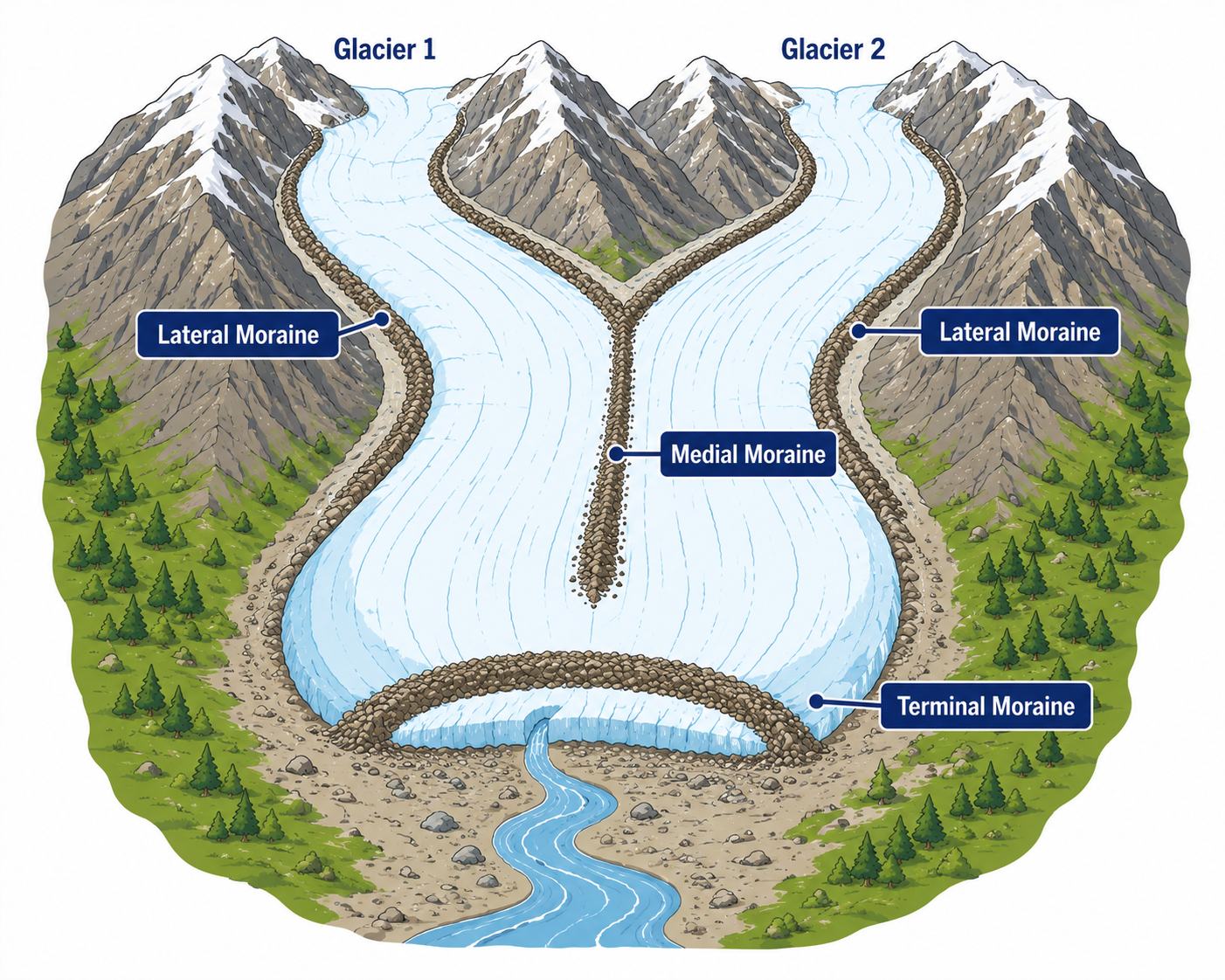
Fig. 2.19: Moraines — lateral, medial and terminal
💡 THINK ABOUT IT
A devastating flood struck the Chamoli district in Uttarakhand in February 2021, in which many people and livestock lost their lives. There was severe damage to buildings, roads, bridges, and hydel projects, and connectivity to villages was adversely affected. Can you find out the reasons that led to the sudden and unexpected flood?
Show Answer
The Chamoli disaster was triggered by a massive rock-and-ice avalanche from the Ronti peak glacier. The falling mass generated an enormous surge of water, ice and debris down the Rishiganga and Dhauliganga rivers — a glacier-related flash flood. Rising temperatures weakening Himalayan glaciers, steep unstable slopes, and construction of hydel projects in this fragile zone all contributed to the scale of the destruction.
Wind
- Wind erosion occurs when strong winds pick up and carry away loose particles of sand and soil, gradually shaping the landscape. It creates several distinctive landforms:
- Yardangs — streamlined rock ridges carved by wind.
- Ventifacts — rocks polished and shaped by sandblasting.
- Deflation hollows or blowouts — shallow depressions formed where loose material is removed (an oasis may form where the hollow reaches the water table).
- Desert pavements — flat surfaces left behind after finer particles are blown away.
- Importance for humans: these landforms influence settlement patterns and agriculture in arid regions, and ventifacts and yardangs attract tourists and geologists interested in unique desert landscapes.
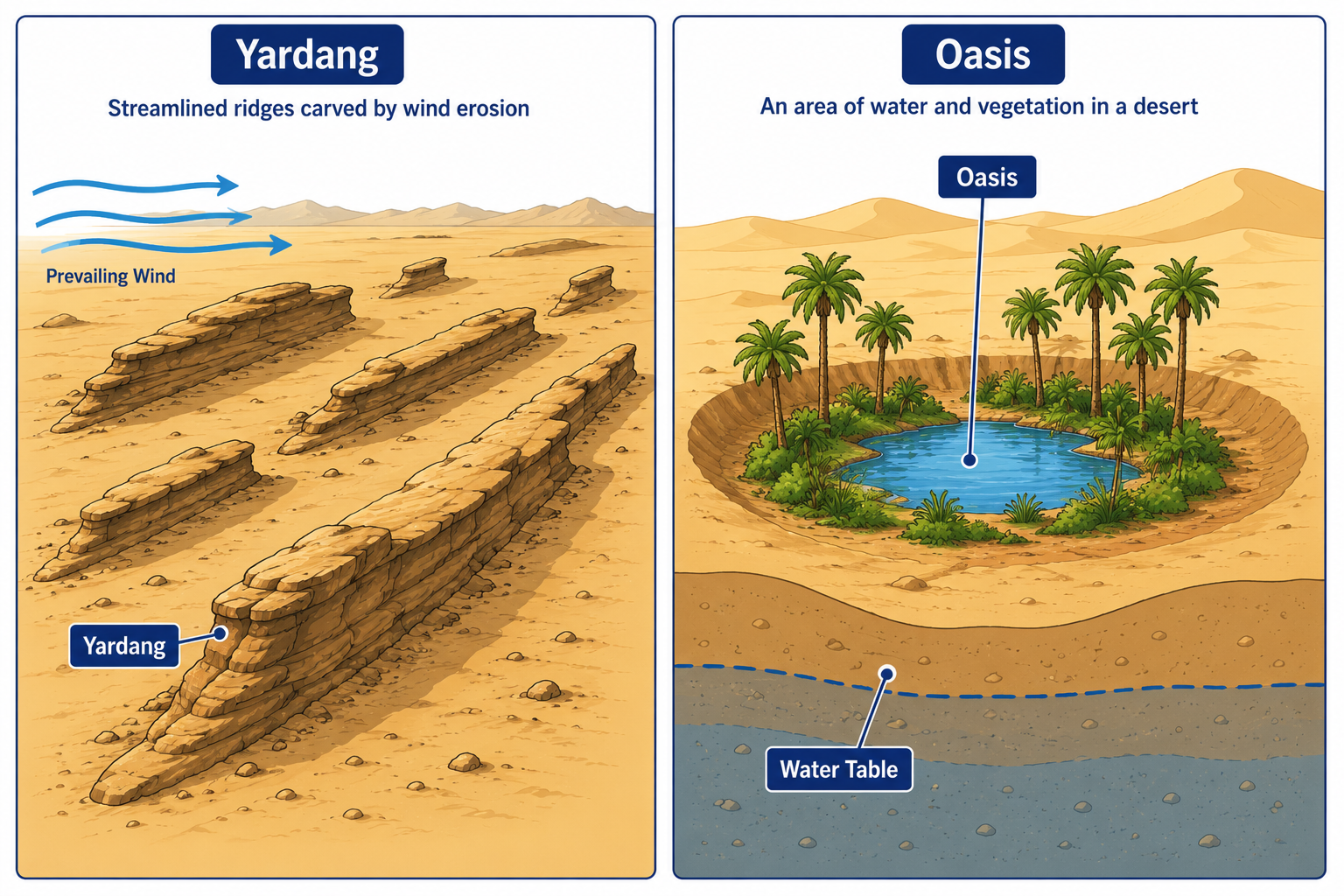
Fig. 2.21–2.22: Yardang and oasis (deflation hollow reaching the water table)
- Dunes are hills or ridges of sand formed by the wind in desert areas or along sandy coasts. Types of dunes:
- Barchan dunes — crescent-shaped; form in areas with limited sand and a single wind direction.
- Longitudinal dunes — long ridges formed parallel to the prevailing wind.
- Star dunes — have multiple arms; form where winds come from different directions.
- Parabolic dunes — U-shaped dunes, often stabilised by vegetation.
- Importance for humans: dunes act as natural barriers against desertification and wind erosion; provide areas for tourism and adventure sports; in coastal regions they protect settlements from strong sea winds and waves; sand from dunes is sometimes used for construction.
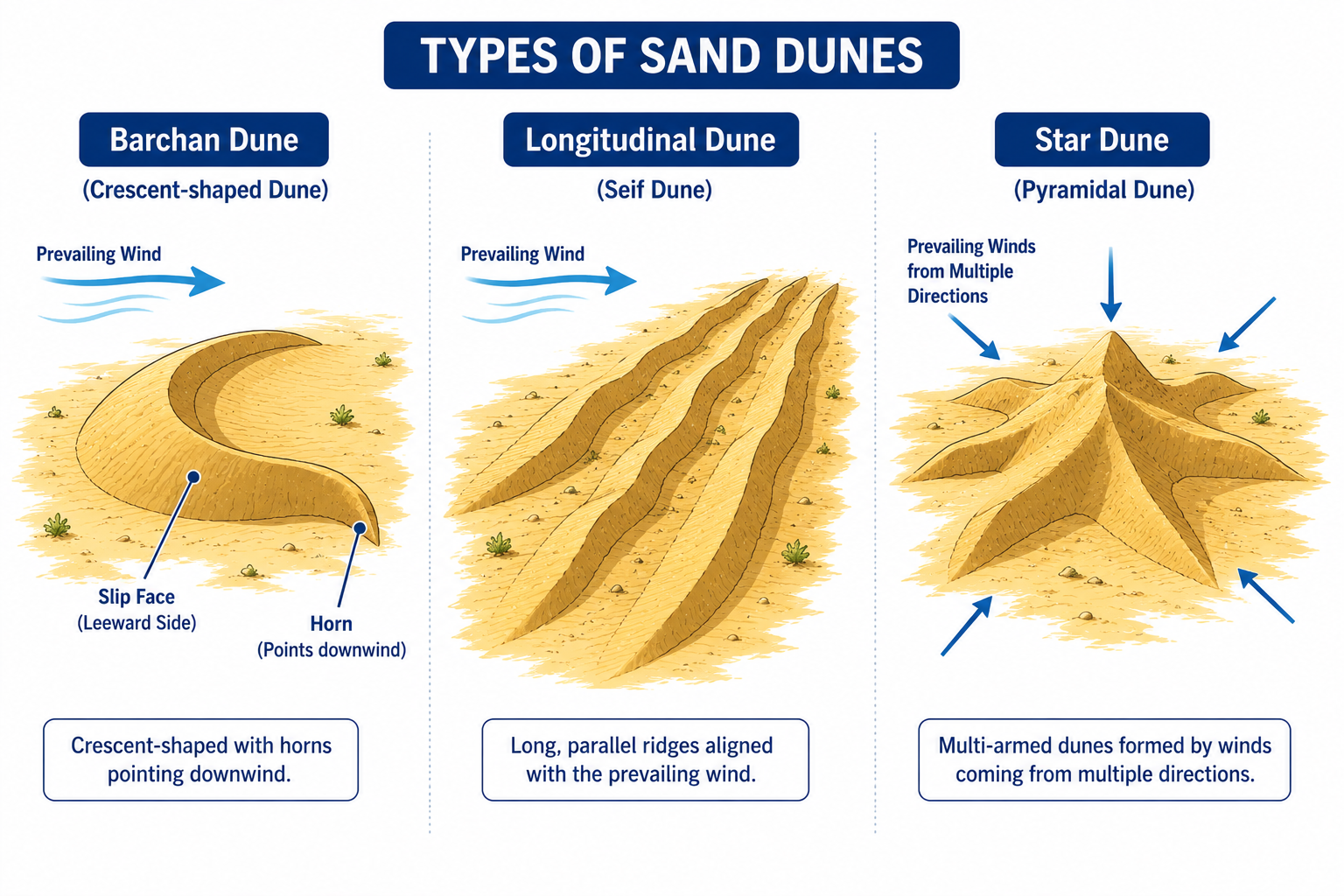
Fig. 2.23: Types of dunes — barchan, longitudinal/transverse, star
Underground Water
- Underground water, especially in areas of limestone or soluble rocks, creates unique landforms called Karst topography through chemical weathering and erosion.
- Caves — hollow spaces formed as acidic water dissolves rock.
- Stalactites — icicle-shaped formations hanging from the ceiling of caves.
- Stalagmites — formations rising from the floor of caves (a stalactite and stalagmite joining forms a pillar).
- Sinkholes or dolines — depressions formed when the ground collapses into an underground cavity.
- Underground rivers — flow through cave systems.
- Importance for humans: caves and underground rivers provide sources of fresh water, tourism opportunities, and cultural or religious significance; stalagmites and stalactites attract geologists and adventurers — valuable for both study and recreation.
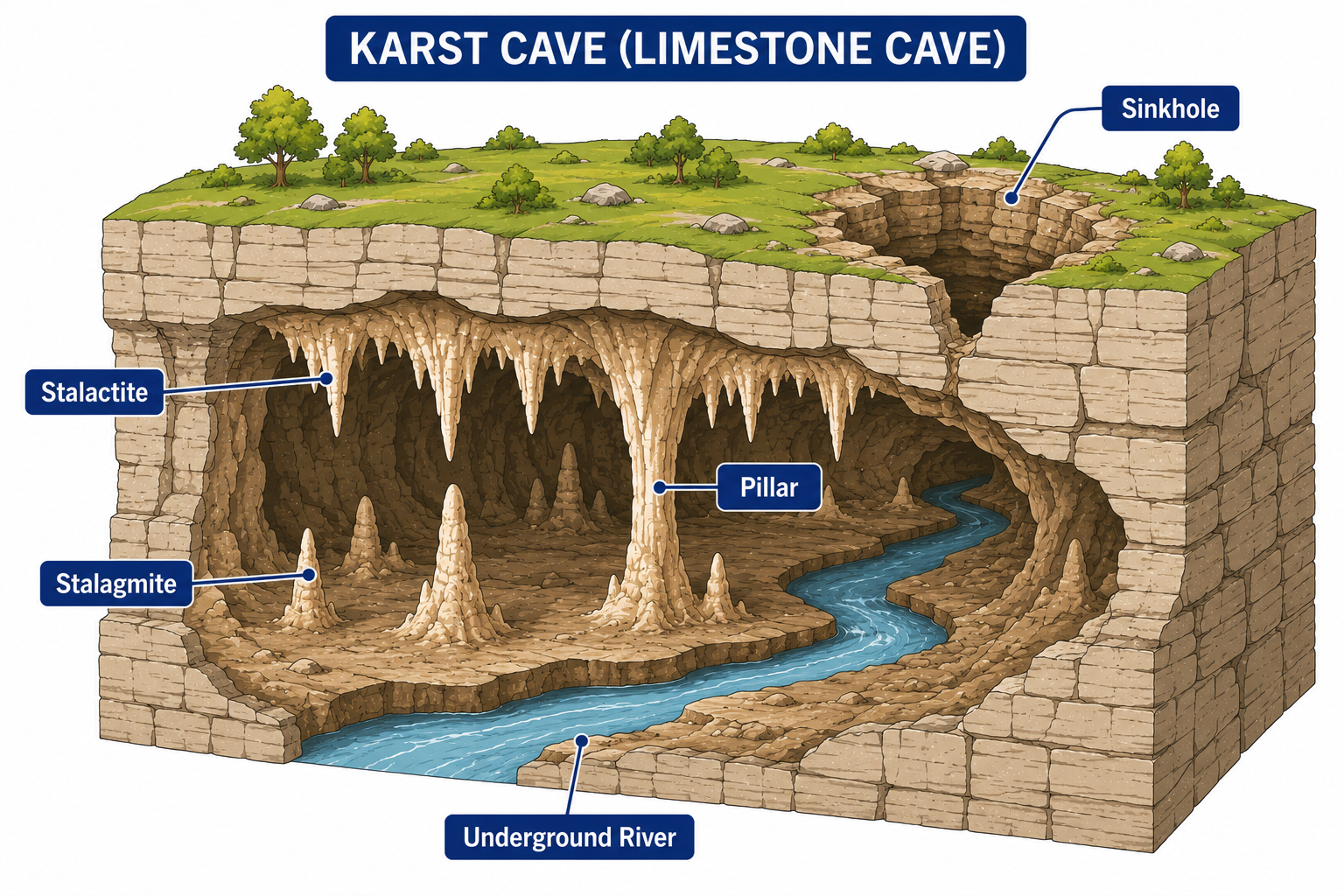
Fig. 2.24–2.26: Karst landforms — cave, stalactite, stalagmite, pillar, sinkhole, underground river
🔍 LET’S EXPLORE
Observe the landforms around your school or residence and try to identify which agent may have created them.
📝 Practice Questions — Glaciers, Wind & Underground Water
LOTS Name the three types of moraines and state where each forms.
Show Answer
Lateral moraines form along the sides of glaciers; terminal moraines form at the end of glaciers, marking their furthest advance; medial moraines form when two glaciers meet and their lateral moraines join in the middle.
Medium What is Karst topography? Name any four Karst landforms.
Show Answer
Karst topography is the landscape created by underground water in areas of limestone or soluble rocks through chemical weathering and erosion. Four Karst landforms: caves, stalactites, stalagmites, and sinkholes (also underground rivers and pillars).
HOTS A barchan dune and a star dune tell us different stories about the wind. Explain.
Show Answer
A barchan’s crescent shape with horns pointing downwind forms only where wind blows from one constant direction with limited sand — so a barchan tells us the region has a single prevailing wind. A star dune’s multiple arms form where winds blow from several different directions at different times — so it tells us the region has variable, shifting winds. Dune shapes are thus a record of local wind patterns.
HOTS Glaciers are called ‘water towers’ for humanity, yet the Chamoli disaster shows their dangers. Analyse this dual role.
Show Answer
As water towers, glaciers store fresh water as ice and release it slowly, feeding rivers like the Ganga that sustain hundreds of millions of people, agriculture and hydropower downstream. But warming makes them unstable: sudden ice-rock avalanches (as at Chamoli, 2021) and bursting glacial lakes can unleash catastrophic flash floods. The same stored water that gives life can destroy it when released suddenly — which is why glacier monitoring and careful development in Himalayan valleys are essential.
🚨 Landforms and Disasters
- There are several disasters associated with different landforms that commonly occur around us. Four such disasters are presented below.
🔍 LET’S EXPLORE
Complete the exercises given at the end of each type of disaster with the help of newspapers, atlases, and books. Make a list of disaster-prone areas from India and the world and enlist mitigation measures quoting recent examples. (Model answers are provided below each disaster for exam preparation.)
⛰️ Landslides
- Landslides are caused by a combination of natural and human factors that make slopes unstable.
- Heavy and continuous rainfall is one of the main natural causes — water seeps into the soil and rocks, increasing their weight and reducing friction.
- Earthquakes and volcanic eruptions can trigger landslides by shaking the ground and weakening slopes.
- Steep slopes and the presence of loose or weathered rocks further increase the risk.
- Human activities — deforestation, mining, road construction, and unplanned construction on hillsides — disturb the natural balance of slopes.
- Poor drainage systems and improper land use also contribute by allowing excess water to accumulate, leading to sudden slope failure.
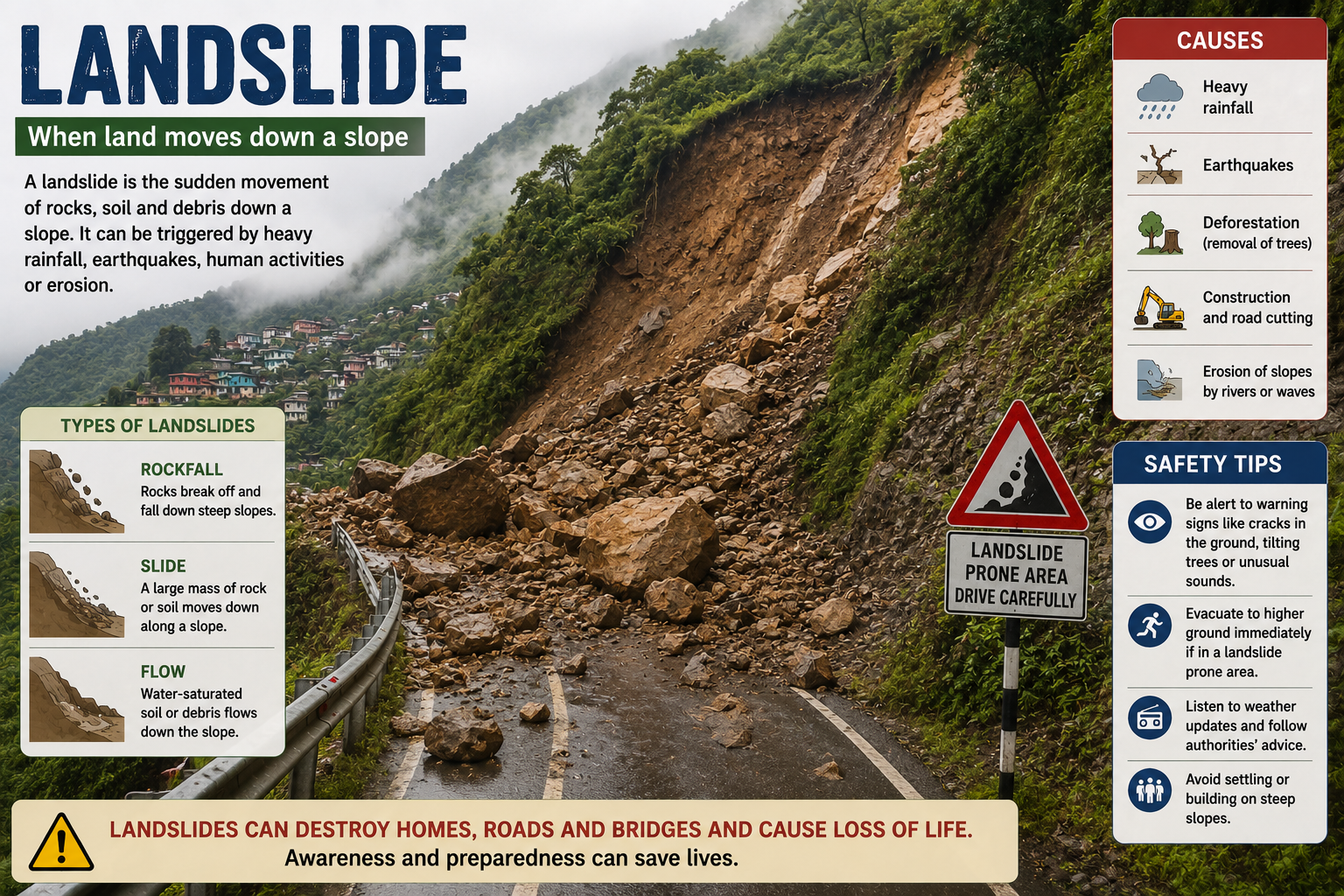
Fig. 2.27: A landslide
🏔️ Avalanches
- Avalanches are caused by the sudden instability of snow on steep mountain slopes.
- Heavy snowfall within a short period adds extra weight to the snowpack, making it unstable — especially when it rests on weak or loosely bonded layers of snow.
- A sudden rise in temperature can cause partial melting, reducing the friction that holds the snow together.
- Strong winds may pile up snow unevenly, creating fragile layers.
- Natural disturbances such as earthquakes and vibrations, and human activities like skiing, trekking, or construction in mountainous areas, can trigger avalanches by disturbing the balance of snow-covered slopes.
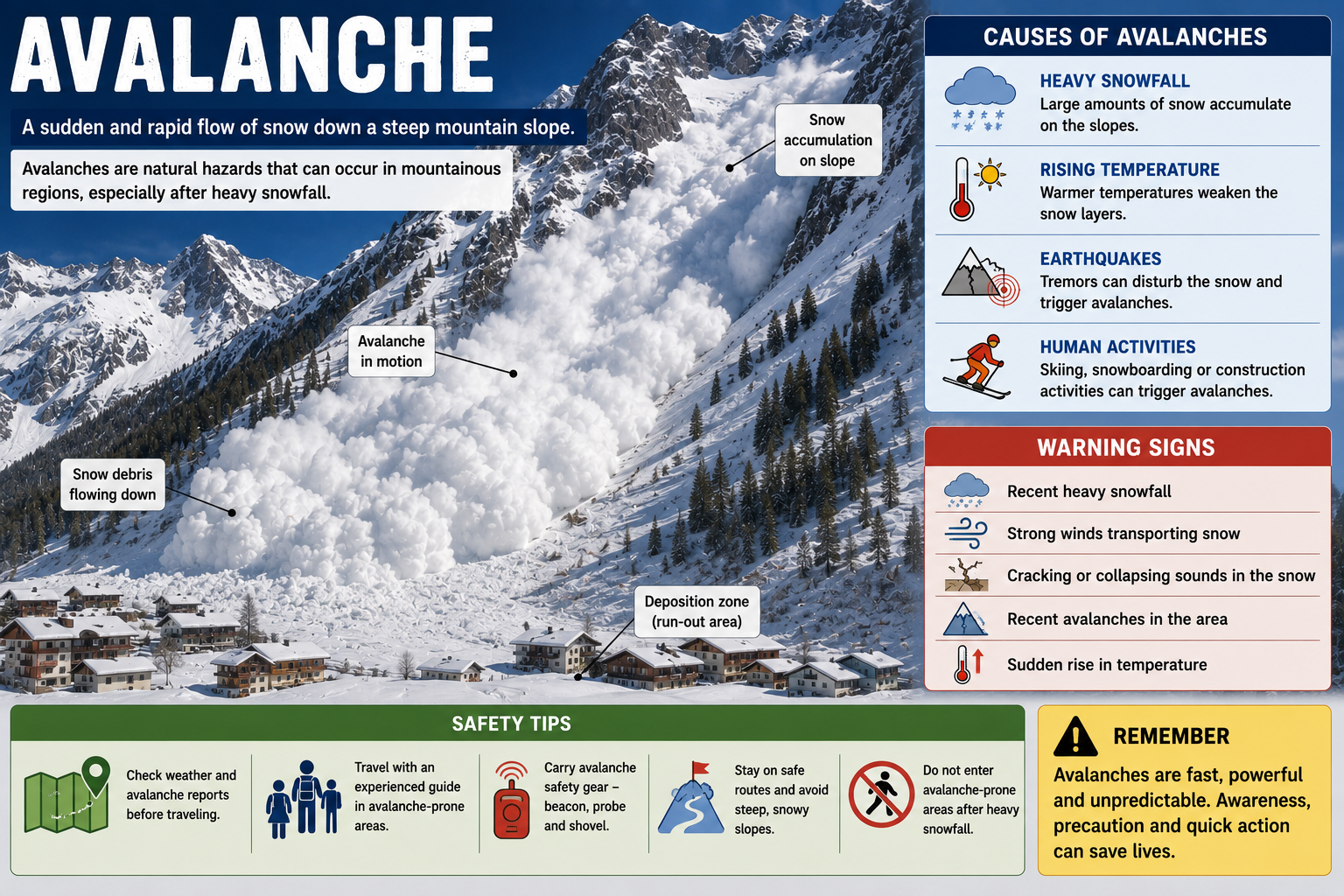
Fig. 2.28: An avalanche
🧊 GLOFs
- Glacial Lake Outburst Floods (GLOFs) are caused by the sudden release of large volumes of water from glacial lakes due to natural and climatic factors.
- Rapid melting of glaciers because of rising temperatures increases the size and water level of glacial lakes, putting pressure on their natural dams made of ice or loose moraines.
- Heavy rainfall or intense snowfall can add excess water to these lakes.
- Earthquakes, avalanches, or landslides may strike the lake or weaken the dam, leading to its sudden collapse.
- As a result, the stored water is released abruptly, causing destructive floods in downstream areas.
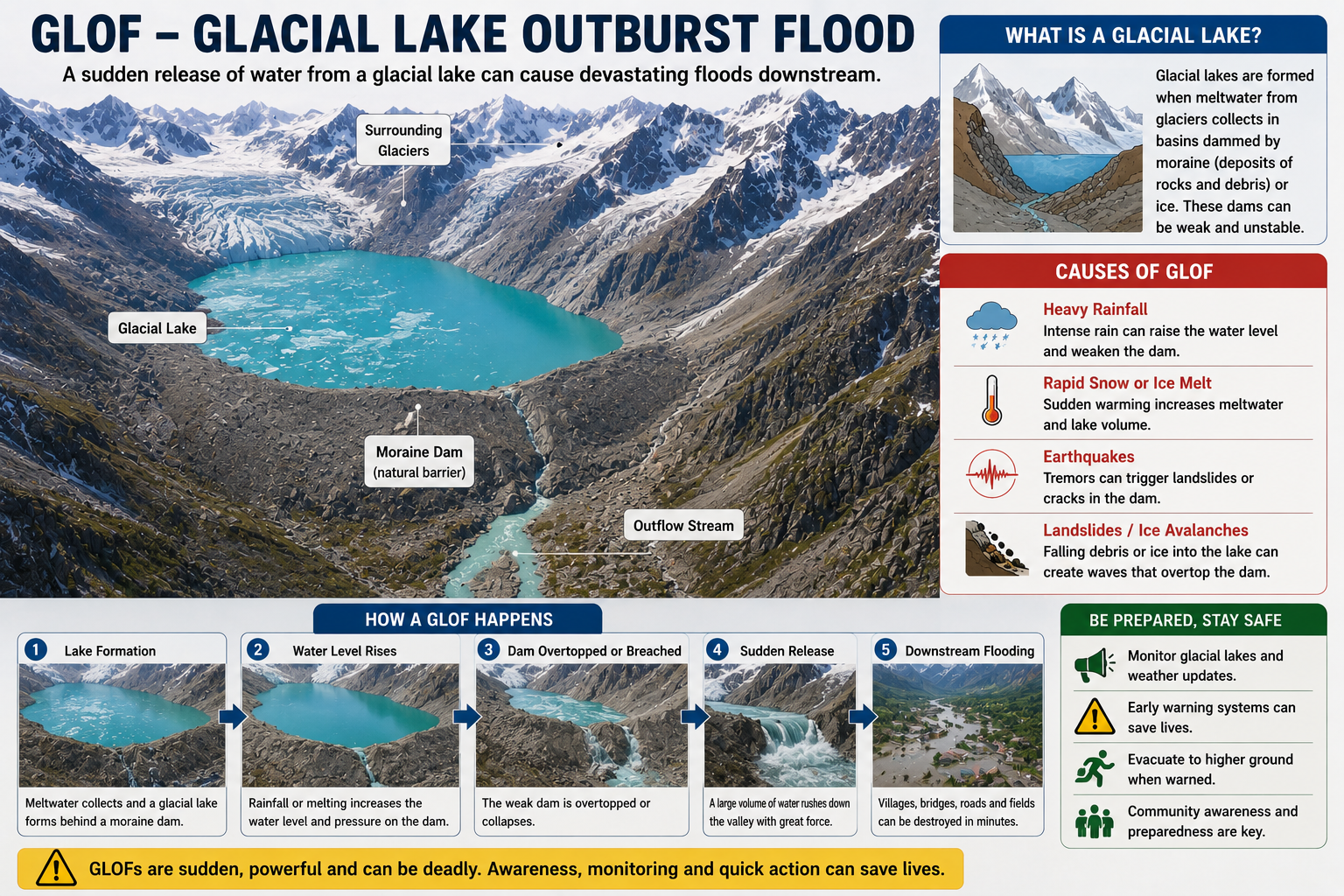
Fig. 2.29: A GLOF — sudden release of water from a glacial lake
🌪️ Dust Storms
- Dust storms are caused by strong winds lifting large amounts of loose, dry soil and sand into the air.
- Prolonged drought and low rainfall dry out the soil, making it easier for wind to pick up the fine particles.
- Dust storms are common in desert and semi-arid regions where the soil is loose and dry.
- Sparse vegetation cover — often due to deforestation, overgrazing, or poor farming practices — leaves the land exposed.
- Climate change and extreme weather conditions can further increase the frequency and intensity of dust storms.
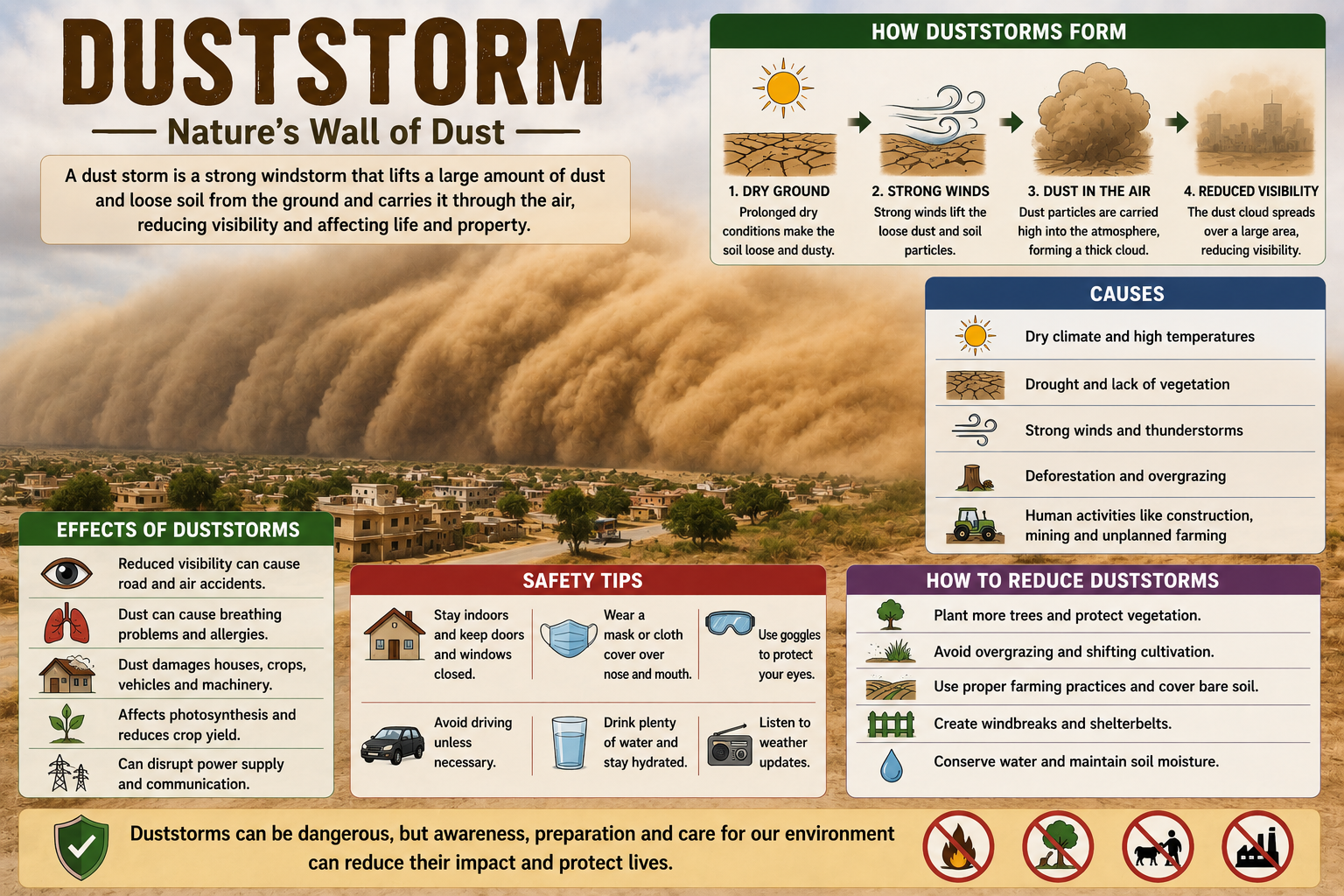
Fig. 2.30: A dust storm
- The Earth’s surface is constantly changing due to powerful forces working both inside and outside the planet.
- Internal forces — earthquakes, volcanic eruptions, folding, and faulting — create mountains, valleys, and ocean basins, while external forces — weathering, erosion, and deposition — slowly wear them down and reshape them.
- Together, these natural processes give rise to the diverse landforms we see today, from the highest peaks to the deepest ocean floors.
- Human life is deeply connected to these landforms, influencing our climate, resources, settlements, and cultures.
- Understanding the shape of the Earth’s surface helps us appreciate nature’s power and prepare wisely for natural disasters, ensuring a safer and more sustainable relationship with our planet.
📌 Before we move on…
- The Earth is made up of layers, namely, the crust, mantle, and core.
- Interior forces of the Earth (earthquakes, volcanoes, folding, and faulting) are responsible for the movement of the crust.
- External forces like weathering and erosion carve smaller landforms over the Earth’s surface which affect human life in multiple ways.
- The surface of the Earth is carved by agents of gradation like running water, waves and tides, glaciers, wind, and underground water.
- Disasters like landslides, avalanches, glacial lake outflows, and sandstorms are associated with specific landforms.
🧠 Questions and activities
1. What are the sources of energy that are required to cause movements associated with the internal forces of the Earth?
Show Answer
The main source is the heat of the Earth’s interior — heat from the core (from the planet’s formation and radioactive decay). This heat creates convection currents in the mantle: hot molten material rises while cooler material sinks, and this continuous movement pushes and pulls the tectonic plates, causing earthquakes, volcanoes, folding and faulting.
2. Relate various physiographic divisions you have studied in the earlier grades with various endogenic forces responsible for their origin.
Show Answer
The Himalayas — formed by the convergent collision of the Indo-Australian and Eurasian plates (folding). The Northern Plains — formed in the depression created in front of the rising Himalayas, later filled by river deposits. The Peninsular Plateau — an ancient, stable block of the Earth’s oldest crust, shaped by past volcanic activity (e.g., the Deccan lava flows) and faulting. The Coastal Plains and Islands — related to plate movements, faulting and volcanic activity (e.g., Barren Island volcano in the Andamans).
3. Why and where do earthquakes occur frequently? Is it possible to predict earthquakes?
Show Answer
Earthquakes occur when energy stored by moving tectonic plates is suddenly released, shaking the ground. They occur most frequently along plate boundaries — especially around the Pacific Ring of Fire and collision zones like the Himalayas. It is not yet possible to predict the exact time and place of an earthquake; scientists can only identify earthquake-prone zones and estimate probabilities, which is why preparedness and earthquake-resistant construction are so important.
4. “Plate movements are responsible for the distribution of earthquakes and volcanoes.” Explain.
Show Answer
Earthquakes and volcanoes are concentrated along plate boundaries. At convergent boundaries, plates collide — the sinking of oceanic plates produces both violent earthquakes and chains of volcanoes. At divergent boundaries, rising magma creates volcanic mid-ocean ridges with frequent tremors. At transform boundaries, plates grinding past each other cause earthquakes (e.g., San Andreas Fault). This is why the world map of earthquakes and volcanoes almost exactly traces the edges of the tectonic plates — most dramatically in the Ring of Fire around the Pacific Plate.
5. Draw and label a diagram of a meander and a delta.
Show Answer
Refer to Fig. 2.11 (Meander) and Fig. 2.12 (Delta) on this page. For the meander, draw a winding river and label: river, steep bank (outer erosion side), bar (inner deposition side), and oxbow lake (cut-off loop). For the delta, draw a river splitting near the sea and label: river, distributaries, islands/bars, and sea. Practise reproducing both diagrams in your notebook.
6. How are deforestation and erosion associated with each other? Explain.
Show Answer
Tree roots bind the soil together, and the forest canopy breaks the force of rain and wind. When forests are cut down, the soil lies bare and loose — rainwater directly strikes and washes away the fertile topsoil, and wind blows it away in dry areas. On slopes, deforestation also increases landslides. Thus deforestation directly accelerates both water and wind erosion, degrading land and reducing fertility.
7. Develop a plan to protect the land in your local area from erosion.
Show Answer
A model plan: (1) Plant trees and grasses on open slopes and field edges (afforestation/shelterbelts); (2) build contour trenches and bunds on slopes to slow rainwater; (3) create terraces on steep farmland; (4) construct small check dams across local streams to slow water and recharge groundwater; (5) prevent overgrazing and keep vegetation cover on soil; (6) ensure proper drainage around roads and buildings; (7) spread awareness in the community about not cutting trees on slopes.
8. Which disasters do you think you might experience in your region? Discuss a mitigation plan in your classroom.
Show Answer
(Adapt to your region.) Example for a plains/urban region of Andhra Pradesh–Telangana: possible disasters include floods, cyclones (coastal), dust storms and heatwaves. Mitigation plan: know local emergency numbers and shelters; follow weather alerts; keep an emergency kit; ensure school buildings meet safety codes; plant trees as windbreaks; avoid construction blocking natural drainage; conduct evacuation drills in school.
9. Prepare a model of landforms created by underground water.
Show Answer
Activity guidance: use clay or thermocol to build a limestone hill cross-section. Show a cave hollow inside; hang small clay ‘icicles’ from the cave ceiling (stalactites), build rising columns from the floor (stalagmites), join one pair into a pillar; cut a funnel-shaped sinkhole from the surface into the cave; and show a blue thread/paper strip as the underground river flowing out of the cave mouth. Label all parts as in Fig. 2.24–2.26.
10. What precautionary measures will you take if you are staying in an earthquake-prone region?
Show Answer
Before: live in/retrofit earthquake-resistant buildings; fix heavy furniture to walls; keep an emergency kit (torch, water, first aid, documents); learn Drop–Cover–Hold; plan a family meeting point. During: drop under a sturdy table, cover head and neck, hold on; stay away from windows and heavy objects; if outside, move to open ground away from buildings and wires; do not use lifts. After: check for injuries and gas leaks, expect aftershocks, follow official instructions.
11. Prepare a map showing landform-associated disasters that happened in the current calendar year.
Show Answer
Activity guidance: take an outline map of India (or the world). Using this year’s newspapers, mark with symbols: landslides (▲) in the Himalayan states and Western Ghats, avalanches (❄) in high Himalaya, GLOF events (💧) in Sikkim/Uttarakhand if any, and dust storms (🌪) over Rajasthan–NCR. Add a legend, date each event, and one line on its impact.
12. Create a poster showing landforms that are considered to be sacred or important in your region, and add the folk stories associated with them.
Show Answer
Activity guidance: examples to include — sacred hills (e.g., Tirumala Hills), rivers (Godavari, Krishna and their origin legends), caves (Borra Caves and its local legends), or hot springs. Draw or paste pictures, and beside each write the folk story or belief connected with it, and the landform type (hill/river/cave) with the natural agent that formed it.
13. Document a case of a disaster that hit your region in the past, highlighting its effects on various human activities.
Show Answer
Model case (adapt locally): The 2001 Gujarat (Bhuj) earthquake — thousands of lives lost; homes, schools and hospitals collapsed; roads, bridges, water and power lines damaged; farming and trade disrupted for months; industries and ports affected; massive rebuilding required. Interview elders or use newspapers to document a disaster from your own district in the same format: what happened → effects on lives, livelihoods, infrastructure → how the region recovered.
14. Translate the given poster on landslide into your native language and display it in your home.
Show Answer
Activity guidance: translate the key landslide safety messages (e.g., ‘Watch for cracks on slopes’, ‘Do not build on steep unstable slopes’, ‘Move to safety during continuous heavy rain’, ‘Report early signs to authorities’) into Telugu/your language, design the poster neatly, and display it at home.
15. Divide the class into three groups. Each group will work on one project (water, wind, and glacier). The project should highlight the causes, impact on human life and the environment, and mitigation measures.
Show Answer
Project guidance: Water group — river erosion/floods: causes (heavy rain, deforestation), impacts (loss of topsoil, flooded homes), mitigation (embankments, afforestation, drainage). Wind group — wind erosion/dust storms: causes (drought, overgrazing), impacts (loss of soil, health problems), mitigation (shelterbelts, dune stabilisation). Glacier group — glacial hazards/GLOFs: causes (warming, unstable moraine dams), impacts (flash floods, damaged dams), mitigation (lake monitoring, early warning, safe siting of projects). Each group presents with maps, pictures and recent examples.