
📖 Chapter Index
2.1 Second Urbanisation
2.2 Janapadas
2.3 The 16 Mahajanapadas
2.4 Early Democratic Traditions
2.5 More Innovations
2.6 Varna-Jati System
2.7 Developments Elsewhere
2.8 Timeline & Summary
📝 Take Quiz
🎯 Learning Objectives
- Understand the meaning of India’s ‘Second Urbanisation’
- Learn how janapadas and mahajanapadas developed as early states
- Identify the 16 mahajanapadas and their importance
- Understand early democratic traditions in ancient India (sabha, samiti, ganas/sanghas)
- Learn about iron metallurgy and the first coins in India
- Understand the varna-jati system and its origins
- Learn about trade routes and developments in other parts of India
🏺 2.1 Second Urbanisation of India
- In the early 2nd millennium BCE, the Indus/Harappan/Sindhu-Sarasvati civilisation — India’s “First Urbanisation” — disintegrated.
- Some cities were abandoned; in others, people continued living but reverted to a rural or village lifestyle.
- This happened because all components of the Harappan urban order disappeared: elaborate structures, crowded streets and markets, specialised occupations, a writing system, a sanitation system, an administration, and a larger state structure with a ruling class.
- For a whole millennium, urban life remained absent from India, though there may have been a few towns in north India.
- In the 1st millennium BCE, a vibrant new phase of urbanisation began in the Ganga plains, parts of the Indus basin, and neighbouring regions, gradually spreading across the Subcontinent.
- We know this from two sources: (1) archaeological excavations confirming ancient urban centres, and (2) ancient literature (late Vedic, Buddhist, and Jain texts) describing them.
- This new phase is called India’s “Second Urbanisation” — which has continued right up to today.
💡 Remember: First Urbanisation = Harappan cities. Second Urbanisation = new urban growth from 1st millennium BCE, starting in the Ganga plains, continuing till today.
🏘️ 2.2 Janapadas
- Towards the end of the 2nd millennium BCE, regional cultures gradually reorganised themselves in north India.
- People formed clans or groups, probably sharing a common language and common customs.
- Each clan came to be associated with a territory called a janapada, led by a raja or ruler.
- ‘Janapada’ is a Sanskrit word meaning “where the people (jana) have set foot (pada),” that is, have settled down.
- The janapadas grew as trade networks expanded and connected them.
- By the 8th or 7th centuries BCE, some of these early states merged together; the resulting bigger units were known as mahajanapadas.
💡 Remember: Janapada = territory of a clan, led by a raja. Several janapadas merged by 8th–7th centuries BCE to form mahajanapadas.
2.1 Second Urbanisation
LOTS
What is meant by the “Second Urbanisation” of India?
Show Answer
The Second Urbanisation refers to the new phase of urban growth that began in the 1st millennium BCE in the Ganga plains and gradually spread across the Subcontinent — a phase that has continued right up to today.
Medium
Why did urban life disappear from India for nearly a millennium after the Harappan civilisation declined?
Show Answer
Because all components of the Harappan urban order disappeared — elaborate structures, crowded streets and markets, specialised occupations, a writing system, a sanitation system, an administration, and a larger state structure with a ruling class.
HOTS
What are the two main sources historians use to confirm the Second Urbanisation occurred? Explain how each contributes to our knowledge.
Show Answer
(1) Archaeological excavations — confirm the physical existence of ancient urban centres through structures and artefacts found. (2) Ancient literature — late Vedic, Buddhist, and Jain texts describe these urban centres, giving written context to what archaeology uncovers.
HOTS
Compare the First and Second Urbanisation. What components were missing during the “urban gap” between them?
Show Answer
During the gap between the two urbanisations, all urban features disappeared: elaborate public/private structures, busy markets, specialised occupations, writing, sanitation systems, administration, and a ruling class structure. People reverted to rural or village life until the Second Urbanisation revived these features.
2.2 Janapadas
LOTS
What does the word “janapada” mean?
Show Answer
‘Janapada’ is a Sanskrit word meaning “where the people (jana) have set foot (pada),” that is, have settled down.
Medium
How did janapadas grow into mahajanapadas over time?
Show Answer
As trade networks expanded and connected janapadas, by the 8th or 7th centuries BCE some of these early states merged together, forming bigger units called mahajanapadas.
HOTS
Why do you think trade networks played a role in the growth and merging of janapadas?
Show Answer
Trade connected different janapadas economically, encouraging cooperation, shared interests, and integration. Stronger economic ties likely made political merging easier and more beneficial for the clans involved.
HOTS
What does the formation of janapadas tell us about how early Indian society organised itself politically?
Show Answer
It shows that early Indian society organised itself around clan-based territories with a recognised ruler (raja), reflecting a shift from purely tribal/clan identity towards organised territorial governance — an early step towards statehood.
📖 Chapter Index
2.1 Second Urbanisation
2.2 Janapadas
2.3 The 16 Mahajanapadas
2.4 Early Democratic Traditions
2.5 More Innovations
2.6 Varna-Jati System
2.7 Developments Elsewhere
2.8 Timeline & Summary
📝 Take Quiz
🗺️ 2.3 The Sixteen Mahajanapadas
- Although texts give different lists, the more frequent list names 16 mahajanapadas.
- They extended from Gandhara in the northwest to Anga in the east, and to Ashmaka in central India, close to the Godavari River.
- There may have been a few more, along with smaller janapadas continuing independently.
- Many mahajanapadas were concentrated in the Ganga plains — due to the growth of agriculture in the fertile plains, availability of iron ore in nearby mountains and hills, and the formation of new trade networks.
- The most powerful states were Magadha, Kosala, Vatsa, and Avanti.
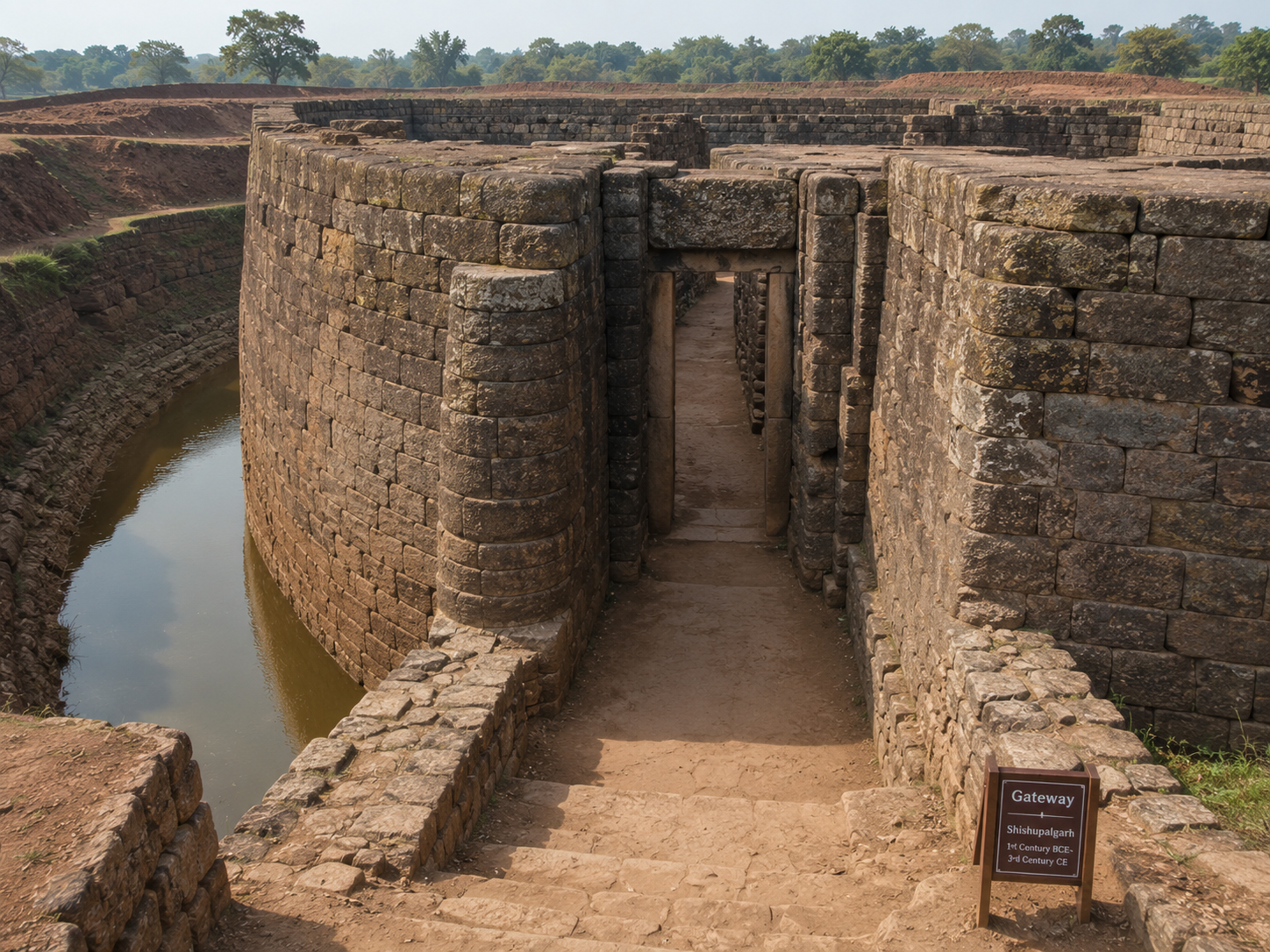
- Most capitals were large, well-fortified cities, with a moat (a deep, wide ditch filled with water) outside the fortifications for defence.
- Gateways through the rampart walls were often deliberately kept narrow, so guards could control the movement of people and goods.
- Most of these ancient capitals continue to be living cities today — “modern” cities that are often 2,500 years old.
Gandhara – Takshashila, Pushkalavati
Kamboja
Kuru – Indraprastha
Panchala – Ahichchhatra
Matsya – Viratha
Shurasena – Mathura
Kosala – Shravasti
Vrijji – Vaishali
Malla – Kushinara
Vatsa – Kaushambi
Chedi – Tripuri
Magadha – Rajagriha
Anga – Champa
Avanti – Ujjayini
Ashmaka
💡 Remember: 16 mahajanapadas existed; Magadha, Kosala, Vatsa, Avanti were the most powerful. Capitals had moats and narrow gateways for defence.
⚖️ 2.4 Early Democratic Traditions
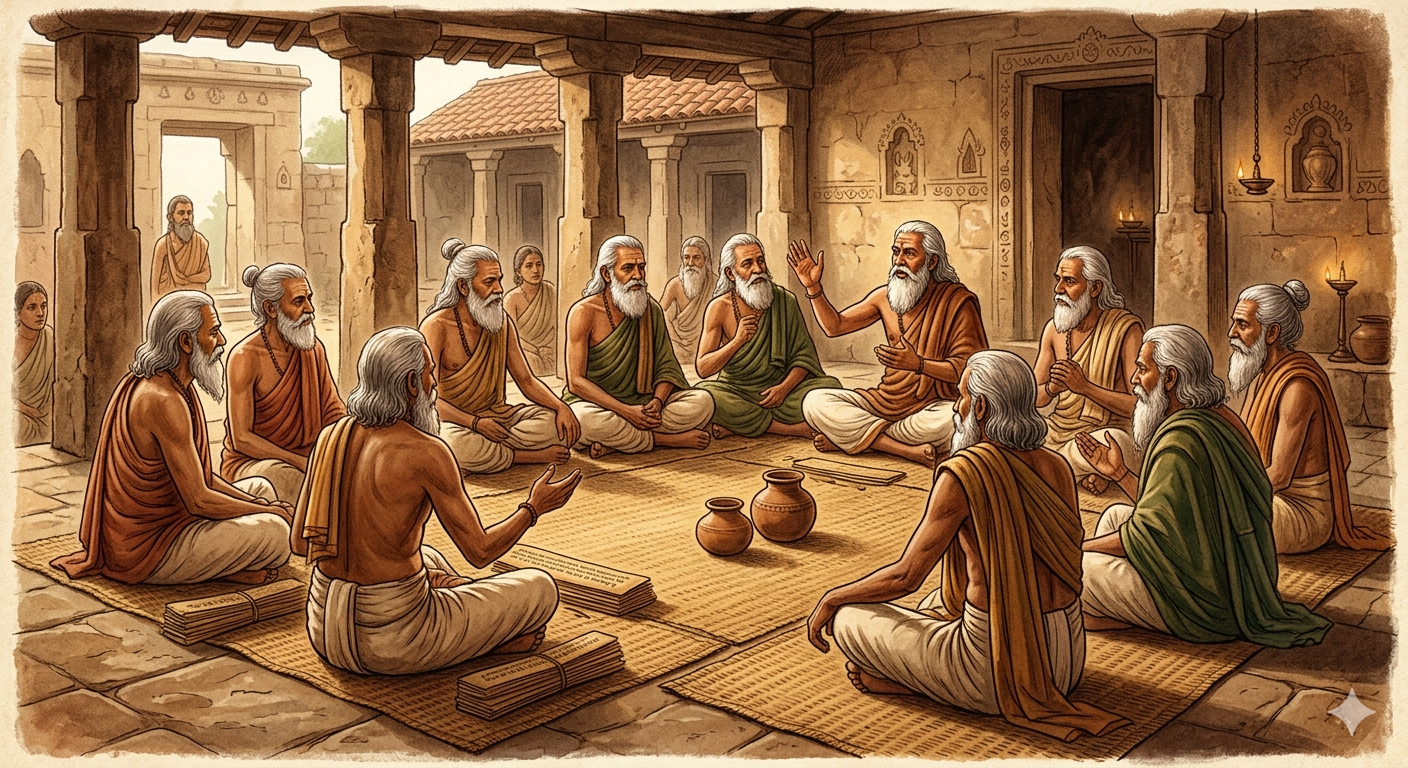
- Each janapada had an assembly or council, called sabha or samiti, where matters concerning the clan were discussed.
- These words first appear in the Vedas, India’s most ancient texts.
- Most members were probably elders in the clan.
- The raja was not expected to rule independently or arbitrarily; a good ruler was supposed to take advice from these assemblies, along with ministers and administrators.
- According to some texts, an incompetent ruler could even be removed by the assembly — though this was not necessarily an established law, since data for such remote periods is incomplete.
- Some mahajanapadas were monarchies — the raja was the ultimate authority, supported by ministers and an assembly of elders. The position was hereditary.
- The king collected taxes/revenue, maintained law and order, built fortifications, and maintained an army. Magadha, Kosala, and Avanti were among the most powerful such monarchies.
- However, at least two mahajanapadas — Vajji (Vrijji) and Malla — had a different system: the sabha or samiti had more power and took important decisions through discussion and, if necessary, vote — including the selection of the raja.
- These mahajanapadas were called ganas or sanghas; their functioning might be called democratic, since assembly members selected the ruler and made major decisions.
- Scholars have often called them “early republics” — among the earliest such systems in the world.
💡 Remember: Sabha/samiti = assembly. Monarchies (Magadha, Kosala) = hereditary raja. Vajji & Malla = gana/sangha “early republics” where assembly selected the ruler.
⚙️ 2.5 More Innovations
- The age of janapadas and mahajanapadas was an age of profound change that impacted Indian civilisation until present times.
- New schools of thought emerged — late Vedic, Buddhist, and Jain — spreading their teachings through scholars, monks, nuns, and pilgrims travelling across India.
- Indian art underwent renewal during this period, which would later blossom in the age of empires.
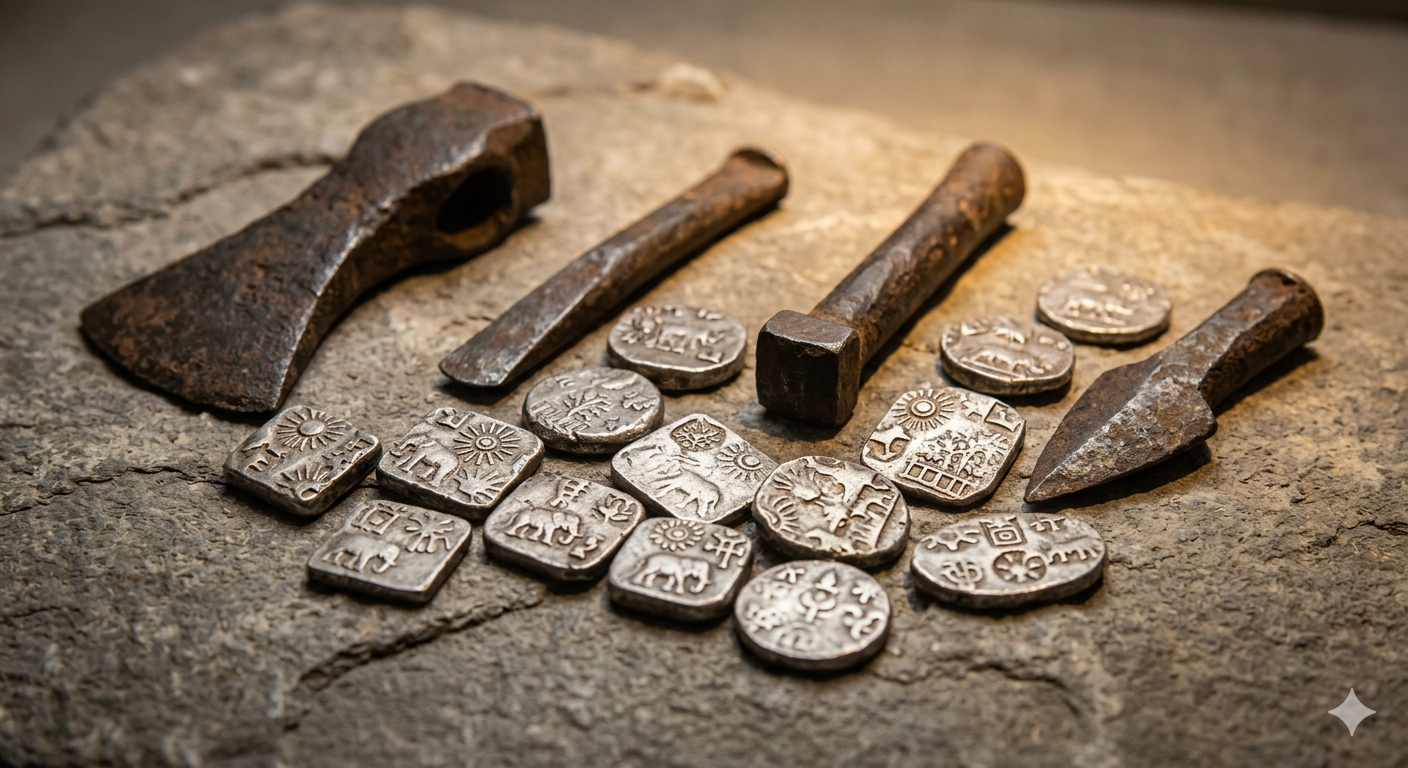
- The Harappan civilisation had mastered copper and bronze metallurgy. In the Second Urbanisation, a major shift involved iron metallurgy.
- Techniques of extracting and shaping iron were perfected from the early 2nd millennium BCE, but it took centuries for iron to become part of daily life.
- By the late 2nd millennium BCE, iron tools became widespread, facilitating agriculture on a bigger scale.
- Iron also made better weapons than bronze — lighter and sharper swords, spears, arrows, and shields.
- There is some evidence of warfare between neighbouring mahajanapadas; such campaigns and occasional alliances gave rise to new kingdoms and empires.
- Another major innovation was the first use of coins in India, made necessary by growing trade.
- The first Indian coins were made of silver, a soft metal into which symbols could be “punched” — these are called punch-marked coins.
- Later, coins of copper, gold, and other metals were also made.
- A mahajanapada generally issued its own coins, but coins from neighbouring regions were also used and exchanged in trade.
💡 Remember: Iron metallurgy boosted agriculture and warfare. Punch-marked silver coins were India’s first coins.
2.3 The 16 Mahajanapadas
LOTS
Name any four of the sixteen mahajanapadas and their capitals.
Show Answer
Magadha – Rajagriha; Kosala – Shravasti; Vatsa – Kaushambi; Avanti – Ujjayini (any four from the list of 16 are acceptable).
Medium
Why were so many mahajanapadas concentrated in the Ganga plains?
Show Answer
Because of the growth of agriculture in the fertile Ganga plains, the availability of iron ore in nearby mountains and hills, and the formation of new trade networks.
HOTS
What was the purpose of building a moat and narrow gateways around mahajanapada capitals? What does this tell us about their priorities?
Show Answer
Moats and narrow gateways were defensive measures — moats kept attackers out, and narrow gateways let guards control movement of people and goods. This shows that security and control over trade/movement were major priorities for these early states.
HOTS
Many ancient mahajanapada capitals are still living cities today. What does this continuity suggest about Indian urban history?
Show Answer
It suggests a remarkable continuity in Indian civilisation — unlike many ancient cities elsewhere that were abandoned, these cities have remained inhabited and functional for over 2,500 years, reflecting deep historical roots of present-day Indian urban centres.
2.4 Early Democratic Traditions
LOTS
What were sabha and samiti?
Show Answer
Sabha and samiti were assemblies or councils where matters concerning the clan were discussed, made up mostly of elders. These words first appear in the Vedas.
Medium
How did the political systems of Vajji and Malla differ from monarchies like Magadha and Kosala?
Show Answer
In monarchies like Magadha and Kosala, the raja was the hereditary ultimate authority. In Vajji and Malla, the sabha/samiti had more power and selected the raja and made major decisions through discussion and vote — making them ganas/sanghas, or “early republics.”
HOTS
Why do scholars call Vajji and Malla “early republics”? Do you think this comparison to modern democracy is accurate? Explain.
Show Answer
They are called “early republics” because assembly members selected the ruler and made major decisions through discussion and vote — similar in spirit to democratic processes. However, it differs from modern democracy since membership was likely limited to elders/elite clan members, not all citizens, so the comparison is partial, not exact.
HOTS
Even in monarchies, rulers were expected to consult assemblies. What does this suggest about the limits of a raja’s power in ancient India?
Show Answer
It suggests that even hereditary monarchs were not expected to rule arbitrarily — good governance required taking advice from ministers and assemblies, and in some texts an incompetent ruler could even be removed, showing some accountability built into the system.
2.5 More Innovations
LOTS
What are punch-marked coins?
Show Answer
Punch-marked coins were India’s first coins, made of silver — a soft metal into which symbols could be “punched.” Later, coins of copper, gold, and other metals were also made.
Medium
How did iron metallurgy change agriculture and warfare in this period?
Show Answer
Iron tools became widespread, facilitating agriculture on a bigger scale. Iron also made better weapons than bronze — lighter and sharper swords, spears, arrows, and shields — improving warfare capability.
HOTS
Why was the development of iron metallurgy so important for the growth of urbanism in the 1st millennium BCE?
Show Answer
Iron tools enabled larger-scale agriculture, producing surplus food that could support growing populations and non-farming professions in cities. Iron weapons also helped states defend and expand their territories, both contributing to the rise of larger, organised urban states.
HOTS
How might the introduction of coins have changed the way trade was conducted compared to earlier barter systems?
Show Answer
Coins provided a standard, portable medium of exchange, making trade faster and easier than bartering goods directly. This would have allowed trade to expand across longer distances and between different mahajanapadas and regions.
📖 Chapter Index
2.1 Second Urbanisation
2.2 Janapadas
2.3 The 16 Mahajanapadas
2.4 Early Democratic Traditions
2.5 More Innovations
2.6 Varna-Jati System
2.7 Developments Elsewhere
2.8 Timeline & Summary
📝 Take Quiz
👥 2.6 The Varna-Jati System
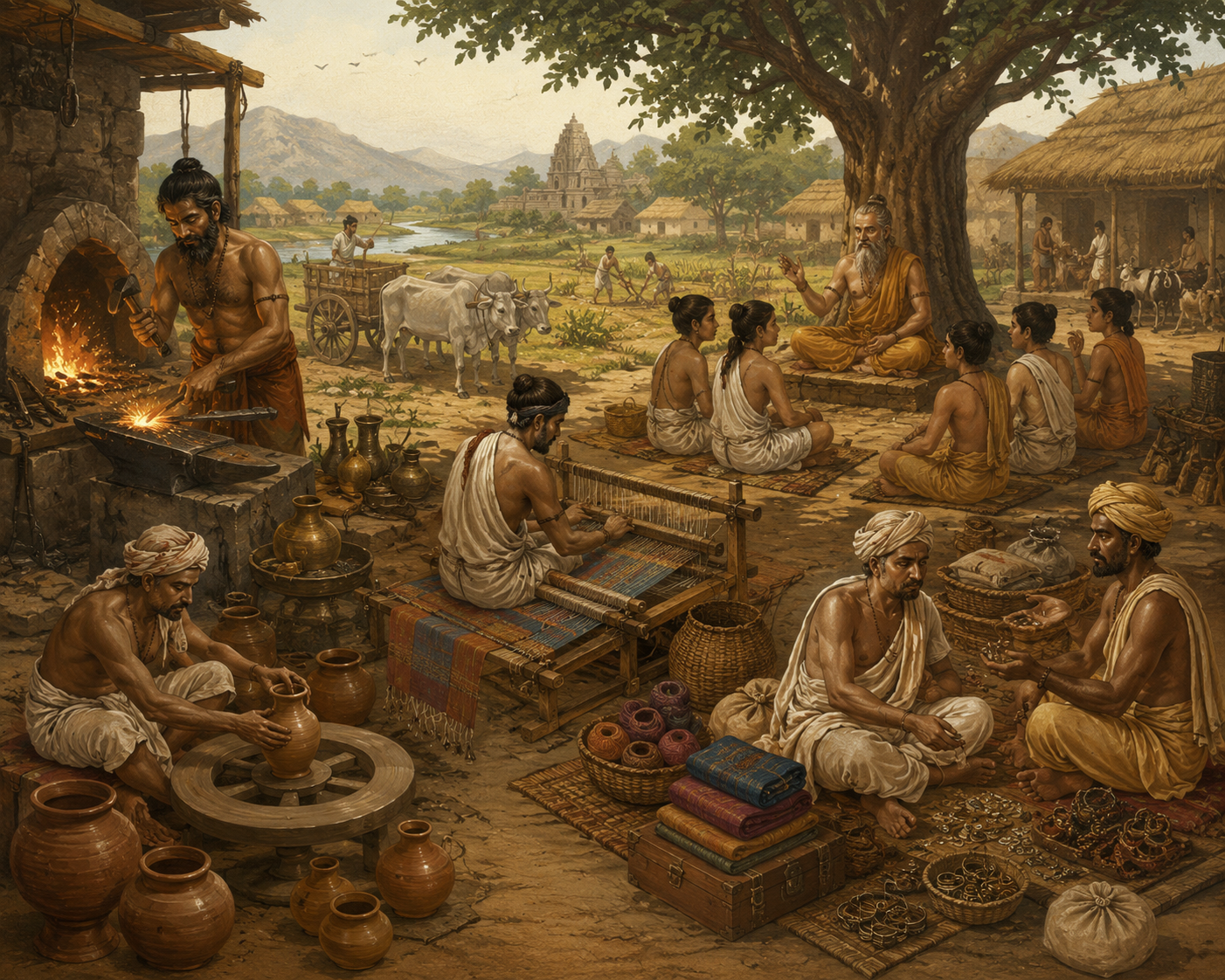
- As human societies grow more complex, they organise themselves into groups based on class, occupation, or other criteria — governance, administration, religion, education, trade, town-planning, farming, crafts, and arts.
- In an ideal society, these groups complement each other and work in harmony. But often, divisions lead to inequalities — some groups acquire more wealth, power, or influence than others.
- In India, society was organised in a two-fold system: jati and varna.
- Jati was a group or community of people with a specific professional occupation closely tied to their livelihood — skills like agriculture, metallurgy, commerce, or craft, generally transmitted from generation to generation.
- A jati would often get subdivided into sub-jatis, each developing its own customs regarding marriage, rituals, or food habits.
- Varna was another category, a concept that emerged from Vedic texts. There were four varnas:
- Brahmins — engaged in preserving and spreading knowledge, and performing rituals
- Kshatriyas — expected to defend society and land, and engage in warfare if necessary
- Vaishyas — supposed to increase society’s wealth through trade, business, or agriculture
- Shudras — artisans, craftspeople, workers, or servants
- The English word “caste” comes from the Portuguese word casta, used by Portuguese travellers in the 16th century CE trying to make sense of Indian society. Some scholars apply “caste” to varnas, most to jatis, and others to the whole varna-jati system.
- Historical evidence shows that in the early period, individuals and communities could change their occupations if circumstances demanded — for example, a drought could force farmers to migrate to a city and take up other work, or some Brahmins turned to trade or military activities.
- This system gave Indian society structure and stability, but in time it became rigid, leading to inequalities and discrimination towards lower jatis or communities excluded from the system altogether.
- Scholars broadly agree the system was more flexible in earlier periods and became more rigid over time, particularly during British rule in India.
💡 Remember: Jati = occupation-based community. Varna = four broad categories (Brahmin, Kshatriya, Vaishya, Shudra) from Vedic texts. “Caste” comes from Portuguese “casta.”
🛣️ 2.7 Developments Elsewhere in India
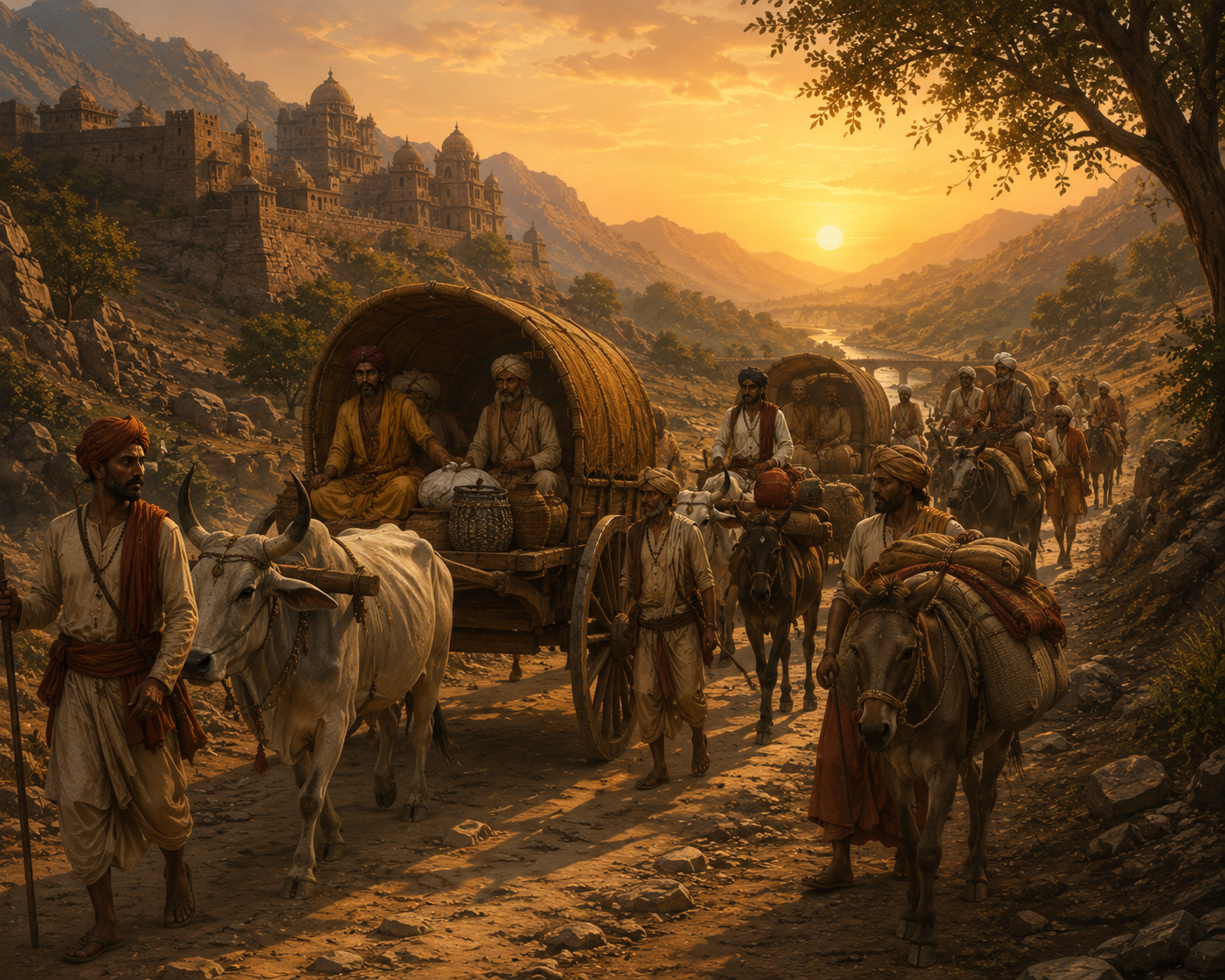
- In the 1st millennium BCE, important communication routes opened up for trade, pilgrimage, and military campaigns.
- The Uttarapatha connected the northwest regions to the Ganga plains, all the way to eastern India.
- The Dakshinapatha started from Kaushambi (near Prayagraj), crossed the Vindhya Range, and proceeded all the way south.
- Many lateral roads connected with other parts of India, especially important ports on the western and eastern coasts, which were vibrant centres of trade.
- In the eastern region, major cities emerged, such as Shishupalgarh (today part of Bhubaneswar) — capital of the Kalinga region, with a strict square ground plan, imposing fortifications, and broad streets.
- In southern India, cities began emerging from about 400 BCE, with some recent excavations suggesting commercial activity even earlier.
- Around this time, three kingdoms emerged in the south — the Cholas, the Cheras, and the Pandyas, mentioned in ancient Tamil literature along with several of their kings.
- Southern regions were rich in resources like precious and semiprecious stones, gold, and spices, enabling profitable trade with the rest of India and with kingdoms overseas.
- By 300 or 200 BCE, almost the entire Subcontinent, including the Northeast, was one vibrant interconnected land — goods and culture travelled across regions and often beyond India to Central and Southeast Asia.
- About this same time, the mahajanapadas ceased to exist, giving way to fresh developments that would reshape India.
💡 Remember: Uttarapatha = northwest–east route. Dakshinapatha = Kaushambi southward. Cholas, Cheras, Pandyas = southern kingdoms from ~400 BCE.
⏳ 2.8 Timeline & Chapter Summary
1900 BCE
Harappan Civilisation
Harappan Civilisation
1200–800 BCE
Janapadas
Janapadas
800–300 BCE
Mahajanapadas
Mahajanapadas
Before we move on:
- From the end of the 2nd millennium BCE, janapadas rose in parts of north and central India — smaller states with a raja at the head, taking counsel from an assembly of elders.
- The 16 mahajanapadas were the first organised states of the 1st millennium BCE; they witnessed the Second Urbanisation of India, spreading from the Ganga region all the way to south India. By 300 BCE or so, the mahajanapadas ceased to exist.
- In the same period, a vast network of roads connected north and south, east and west, and eventually all regions of the Subcontinent — people, goods, ideas, and teachings travelled along all those roads.
2.6 Varna-Jati System
LOTS
Name the four varnas and their associated roles.
Show Answer
Brahmins (knowledge/rituals), Kshatriyas (defence/warfare), Vaishyas (trade/business/agriculture), Shudras (artisans/craftspeople/workers/servants).
Medium
What is the difference between jati and varna?
Show Answer
Jati is a community tied to a specific professional occupation (like a craft or trade), often subdivided into sub-jatis. Varna is a broader four-fold Vedic classification (Brahmin, Kshatriya, Vaishya, Shudra) based on general societal roles.
HOTS
Why do you think the varna-jati system became more rigid over time instead of remaining flexible?
Show Answer
As social structures solidified over centuries — and particularly during British rule, when occupations and categories were formally recorded and codified — flexibility to change occupations or move between groups reduced, leading to a more fixed and hereditary system.
HOTS
The chapter says equality is an ideal “very few societies have achieved.” Do you agree? Explain using examples from the chapter.
Show Answer
Yes — the chapter shows that even in ancient India, occupational divisions (varna-jati) led to unequal access to wealth, power, and influence, despite the ideal of complementary groups working in harmony. This pattern of inequality despite ideals of fairness is common across many societies, not just India.
2.7 Developments Elsewhere
LOTS
Name the three kingdoms that emerged in southern India around 400 BCE.
Show Answer
The Cholas, the Cheras, and the Pandyas.
Medium
What was the difference between the Uttarapatha and the Dakshinapatha?
Show Answer
The Uttarapatha connected the northwest regions to the Ganga plains and onward to eastern India. The Dakshinapatha started from Kaushambi, crossed the Vindhya Range, and proceeded south.
HOTS
Why were southern Indian kingdoms able to trade profitably with kingdoms overseas?
Show Answer
Because southern regions were rich in resources such as precious and semiprecious stones, gold, and spices — valuable goods that could be traded profitably both within India and with overseas kingdoms and empires.
HOTS
What evidence do historians use to learn about the Chola, Chera, and Pandya kingdoms, given they are not part of the 16 mahajanapadas?
Show Answer
Historians rely on archaeological evidence and the most ancient Tamil literature, which mentions these kingdoms and several of their kings.
📋 2.9 Questions and Activities (NCERT)
- Consider the quotation at the start of the chapter and discuss in several groups. Compare your observations and conclusions on what Kautilya recommends for a kingdom. Is it very different today?
- According to the text, how were rulers chosen in early Vedic society?
- Imagine you are a historian studying ancient India. What types of sources (archaeological, literary, etc.) would you use to learn more about the mahajanapadas? Explain how each source might contribute to your understanding.
- Why was the development of iron metallurgy so important for the growth of urbanism in the 1st millennium BCE? You may use points from the chapter but also from your knowledge or imagination.
📝 Chapter 4 Practice Quiz — 25 Questions