
The Age of Reorganisation
Complete chapter notes — read only this page and score full marks
Why “Reorganisation”?
- Maurya empire breaks up
- Last emperor killed ~185 BCE
- Many new kingdoms
- Map of India changes
Two Groups
- Within: Śhungas, Chedis, Sātavāhanas
- Within: Cholas, Cheras, Pāṇḍyas
- Outside: Indo-Greeks
- Outside: Śhakas, Kuṣhāṇas
How They Competed
- Matrimonial alliances
- Warfare
- Border control mattered
The Śhungas
- Puṣhyamitra Śhunga
- Aśhvamedha yajña
- Patañjali’s Yoga Sūtras
- Bharhut Stūpa art
The Big Questions
- Why is the period that followed the Maurya empire sometimes called the ‘Age of Reorganisation’?
- What were the values or principles that guided emperors of that period?
- How did foreign invaders assimilate into Indian society and contribute to cultural confluence?
The Age of Reorganisation Begins
- Very little is known about Aśhoka‘s successors to the throne.
- It is generally accepted that the last Maurya emperor was assassinated around 185 BCE by his commander-in-chief, Puṣhyamitra Śhunga.
- This led to the breakup of the empire — hardly half a century after Aśhoka.
- Many new kingdoms emerged across the subcontinent — often earlier tributary kingdoms under Maurya overlordship.
- The northwest region became weak, exposing it to invasions from outside the subcontinent.
- The period is called the ‘age of reorganisation’ because existing regions were being reorganised into new kingdoms constantly competing to become powerful.
- The map of India changed significantly in that age, as did people’s lives.
How the new kingdoms competed
- Peaceful method: matrimonial alliances between neighbouring kingdoms.
- Forceful method: warfare.
- There was constant wrestling for control over border areas, since holding them kept the kingdom safe from attacks.
- Alongside politics there was a burst in art, architecture and literature, with enriching cultural exchanges.
Matrimonial alliance: an alliance arranged through a marriage, generally between two members of royal families. In practice this would often mean a king offering his daughter for marriage into the royal family of a neighbouring kingdom, with the intention of cementing an alliance between the two kingdoms.
Prominent dynasties of the Subcontinent
Dynasties from WITHIN the Subcontinent
Śhungas · Chedis · Sātavāhanas · Cholas · Cheras · Pāṇḍyas
Dynasties from OUTSIDE the Subcontinent
Indo-Greeks · Śhakas · Kuṣhāṇas
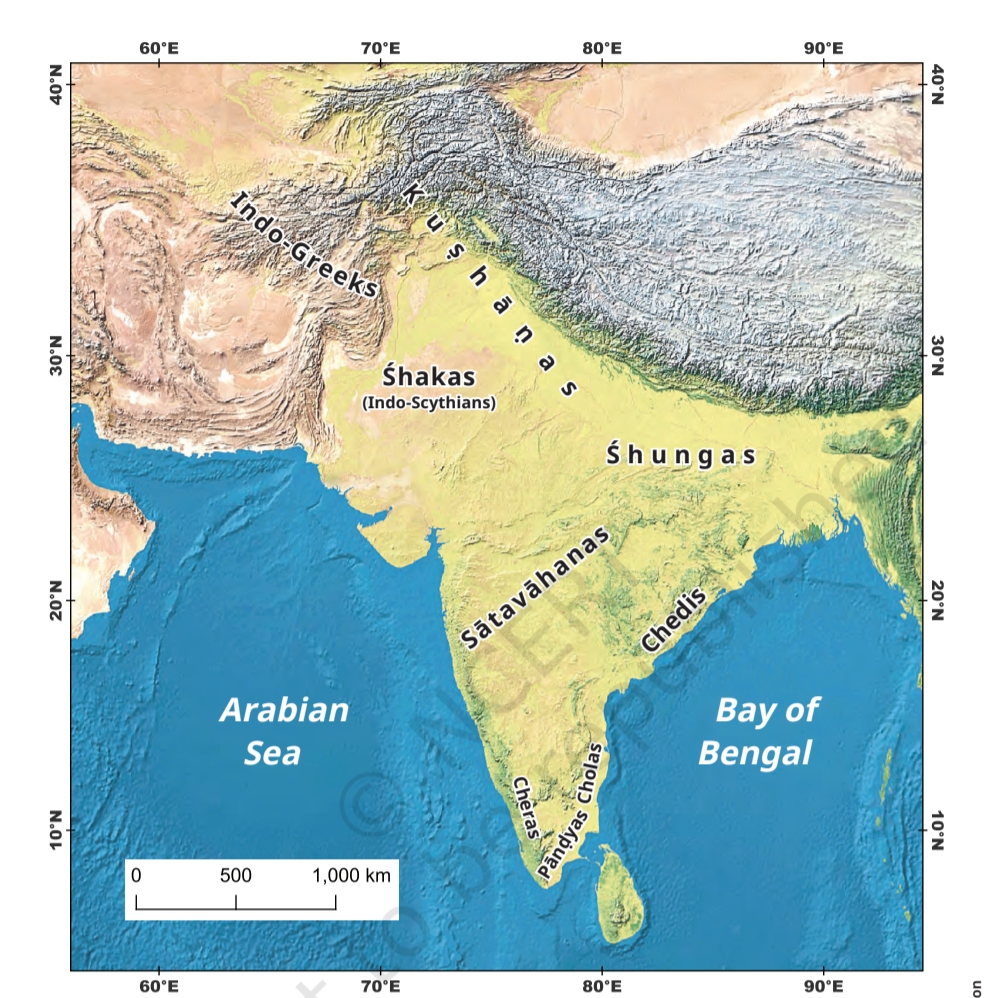
Surge of the Śhungas
- Puṣhyamitra Śhunga founded the Śhunga dynasty, ruling over parts of north and central India.
- He performed the aśhvamedha yajña, a Vedic ritual, to establish himself as a most powerful ruler.
- His empire was smaller than the Maurya Empire, but he kept it safe from potential invaders.
- He maintained friendly relations with the Greeks, after some initial military campaign against them.
- The empire did not last long — a century after him, it was gone.
- The period witnessed a revival of Vedic rituals and practices, but other schools of thought continued to flourish.
Aśhvamedha yajña: a Vedic ritual conducted by many rulers to declare their position as king. A horse accompanied by soldiers was left to wander freely. Any territory the horse crossed unchallenged became part of the king’s empire. If any ruler stopped the horse, it led to a battle to determine supremacy.
Literature and art under the Śhungas
- Sanskrit emerged as one of the preferred languages for philosophical and literary works.
- The Yoga Sūtras were compiled by Patañjali during this period.
- The Śhungas patronised literature, art and architecture.
- The Bharhut Stūpa (present-day Madhya Pradesh) presents beautiful examples of Śhunga art.
- It was probably built during Aśhoka’s time, but the Śhungas added carved railings and reliefs depicting stories from the Buddha’s life.
- These are considered some of the earliest examples of Buddhist art.
Sātavāhanas
- Deccan, 2nd c. BCE
- Amrāvatī · Pratiṣhṭhāna
- Ships on coins → sea trade
- Named after mothers
Chedis (Kalinga)
- Khāravela — bhikṣhu-rāja
- Jain, but respected all
- Hāthīgumphā inscription
- Udayagiri–Khandagiri caves
The South
- Cheras · Cholas · Pāṇḍyas
- Sangam Age & literature
- Silappadikāram
- Kallaṇai (Grand Anicut)
Capitals & Emblems
- Chola — Uraiyūr, tiger
- Chera — Vanji (Karur), bow
- Pāṇḍya — Madurai, fish
The Sātavāhanas
- The Śhungas seem to have waged wars with neighbouring regions — possibly including the Sātavāhanas.
- They ruled large parts of the Deccan from the 2nd century BCE onward, to the south of the Śhunga Empire.
- Sometimes referred to as ‘Andhras’.
- Their empire largely comprised present-day Andhra Pradesh, Telangana and Maharashtra.
- Capitals at different times — the most famous were Amrāvatī and Pratiṣhṭhāna (Paithan).
- Trade and commerce flourished in the Sātavāhana kingdom.
Coins, agriculture and trade
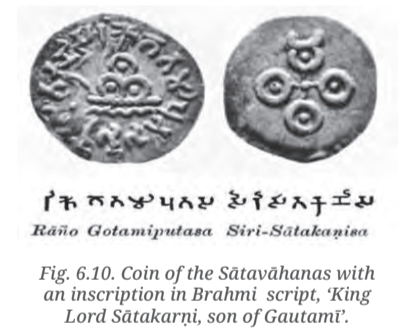
- Sātavāhana coins are found from Gujarat to Andhra Pradesh — India’s western and eastern coasts.
- Many coins depicted ships, suggesting maritime trade was an important part of economic life.
- The type of ship shown suggests advanced shipbuilding and navigation technologies.
- Agriculture flourished in the Krishna–Godavari river system, giving economic stability.
- Trade networks reached as far as the Roman Empire.
- Exports: spices, textiles, sandalwood, gold-plated pearls, ivory. Imports: glass and perfumed ointments.
- Tolls and taxes on trade added revenue to the kingdom.
- Economic prosperity and a peaceful political period helped literature, art and culture develop.
Life under the Sātavāhanas
- Princes were often named after their mothers.
- Gautamīputra Sātakarṇi was named after his mother, Gautamī Balaśhrī.
- She was a powerful queen who donated land to Buddhist monks and had an important inscription carved at Nāśhik.
- The Naneghat caves near Pune lay close to a major trade route — used for collecting tolls and taxes and as resting places for traders.
- Naneghat inscriptions describe a Sātavāhana widow queen who performed several Vedic rituals, including the aśhvamedha yajña.
- They mention Vedic gods Indra, Chandra and Sūrya.
- Her donations (dāna): land, cows, horses, elephants, silver coins and other items to priests, guests, workers, scholars and monks.
- These inscriptions are in the Brahmi script and include early numerals — some resembling today’s shapes.
- This is evidence that modern numerals ultimately originated in India.
Faith, caves and decline
- The Sātavāhanas were devout followers of Vāsudeva (another name for Kṛiṣhṇa).
- They also patronised other schools of thought — granting tax-free agricultural land to Vedic scholars, Jaina and Buddhist monks.
- The Karla caves (near Lonavala, Maharashtra) were made for Buddhist monks — magnificent pillars and a stone replica of a stūpa, all carved out of a rocky hillside.
- A yakṣha (a minor deity associated with nature) from the Pitalkhora caves carries the inscription kanhadāsena hiramakarena kāṭa — ‘made by Kanahadasa, a goldsmith’.
- In the 3rd century CE the empire fragmented into smaller independent kingdoms.
- Main causes: weak central control and gradual economic decline.
Coming of the Chedis
- After the decline of the Maurya Empire, Kalinga rose as a prominent power under the kings of the Chedi dynasty.
- Khāravela, one of their main rulers, was a devoted follower of Jain teachings.
- He was sometimes called bhikṣhu-rāja or monk-king — although he respected all schools of thought.
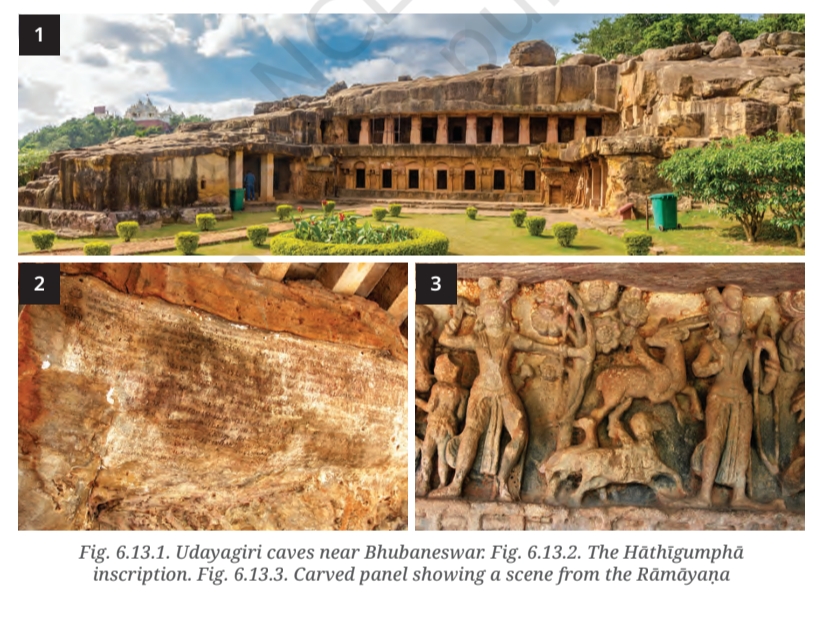
- Near Bhubaneswar, the Udayagiri–Khandagiri caves were likely developed for Jain monks.
- They feature intricate panels, statues and spacious rooms carved into the rock — notable examples of ‘rock-cut architecture’.
The Hāthīgumphā inscription
- Written in Brahmi script, found in one of the caves.
- It records King Khāravela’s accomplishments year after year — his victorious military campaigns and benevolent works for his people.
- Khāravela declares he created a ‘council of ascetics and sages’ from a hundred regions.
- He describes himself as “accomplished in extraordinary virtues, respector of every sect and repairer of every temple”.
- A ruler taking pride in protecting all schools of thought is a fundamental part of the ‘Indian ethos’.
Kingdoms and Life in the South
- Between the 2nd or 3rd century BCE and the 3rd century CE, three powerful kingdoms rose to prominence — the Cheras, the Cholas and the Pāṇḍyas.
- They often competed with each other for control over the South, while contributing to the region’s growth in trade and culture.
- Aśhoka’s empire stopped at these south Indian kingdoms (he mentions them in his edicts) — so they remained independent even at the height of Mauryan power.
- Khāravela claims he defeated an alliance of south Indian kings, but the battle’s location is unknown and he does not seem to have invaded the South.
The Sangam Age
- The period saw many poets whose works are collectively known as ‘Sangam literature’ — so the era is called the ‘Sangam Age’.
- Sangam comes from the Sanskrit sangha, meaning ‘association’ and ‘coming together’ — here, an assembly of poets.
- Sangam literature is the oldest in south India, consisting of several collections or anthologies of poems.
- Historians consult it heavily to investigate the society and culture of the times.
- Sangam poetry expresses personal emotions such as love, and societal values like heroism and generosity.
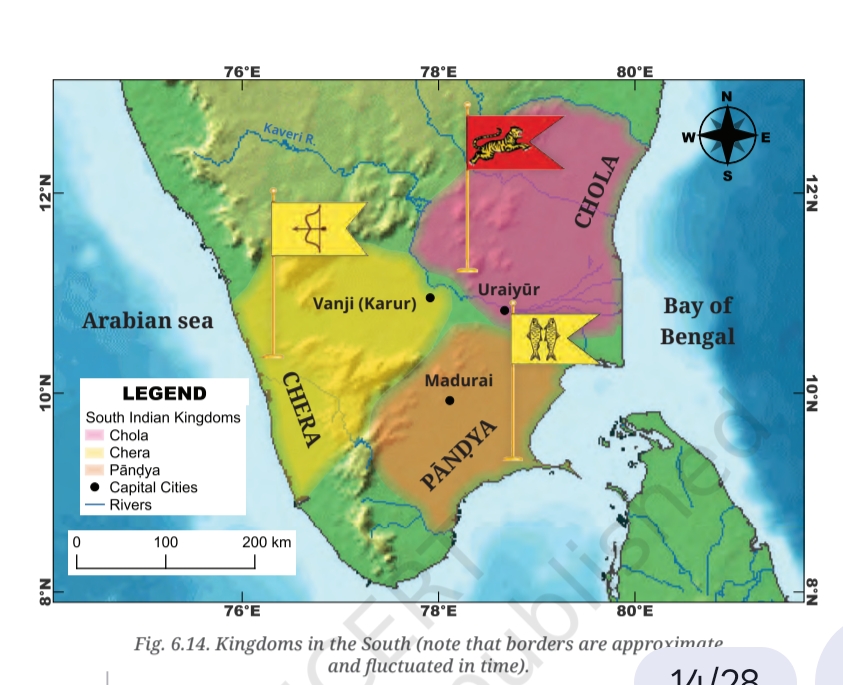
| Kingdom | Capital | Emblem | Region |
|---|---|---|---|
| Chola | Uraiyūr | Tiger | Kāveri delta, eastern Tamil Nadu |
| Chera | Vanji (present-day Karur) | Bow | Western Tamil Nadu and Kerala |
| Pāṇḍya | Madurai | Fish | Southern Tamil Nadu |
The Cholas
- The Sangams refer to three ‘crowned kings’ — the Cholas, Cheras and Pāṇḍyas.
- The Cholas ruled parts of south India from the 3rd century BCE to the 13th century CE.
- The Chola king Karikāla is said to have defeated a combined force of the Cheras and Pāṇḍyas and established his supremacy.
- Karikāla undertook many projects for the people — among them the Kallaṇai or Grand Anicut, a complex water diversion system.
- It lies just downstream of Srirangam island and diverts water from the Kāveri to the central and southern parts of the Kāveri delta.
- It brought more land under cultivation, earning the area the name ‘rice bowl of the South’.
- Restored several times, it is still in use today, supporting irrigation for millions in Tamil Nadu.
Silappadikāram: The Tale of the Anklet — composed soon after the Sangam collections. Kaṇṇagi lived happily with her husband Kovalan in the Chola capital Puhār (Kāveripattinam). Kovalan lost his wealth over a dancer, returned to Kaṇṇagi, and they travelled to Madurai to rebuild their lives. Kaṇṇagi gave him an anklet to sell, but he was falsely accused of theft and executed by the Pāṇḍya king. Kaṇṇagi proved his innocence with her second anklet; the king died of shock. She cursed Madurai, invoking the god of fire who destroyed the city, then walked west to the Chera kingdom where she was honoured as a goddess. She is still worshipped in Tamil Nadu and Kerala today.
The Cheras
- Also known as the Keralaputra — ‘sons of Kerala’.
- Ruled the western parts of Tamil Nadu and Kerala, capital at Vanji, present-day Karur.
- They shaped the region’s cultural and economic history, encouraging Tamil literature and patronising Sangam poets.
- Known for extensive trade with the Roman Empire and West Asia.
- The kingdom became a hub for the export of spices, timber, ivory and pearls.
- Chera kings issued coins bearing their royal emblem, the bow.
The Pāṇḍyas
- Ruled parts of Tamil Nadu and surrounding regions, capital at present-day Madurai; their rule goes back several centuries BCE.
- In his work Indika, Megasthenes mentions the kingdom as prosperous, with strong administration.
- Active trade with the Greeks and Romans, plus much internal trade.
- Khāravela states he received hundreds of pearls from the Pāṇḍya kingdom.
- They were an important naval power of the subcontinent.
- Later Pāṇḍyas contributed greatly to art, architecture and the region’s prosperity.
- Their inscriptions assert kings’ concern for their subjects’ welfare and encouragement to all schools of thought and belief.
Indo-Greeks
- From Alexander’s satraps
- Northwest — Pakistan, Afghanistan
- Heliodorus pillar, Vidisha
- Coins → main source
Śhakas
- Indo-Scythians
- 2nd c. BCE – 5th c. CE
- Śhaka Samvat calendar
- 78 years behind Gregorian
Kuṣhāṇas
- From central Asia
- Kaṇiṣhka — greatest ruler
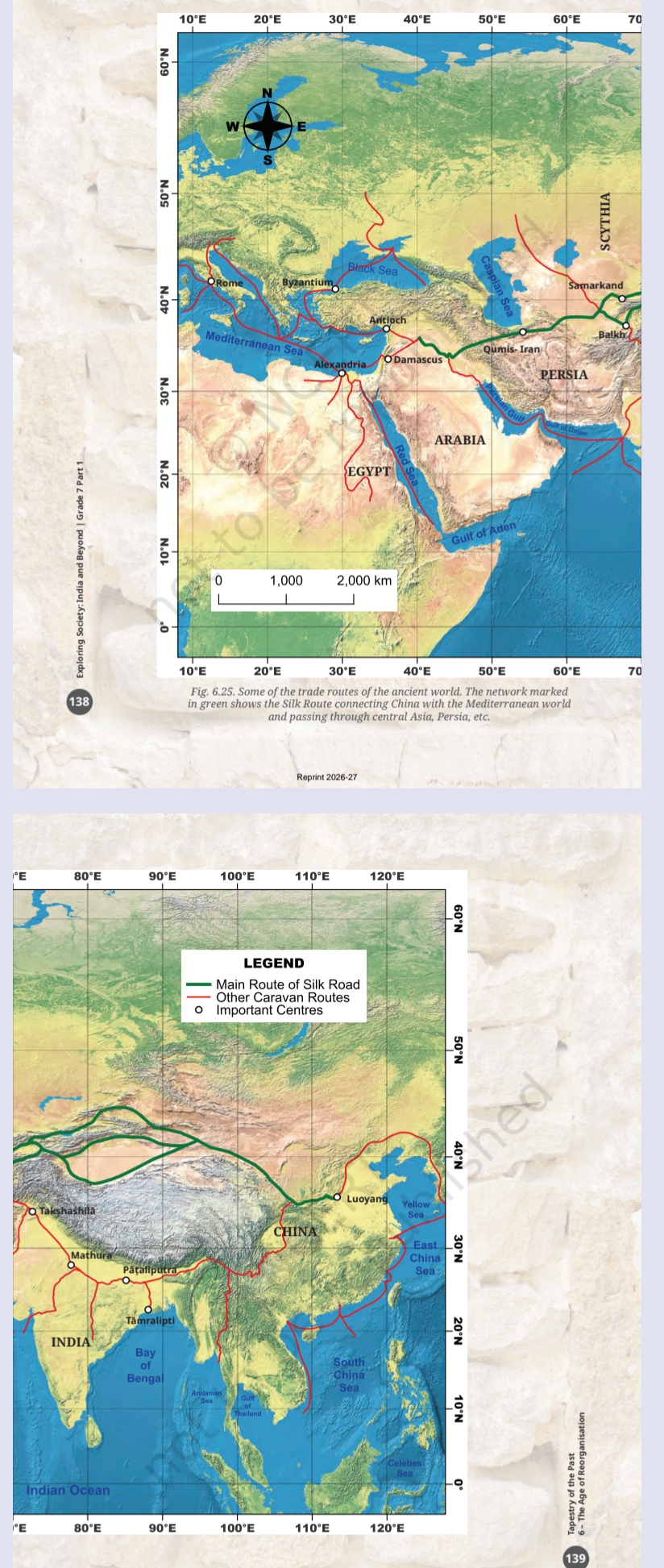
- Controlled the Silk Route
- Coins with Buddha & Śhiva
Two Art Schools
- Gāndhāra — schist, Greco-Roman
- Mathurā — red sandstone, Indian
- Fusion of styles
- Base for temple architecture
Invasions of the Indo-Greeks
- The same period saw the arrival of invaders through the northwest frontier, who took control of the northwestern, northern and central regions.
- While retreating from the Indus plains, Alexander left satraps behind.
- Over time these regional rulers established independent domains and came to be known as ‘Indo-Greeks’.
- After the decline of the Mauryas, the northwestern regions (roughly present-day Pakistan and Afghanistan) were an easy target.
- They arrived as conquerors but were much influenced by the rich local culture.
- This produced a blend of Greek and Indian elements in governance, art, language and daily life.
The Heliodorus pillar
- Located near Vidisha (Madhya Pradesh) — a notable example of these connections.
- Named after an Indo-Greek ambassador whose inscription praises Vāsudeva as the ‘god of gods’.
- The inscription also names three immortal precepts that lead to heaven: self-restraint, charity, consciousness.
Indo-Greek coins
- Coins found in north India give most of the information we have about these rulers.
- Made of gold, silver, copper and nickel.
- Usually a king on one side and Greek deities on the other.
- But some coins instead depicted Indian deities — Vāsudeva-Kṛiṣhṇa and Lakṣhmī.
- Indo-Greek rule ended with the invasions of the Indo-Scythians or Śhakas.
The Śhakas (sometimes called Indo-Scythians) invaded the northwest and ruled from the latter part of the 2nd century BCE to the 5th century CE. They rose to power after the Indo-Greeks and remained until the arrival of the Kuṣhāṇas. The Śhaka Samvat calendar was developed during this period. It is 78 years behind the Gregorian calendar (except from January–March, when it is behind by 79 years), and was adopted as the Indian National Calendar in 1957.
The Emergence of the Kuṣhāṇas
- The Kuṣhāṇas, originally from central Asia, entered India probably in the 2nd century CE.
- At its peak their empire extended from central Asia to large parts of northern India.
- Their rule marked a period of extensive cultural intermixing with a profound impact on the subcontinent.
- Kaṇiṣhka — probably the most powerful Kuṣhāṇa ruler — encouraged art and culture when not on campaign, leading to new artistic styles.
- His famous ‘headless’ statue (1.85 m high) carries a Brahmi inscription: mahārāja rājadhirāja devaputra kaṇiṣhka — ‘The great king, king of kings, son of God, Kaṇiṣhka’.
Coins of Kaṇiṣhka
- First coin: Kaṇiṣhka holding a spear, titled ‘King of Kings’; the other side shows the Buddha with the inscription BOΔΔO in Greek script.
- Second coin: an emperor on one side and Śhiva with the bull Nandi on the other.
- Featuring both Buddha and Śhiva shows the ruler’s respect for multiple schools of thought.
- The Kuṣhāṇas controlled significant sections of the Silk Route — trade grew, connecting India with the rest of Asia and the West.
Gāndhāra and Mathurā Schools of Art
- Kuṣhāṇa art continued the trend set under the Indo-Greeks, celebrated for its fusion of Indian and Greek styles.
- Sculptures feature a variety of deities, reflecting the peaceful co-existence of various schools of thought.
- This era saw deities like Sūrya, the sun god, depicted to look more similar to humans.
- Religious art increased, laying the groundwork for later temple architecture in the subcontinent.
| Feature | Gāndhāra School | Mathurā School |
|---|---|---|
| Region | Western regions of Punjab | Mathura region, present-day Uttar Pradesh |
| Material | Grey-black schist stone | Red sandstone |
| Influence | Blends Greco-Roman elements with Indian features | Distinctly Indian; less Greco-Roman influence |
| Known for | Fine Buddha images with realistic anatomy and flowing robes | Kubera, Lakṣhmī, Śhiva, Buddha, yakṣhas and yakṣhiṇīs; fuller figures with smooth modelling |
Cultural assimilation — the big picture
- Despite political conflicts and power struggles, the period saw remarkable cultural exchange and assimilation.
- Styles interacted in art and architecture, but with a dominance of Indian themes (especially Hindu and Buddhist).
- It was also the age when Sanskrit literature flourished, with the composition of the Mahābhārata and the Rāmāyaṇa.
- The ‘Tapestry of the Past’ is not confined to any one kingdom or ruler — it is a dynamic process of interaction and assimilation over time.
Timeline of the Age
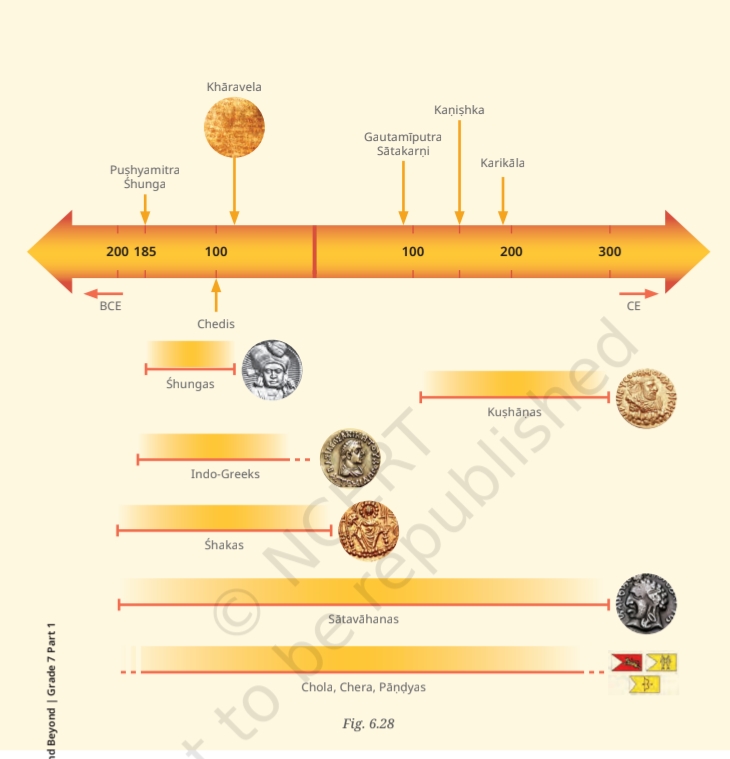
| When | Who / What |
|---|---|
| 185 BCE | Puṣhyamitra Śhunga assassinates the last Maurya emperor |
| c. 100 BCE | Khāravela of the Chedis rules Kalinga |
| 2nd c. BCE onward | Sātavāhanas rule the Deccan; Indo-Greeks and Śhakas in the northwest |
| c. 100 CE | Gautamīputra Sātakarṇi |
| 2nd c. CE | Kaṇiṣhka of the Kuṣhāṇas |
| c. 200 CE | Karikāla of the Cholas |
| 3rd c. CE | Sātavāhana Empire fragments |
Before we move on…
- The period after the disintegration of the Maurya empire was characterised by the emergence of many big and small kingdoms across the Subcontinent.
- The internal conflicts were coupled with foreign invasions, which together led to a period of reorganisation of political powers.
- This period witnessed a dialogue of various cultures that absorbed each other’s influence to create new styles of art, architecture and coinage, with ultimately a dominance of Indian themes and flourishing Sanskrit literature.
- This time was also marked by remarkable developments in trade activities, both internal and external.
Master Questions — cover the whole chapter
Answer these six and you have revised every concept in the chapter.
Show Answer
- The last Maurya emperor was assassinated around 185 BCE by his commander-in-chief Puṣhyamitra Śhunga, breaking up the empire barely half a century after Aśhoka.
- Many new kingdoms emerged, often earlier tributary kingdoms under Maurya overlordship.
- Existing regions were being reorganised into new kingdoms constantly competing to become powerful — hence the name.
- The northwest became weak, exposing it to invasions from outside the subcontinent.
- Kingdoms competed peacefully through matrimonial alliances — a king offering his daughter in marriage to a neighbouring royal family.
- They also competed through warfare, especially over border areas, since holding them kept the kingdom safe from attack.
- Alongside this came a burst in art, architecture and literature and rich cultural exchange.
Show Answer
- Puṣhyamitra Śhunga founded the dynasty, ruling parts of north and central India.
- He performed the aśhvamedha yajña to establish himself as a most powerful ruler.
- In this ritual a horse accompanied by soldiers wandered freely; territory it crossed unchallenged joined the empire, and stopping the horse meant battle.
- His empire was smaller than the Mauryas’ but he kept it safe from invaders and kept friendly relations with the Greeks after an initial campaign.
- The empire lasted only about a century after him.
- The period saw a revival of Vedic rituals, while other schools of thought continued to flourish.
- Sanskrit became a preferred language for philosophy and literature; Patañjali compiled the Yoga Sūtras.
- The Śhungas added carved railings and reliefs to the Bharhut Stūpa (Madhya Pradesh) depicting the Buddha’s life — among the earliest examples of Buddhist art.
Show Answer
- Ruled large parts of the Deccan from the 2nd century BCE, south of the Śhunga Empire; sometimes called ‘Andhras’.
- Empire covered present-day Andhra Pradesh, Telangana and Maharashtra; famous capitals were Amrāvatī and Pratiṣhṭhāna (Paithan).
- Coins found from Gujarat to Andhra Pradesh; many depicted ships, showing maritime trade and advanced shipbuilding.
- Agriculture flourished in the Krishna–Godavari river system, giving economic stability.
- Trade reached the Roman Empire — exporting spices, textiles, sandalwood, gold-plated pearls and ivory; importing glass and perfumed ointments. Tolls and taxes added revenue.
- Princes were named after their mothers — Gautamīputra Sātakarṇi after Gautamī Balaśhrī, who donated land to Buddhist monks and had an inscription at Nāśhik. This shows royal women held real status.
- Naneghat cave inscriptions record a widow queen performing Vedic rituals including the aśhvamedha yajña, and her donations (dāna) of land, cows, horses, elephants and silver coins.
- These Brahmi inscriptions include early numerals resembling modern shapes — evidence that modern numerals originated in India.
- They followed Vāsudeva (Kṛiṣhṇa) but gave tax-free land to Vedic scholars, Jaina and Buddhist monks. The empire fragmented in the 3rd century CE from weak central control and economic decline.
Show Answer
- After the Maurya decline, Kalinga rose as a prominent power under the kings of the Chedi dynasty.
- Khāravela was a devoted follower of Jain teachings, sometimes called bhikṣhu-rāja or monk-king.
- Even so, he respected all schools of thought.
- Near Bhubaneswar, the Udayagiri–Khandagiri caves, likely developed for Jain monks, have intricate panels, statues and rock-cut rooms — notable examples of rock-cut architecture.
- The Hāthīgumphā inscription, in Brahmi script, records his accomplishments year after year — military campaigns and benevolent works for his people.
- He declares he created a ‘council of ascetics and sages’ from a hundred regions.
- He calls himself “respector of every sect and repairer of every temple”.
- A ruler taking pride in protecting all schools of thought is a fundamental part of the ‘Indian ethos’.
Show Answer
- Between the 2nd–3rd century BCE and the 3rd century CE, the Cheras, Cholas and Pāṇḍyas rose to prominence, competing for control while growing trade and culture.
- They stayed independent even at the height of Mauryan power — Aśhoka’s empire stopped at them and he mentions them in his edicts.
- Cholas — capital Uraiyūr, emblem the tiger; ruled from the 3rd century BCE to the 13th century CE. King Karikāla defeated a combined Chera–Pāṇḍya force and built the Kallaṇai (Grand Anicut), still in use, which made the Kāveri delta the ‘rice bowl of the South’.
- Cheras — also called Keralaputra, capital Vanji (present-day Karur), emblem the bow; traded with Rome and West Asia, exporting spices, timber, ivory and pearls, and patronised Sangam poets.
- Pāṇḍyas — capital Madurai, emblem the fish; described as prosperous by Megasthenes in Indika; an important naval power famed for pearls.
- Sangam literature is the oldest in south India — anthologies of poems from an assembly of poets (sangam from Sanskrit sangha, meaning ‘coming together’).
- Historians use it to study society and culture; it expresses personal emotions like love and values like heroism and generosity.
- Silappadikāram, composed soon after, tells of Kaṇṇagi and Kovalan and centres on justice and the ruler’s dharma to protect it.
Show Answer
- Indo-Greeks arose from satraps Alexander left behind; they arrived as conquerors but were much influenced by the rich local culture.
- This blended Greek and Indian elements in governance, art, language and daily life.
- The Heliodorus pillar near Vidisha, named after an Indo-Greek ambassador, praises Vāsudeva as the ‘god of gods’ — a Greek envoy honouring an Indian deity.
- Some Indo-Greek coins depicted Indian deities like Vāsudeva-Kṛiṣhṇa and Lakṣhmī instead of Greek ones.
- The Śhakas gave India the Śhaka Samvat calendar, still used as the Indian National Calendar since 1957.
- Kaṇiṣhka‘s coins carried the Buddha (BOΔΔO in Greek script) and Śhiva with Nandi, showing respect for multiple schools of thought.
- Kuṣhāṇa control of the Silk Route grew trade linking India with Asia and the West.
- The Gāndhāra school blended Greco-Roman with Indian features in grey-black schist; the Mathurā school used red sandstone in a distinctly Indian style — together laying the groundwork for later temple architecture.
- Overall, styles interacted but with a dominance of Indian themes, and Sanskrit literature flourished with the Mahābhārata and Rāmāyaṇa.
Test Yourself — 25 Question Quiz
Tap Show answer on any question. Try writing your answer first, then check.
Very Short Answer Questions 1 mark
1Who founded the Shunga Dynasty?
Pushyamitra Shunga founded the Shunga Dynasty after overthrowing the last Mauryan ruler.
2What is Sangam Literature?
Sangam Literature is the earliest collection of Tamil literary works that provides information about ancient South India.
Short Answer Questions 2 marks
3Why is the period after the Mauryan Empire called the Age of Reorganisation?
After the fall of the Mauryan Empire, many regional kingdoms emerged. These kingdoms reorganised political power and administration in different parts of India.
4Mention any two achievements of Kharavela.
Kharavela was a powerful ruler of Kalinga who promoted Jainism. His achievements are recorded in the Hathigumpha Inscription.
5What was the importance of maritime trade during the Satavahana period?
The Satavahanas developed sea trade with Rome and Southeast Asia. This trade increased wealth and prosperity in their kingdom.
6How did the Kushanas contribute to Indian culture?
The Kushanas encouraged Buddhism and promoted Gandhara art. They also strengthened trade through the Silk Route.
Long Answer Questions 4 marks
7Explain the role of Pushyamitra Shunga in the Age of Reorganisation.
Pushyamitra Shunga founded the Shunga Dynasty after the decline of the Mauryan Empire. He strengthened his kingdom and performed Ashvamedha Yajnas to demonstrate his power. He encouraged Vedic traditions and helped restore political stability in northern India.
8Explain the significance of Sangam Literature.
Sangam Literature is an important source for the history of ancient South India. It describes the lives of the Cheras, Cholas, and Pandyas. It provides information about society, trade, culture, and administration. It also reflects the rich literary traditions of the Tamil people.