
Understanding Society: India and Beyond — Grade 9 Part 1
Chapter 3 — New NCERT Syllabus🌤️ Atmosphere and Climate
🎯 The Big Questions
- What is the composition of the atmosphere?
- How do the different layers of the atmosphere affect the planet Earth?
- What is the mechanism of monsoon?
- How can we reduce our carbon footprint?
📖 Chapter Index
- What do you see when you look up in the sky? Floating clouds, sunshine, and a breeze — all of these are a result of a blanket of air surrounding the Earth, called the atmosphere.
- It is pulled down around the Earth by gravity, and is a mixture of gases in various proportions, vital for the survival of all living beings on the Earth.
- The atmosphere shields us from the harmful radiation coming from the Sun, including ultraviolet radiation.
- It regulates the Earth’s temperature by trapping some of the Sun’s energy and prevents it from escaping back into space.
- The atmosphere is a key component of the Earth’s weather and climate systems, influencing factors such as temperature, humidity, and air pressure.
🔑 Key Term — Gravity
- Gravity is a fundamental physical force of attraction between objects that have mass or energy, such as the Sun and the Earth.
- The force of attraction that the Earth’s mass exerts on the objects that are on or close to its surface is referred to as Earth’s gravity.
💡 THINK ABOUT IT
Can you imagine what would happen if there were no atmosphere? Discuss your thoughts with your friends and teachers.
Show Answer
Without the atmosphere there would be no air to breathe — life would be impossible. The Earth would be scorching hot by day and freezing at night, harmful ultraviolet radiation would reach the surface unchecked, there would be no clouds, rain, wind or weather, no sound could travel, and meteors would strike the surface without burning up.
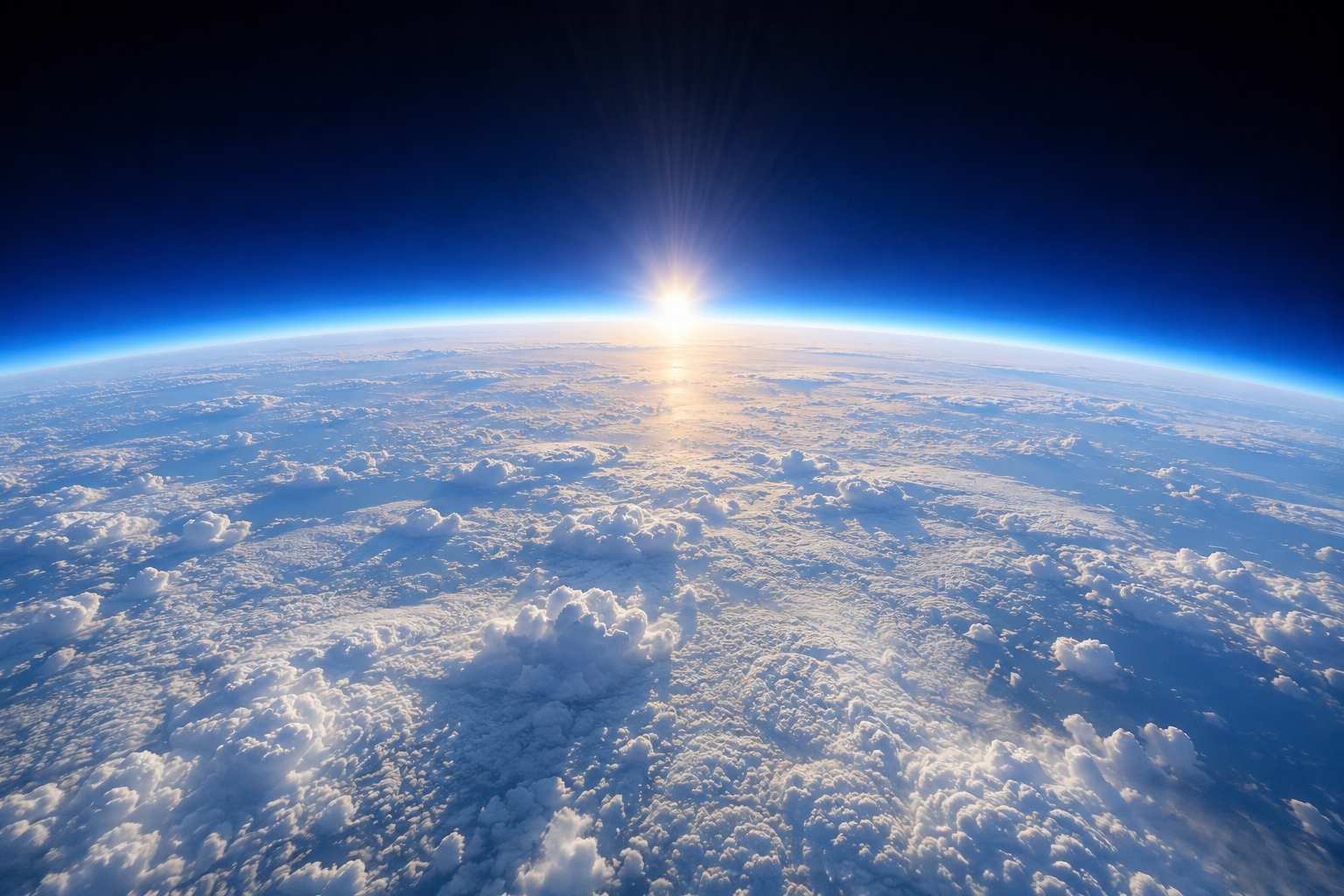
Fig. 3.1: The blanket of air surrounding the Earth
🧪 Composition and Structure of the Atmosphere
Composition of the Atmosphere
- The Earth’s atmosphere is composed of a mixture of various gases.
- Nitrogen and oxygen are the two primary and most abundant gases that are essential to life on the Earth.
- Carbon dioxide, argon, helium, neon, krypton, xenon, ozone, and hydrogen are some other gases present in the atmosphere, but are found in lesser quantities.
- Besides these, the atmosphere also consists of water vapour and tiny dust particles.
- The amount of water vapour in the atmosphere varies, but it generally ranges from 0.1 per cent to 0.4 per cent. It plays a significant role in cloud formation and precipitation.
- The composition of the atmosphere also varies with altitude.
- Nitrogen — 78%
- Oxygen — 21%
- Argon — 0.93%
- Carbon Dioxide — 0.04%
- Others — 0.03%
Fig. 3.2: Composition of the atmosphere
🔄 LET’S RECALL
How is nitrogen useful for plants? Remember that you learnt this in the chapter ‘The Invisible Living World: Beyond Our Naked Eyes’, in your Grade 8 Science textbook.
Show Answer
Plants need nitrogen to make proteins and grow, but they cannot use nitrogen gas directly from the air. Micro-organisms like Rhizobium bacteria (in the root nodules of leguminous plants) fix atmospheric nitrogen into compounds in the soil that plants can absorb — this is nitrogen fixation.
Structure of the Atmosphere
- The atmosphere has a layered structure. These layers are defined on the basis of changes in temperature and density with increasing altitude.
- The density of air is highest near the Earth’s surface and decreases with altitude.
🔑 Key Term — Altitude
- The height of a location above mean sea level is called altitude, usually measured in metres or feet. The mean sea level is considered zero.
Fig. 3.3: Layers of the atmosphere
- Troposphere: The most important layer of the atmosphere, with an average height of about 12 kilometres. In this layer, temperature decreases with increasing altitude. The air we breathe exists here, along with most of the water vapour and clouds. Nearly all the weather phenomena, such as rainfall, fog, and hail, occur in this layer. The troposphere is separated from the stratosphere by a transition zone known as the tropopause.
- Stratosphere: Above the troposphere, extending up to 50 kilometres. This layer is ideal for flying aeroplanes because it is free of clouds and other weather disturbances. A notable feature is that it contains a layer of ozone gas, which shields us by filtering the Sun’s harmful radiation, including ultraviolet radiation. The stratopause marks the boundary between the stratosphere and the mesosphere.
- Mesosphere: The third layer, extending up to a height of 80 kilometres. Temperature decreases with increasing altitude. Most meteorites entering from space burn up in the mesosphere.
- Thermosphere: Temperature rises very rapidly with increasing altitude, as the gas molecules absorb the X-rays and short-wave ultraviolet radiation of the Sun. It extends from 80 to 700 km. It helps with radio transmission by reflecting radio waves back towards the Earth. The Ionosphere is a part of the thermosphere. The northern and southern lights (auroras) also occur in the thermosphere.
- Exosphere: The uppermost layer, characterised by very thin air. Light gases like helium and hydrogen float into space from this layer due to weak gravity. All of these layers play a vital role in the Earth’s atmospheric processes and also affect its weather and climate.
⚠️ DON’T MISS OUT
Temperature decreases with altitude only in the troposphere and mesosphere.
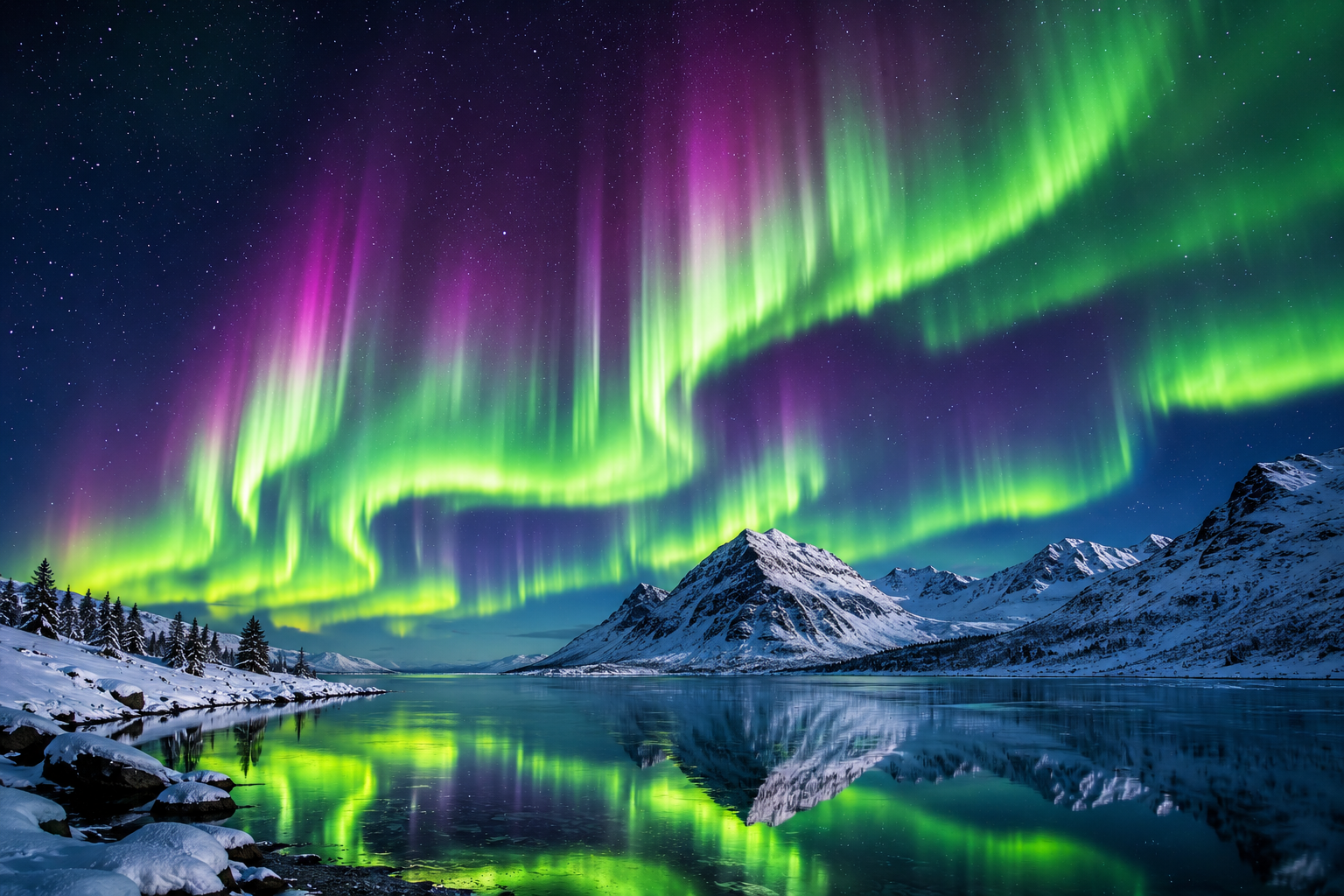
Fig. 3.4: Aurora
- The word ‘aurora’ originates from Latin, meaning ‘dawn’ or ‘morning light’ — named after the Roman goddess Aurora, the goddess of dawn.
- It refers to the colourful display of light seen in the sky near the poles.
- The ‘solar wind’ (charged particles emitted by the Sun), upon reaching the Earth’s atmosphere, is directed towards the magnetic poles.
- As these particles interact with different atmospheric gases, each gas glows with a particular colour.
- This phenomenon is known as the Aurora Borealis in the Northern Hemisphere and the Aurora Australis in the Southern Hemisphere.
⚠️ DON’T MISS OUT
The air above us exerts a significant force on our bodies, and yet we do not feel it. This is because air presses on us from all sides, and our bodies exert a counter-pressure in response.
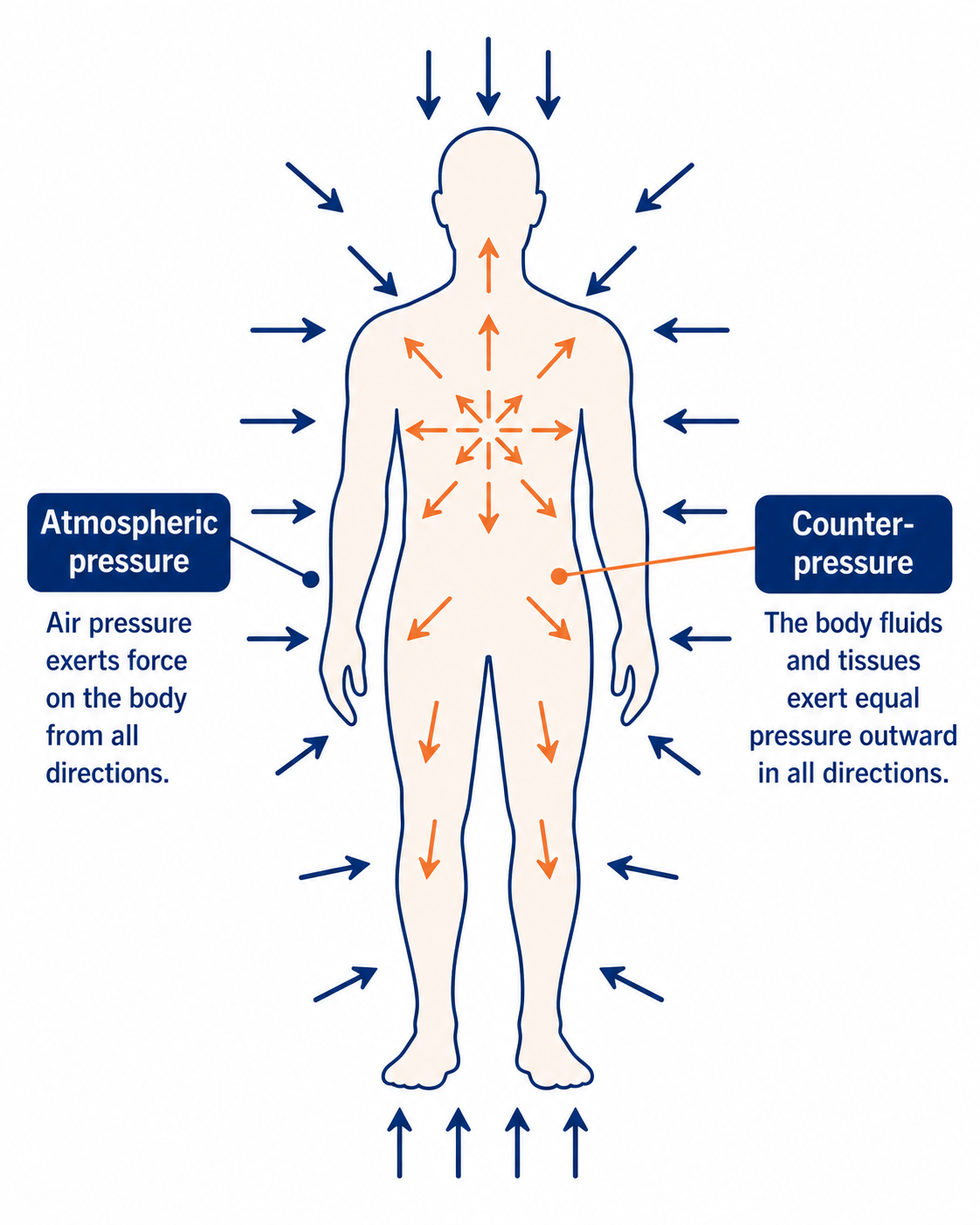
Fig. 3.5: The pressure inside our bodies is also equal to the atmospheric pressure and cancels the pressure from outside
📝 Practice Questions — Composition & Structure
LOTS Name the two most abundant gases of the atmosphere with their percentages.
Show Answer
Nitrogen (78%) and Oxygen (21%) are the two primary and most abundant gases of the atmosphere, essential to life on Earth.
Medium Why is the stratosphere ideal for flying aeroplanes? What important gas layer does it contain?
Show Answer
The stratosphere is ideal for flying aeroplanes because it is free of clouds and other weather disturbances. It contains the ozone layer, which shields us by filtering the Sun’s harmful radiation, including ultraviolet radiation.
HOTS A meteor entering the Earth usually never reaches the ground, and your phone’s radio signals travel long distances. Which layers of the atmosphere are responsible for each, and how?
Show Answer
The mesosphere protects us from meteors — most meteorites burn up there due to friction with air. The thermosphere (specifically the ionosphere within it) helps radio transmission — it reflects radio waves transmitted from the Earth back towards it, allowing signals to travel far beyond the horizon.
HOTS The air above presses on us with great force, yet we don’t get crushed. Explain, and predict what would happen to our bodies in space without protection.
Show Answer
We don’t feel atmospheric pressure because air presses on us equally from all sides, and the pressure inside our bodies is equal to the atmospheric pressure — the two cancel out. In space, there is no external pressure, but our internal pressure remains; without a protective spacesuit maintaining pressure, the imbalance would be dangerous — which is why astronauts must wear pressurised suits.
🌦️ Weather and Climate
- ‘Is it going to rain today?’ ‘Will it be bright and sunny today?’ How often do you find yourself wondering about these questions when you want to go out and play?
- The term weather refers to the hour-to-hour and day-to-day conditions of the atmosphere. Hot or humid weather may make one irritable, while pleasant or breezy weather may make one cheerful, or even plan for an outing. Weather can vary significantly from day-to-day.
- The average weather conditions of a place over a longer period of time refer to the climate of the place.
- Climate refers to the sum total of weather conditions and variations over a large area for an extended period of time, usually thirty years or more.
🌡️ Elements of Weather and Climate
- Various elements influence weather and climate. The major elements of atmosphere that impact human life on the Earth are temperature, precipitation, humidity, wind, and atmospheric pressure. These elements can change under varying conditions.
Temperature
- The temperature of the atmosphere varies not only between day and night but also across seasons, just as summers tend to be hotter than winters.
- An important factor affecting temperature distribution is insolation.
- The amount of insolation decreases from the equator towards the poles. Hence, the temperature decreases from the equator towards the poles.
🔑 Key Term — Insolation
- Insolation is the incoming solar energy from the Sun that is intercepted by the Earth.
- Near the equator, sunlight strikes most directly; towards the poles, the angle of incoming sunlight is low — so less heat is received per unit area.
Fig. 3.6: Temperature zones of the Earth — sunlight strikes most directly at the Equator; the angle of incoming sunlight is low near the poles
Humidity
- When water evaporates from land and different water bodies, it becomes water vapour. When the levels of water vapour in the air are high, it leads to humidity.
- Humidity refers to the presence of water vapour in the air, creating moisture.
- As the air gets warmer, its capacity to hold water vapour increases, leading to higher humidity levels.
- On such a day, clothes take longer to dry, and sweat evaporates more slowly, leaving us feeling very uncomfortable.
Precipitation
- Precipitation occurs when a part of the atmosphere becomes saturated with water vapour, which condenses and ‘precipitates’, or falls on the Earth due to gravity.
- This includes drizzle, rain, snow, sleet, and hail.
- The main factors that affect precipitation include prevailing winds, mountains, and seasons.
- When precipitation falls on the Earth in liquid form, it is called rain — the most common form of precipitation, which lowers the temperature of a place.
- A long absence of rainfall results in a dry climate. Most of the groundwater is collected from rainwater.
Atmospheric Pressure
- The pressure exerted by the weight of air on the Earth’s surface is called air pressure.
- As we go higher in the atmosphere, pressure falls rapidly. It is highest at sea level and decreases with altitude.
- Horizontally, the distribution of air pressure is influenced by the air’s temperature at a given place.
- In areas with high temperatures, air heats up and rises — creating a low-pressure area. Low pressure is associated with cloudy skies and wet weather.
- In areas with lower temperatures, air is cold, heavy and sinks — creating a high-pressure area. High pressure is associated with clear and sunny skies.
- Air always moves from high-pressure areas to low-pressure areas.
High Pressure
Cold, heavy air sinks ⬇
Clear and sunny skies ☀️
Air flows OUT of H →
Low Pressure
Warm, light air rises ⬆
Cloudy skies, wet weather 🌧️
→ Air flows IN to L
Fig. 3.7: Wind is caused by air flowing from high-pressure to low-pressure areas. Its direction is influenced by the Earth’s rotation.
Wind
- The movement of air from a high-pressure area to a low-pressure area is called wind. It can be gentle or strong.
- You can observe the flow of wind as it blows dry leaves down the pavement, gently blows away dust particles, or uproots trees during a storm.
💡 THINK ABOUT IT
You might have noticed that sometimes the wind is so strong that it is difficult to walk against it. Can you think of some other times when strong winds have caused problems for you?
⚠️ DON’T MISS OUT
Winds are named after the direction they blow from — for example, the wind blowing from the west is called westerly.
| Wind | Speed (km/hr) | Common Effects |
|---|---|---|
| Calm | 0–1 | Calm, smoke rises vertically. |
| Light breeze | 6–11 | Wind can be felt on the face. Leaves rustle. An ordinary vane moves by winds. |
| Strong breeze | 39–49 | Large branches sway in the wind. Umbrellas are difficult to use. |
| Storm | 103–117 | It is very rarely experienced. Usually accompanied by widespread damage. |
Table 3.1: Wind speeds and their common effects
🔍 LET’S EXPLORE
Find out other categories of wind based on speed and their common effects, and share your findings in class.
Show Answer
From the Beaufort scale: Gentle breeze (12–19 km/hr) — leaves and small twigs in constant motion, flags extend; Moderate breeze (20–28 km/hr) — raises dust and loose paper, small branches move; Fresh breeze (29–38 km/hr) — small trees sway; Gale (62–74 km/hr) — twigs break off trees, walking is difficult; Hurricane/Cyclone (above 118 km/hr) — massive destruction over wide areas.
- Local winds such as the land breeze and the sea breeze also affect the weather and climate of a place. They are essential in creating moderate climatic conditions in the coastal region.
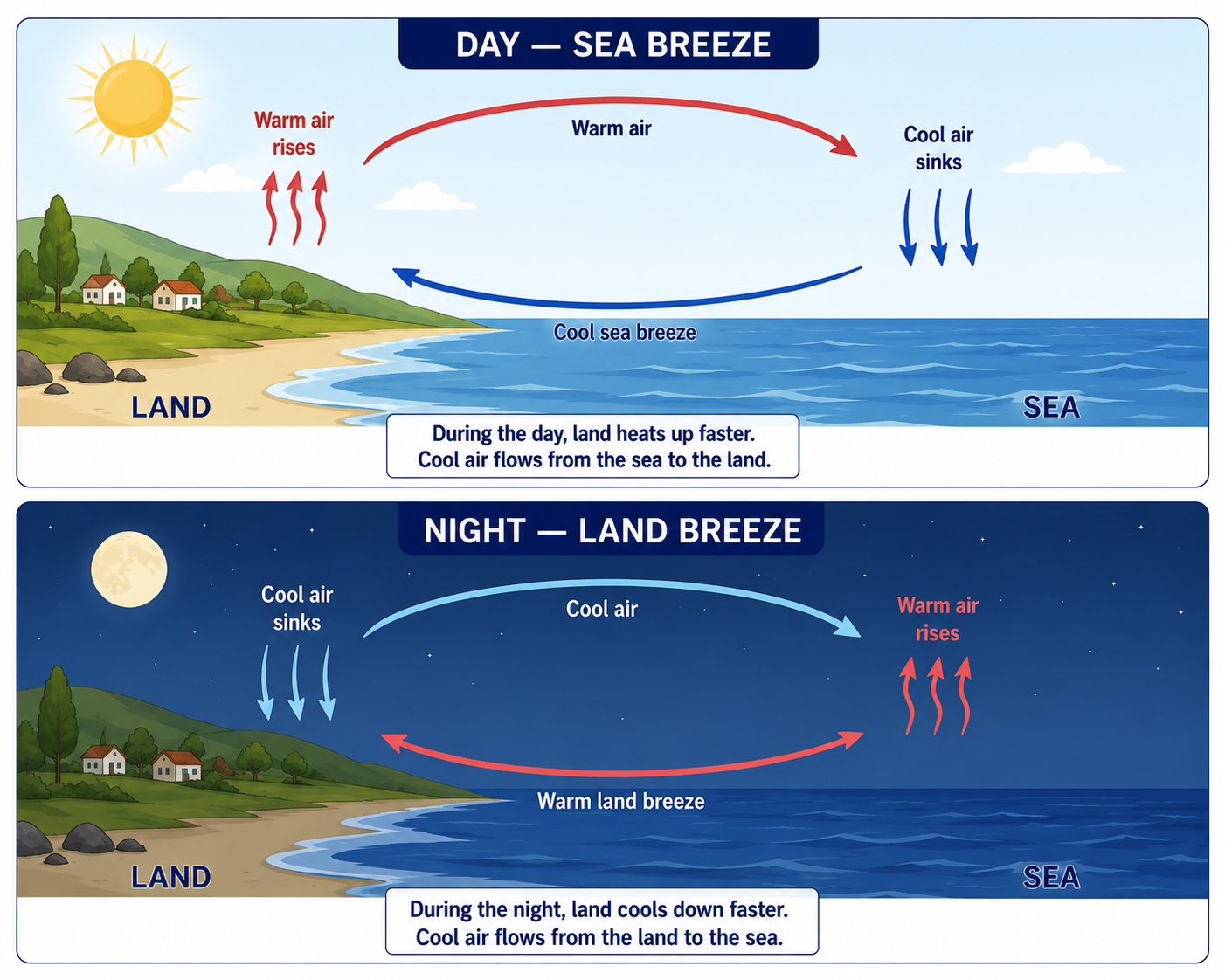
Fig. 3.8: Land and sea breeze — (Day) land is warmer than the water; (Night) water is warmer than the land
| Sea breeze | Land breeze |
|---|---|
| A local wind that blows from sea to land during the day, especially in the afternoon, when the land becomes relatively warmer than the sea. This results in the formation of a low-pressure region over land, and so the wind starts blowing from the sea. | A local wind that blows from land to sea during the night, resulting from differential surface cooling between the land and the sea. Land cools faster than sea at night. Since the difference in temperatures and air pressure between the sea and the land is low, the wind speed is low. |
- Weather conditions often fluctuate, sometimes even within a single day. However, based on generalised monthly atmospheric conditions, or a common pattern over a few weeks or months — such as the days being cool or hot, windy or calm, cloudy or bright, and wet or dry — the year is divided into seasons.
📊 LET’S ANALYSE
Note down the weather report from a local newspaper for two weeks and observe the changes occurring in the weather.
🍂 Seasons in India
- The climate of India can be broadly classified as tropical monsoon. The Indian Meteorological Department (IMD) has recognised four distinct seasons in India:
- Winter: Generally lasts from December to early April. The coldest months are December and January, when the average temperature in the north-west is around 10–15°C. Temperatures increase towards the equator, reaching around 20–25°C in mainland India’s south-east.
- Summer or pre-monsoon: Spans from April to June, or up to July in north-western India. In western and southern regions, the hottest month is April; in northern regions, it is May. The average temperature across most of inland India ranges from 32–40°C.
- Monsoon or rainy (Advancing monsoon): Generally spans from June to September. Dominated by the humid south-west summer monsoon, which slowly sweeps across the country in late May or early June. Monsoon rain begins to recede from north India at the beginning of October, and South India typically receives more rainfall during this time.
- Post-monsoon (Retreating monsoon): Lasts from October to December. In north-western India, October and November are usually cloudless.
- The Himalayan states, being more temperate, experience two additional seasons — autumn and spring.
⚠️ DON’T MISS OUT
Traditionally, India experiences six seasons, each about two months long — spring, summer, monsoon, early autumn, late autumn, and winter. These seasons are based on the astronomical division of the 12 months into six parts. The traditional Indian calendar also reflects these seasons through its arrangement of months.
| Seasons (Ṛtu) | Months (Indian Calendar) | Months (Gregorian Calendar) |
|---|---|---|
| Vasanta (Spring) | Chaitra–Vaiśhākha | March–April |
| Grīṣhma (Summer) | Jyeṣhṭha–Āṣhāḍha | May–June |
| Varṣhā (Monsoon) | Śhrāvaṇa–Bhādrapada | July–August |
| Śharad (Early Autumn) | Āśhvina–Kārtika | September–October |
| Hemanta (Late Autumn) | Mārgaśhīrṣha–Pauṣha | November–December |
| Śhiśhira (Winter) | Māgha–Phālguna | January–February |
Table 3.2: Traditional Indian seasons. These seasons and their duration may vary across different parts of the country.
💡 THINK ABOUT IT
Hindustani Classical music associates certain rāgas with specific seasons. Find out which rāgas are connected to each season with the help of your elders and teachers.
Show Answer
Some well-known season–rāga associations: Vasanta (spring) — Rāga Basant and Bahar; Grīṣhma (summer) — Rāga Deepak; Varṣhā (monsoon) — Rāga Malhar (Megh Malhar, Miyan ki Malhar); Śharad — Rāga Jaijaivanti; Hemanta/Śhiśhira (winter) — Rāga Hemant and Shree. (Associations may vary across traditions — discuss with your music teacher.)
⚠️ DON’T MISS OUT
Kauṭilya’s Arthaśhāstra contains records of scientific measurements of rainfall and their practical application in managing the country’s revenue and relief efforts.
📝 Practice Questions — Weather, Elements & Seasons
LOTS Define weather and climate. Over what period is climate usually measured?
Show Answer
Weather refers to the hour-to-hour and day-to-day conditions of the atmosphere. Climate is the average weather conditions of a place over a longer period — the sum total of weather conditions and variations over a large area for an extended period, usually thirty years or more.
Medium Name the four seasons recognised by the IMD with their months. Which two extra seasons do the Himalayan states experience?
Show Answer
(1) Winter — December to early April; (2) Summer or pre-monsoon — April to June (up to July in the north-west); (3) Monsoon or rainy (advancing monsoon) — June to September; (4) Post-monsoon (retreating monsoon) — October to December. The Himalayan states, being more temperate, also experience autumn and spring.
HOTS Why does temperature decrease from the equator towards the poles? Use the concept of insolation.
Show Answer
Insolation is the incoming solar energy intercepted by the Earth. Near the equator, the Sun’s rays strike the surface almost directly (vertically), concentrating energy over a small area — so heating is intense (Torrid Zone). Towards the poles, the rays arrive at a low slanting angle, spreading the same energy over a much larger area and passing through more atmosphere — so each unit of area receives less heat (Temperate and Frigid Zones). Hence temperature decreases from the equator to the poles.
HOTS Explain why the sea breeze blows during the day and the land breeze at night, and why coastal places have moderate climates.
Show Answer
During the day, land heats faster than the sea, so warm air over land rises, creating low pressure over land — cooler air flows in from the sea (sea breeze). At night, land cools faster than the sea; now the sea is relatively warmer with lower pressure, so air flows from land to sea (land breeze). These daily exchanges of marine air prevent extremes — cooling the coast by day and warming it by night — giving coastal regions their moderate climate.
🌧️ Monsoon
- The climate of India is strongly influenced by monsoon winds.
- The sailors who came to India during ancient times were among the first to notice the phenomenon of monsoon — they benefited from the reversal of the wind system as they travelled by sailing ships at the mercy of the winds.
- The Arabs, who had also come to India as traders, named this seasonal reversal of the wind system ‘monsoon’, derived from the Arabic word mausim, which literally means season.
🔑 Key Terms
- Monsoon: It refers to the seasonal reversal in the wind direction during a year.
- Lunar Mansions (nakṣhatras): Nakṣhatras are a way of dividing the sky into 27 equal parts along the path the Moon travels. Each part is linked to a star or group of stars. The Moon takes about 27 days to go around the Earth relative to the stars, so it moves through one nakṣhatra each day — that’s why they are called “lunar mansions”; it’s like the Moon stays in a different “house” in the sky every night.
⚠️ DON’T MISS OUT
Since crop production often depended on seasonal monsoon rains, Indians worked out methods to predict rainfall. Kṛiṣhiparāśhara and the Bṛihatsaṁhitā describe such methods in every season. Kṛiṣhiparāśhara’s main technique was based on the positions of the Moon and the Sun in the sky. Varāhamihira in his Bṛihatsaṁhitā considered lunar mansions (nakṣhatras) in predicting seasonal rainfall. Even today, a large number of farming practices in India are based on these ancient methods.
- Monsoon winds are seasonal winds, categorised into the south-west and the north-east monsoon.
- South-west monsoon (summer monsoon): Characterised by winds blowing from sea to land across the Indian Ocean, the Arabian Sea, and the Bay of Bengal between June and September.
- Mechanism: It is mainly caused by the unequal heating of land and the sea. During summer, the landmass of India heats up faster than the surrounding oceans. This creates a low-pressure area over the Indian subcontinent, while the Indian Ocean remains relatively cooler and has high pressure. Winds move from high-pressure areas to low-pressure areas, so moist winds blow from the ocean towards the land, bringing rainfall. It accounts for most of the rainfall in the country throughout the year.
- North-east monsoon (winter monsoon): Occurs from October to February. The Indian landmass cools faster than the surrounding oceans, creating high pressure over the land and low pressure over the seas. As a result, cold and dry winds blow from land to sea — these generally do not bring rainfall to most parts of India.
- However, when the north-east monsoon winds pass over the Bay of Bengal, they pick up moisture and cause rainfall on the eastern coast of India — especially Tamil Nadu, Andhra Pradesh, and parts of Karnataka. Thus, the winter monsoon is important for the rainfall of the south-eastern regions of India.
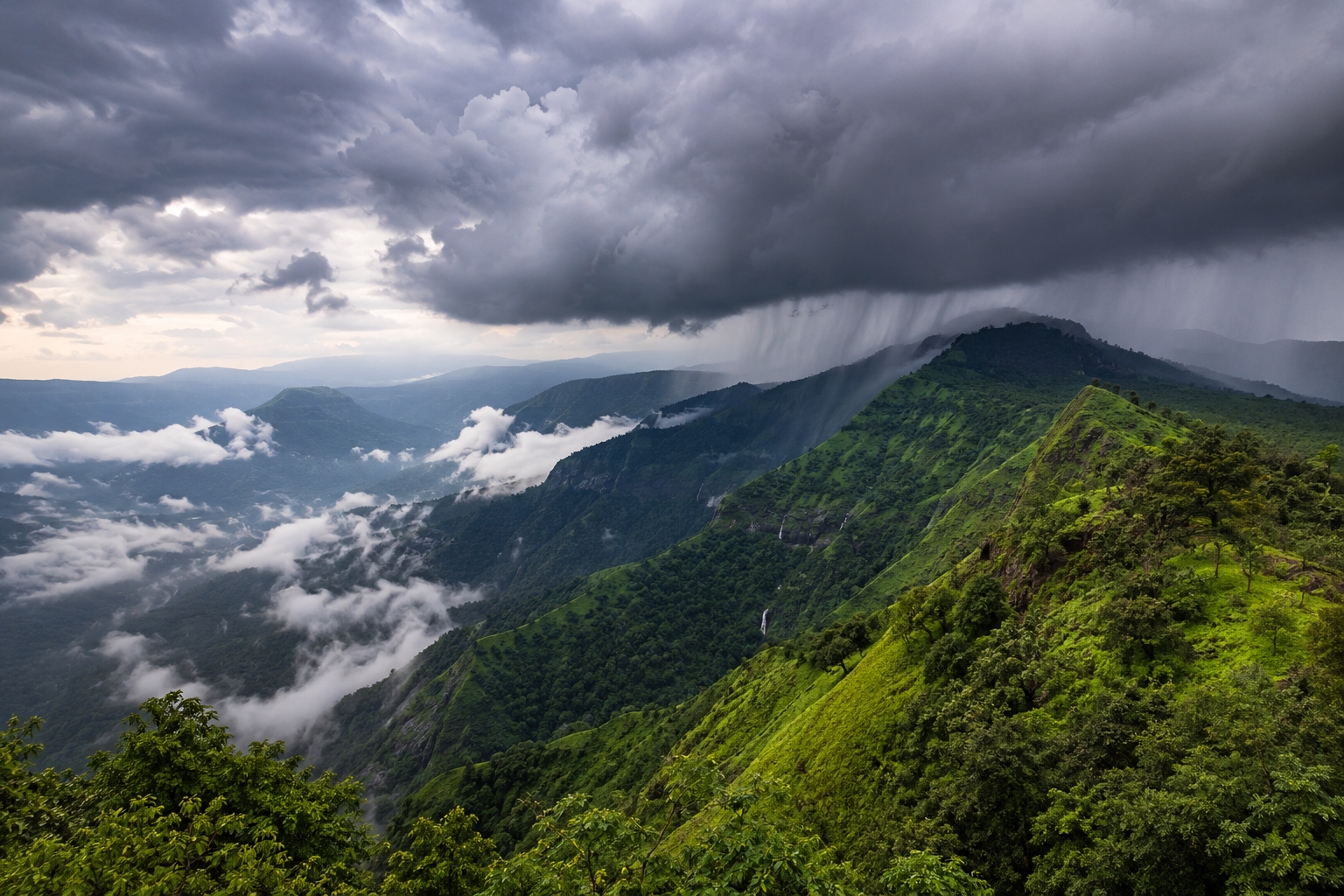
Fig. 3.9: Arrival of monsoon in the Mountains
| Advancing SW Monsoon (Fig. 3.10) | Normal date | Retreating Monsoon (Fig. 3.11) | Normal date |
|---|---|---|---|
| Andaman & Nicobar Islands | 22 May | North-west India (Rajasthan, Punjab) | 17–20 September |
| Kerala coast & South Bay | 1 June | Delhi–Kashmir belt | 25–30 September |
| Goa, Bengal coast | 5–10 June | Central India (MP, UP) | 5–10 October |
| Mumbai, Kolkata, North-East | 10–15 June | Peninsular interior | 10–15 October |
| Central India | 15–20 June | South-east coast | 15 October |
| Delhi | 25–30 June | Key pattern: the monsoon arrives from the south-east and withdraws from the north-west | |
| West Rajasthan (last) | 5–8 July | ||
Figs. 3.10 & 3.11: Normal dates of advancing of south-west monsoon and retreating monsoon (key dates for exams)
- Monsoon plays a vital role in the lives of people in India. Most of India’s agriculture depends on monsoon rainfall, as farmers rely on rain for sowing and growing crops.
- A good monsoon ensures sufficient food production and water supply in rivers, reservoirs, and wells.
- Monsoon also affects daily life, transport, festivals, and employment, especially in rural areas.
- However, excessive rainfall can cause floods, while weak monsoons can lead to droughts. Thus, monsoon greatly influences the economy, lifestyle, and livelihoods of people in India.
⚠️ DON’T MISS OUT
Kālidāsa, in Meghadūtam written around the 5th century CE, mentions the date of the onset of the monsoon over central India and also traces the path of monsoon clouds.
🔍 LET’S EXPLORE
Describe in your own words how monsoon affects the lives of the people around you.
Show Answer
(Model answer — adapt to your region.) In our region, farmers wait eagerly for the monsoon to sow paddy and cotton; a delayed monsoon delays the entire crop calendar. Wells and borewells recharge with the rains, drinking water becomes plentiful, and festivals feel joyful in a good rain year. But heavy spells flood streets, disrupt school and transport, and damage crops — while a failed monsoon means costly water tankers and worried farmers. Our lives quietly follow the monsoon’s rhythm.
⚠️ DON’T MISS OUT
- Under the National Monsoon Mission (NMM), Ministry of Earth Sciences (Government of India) has developed state-of-the-art weather and climate prediction models. The overall objective of the NMM is to enhance monsoon predictions for India over all time frames.
- ‘Mission Mausam’ is designed to position India as a global leader in weather and climate sciences. The mission aims to make the nation ‘Weather Ready’ and ‘Climate Smart’, meeting global standards. It aims to improve weather and climate services, ensuring timely and precise observation, modelling, and forecasting information for multiple sectors, including agriculture, disaster management, and rural development.
🌍 Climate Change
- One of the most urgent challenges that the Earth is facing today is climate change — long-term changes in weather patterns, such as temperature, rainfall, and wind, caused mainly by human activities, including the burning of fossil fuels, deforestation, and industrial pollution that releases gases like carbon dioxide into the atmosphere.
- These actions increase greenhouse gases such as carbon dioxide, methane, nitrous oxide, water vapour in the atmosphere, trapping heat and raising global temperatures.
- As a result, we are witnessing more frequent floods, droughts, melting of glaciers, rising sea levels, and loss of biodiversity.
- Climate change not only threatens ecosystems but also impacts human health, agriculture, and livelihoods — it has great impact on almost all sections of the population, including women and children.
- Tackling this issue requires collective efforts — reducing carbon footprints, using renewable energy, protecting forests, and adopting sustainable lifestyles. Every small step counts, and every human being plays a vital role in shaping a healthier and greener future.
🔑 Key Term — Carbon footprint
- The total amount of greenhouse gases released into the atmosphere as a result of human activities, such as energy use, transportation, or the production of goods and services.
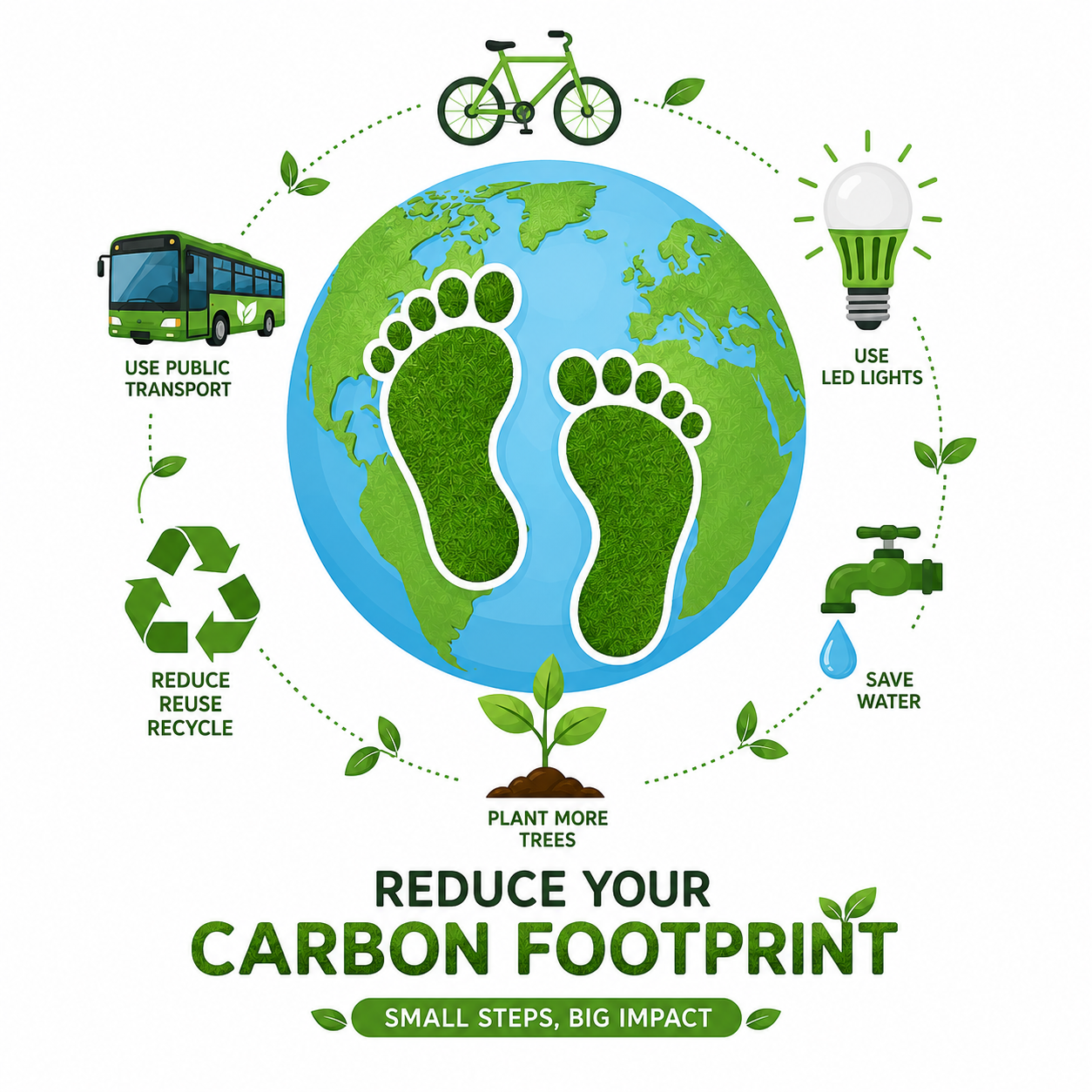
Every small step counts towards reducing our carbon footprint
🔍 LET’S EXPLORE — My Carbon Footprint
Step 1: My Daily Habits — Tick the options that best describe you.
- A. Transport: I usually walk/use a cycle (Low impact) • I use public transport/carpool (Medium impact) • I travel by private cars even for short distances (High impact) • I take flights more than twice a year (Very high impact)
- B. Electricity Use: I always switch off electrical appliances (lights, fans, etc.) when not in use (Low impact) • I sometimes forget to switch off electrical appliances (Medium impact) • I leave electrical appliances on frequently (High impact)
- C. Water Use: I use water judiciously, for example, just one bucket of water for bathing (Low impact) • I sometimes waste water (leaving the tap running/more buckets of water for a bath/long showers) (Medium impact) • I rarely think about saving water (High impact)
- D. Waste and Plastics: I reuse, recycle, and avoid single-use plastics (Low impact) • I sometimes use disposable plastics (bottles/bags/straws) (Medium impact) • I often throw away plastic and do not recycle (High impact)
Step 2: Score Yourself — Low impact = 1 point • Medium = 2 points • High = 3 points • Very high = 4 points. Now add up your total score.
Step 3: My Climate Action Pledge — Think about two simple changes you can make to reduce your score, and write them down.
🌊 Punjab Floods 2025: A Case Study
- In 2025, Punjab experienced severe floods due to heavy monsoon rains and the consecutive swelling of the rivers Satluj, Beas, and Ravi.
- The floods damaged large parts of the state, including villages, agricultural fields, houses, and important infrastructure such as roads and bridges.
- While the water started to recede in some places and relief operations were carried out, the overall impact was devastating — heavy economic losses, social disruption, and environmental damage, underscoring the urgent need for improved flood management and preparedness.
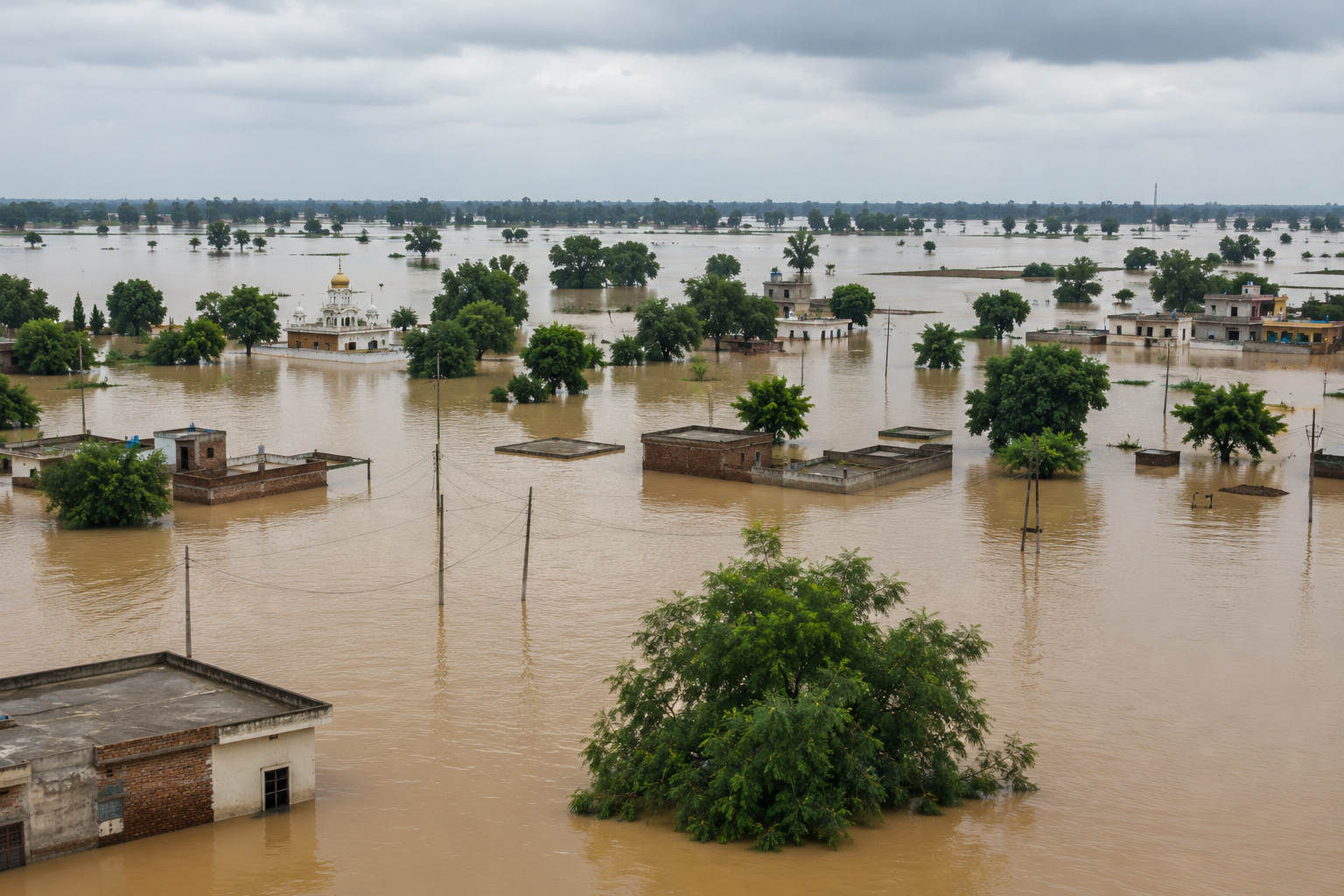
Fig. 3.12: Floods in Punjab
Causes
- The floods in Punjab resulted from both natural and human-made factors.
- Natural Causes: In 2025, Punjab faced very heavy monsoon rains, which were intensified by the western disturbances that brought even more moisture and rain. It rained not only in Punjab but also in Himachal Pradesh and Jammu & Kashmir. The major rivers of Punjab — the Satluj, the Beas, the Ravi, and the Ghaggar — were already flowing high before the heavy rains began. When additional rain fell, water from the hills and local rainfall caused rivers to overflow, leading to severe flooding in many parts of Punjab.
- Human-made Causes: The floods were further aggravated by weak and old river embankments, or dhūsī bāndh, which could not stop the rising water during heavy monsoon rains. People had also built houses and farms too close to the rivers, reducing the natural space where floodwater could spread safely. Over time, silt and mud had collected in rivers and dams, reducing their capacity to hold and carry water. In some areas, flood warnings came late or were not clearly communicated, leaving people unprepared. All these factors together increased the damage caused by the floods.
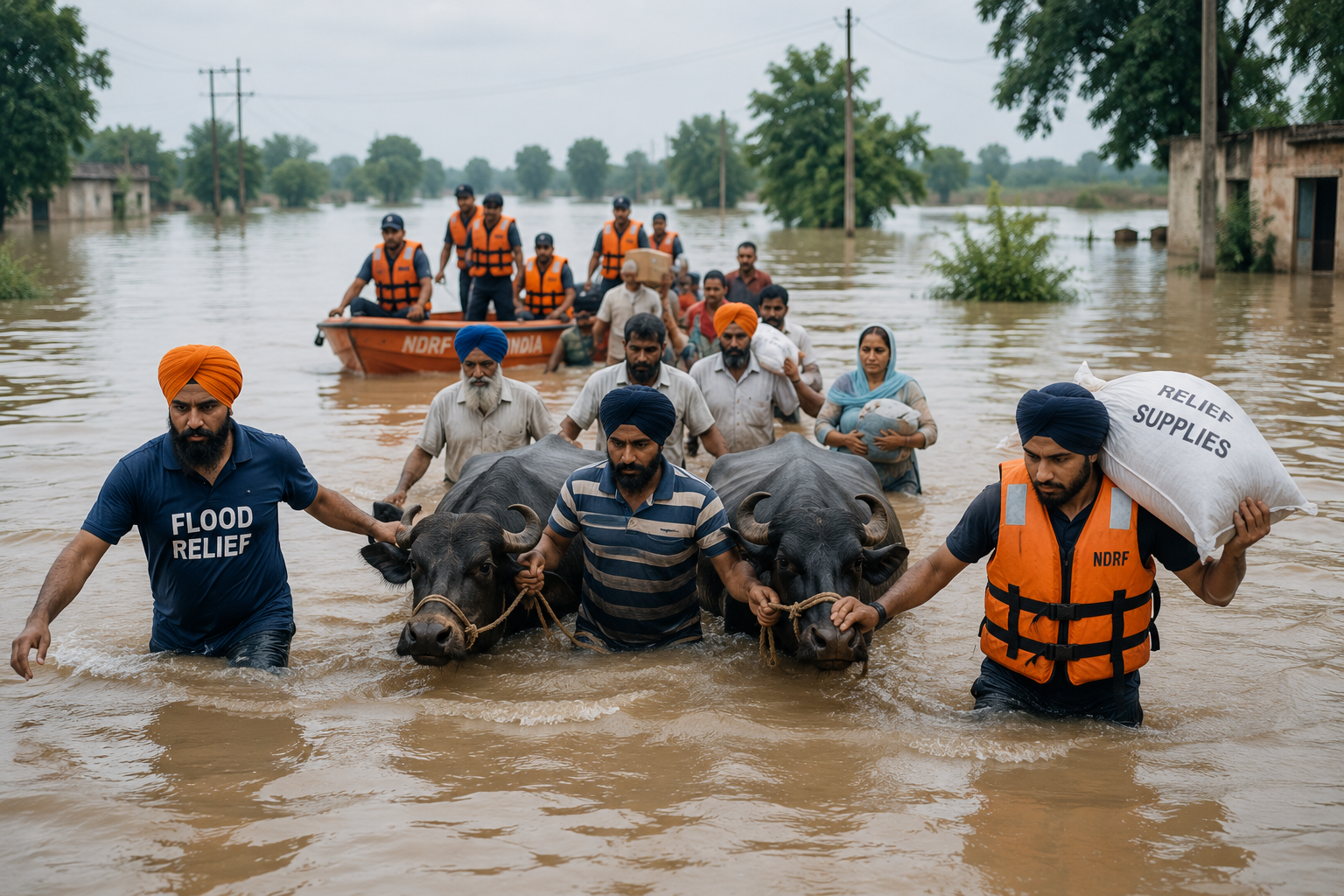
Fig. 3.13: Relief operations during the floods
Effects of the Floods in Punjab
- Many people lost their lives in the floods.
- Thousands of people had to leave their homes and move to relief camps for safety.
- Large areas of farmland were covered with water, and crops like paddy were severely damaged.
- Poultry and dairy farms were damaged and destroyed. Many animals, including cows, buffaloes, and chickens, got sick or died.
- Roads, bridges, border fences, and some public buildings were also damaged.
- Murky standing water caused health problems, including the spread of waterborne diseases and sanitation concerns.
💬 Classroom Discussion
1. To what extent did natural factors cause these floods compared to human activities?
Show Answer
Natural factors (very heavy monsoon rains intensified by western disturbances, already-swollen rivers) triggered the floods — but human factors decided how destructive they became: weak old embankments (dhūsī bāndh), construction too close to rivers, silted rivers and dams with reduced capacity, and late warnings. Nature loaded the gun; human negligence magnified the damage.
2. Do you think better planning could have reduced the damage? How?
Show Answer
Yes. Strengthening and maintaining embankments before the monsoon, regular desilting of rivers and dams, enforcing no-construction zones along rivers, timely and clear flood warnings with evacuation plans, and preserving floodplains as safety buffers would have greatly reduced losses.
3. What are the guidelines for the management of floods according to the National Disaster Management Authority (NDMA)?
Show Answer
NDMA’s flood guidelines include: flood forecasting and early warning systems; flood plain zoning (regulating construction in flood-prone areas); structural measures like embankments, reservoirs and proper drainage with regular maintenance; preparedness through mock drills, awareness and trained response teams; safe evacuation plans, relief camps and post-flood health measures against waterborne diseases.
4. What role can students/youth play in helping with disaster preparedness?
Show Answer
Students can learn and spread awareness about do’s and don’ts, take part in school mock drills, prepare family emergency kits and plans, volunteer responsibly in relief work (collection drives, helping at camps), avoid spreading rumours, use social media to share verified alerts, and join programmes like NCC/NSS/Aapda Mitra to be trained young responders.
📌 Before we move on…
- The Earth’s atmosphere is made up of different gases, mainly nitrogen and oxygen, along with small amounts of other gases like water vapour and dust, support life and help in forming clouds and causing rainfall.
- The atmosphere is made up of different layers, namely the Troposphere, Stratosphere, Mesosphere, Thermosphere, and Exosphere, which are divided based on changes in temperature and air density as we go higher above the Earth’s surface.
- Weather refers to the daily atmospheric conditions, while climate is the average weather of a place over a long period of time.
- India has a tropical monsoon climate, and the Indian Meteorological Department (IMD) divides the year into four main seasons, namely — Winter, Summer, Monsoon, and Post-monsoon.
- Climate change is the long-term change in weather caused mainly by human activities like burning fuels and cutting trees, which leads to global warming and extreme weather conditions.
- We can reduce our carbon footprint by saving energy, using renewable sources, planting trees, and living in more eco-friendly ways.
🧠 Questions and activities
1. What is atmosphere? Explain its composition with the help of a pie diagram.
Show Answer
The atmosphere is the blanket of air surrounding the Earth, pulled down by gravity — a mixture of gases vital for the survival of all living beings. Composition: Nitrogen 78%, Oxygen 21%, Argon 0.93%, Carbon dioxide 0.04%, and other gases 0.03%, along with water vapour (0.1–0.4%) and tiny dust particles. (Draw the pie diagram as shown in Fig. 3.2 on this page, with nitrogen taking the largest share.)
2. Draw a labelled diagram of the structure of atmosphere.
Show Answer
Refer to Fig. 3.3 on this page. Draw five layers from bottom to top with heights: Troposphere (~12 km — weather, clouds), Tropopause, Stratosphere (up to 50 km — ozone layer, aeroplanes), Stratopause, Mesosphere (50–80 km — meteors burn), Mesopause, Thermosphere (80–700 km — ionosphere, auroras, satellites), and Exosphere (above 700 km — very thin air). Practise reproducing it with all labels.
3. Which are the four main seasons of India?
Show Answer
According to the IMD: (1) Winter (December to early April), (2) Summer or pre-monsoon (April to June), (3) Monsoon or rainy — advancing monsoon (June to September), and (4) Post-monsoon — retreating monsoon (October to December).
4. Why do you not feel the pressure of the atmosphere?
Show Answer
Because air presses on us from all sides equally, and our bodies exert a counter-pressure in response — the pressure inside our bodies is equal to the atmospheric pressure and cancels the pressure from outside. Hence we do not feel the enormous weight of the air above us.
5. In which layer of the atmosphere do aeroplanes fly and why?
Show Answer
Aeroplanes fly in the stratosphere (up to 50 km) because it is free of clouds and other weather disturbances — offering smooth, stable flying conditions above the weather of the troposphere.
6. Distinguish between the following:
a. The troposphere and stratosphere
b. The south-west monsoon and north-east monsoon
Show Answer
a. Troposphere: the lowest layer (average ~12 km); temperature decreases with altitude; contains the air we breathe, most water vapour and clouds; nearly all weather occurs here. Stratosphere: lies above the troposphere up to 50 km; free of clouds and weather disturbances (ideal for aeroplanes); contains the ozone layer that filters harmful UV radiation.
b. South-west monsoon: blows from sea to land, June–September; caused by low pressure over the heated Indian landmass and high pressure over the cooler ocean; moist winds bring most of India’s annual rainfall. North-east monsoon: blows from land to sea, October–February; land cools faster creating high pressure over land; winds are cold and dry, but pick up moisture over the Bay of Bengal and bring rainfall to the eastern coast — Tamil Nadu, Andhra Pradesh and parts of Karnataka.
7. Do it yourself: Table 3.3 shows the average monthly temperatures and rainfall amounts for 10 representative stations. Study these figures and convert them into ‘temperature and rainfall’ graphs.
| Station (Latitude, Altitude) | Jan | Feb | Mar | Apr | May | Jun | Jul | Aug | Sep | Oct | Nov | Dec | Annual Rain (cm) |
|---|---|---|---|---|---|---|---|---|---|---|---|---|---|
| Bengaluru (12°58’N, 909 m) — Temp °C Rainfall cm | 20.5 0.7 | 22.7 0.9 | 25.2 1.1 | 27.1 4.5 | 26.7 10.7 | 24.2 7.1 | 23.0 11.1 | 23.0 13.7 | 23.1 16.4 | 22.9 15.3 | 18.9 6.1 | 20.2 1.3 | 88.9 |
| Mumbai (19°N, 11 m) — Temp Rain | 24.4 0.2 | 24.4 0.2 | 26.7 – | 28.3 – | 30.0 1.8 | 28.9 50.6 | 27.2 61.0 | 27.2 36.9 | 27.2 26.9 | 27.8 4.8 | 27.2 1.0 | 25.0 – | 183.4 |
| Kolkata (22°34’N, 6 m) — Temp Rain | 19.6 1.2 | 22.0 2.8 | 27.1 3.4 | 30.1 5.1 | 30.4 13.4 | 29.9 29.0 | 28.9 33.1 | 28.7 33.4 | 28.9 25.3 | 27.6 12.7 | 23.4 2.7 | 19.7 0.4 | 162.5 |
| Delhi (29°N, 219 m) — Temp Rain | 14.4 2.5 | 16.7 1.5 | 23.3 1.3 | 30.0 1.0 | 33.3 1.8 | 33.3 7.4 | 30.0 19.3 | 29.4 17.8 | 28.9 11.9 | 25.6 1.3 | 19.4 0.2 | 15.6 1.0 | 67.0 |
| Jodhpur (26°18’N, 224 m) — Temp Rain | 16.8 0.5 | 19.2 0.6 | 26.6 0.3 | 29.8 0.3 | 33.3 1.0 | 33.9 3.1 | 31.3 10.8 | 29.0 13.1 | 20.1 5.7 | 27.0 0.8 | 20.1 0.2 | 14.9 0.2 | 36.6 |
| Chennai (13°4’N, 7 m) — Temp Rain | 24.5 4.6 | 25.7 1.3 | 27.7 1.3 | 30.4 1.8 | 33.0 3.8 | 32.5 4.5 | 31.0 8.7 | 30.2 11.3 | 29.8 11.9 | 28.0 30.6 | 25.9 35.0 | 24.7 13.9 | 128.6 |
| Nagpur (21°9’N, 312 m) — Temp Rain | 21.5 1.1 | 23.9 2.3 | 28.3 1.7 | 32.7 1.6 | 35.5 2.1 | 32.0 22.2 | 27.7 37.6 | 27.3 28.6 | 27.9 18.5 | 26.7 5.5 | 23.1 2.0 | 20.7 1.0 | 124.2 |
| Shillong (24°34’N, 1461 m) — Temp Rain | 9.8 1.4 | 11.3 2.9 | 15.9 5.6 | 18.5 14.6 | 19.2 29.5 | 20.5 47.6 | 21.1 35.9 | 20.9 34.3 | 20.0 30.2 | 17.2 18.8 | 13.3 3.8 | 10.4 0.6 | 225.3 |
| Thiruvananthapuram (8°29’N, 61 m) — Temp Rain | 26.7 2.3 | 27.3 2.1 | 28.3 3.7 | 28.7 10.6 | 28.6 20.8 | 26.6 35.6 | 26.2 22.3 | 26.2 14.6 | 26.5 13.8 | 26.7 27.3 | 26.6 20.6 | 26.5 7.5 | 181.2 |
| Leh (34°N, 3506 m) — Temp Rain | −8.5 1.0 | −7.2 0.8 | −0.6 0.8 | 6.1 0.5 | 10.0 0.5 | 14.4 0.5 | 17.2 1.3 | 16.1 1.3 | 12.2 0.8 | 6.1 0.5 | 0.0 – | −5.6 0.5 | 8.5 |
Table 3.3: Average monthly temperatures and rainfall for 10 representative stations (data are representational). For graphs, plot temperature as a line and rainfall as bars, as in Fig. 3.14 (Delhi).
7.1. Re-arrange the 10 stations according to their distance from the equator.
Show Answer
From nearest to farthest from the equator (by latitude): Thiruvananthapuram (8°29’N) → Bengaluru (12°58’N) → Chennai (13°4’N) → Mumbai (19°N) → Nagpur (21°9’N) → Kolkata (22°34’N) → Shillong (24°34’N) → Jodhpur (26°18’N) → Delhi (29°N) → Leh (34°N).
7.2 Find out: (a) Two stations with the most extreme climate. (b) Two stations influenced by retreating monsoons. (c) The two hottest stations in the months of (i) February (ii) June.
Show Answer
(a) Leh (temperature swings from −8.5°C in January to 17.2°C in July — a cold desert) and Jodhpur (14.9°C to 33.9°C with very little rain — a hot desert). Delhi also shows a large annual range.
(b) Chennai and Thiruvananthapuram — both receive heavy rainfall in October–November (Chennai’s maximum rain falls in Oct–Nov: 30.6 and 35.0 cm) from the retreating (north-east) monsoon picking up moisture over the Bay of Bengal.
(c) (i) February: Thiruvananthapuram (27.3°C) and Chennai (25.7°C). (ii) June: Jodhpur (33.9°C) and Delhi (33.3°C).
7.3. Now find out: (a) Why does Shillong experience more rainfall than Kolkata? (b) Why does Delhi receive more rainfall than Jodhpur?
Show Answer
(a) Shillong (altitude 1,461 m) sits in the Meghalaya hills directly in the path of the moisture-laden Bay of Bengal branch of the monsoon. The hills force the moist winds to rise, cool and condense, giving very heavy orographic rainfall (225.3 cm). Kolkata, on the flat plains at just 6 m altitude, has no such barrier to lift the winds, so it receives less (162.5 cm).
(b) The monsoon winds progressively lose moisture as they travel north-westwards across the plains. Delhi lies further east on this track and still receives 67 cm; by the time the winds reach Jodhpur in the Thar region, little moisture is left — and the Aravalli hills lie parallel to the winds, failing to force them to rise — so Jodhpur gets only 36.6 cm.
7.4. Now think why: (a) Thiruvananthapuram has an equable climate? (b) Chennai has more rainfall only after the fury of the monsoon is over in most parts of the country? (c) Leh has moderate precipitation almost throughout the year?
Show Answer
(a) Thiruvananthapuram lies close to the equator (8°29’N) and on the sea coast — the sea moderates its temperature, which stays between about 26.2°C and 28.7°C all year (a range of barely 2.5°C). Hence its climate is equable.
(b) During the south-west monsoon, Chennai lies in a relatively rain-poor position (winds move roughly parallel to the Coromandel coast). Its main rains come from the retreating north-east monsoon (October–December), when winds passing over the Bay of Bengal pick up moisture and strike the Tamil Nadu coast — after the monsoon has withdrawn from most of the country.
(c) Leh (3,506 m) is a cold desert beyond the great Himalayan ranges, which block the monsoon winds — so no month gets heavy rain. The small precipitation it receives (total 8.5 cm) comes in modest amounts spread across the year, largely as snowfall from westerly disturbances.
7.5. Despite these differences across regions, can you observe any substantial evidence to conclude that the monsoons provide a very strong framework, lending overall climatic unity to the whole country?
Show Answer
Yes. Almost every station — Mumbai, Kolkata, Delhi, Nagpur, Shillong, Bengaluru, Jodhpur — receives the bulk of its annual rainfall in the same June–September window, whatever its latitude or altitude; Chennai and Thiruvananthapuram are watered by the same system in its retreating phase. The entire agricultural calendar, festivals, water supply and economy of India move to this single seasonal rhythm — the monsoon binds India’s diverse regions into one climatic framework.
8. Collect pictures of houses and clothing of people from different regions of India. Examine whether they reflect any relationship with the climatic conditions or the relief of those regions.
Show Answer
Activity guidance with examples: Rajasthan — thick-walled mud houses with flat roofs and small windows (hot, dry climate); light cotton clothes and turbans against heat. Kerala/coastal areas — sloping tiled roofs to drain heavy rain; light cotton clothing for humidity. Assam/North-East — houses on bamboo stilts against floods and dampness. Himalayan regions — stone/wood houses with sloping roofs for snow; thick woollens for cold. Punjab plains — brick houses with courtyards. Conclusion: house design and clothing everywhere directly reflect local climate and relief.