
Class 8 Social Science — Economic Life Around Us
Chapter 7🏭 Factors of Production
🎯 Learning Objectives
- Understand what factors of production are and identify the four types — land, labour, capital, and entrepreneurship
- Distinguish between labour and human capital
- Explain the facilitators of human capital: education, training, healthcare, and social/cultural influences
- Identify challenges to human capital development in India
- Describe India’s ancient skill heritage with examples
- Understand the role of capital and entrepreneurship in production
- Explain the role of technology as an enabler of production
- Understand how all factors of production are interconnected
- Identify responsibilities of producers towards natural resources and workers
💡 The Big Questions
- What are the factors of production?
- How are these factors interconnected?
- What is the role of human capital in production, and what are its facilitators?
📖 Chapter Index
📜 Introduction
- Every product around you goes through a production process before it finally reaches you.
- This process involves using resources or inputs required to produce the final product.
- The resources or inputs used in producing goods and services are called factors of production.
- Businesses combine various inputs to create goods and services, which also generate opportunities for people to engage in economic activities.
🔑 Key Term — Business
Business: A firm, a shop, a factory, etc., which produces or sells goods or provides a service.
📖 Meet Ratna — Pause Point Restaurant
Ratna runs a small restaurant named Pause Point on the city outskirts — popular among highway travellers for its tasty, high-quality food. It is growing, with a team of seven people who assist her. When she started five years ago, she had to: choose a location, organise money for rent and equipment, hire staff, buy ingredients, and plan how to make her dream a success.

Ratna’s Pause Point — a successful small restaurant popular among highway travellers
🔍 Let’s Explore — Economic Activities in Your Locality
In small groups, study the economic activities around your locality. Here is a sample report:
| Types of Shops | No. in Locality | Goods/Services | Inputs Required |
|---|---|---|---|
| Grocery shops | 13 | Food grains, milk, bread | Packaged goods, perishables, storage space |
| Restaurants/food stalls | 8 | Cooked meals, snacks, beverages | Raw ingredients, gas, utensils; cook/helper |
| Vegetable vendors | 15 | Fresh vegetables and fruits | Fresh produce, baskets, weighing scale, cart/stall |
| Mobile repair shops | 4 | Mobile repair, accessories | Tools, spare parts, knowledge of mobile components |
| Salons/parlours | 3 | Haircut, grooming, beauty | Scissors, creams, products, water, electricity |
Looking at your group’s report, think about: Where do people get the money for their business? Where did the hairdresser get trained? Who taught the food vendors to cook? What motivated the business owners to start their business?
🧩 Factors of Production
- In economics, the inputs used in a production process are classified into four types: Land (natural resources), Labour (human resources), Capital, and Entrepreneurship.
- Technology is a facilitator and a crucial factor that enables businesses to produce more goods with the same or fewer inputs.
🌿 Land (Natural Resources)
- The word ‘land’ in economics encompasses not only geographical land but also natural resources like soil, forests, water, air, sunlight, minerals, oil, and natural gas.
- Businesses either purchase the required land or pay rent to use it for a period of time.
🔍 Let’s Explore
Revisit the table in your report. Which of the items on your list can be labelled as ‘land’?
Show Answer
From the sample table, ‘land’ (natural resources) would include: fresh produce and food grains (grown on land using soil, water and sunlight), milk (from animals reared on land), and water and electricity (electricity often generated from natural resources). The raw ingredients and perishables ultimately come from land/natural resources.
👷 Labour (Human Resources)
- Labour is essential in production, involving physical and mental effort.
- Carpenters, farmers, construction workers, teachers, and doctors use varying levels of physical strength, knowledge, and skill.
- Everyone contributes differently through their work, helping create goods and services for society’s needs.
🔑 Key Term — Skill
Skill: The ability to do an activity or job well with practice and training.
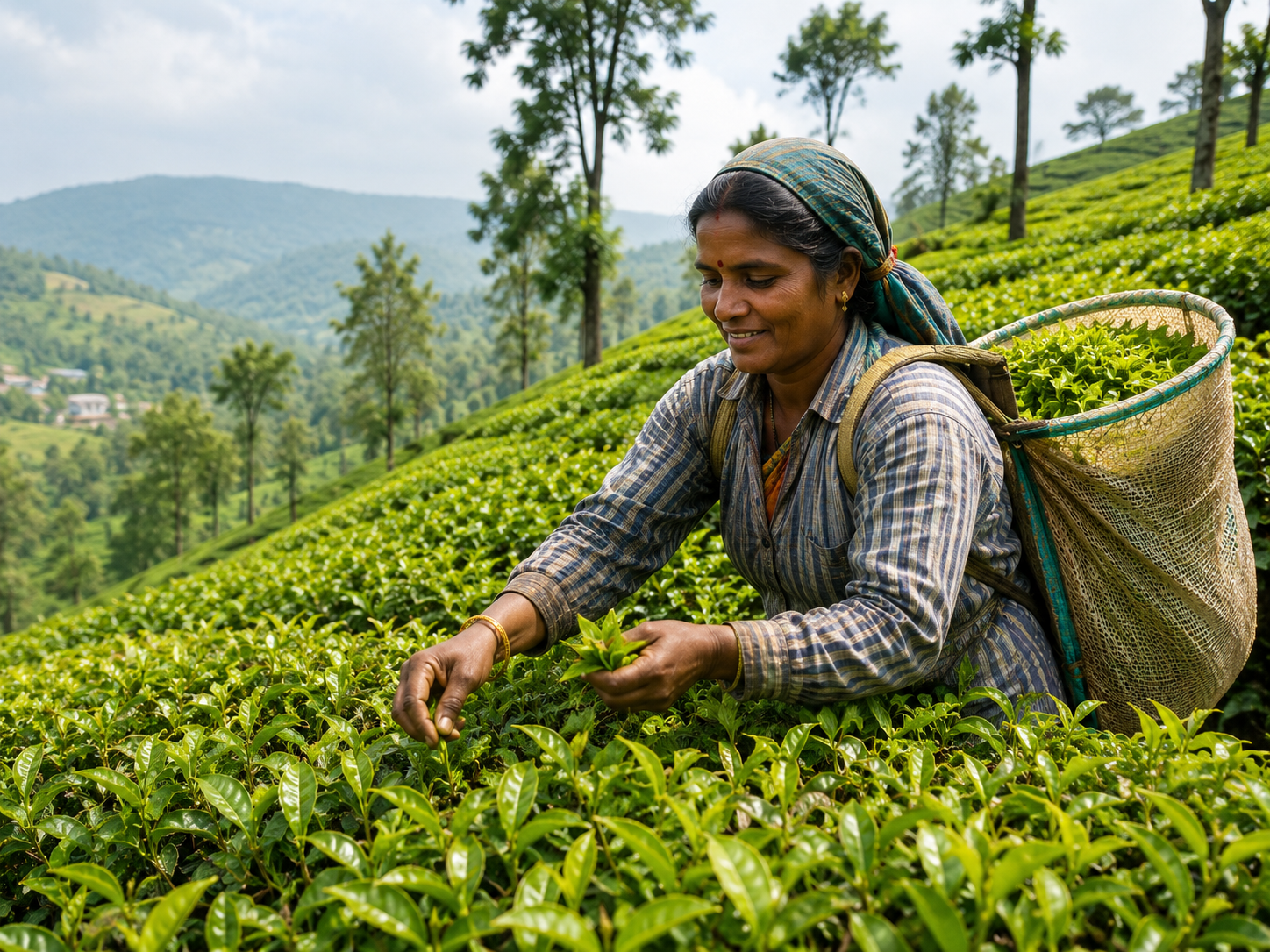
Fig. 7.3 — Worker at a tea plantation
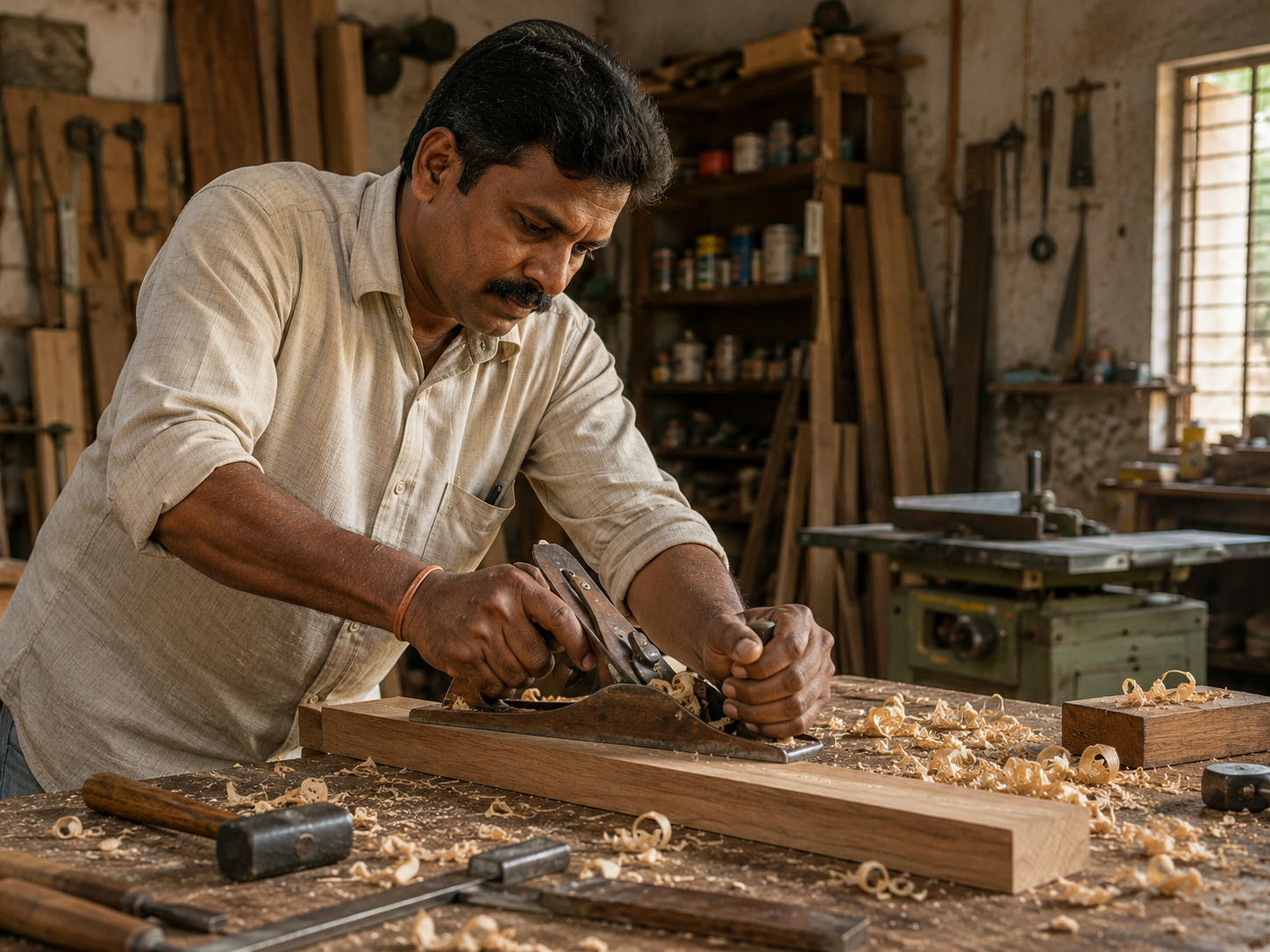
Fig. 7.5 — Carpenter

Fig. 7.6 — Software developer
People as a Resource
- Human beings play a key role in economic activities as they apply their knowledge, skills, and decision-making abilities to create goods and services.
- Examples: a police officer maintains law and order; a scientist invents new technologies; a chef develops new recipes.
- They all require a special set of knowledge and skills and must be dedicated to their work.
- Labour refers to the physical and mental effort used in production.
- Human capital refers to the specialised skills, knowledge, abilities, and expertise required to perform that labour.
- Human capital is not just the basic efforts of labour but also the quality and efficiency of that labour.
🎓 Facilitators of Human Capital
Education and Training
- Education helps individuals gain knowledge, starting with basic literacy and extending to expertise in specific fields.
- What you learn in school enriches your knowledge and prepares you to solve real-world problems.
- Example: A civil engineering student learns principles of design and materials, applied to building infrastructure like roads and bridges.
- The challenge lies in creating durable, cost-efficient, and eco-friendly solutions — achieved through training such as observing construction sites, testing materials, and hands-on application.
- With education and training, individuals are prepared to excel in their careers.
🔑 Key Terms
- Training: The process of learning the required skills to do a particular job or activity.
- Cognitive: Refers to the process of learning, knowing, and understanding.
Healthcare
- Good health supports cognitive development, allowing children to attend school regularly and learn better.
- Workers are able to give their best, physically and mentally, when they are of sound body.
- They are able to: do more in shorter time periods, be creative, and avoid being away from work due to ill health.
💡 Think About It
How do infrastructure and healthcare systems like hospitals, primary healthcare centres, doctors, pharmacies, diagnostic labs, etc., contribute to developing human capital?
Show Answer
A strong healthcare system keeps people healthy, so children attend school regularly and learn better, and workers can be more productive, creative and rarely absent due to illness. Hospitals, PHCs, doctors and labs prevent and treat disease, reducing lost working days and improving cognitive development — directly raising the quality and efficiency of a nation’s human capital.
Social and Cultural Influences
- A culture of hard work, continuous improvement, and endeavouring to do things well has helped countries move forward.
- Kaizen — a Japanese concept meaning ‘continuous improvement‘: applied in Japan since the mid-1940s; has helped Japan achieve higher standards of living.
- German work ethic — deeply rooted in history: Germany is renowned for high-quality industrial output; they place high value on punctuality, attention to detail, and quality; these qualities contributed to their rise as a global leader in technology and manufacturing.
🔍 Let’s Explore
- Make a list of 10 working adults in your family and neighbourhood. Ask them to describe the culture at their workplace. What are some adjectives that occur more frequently?
- In the Tapestry chapters, you have seen examples of art and architecture in India across several centuries. What factors enabled their creators to achieve such high levels of excellence? Discuss in groups.
📉 Challenges to Human Capital
- Our nation has come a long way in various aspects of human capital since Independence.
- Literacy is an important characteristic of the population and helps enhance the skills and productivity of human capital.
- The Adult Literacy Rate in India is 85 per cent for males and 70 per cent for females as of 2023 (World Bank estimates).
- Despite progress, India faces challenges in developing human capital.
🔑 Key Terms
- Productivity: Ability to do more in a particular time period.
- Adult Literacy Rate: Percentage of people aged 15 and above who can read and write with understanding a short, simple statement about their everyday life.
💡 Think About It
- Shivay, a Grade 8 student, had to drop out of school two years back as his father lost his job. How do you think the loss of schooling years will affect Shivay when he grows up?
- What problems could businesses face when they do not find workers with the required skills?
Show Answer
Losing schooling years will reduce Shivay’s literacy, skills and future job options, likely trapping him in low-paid work and reducing his lifetime earnings and human capital. For businesses, a shortage of skilled workers means lower productivity, poorer quality goods and services, higher training costs, and difficulty growing or competing — showing how education gaps hurt both individuals and the economy.
- According to the Economic Survey of India 2024, 65 per cent of people in India are below the age of 35 years.
- This means India has a young, productive population, which may help the country reap the benefits of a demographic dividend.
- The demographic dividend refers to the benefit a country gets when it has a large number of young and working people.
- When more people are working and earning, and fewer depend on them, the country can grow businesses and improve living standards.
- To take advantage of this potential, individuals must have access to quality education, health, training, and skilling.
💡 Think About It
Are some jobs more important than others? What would happen if nobody cleaned the streets, collected the trash, farmers stopped cultivating crops, doctors were not available to treat patients, and so on?
Show Answer
No job is unimportant — society depends on all of them working together. If street cleaners and trash collectors stopped, disease would spread; if farmers stopped, there would be no food; if doctors were unavailable, illness would go untreated. Every kind of work contributes to society’s functioning, so all jobs deserve respect and dignity, regardless of status or pay.
🏛️ India’s Ancient Skill Heritage
🕉️ Work as Worship — India’s Ancient Tradition
- For ancient Indians, work was a form of expressing their nature and striving for perfection — an offering to the deity or the receiver.
- It had to be created or done with devotion.
- The tools used (a type of technology) were worshipped — this tradition continues as Viśhwakarmā pūjā or Āyudha pūjā.
- Creating products involved a unique blend of kalā (art) and vidyā (knowledge).
- Knowledge was passed on from generation to generation, and also built upon.
- The śhilpa śhāstras are ancient texts containing detailed design guidelines on sculptures, paintings, buildings, wooden items, and jewellery — texts on sculpture prescribe exact specifications regarding postures, colours, measurements, and proportions.
⭐ Don’t Miss Out — Temple Sculptors
- Generations of families of sculptors have worked on constructing India’s temples over centuries.
- They used their skills without expecting to see the finished outcome.
- They pursued excellence, considering work as worship by practising regularly and learning new techniques.
Stitched Shipbuilding
- Indians used a unique stitching technique dating back over 2000 years to make ships and boats.
- Used to conduct maritime trade and cultural exchanges across the Indian Ocean.
- The technique involved stitching wooden planks together using cords instead of nails, which made them flexible and helped ships navigate the Indian Ocean with ease.
🔍 Let’s Explore
- Many traditional techniques of production have disappeared or declined — e.g. the stitching of ships declined severely after Europeans arrived in the Indian Ocean in the 16th century; it is now used only for small fishing boats. Why do you think the use of indigenous techniques has declined?
- Find out some techniques and products from your region that showcase human effort and skill. Explain briefly using drawings and text in class.
Show Answer
Indigenous techniques declined because cheaper, faster, mass-produced alternatives (often European or industrial) replaced them, colonial policies discouraged local industries, younger generations moved to other work, and the knowledge — passed down orally within families — was lost when it stopped being practised. Without demand or new learners, many traditional skills faded.
🧠 Check Your Understanding — Land, Labour & Human Capital
LOTS In economics, what does the word ‘land’ include beyond geographical land? Give three examples.
Show Answer
In economics, ‘land’ encompasses not only geographical land but also natural resources like: (1) soil and forests; (2) water, air, and sunlight; (3) minerals, oil, and natural gas. Businesses either purchase the required land or pay rent to use it.
Medium What is the difference between ‘labour’ and ‘human capital’? Use examples to explain.
Show Answer
Labour refers to the basic physical and mental effort used in production — for example, a farmer ploughing a field or a factory worker operating a machine. Human capital refers to the specialised skills, knowledge, abilities, and expertise that make that labour more effective — for example, a farmer trained in modern agricultural techniques produces far more than an untrained one. Human capital is the quality and efficiency of the effort, not just the effort itself. A carpenter (labour) who has completed formal training in advanced woodworking (human capital) produces better furniture faster.
HOTS Japan’s kaizen and Germany’s work ethic are cited as social/cultural influences on human capital. Can you identify a similar value in India’s ancient tradition that influenced the quality of work? How relevant is it today?
Show Answer
India’s ancient tradition treated work as worship — tools were revered (Vishwakarma/Ayudha Puja), and creating products required devotion and mastery of both kalā (art) and vidyā (knowledge) through the śhilpa śhāstras. Temple sculptors worked for generations without seeing the completed result, pursuing excellence intrinsically. This value is still relevant: workers who take genuine pride in their craft — software engineers, doctors or artisans — produce higher-quality outcomes than those motivated only by salary. Reviving this ethos could help India reclaim global recognition for quality craftsmanship.
HOTS India has 65% of its population below 35 — a potential “demographic dividend.” But there are literacy challenges. What conditions must be met to convert this young population from a potential burden into an actual dividend?
Show Answer
To convert the young population into a demographic dividend, India must ensure: (1) Quality education and skill training — improving literacy (85% male, 70% female) and vocational training so young people are job-ready; (2) Healthcare access — a healthy workforce is more productive; (3) Job creation — a large young population only benefits the economy if there are enough meaningful jobs; without them, it becomes a burden; (4) Girls’ education and participation — with female literacy at only 70%, nearly half the potential workforce is underutilised. The example of Shivay shows how a single setback can break the education-productivity chain for a whole generation.
🏭 Capital
- Businesses require capital that comprises: monetary resources (money) and durable assets like machinery, tools, equipment, vehicles, vending carts, computers, shops, factories, and office buildings.
- Just as Ratna would have required money to take land on lease, buy furniture, and kitchen equipment — these are all called ‘capital’.
- Capital = money plus human-made resources that are used to produce goods and services.
🔑 Key Term — Capital
Capital: In economics, any asset, whether physical or financial, used to produce goods and services.
Where Do Businesses Get Capital?
- Personal savings, family, and friends are the first source of funds — just as Ratna did when she started her business.
- When personal funds are insufficient, businesses take a loan from the bank — Ratna paid interest along with part of her loan amount over time.
- Large companies require a lot of money to expand — they raise money from the general public through the stock market.
- The stock market is a special type of market where shares are bought and sold.
- Large companies raise money from the public by offering them a share of the profits, called a dividend.
- In other words, big businesses can raise financial capital through the stock market by selling shares of their business.
🔑 Key Terms
- Interest: The amount of money paid by the borrower of a loan to the lender for using their money for a specific time.
- Dividend: An amount of money paid regularly by a company to its shareholders out of its profits.
🔍 Let’s Explore
Identify a factory in your region. Find out how much capital may have been invested in its construction (you may provide an estimate). What kinds of equipment does the factory use to create its finished products?
💡 Entrepreneurship
- Entrepreneurship means starting your own business or creating something new to solve a problem.
- An entrepreneur is a person who: comes up with an idea; takes risks; gathers other factors of production; and works hard to make their startup idea successful.
- An entrepreneur’s vision for solving a problem helps bring innovative products and services to the market that benefit society and the nation.
- At the same time, they also create job opportunities and support livelihoods.
- In return, they derive a deep sense of satisfaction from seeing their dreams become a reality and serving the people.
🔑 Key Term — Startup
Startup: An entrepreneurial venture with limited resources that aims at rapid growth and expansion while leveraging technology.
Tasks Performed by an Entrepreneur (Fig. 7.16)
🏭 The Man Who Dreamed Big for India — J.R.D. Tata
- Jehangir Ratanji Dadabhoy (J.R.D.) Tata was one of India’s greatest entrepreneurs and played a big role in building modern India.
- Born in 1904, he became the head of the Tata Group, one of the largest business groups in the country.
- He believed that businesses should not only make money but also help society.
- He started India’s first airline, Tata Airlines, in 1932, which later became Air India.
- Under his leadership, the Tata Group expanded into many areas like steel, cars, power, and chemicals.
- He was known for caring about his workers and believed in providing them with good working conditions.
- He was a man of vision, hard work, and honesty.
- In 1992, he received the Bharat Ratna, India’s highest civilian award, for his great service to the nation.
💡 Think About It — J.R.D. Tata
- What could be the lessons for young entrepreneurs from the above case?
- Does the existing knowledge of the entrepreneur help in finding solutions? Or do they need to seek other sources?
- Is profit the only motivation for an entrepreneur? Why or why not?
- What are the other personality traits required to be a successful entrepreneur?
Show Answer
Lessons: dream big, take calculated risks, act with honesty, and care for workers and society — not just profit. An entrepreneur’s existing knowledge helps, but they must also seek new sources — experts, research and teamwork — to solve problems. Profit is not the only motivation; JRD was driven by nation-building, innovation and worker welfare. Successful entrepreneurs also need vision, perseverance, honesty, risk-taking ability, leadership and empathy.
🧠 Check Your Understanding — Capital & Entrepreneurship
LOTS What is ‘capital’ in economics? Give three examples of capital used in a business.
Show Answer
In economics, capital is any asset — physical or financial — used to produce goods and services. It is money plus human-made resources. Three examples: (1) machinery and tools used in a factory; (2) vehicles used to transport goods; (3) money/loans raised from banks or investors to fund operations.
Medium What is the difference between a ‘loan’ and a ‘dividend’ as ways of raising capital? Who typically uses each method?
Show Answer
A loan is borrowed money that must be repaid to the lender (e.g. a bank) with interest over time — small businesses like Ratna’s restaurant typically use loans. A dividend is a share of a company’s profits paid to shareholders who bought its shares on the stock market — large companies raise capital this way. Key difference: a loan must be repaid with interest regardless of profit; a dividend is only paid when the company makes profits.
HOTS J.R.D. Tata believed “businesses should not only make money but also help society.” How does this connect to entrepreneurship? Can a business succeed long-term if it only focuses on profit?
Show Answer
The chapter describes an entrepreneur as someone who contributes to the welfare of society through innovation — not just profit. JRD Tata exemplified this by building India’s aviation sector, providing good worker conditions, and strengthening the nation. A business that only chases profit tends to exploit workers (reducing quality and loyalty), damage the environment (harming its own resource base), and lose public trust. Long-term success needs community goodwill, employee motivation and sustainable resource use — which is also why India made CSR mandatory in 2014.
HOTS Ratna used personal savings first, then a bank loan. What are the advantages and risks of each source of capital? When might a startup choose one over the other?
Show Answer
Personal savings — Advantages: no interest, no repayment obligation, full control. Risks: limited amount, risks personal finances if the business fails. Bank loan — Advantages: larger amounts, faster start/expansion. Risks: must repay with interest regardless of success, creating pressure early on. A small, low-risk idea (like a local restaurant) might start with savings; a business needing big infrastructure (a factory or tech startup) might need a loan early. The key is matching the capital source to the scale and risk of the idea.
⚙️ Technology: An Enabler of Production
- Technology means the application of scientific knowledge. For example, a camera converts light into electrical signals to create a digital image.
- Any production-related activity uses some form of technology.
- Some early forms of technology that have existed since ancient times are still in use today (e.g. pulleys and wheelbarrows).
Modern Technology in Action
- Newer and advanced technological developments make our lives easier: UPI (Unified Payments Interface) — payments at the click of a button; weather apps — farmers get advance weather updates; GPS (Global Positioning Systems) — discovers the shortest routes for transporting goods.
- Old technology gets replaced by a new, better one — making it easier for people and businesses to get things done. For example, instead of sending letters by post, we now use email to communicate quickly and cheaply.
- However, technological progress does not always mean replacing old technologies — some, like pulleys and wheelbarrows, are still in use.
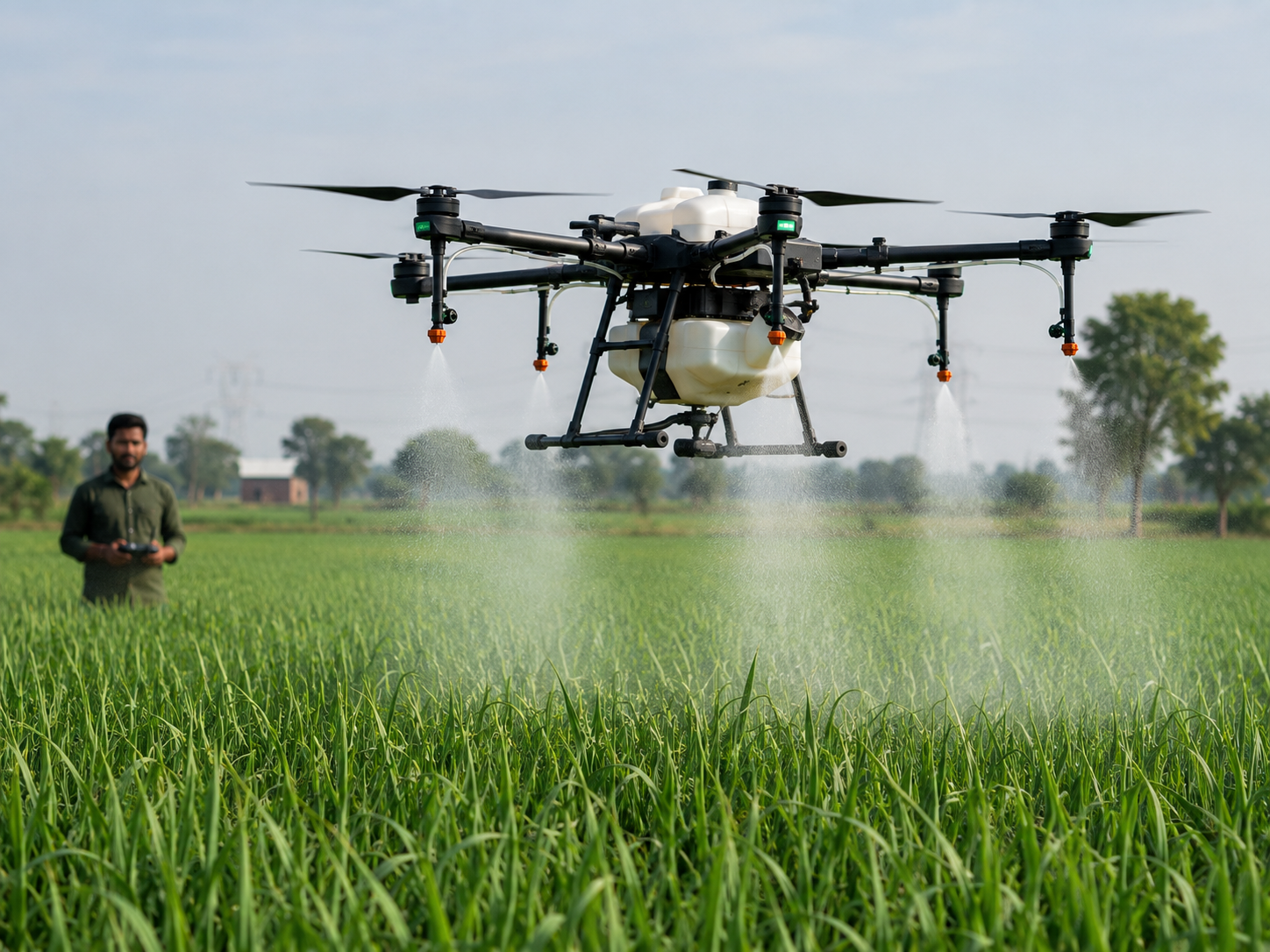
Fig. 7.18 — Drones spraying fertilisers to improve crop health
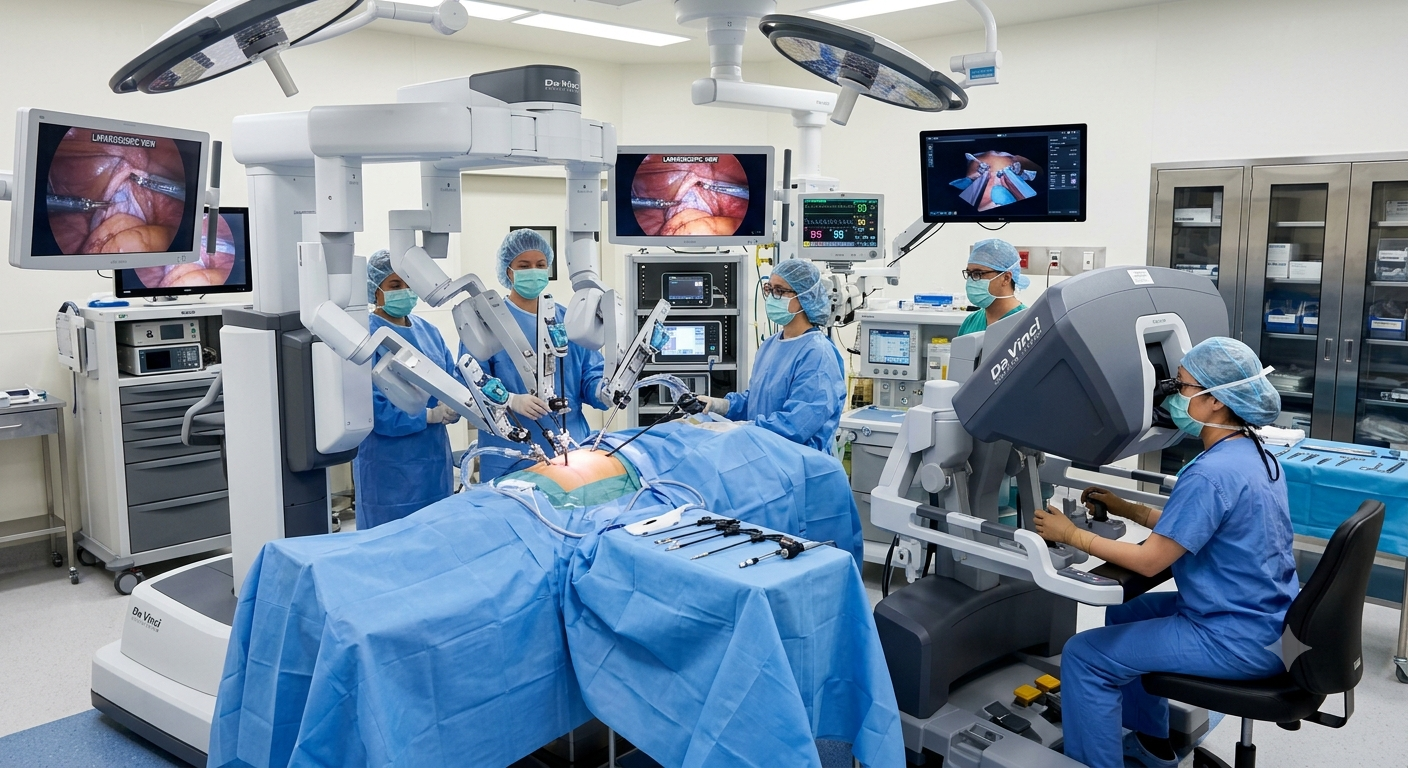
Fig. 7.19 — Robots assisting in surgical processes
🌐 Online Learning and Job Platforms
- SWAYAM (Study Webs of Active Learning for Young Aspiring Minds): a government platform offering courses for Grade 9 onwards; operates on MOOCs (Massive Open Online Courses); learners can explore subjects like robotics, aquaculture, textile printing — free of cost; students learn at their own pace, from anywhere.
- National Career Service — the government’s online portal: helps people find job opportunities across various sectors, from plumbing to accounting.
- Technology has eliminated geographical barriers, allowing people access to knowledge, skill development, and jobs in India and abroad.
- 📱 SWAYAM: swayam.gov.in • 💼 National Career Service: ncs.gov.in
🔍 Let’s Explore
- Can you think of technological advancements that have impacted the lives of people around you? Talk to elders about it.
- Think of an invention you would like to make to solve a problem. Write its name, what it does, how it works, and sketch what it would look like. Discuss with classmates.
🧠 Check Your Understanding — Technology
LOTS What does SWAYAM stand for? What kind of platform is it and who can access it?
Show Answer
SWAYAM stands for Study Webs of Active Learning for Young Aspiring Minds. It is a Government of India online learning platform that operates on MOOCs (Massive Open Online Courses), offering free courses from Grade 9 onwards in subjects like robotics, aquaculture and textile printing. Students can learn at their own pace from anywhere in India.
Medium How has technology acted as an “enabler” of production? Give two specific examples where it helped businesses or farmers do more with less effort.
Show Answer
Technology enables production by allowing businesses and workers to produce more efficiently with the same or fewer inputs. Two examples: (1) Drones spraying fertilisers — farmers cover large areas quickly and precisely, reducing time, labour and chemical waste versus manual spraying; (2) GPS for goods transport — businesses find the shortest routes, reducing fuel costs, travel time and logistics expense. Both show technology improving upon manual, time-consuming processes.
HOTS “Technological progress does not always mean replacing old technologies.” Why have pulleys and wheelbarrows survived while letter-writing by post has been replaced? What determines whether an old technology survives?
Show Answer
Old technologies survive when they are (1) still the most cost-effective solution — a pulley lifts heavy loads cheaply with no electricity; a wheelbarrow moves materials on rough terrain where machines can’t easily go; and (2) not yet replaced by something significantly better for that specific use. In contrast, letter-writing was replaced by email because email does everything a letter does but far faster, cheaper and more conveniently. The determining factor is whether a new technology offers enough advantage in cost, speed or capability to justify switching. When an old technology still does its job efficiently at low cost, it persists alongside newer ones.
HOTS Platforms like SWAYAM and National Career Service have “eliminated geographical barriers.” How might this benefit students in smaller towns or rural areas compared to those in big cities? What challenges remain?
Show Answer
Benefits: Rural and small-town students can access the same quality courses and job listings once available only to urban students, without relocating or paying high fees — levelling the playing field and letting rural talent compete nationally. Challenges: (1) reliable internet is still poor in many rural areas; (2) not all students have smartphones or computers; (3) language barriers — many courses are in English or Hindi; (4) online learning needs self-discipline, and without teachers for support, students may struggle to finish courses.
🔗 How Are the Factors Connected?
- The factors — land, labour, capital, entrepreneurship, and technology — are combined to produce goods and services.
- The proportion of each factor used depends on the product:
- Labour-intensive — agriculture, construction, and handicraft sectors rely more on labour.
- Capital-intensive — semiconductor chips or satellites require more capital and specialised machinery.
- These factors complement each other and are interconnected — if some are missing or misused, production can become inefficient or halted.
- New techniques can change the proportion used and output: increased machine use in agriculture can lower dependence on labour; 3-D printing can help revive dying art forms in textiles by producing handloom products at large scale.
- Production inputs are available at different geographic locations — businesses procure them from varied locations and combine them; this geographic interconnectedness provides access to varied inputs.
🔑 Key Term — Supply Chain
Supply chain: A network of individuals, organisations, resources, activities, and technology that are involved in the production and sale of goods.
- Production activities sometimes face severe supply chain challenges.
- When a disruption occurs due to relying on sources from far-off places (instead of local inputs), it results in a halt in the production process.
- This was seen during the COVID-19 pandemic.
⭐ Don’t Miss Out — India: Mobile Phone Manufacturer
- India is the world’s second-largest mobile phone manufacturer after China in 2025!
- Human effort is involved at every stage of production — to design, supervise, and improve products and processes.
- Teams of software, electrical, and mechanical engineers, along with project managers, use their expertise to develop a product.
- The entrepreneur provides guidance on how resources should be used.
- Together, all these inputs are essential, working like puzzle pieces to create the goods and services we rely on.
The Process of Mobile Phone Assembly (Fig. 7.23)
- Every stage needs Land + Labour + Capital + Entrepreneurship + Technology — no single factor works alone.
🧠 Check Your Understanding — How Factors Connect
LOTS What is a ‘supply chain’? Give one example of a supply chain disruption mentioned in the chapter.
Show Answer
A supply chain is a network of individuals, organisations, resources, activities and technology involved in the production and sale of goods. A disruption example: the COVID-19 pandemic — production halted when businesses relying on inputs from far-off places lost access to those supplies, stopping the whole production process.
Medium What is the difference between a ‘labour-intensive’ and a ‘capital-intensive’ industry? Give one example of each.
Show Answer
A labour-intensive industry relies more on human effort than machinery — examples: agriculture, construction and handicrafts. A capital-intensive industry needs more machinery, specialised equipment and financial investment than labour — examples: semiconductor chips and satellite manufacturing. The proportion of each factor used depends on the type of product.
HOTS “3-D printing can help revive dying art forms in textiles by producing handloom products at large scale.” Is this a good or bad outcome for traditional artisans? Who benefits and who might be harmed?
Show Answer
Benefits: art forms that might disappear can be preserved and reach a wider market; consumers get products cheaply; cultural heritage survives even if the artisan community shrinks. Potential harms: artisans who spent years mastering a craft may lose their livelihood if machines replicate their work cheaply at scale, threatening whole communities. Balance: the ideal is using 3-D printing to reach new markets while still supporting original artisans for premium, authentic handmade versions — the key question is whether the technology supplements artisans’ work or entirely replaces them.
HOTS For Ratna’s Pause Point, identify which factor of production each represents: (a) the land the restaurant sits on, (b) the gas stove and equipment, (c) the cooks and helpers, (d) Ratna’s decision to start it. What happens if any ONE factor is removed?
Show Answer
(a) Land — the physical space/location; (b) Capital — the gas stove, equipment and furniture; (c) Labour — the cooks and helpers; (d) Entrepreneurship — Ratna spotting the opportunity, taking the risk and combining the other factors. If any one is removed: without land, no place to cook or serve; without capital, food can’t be prepared efficiently; without labour, no one to cook or serve; without Ratna’s entrepreneurship, the other factors would never have been combined. This shows all four factors are interdependent — missing even one makes production inefficient or stops it entirely.
🌿 Responsibilities towards Factors of Production
Responsibilities towards Natural Resources
- When we produce goods, we use natural resources like land, water, and minerals — but these are limited and can be harmed if we are not careful.
- Example 1: In Tamil Nadu, many people earn money working in leather factories — this helps the local economy, but the waste can pollute rivers and soil.
- Example 2: When old smartphones are not recycled properly, harmful substances like lead and mercury can leak into the ground and water — dangerous for people, animals, and plants.
- Producers should use natural resources responsibly — meeting today’s needs without making it harder for future generations to meet theirs.
- Producers should try to: reduce waste, avoid pollution, and protect the environment while making products.
- It is important for producers to adopt sustainable practices to replenish natural resources for future use.
💡 Think About It
How are local communities and biodiversity affected by such activities? Do you know some places around you that have seen water and land degradation over time? Discuss in class.
Responsibilities towards Workers and Employees
🤝 Three Key Responsibilities
- Fair compensation and working conditions: Employers need to ensure workers are paid fairly and work in a safe environment.
- Skill development and training: There is a responsibility to invest in training and education so workers develop the skills needed to remain competitive.
- Workplace rights and protections: Laws on fair treatment, preventing discrimination, and providing benefits like healthcare or paid leave should be adhered to.
Corporate Social Responsibility (CSR)
- Businesses are motivated to address social and environmental concerns to benefit society and biodiversity through Corporate Social Responsibility (CSR).
- CSR includes: reducing polluting activities; addressing the well-being of local communities; treating employees and customers with respect.
⭐ Don’t Miss Out — India’s CSR Law
- India was the first nation in the world to bring a Corporate Social Responsibility law in 2014.
- It mandated companies to spend 2 per cent of their average profits of the last three years on CSR activities.
📌 Before We Move On…
- Land, labour, capital, and entrepreneurship are factors of production used in a particular proportion to produce goods and services — these factors complement each other and are interconnected.
- Human capital is the knowledge, skills, experience, and ability of individuals that contribute to their ability to perform work and create economic value — it is influenced by education, training, health, use of technology, and social context.
- The resources help in the production of goods and services that serve society and need to be preserved and utilised judiciously.
📝 Questions and Activities
1. How are the factors of production different from each other? What difficulties did you face in classifying them?
Show Answer
The four factors differ in nature: Land is natural resources (soil, water, minerals) provided by nature; Labour is human physical and mental effort; Capital is human-made resources and money; Entrepreneurship is the vision and risk-taking that combines the others. Difficulties in classifying arise because some inputs overlap — e.g. a trained worker is both labour and human capital, and electricity could be seen as coming from land (natural resources) but delivered through capital (infrastructure). Real-world inputs often blend more than one factor.
2. How does human capital differ from physical capital?
Show Answer
Human capital is the knowledge, skills, experience and abilities of people — it exists within human beings and grows with education, training and health. Physical capital is the tangible, human-made assets like machinery, tools, buildings and vehicles used in production. Human capital can think, innovate and improve itself; physical capital cannot act on its own and depends on human capital to be used effectively.
3. How do you think technology is changing how people develop their skills and knowledge?
Show Answer
Technology has made learning more accessible and flexible. Online platforms like SWAYAM offer free courses to anyone with internet, removing geographical and cost barriers. People can learn at their own pace, access global knowledge, watch demonstrations, and even practise with simulations. The National Career Service connects people to jobs online. Technology thus lets people continuously upgrade skills throughout life, not just in school — though challenges like internet access and self-discipline remain.
4. If you could learn one skill today, what would it be and why?
Show Answer
Open-ended — a sample answer: “I would like to learn coding, because it lets me create apps and solve real problems, is useful in almost every field today, and opens many career opportunities. Learning it now would give me time to practise and improve.” (Any well-reasoned choice — a sport, cooking, public speaking, an art — is acceptable if you explain why it matters to you and how you’d use it.)
5. Do you think entrepreneurship is the ‘driving force’ of production? Why or why not?
Show Answer
Yes, entrepreneurship can be seen as the driving force because the entrepreneur has the vision to spot an opportunity, takes the risk, arranges money (capital), hires workers (labour), acquires land, and applies technology — combining all the other factors into an actual business. Without the entrepreneur to bring them together, land, labour and capital would remain idle and unproductive. However, one could also argue that no single factor is supreme, since all are interdependent and production halts if any is missing.
6. Can technology replace other factors like labour? Is this good or bad? Support with an example.
Show Answer
Technology can partly replace labour — e.g. machines and drones in agriculture reduce the number of workers needed, and robots assist in surgery and manufacturing. This can be good: it raises productivity, improves precision and safety, and frees people for higher-skilled work. But it can be bad: workers may lose jobs and need retraining. For example, drones spraying fertiliser cover fields faster than many labourers, cutting costs — but the displaced workers need new skills to find other employment. The impact depends on whether society helps affected workers reskill.
7. How do education and skill training affect human capital? Can they substitute for each other or complement each other?
Show Answer
Education gives broad knowledge and understanding (e.g. principles of design and materials for an engineer), while skill training gives hands-on ability to apply that knowledge (e.g. testing materials at a construction site). Both raise human capital by making workers more capable and productive. They complement rather than substitute each other — education without practical training leaves knowledge unapplied, while training without education may lack deeper understanding. Together they prepare individuals to excel in their careers.
8. To start a business producing steel water bottles, what inputs are needed? How would you obtain them? What if one factor is missing?
Show Answer
Inputs needed: Land — a factory site; Labour — workers and engineers; Capital — money, machines to shape and finish steel, and raw steel; Entrepreneurship — planning and combining everything; Technology — machinery and processes to manufacture and package bottles. Obtaining them: buy or rent land, hire skilled workers, raise capital from savings or a bank loan, procure steel from suppliers, and set up machinery. If a factor is missing: without steel (land/raw material) production stops; without workers or machines, bottles can’t be made; without capital, nothing can be bought; without the entrepreneur, the business would never be organised. All factors are essential and interdependent.
9. Interview an entrepreneur to understand their motivation, opportunities and challenges.
Show Answer
Activity guidance: Working in pairs, prepare a questionnaire asking: What motivated you to start? What problem does your business solve? Where did you get the capital? What were the biggest challenges (funding, skilled workers, competition)? What keeps you going? Conduct the interview, take notes, and present your findings as a short report — noting whether profit was the only motivation or whether serving society also mattered.
10. Think like an economist — what would you do as Ratna in these situations? (rent doubles / a helper quits / a loan for better technology / a new competitor opens / what rules should change)
Show Answer
Sample thinking: (I) Rent doubles — compare the cost of raising prices (may lose customers) versus moving to a cheaper location (may lose loyal highway traffic); choose based on which hurts the business least. (II) Helper quits — the remaining staff may be overworked, quality may drop; you might raise the salary to attract a skilled replacement quickly. (III) Loan for better technology — better kitchen equipment can increase output and quality, helping serve more customers and repay the loan. (IV) New competitor — improve service, offer new dishes, keep quality high, or adjust prices to retain customers. (V) Rules to change — simpler licensing, easier loans for small businesses, and lower compliance burden would improve the ease of doing business.
🧠 Final Review — Responsibilities & The Big Picture
LOTS In what year did India introduce the world’s first mandatory CSR law? What percentage of profits must companies spend on CSR?
Show Answer
India introduced the world’s first mandatory CSR law in 2014. It mandated companies to spend 2 per cent of their average profits of the last three years on Corporate Social Responsibility activities.
Medium What are the three main responsibilities businesses have towards their workers? Why is each important?
Show Answer
(1) Fair compensation and working conditions — fairly paid, safe workers are more motivated, productive and loyal; (2) Skill development and training — investing in workers’ skills makes them more capable and improves the quality of goods and services; (3) Workplace rights and protections — following laws on fair treatment, anti-discrimination and benefits ensures workers are not exploited and the business operates ethically, building long-term trust and stability.
HOTS Leather factories in Tamil Nadu pollute rivers, and improperly recycled smartphones leach chemicals. What does this tell us about the relationship between production and environmental responsibility? How can businesses balance profit with environmental care?
Show Answer
These examples show that production without responsibility damages the very natural resources future production depends on — short-term profit leads to long-term loss. Production uses natural resources as inputs, but irresponsible production destroys them. To balance profit and care, businesses can: (1) invest in waste treatment (treating industrial wastewater before release); (2) use recycled materials as inputs, cutting costs and waste; (3) comply with CSR and environmental rules. India’s 2014 CSR law recognises this balance cannot be left entirely to voluntary choice — legal requirements help businesses account for environmental costs otherwise borne by communities.
HOTS Of all five factors — land, labour, capital, entrepreneurship, technology — which do you think is MOST important for India’s growth today, and why?
Show Answer
Open-ended — a strong sample answer focuses on human capital (labour): India’s greatest opportunity is its demographic dividend — 65% of people are under 35 (Economic Survey 2024). A young workforce equipped with education, training and healthcare can drive all other factors: entrepreneurship needs skilled people, technology needs people to develop and use it, and capital is created by productive labour. Bibek Debroy’s quote also stresses using “land, labour and capital” more efficiently. Students could equally argue for technology (a force multiplier) or entrepreneurship (the force that combines everything) — full marks for any view supported with chapter evidence.