
Class 6 Social Science — Exploring Society: India and Beyond
Chapter 4 — Tapestry of the Past🕰️ Timeline and Sources of History
Museums like the National Museum, New Delhi, preserve objects from the past — statues, coins and ornaments — all of which help us understand our history.
🎯 The Big Questions
- How do we measure historical time?
- How can various sources help us understand history?
- How did early humans live?
📖 Chapter Index
🔍 How Do We Learn About the Past?
🔑 Key Term — History
History: The study of the human past.
💡 THINK ABOUT IT
- What is the earliest memory you can recollect? Do you remember how old you were at that time? Those memories together are a part of your past, maybe going five or six years back.
- How do you think understanding the past will help us understand the present world?
Show Answer
Understanding the past helps us know how today’s world, societies, traditions and problems came to be. Just as your own memories explain who you are now, history explains why countries, cultures and ideas exist as they do — helping us learn from earlier mistakes and successes to shape a better future.
- You will discover in Science that the Earth has a very, very long history, of which we humans occupy only a tiny part — the most recent one.
- Many people study the history of the Earth. Some are trained to uncover the secrets left beneath the Earth’s surface and help us learn about its past — and also our past.
Timeline of Life on Earth (Fig. 4.1)
Fig. 4.1: Timeline of a few important stages in the evolution of life on Earth
Who Studies the Past?
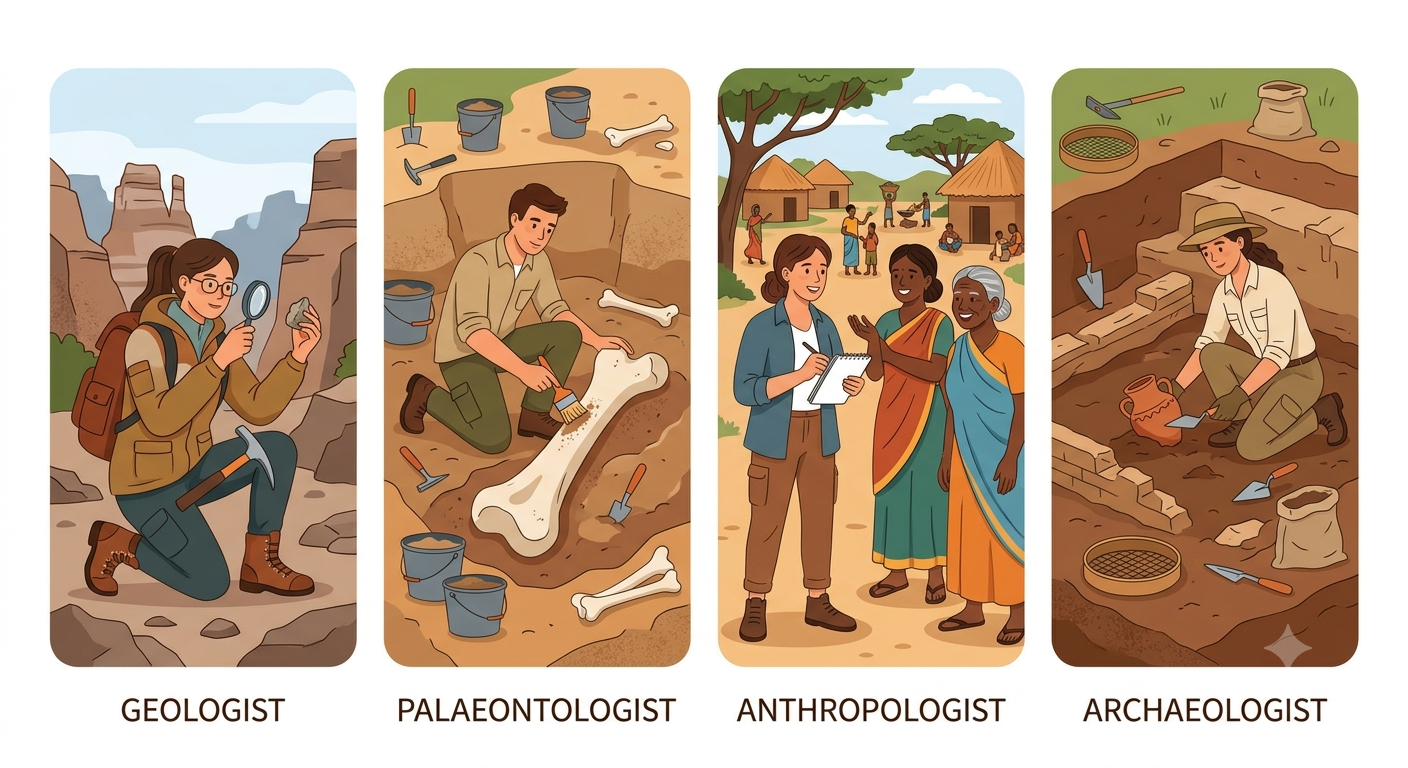
Fig. 4.2: Geologists, Palaeontologists, Anthropologists and Archaeologists
- Geologists study the physical features of the Earth — like the soil, stones, hills, mountains, rivers, seas, oceans and other such parts of the Earth.
- Palaeontologists study the remains of plants, animals and humans from millions of years ago in the form of fossils.
- Anthropologists study human societies and cultures from the oldest times to the present.
- Archaeologists study the past by digging up remains that people, plants and animals left behind — such as tools, pots, beads, figurines, toys, bones and teeth of animals and humans, burnt grains, parts of houses or bricks, among others.
🔑 Key Term — Fossils
Fossils: Impressions of footprints, or parts of plants or animals that are found preserved within layers of soil or rocks.
📝 Practice Questions — Learning About the Past
LOTS What is history? Name the four types of experts who study the past.
Show Answer
History is the study of the human past. The four experts: Geologists (study the Earth’s physical features), Palaeontologists (study fossils of plants, animals and humans), Anthropologists (study human societies and cultures), and Archaeologists (study the past by digging up remains like tools, pots and bones).
Medium What are fossils? Which expert studies them?
Show Answer
Fossils are impressions of footprints, or parts of plants or animals, found preserved within layers of soil or rocks. Palaeontologists study fossils to learn about plants, animals and humans from millions of years ago.
HOTS An archaeologist and a geologist both dig into the Earth. How is their purpose different?
Show Answer
A geologist digs to study the physical Earth itself — soil, stones, rocks and how the land formed. An archaeologist digs to find what humans left behind — tools, pottery, bones and buildings — to understand how people lived. The geologist studies nature’s past; the archaeologist studies humanity’s past, though they often work together.
HOTS Humans appeared only about 300,000 years ago, while the Earth is 4.54 billion years old. Why does the textbook say we occupy “only a tiny part” of the Earth’s history?
Show Answer
Because 300,000 years is extremely small compared to 4.54 billion years. If the Earth’s whole history were squeezed into a single day, humans would appear only in the last few seconds before midnight. The evolution timeline shows life took billions of years — first cells, fish, dinosaurs, mammals — before humans arrived very recently, so our share of Earth’s story is truly tiny.
📅 How Is Time Measured in History?
- Each society and culture has had its own ways of measuring time. Major events — such as the birth of an important person or the start of a ruler’s reign — have often marked the beginning of a new era.
- At present, the Gregorian calendar is commonly used worldwide; side by side, Hindu, Muslim, Jewish, Chinese and other calendars are also used for calculating the dates of festivals and other auspicious events.
- In the West, the conventional year for Jesus Christ’s birth has generally been taken as the starting point. Years counted forward used to be marked ‘AD’, now called the Common Era or CE. For example, 1947 (India’s independence) can be written as 1947 CE.
- The years before that date, counted backward, used to be marked BC, now called Before Common Era or BCE. For example, 560 BCE is an approximate year of birth of Gautama Buddha.
🔑 Key Terms
- Era: A distinct period of time.
- Gregorian calendar: The calendar now used the world over; it has 12 months adding up to 365 days, and a leap year every four years. Century years (1800, 1900, 2000) are leap years only if they are multiples of 400 — so of those three, only 2000 is a leap year.
- Auspicious: favourable or bringing luck; for instance, ‘an auspicious beginning’.
🔍 LET’S EXPLORE — The ‘No Year Zero’ Catch
- In the Gregorian calendar, there is no ‘year zero’. The year 1 CE follows immediately after the year 1 BCE.
- If you draw a timeline from 2 BCE to 2 CE, only 3 years have passed — not 4 — because of the missing year zero.
- So to calculate the number of years between a BCE date and a CE date, you add them but subtract 1.
560 + 2024 − 1 = 2,583 years ago
- A timeline is a convenient tool to mark events, as it shows a sequence of dates and events covering any particular period. It runs from the beginning of humanity to the present, with a few important landmarks.
- A timeline also helps in understanding the order in which historical events take place. For example, even without looking at dates, you can see that the birth of Buddha occurs before that of Jesus.
A Timeline of Main Events (Fig. 4.3)
Fig. 4.3: Timeline of some main events since 300,000 BCE (the dotted portion marks a skipped period — otherwise the timeline would be almost 3 metres long!)
💯 Century and Millennium
⚠️ DON’T MISS OUT — Longer Durations of Time
- Along with a year and a decade (a period of ten years), we use other terms for longer durations.
- 1. Century: Any period of 100 years. Specific centuries are counted every 100 years starting from the year 1 CE. For instance, we are currently in the 21st century CE, which runs from 2001 to 2100.
- Centuries BCE are calculated beginning from 1 BCE and keep going back in time. For example, the 3rd century BCE would include the years 300 BCE to 201 BCE.
- 2. Millennium: Any period of 1,000 years. We are currently in the 3rd millennium CE, which began in 2001 CE and will go up to 3000 CE.
- Millenniums BCE are also calculated beginning from 1 BCE and go backwards. So the 1st millennium BCE would include the years 1 BCE to 1000 BCE. (The plural is ‘millenniums’ or ‘millennia’ — both correct.)
🔍 LET’S EXPLORE
Create a timeline stretching from 1900 CE to the current year and place the dates of birth of your grandparents, parents, siblings and yourself. Also, mark the years that the 20th century CE begins with and ends with.
Show Answer
The 20th century CE begins in 1901 and ends in 2000. On your timeline, plot each family member’s birth year in order — you’ll see the generations spread across the 20th and 21st centuries.
⚠️ DON’T MISS OUT — Indian Calendars
Many Indian calendars rely on the positions of the sun and the moon to define the months of the year. A pañchānga is a book of tables which lists the days of each month along with related astronomical data; for instance, it precisely predicts events like solar and lunar eclipses, times for sunrise and sunset, etc. Pañchāngas, still widely used in India, often also give weather predictions for the year, dates and timings of festivals, and more.
📝 Practice Questions — Measuring Time
LOTS What do CE and BCE stand for? Give one example of each.
Show Answer
CE means Common Era (years counted forward from the conventional birth of Jesus) — e.g., 1947 CE, when India gained independence. BCE means Before Common Era (years counted backward) — e.g., 560 BCE, the approximate birth year of Gautama Buddha.
Medium What is a century and a millennium? Which century and millennium are we in now?
Show Answer
A century is a period of 100 years; a millennium is a period of 1,000 years. We are currently in the 21st century CE (2001–2100) and the 3rd millennium CE (2001–3000).
HOTS Why must we “subtract 1” when counting years between a BCE date and a CE date?
Show Answer
Because the Gregorian calendar has no year zero — 1 CE comes right after 1 BCE with no gap in between. So if we simply add a BCE year and a CE year, we count one year too many. Subtracting 1 corrects for the missing year zero. Example: from 2 BCE to 2 CE is 2 + 2 − 1 = 3 years, not 4.
HOTS The textbook’s timeline has a dotted (skipped) portion. Why was this necessary?
Show Answer
The span from 300,000 BCE to today is so enormous that drawing every period to scale would make the timeline almost 3 metres long. The dotted portion marks a skipped period, letting the timeline fit on a page while still showing the important landmarks in the correct order. It reminds us that vast stretches of early time are being compressed.
📜 What Are the Sources of History?
🔑 Key Term — Source of History
Source of history: A place, person, text or an object from which we gather information about some past event or period.
🔍 LET’S EXPLORE — Your Family Tree
Can you collect information about at least three generations of your family on your mother’s and father’s sides? Create a family tree with your parents, grandparents and great-grandparents. Find out their names, what they did for a living and where they were born. Also, write the sources from where you got this information (photographs, diaries, ID cards, or memories of relatives).
💡 THINK ABOUT IT
Have you ever seen old coins, books, clothes, jewellery or utensils in and around your house? What type of information can we gain from such objects? Or from old houses or buildings?
Show Answer
Old objects tell us how people in the past lived — what they wore, ate, used and valued. Old coins reveal which rulers governed and what trade was like; old utensils show cooking habits; jewellery shows craft skills and wealth; old buildings reveal architecture and daily life. Each object is like a clue that helps piece together the story of the past.
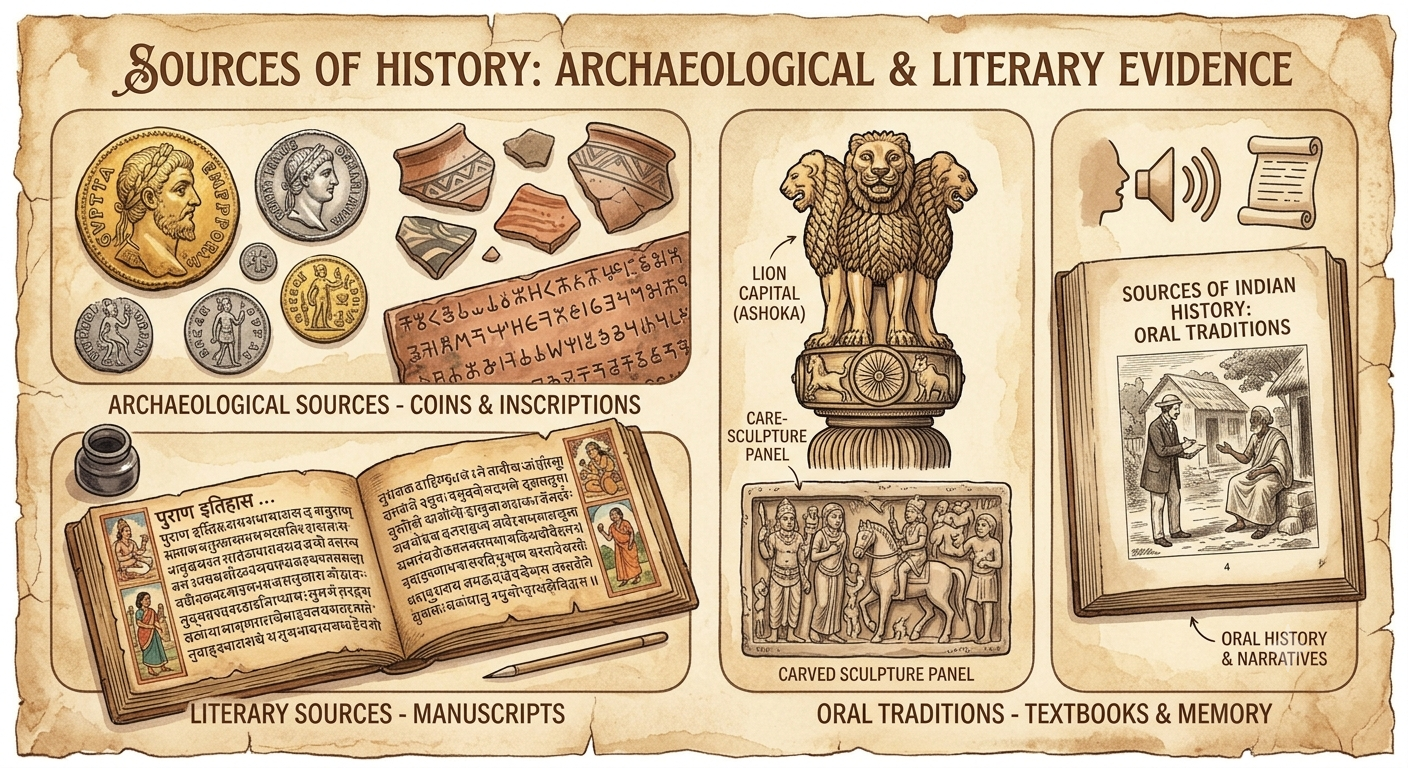
- Every object or structure tells a story and is like a piece in a jigsaw puzzle. The objects around your house convey something of your family’s history. Similarly, we put together historical events through a variety of sources — but in history, quite a few pieces of the puzzle may remain missing!
The Main Sources of History (Fig. 4.5)
Fig. 4.5: The main sources of history
🔑 Key Terms
- Historian: A person who studies and writes about the past.
- Genetics: The branch of biology that studies how, in plants, animals or humans, certain features and characteristics get passed down from one generation to the next.
- When historians study a king or queen of 1,500 years ago, an ancient monument, a war or items of trade, they gather information from as many sources as they can find. Sometimes the sources confirm each other (the jigsaw pieces match); at other times, sources give contradictory information (the pieces don’t match), and historians must decide which source they can trust more.
- Who contributes to these sources? Historians themselves, but also archaeologists, epigraphists (who study ancient inscriptions), anthropologists, experts in literature and languages, and more.
- In the last 50 years or so, scientific studies have contributed more and more — studies of ancient climates, chemical studies of excavated materials, and studies of the genetics of ancient people have provided fresh insights.
- When historians study recent history (the last two or three centuries), another source is newspapers; for the last few decades, electronic media (television, the internet) can also be consulted.
Fig. 4.6: Different sources of history — a coin, a carved sculpture panel, and the lion capital — each object tells us about the people and period it comes from.
🔥 The Beginnings of Human History
- Modern humans (Homo sapiens) have walked the planet for about 300,000 (three lakh) years. This appears to be a very long time, yet it is only a tiny fraction of the Earth’s history.
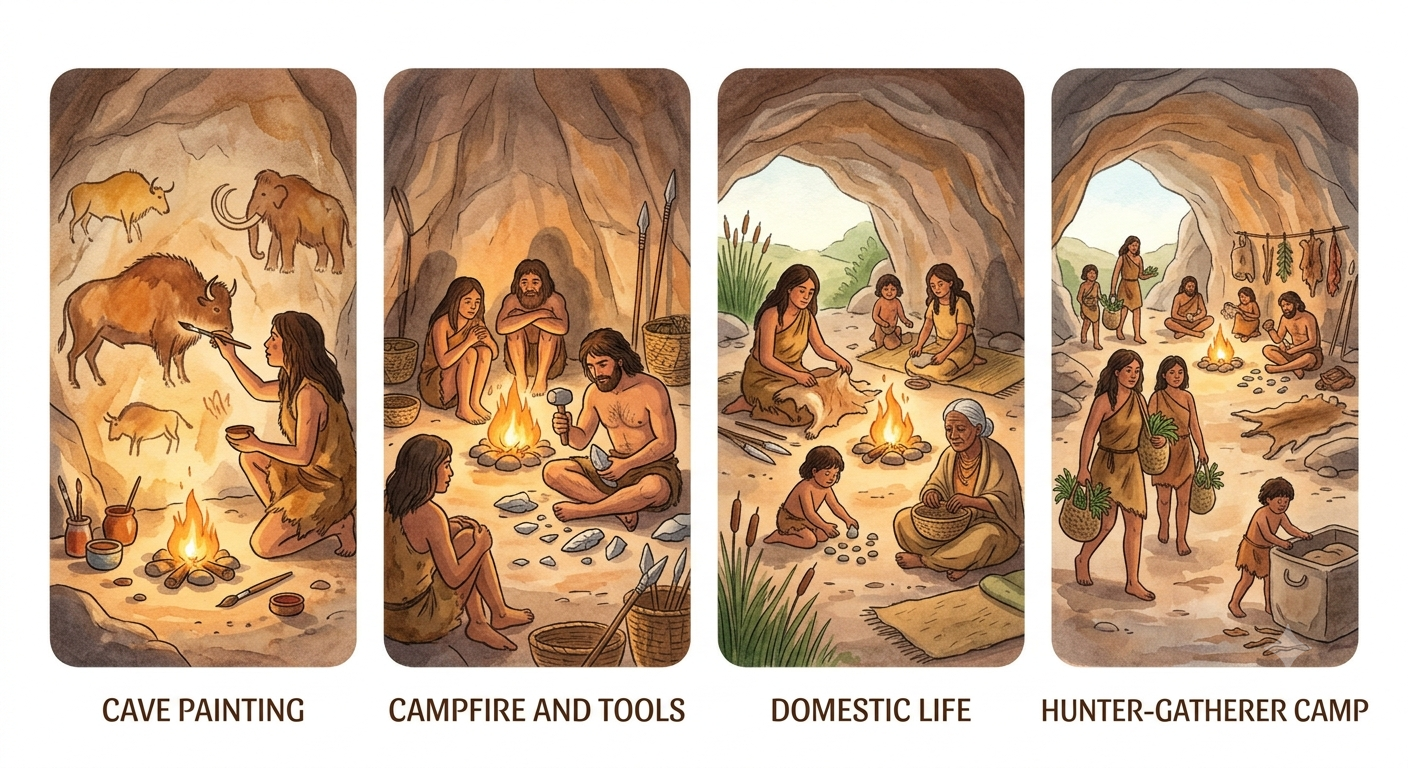
Early humans in a rock shelter — painting on walls, making tools, and gathering around a fire
🔍 LET’S EXPLORE
In the picture above, look at some activities of early humans in a rock shelter. Which ones can you recognise? Give a brief description for each.
Show Answer
Activities you can spot: painting animals and figures on the cave wall; sitting around a fire for warmth and cooking; making stone tools by chipping stones; preparing or cooking food; and adults caring for children. These show that early humans lived together in groups, sharing work and skills.
- Early humans faced many challenges from nature and lived in bands or groups to help each other. They were constantly seeking shelter and food, and were mainly hunters and gatherers — they relied on hunting and collecting edible plants and fruits for survival.
- Our early ancestors also had certain beliefs about the natural elements and possibly some notion of afterlife.
- These groups lived in temporary camps, rock shelters or caves, and communicated using languages that are now lost.
- They used fire and started making objects that made their lives easier — improved stone axes and blades, arrowheads and other tools.
- Aspects of their life are visible in rock paintings found in hundreds of caves all over the world. Some depict simple figures or symbols; others represent detailed scenes with animals or humans.
- In time, these early humans learned to make simple ornaments such as stone or shell beads, pendants made of animal teeth, and sometimes exchanged them with other groups.
🔑 Key Term — Afterlife
Afterlife: A life that begins after death.
🌾 The First Crops
- Over long ages, the Earth’s climate has gone through many changes. At certain times it was very cold and much of the Earth was covered with ice — this is called an ‘Ice Age’.
- Later, when the climate warmed up, this ice partly melted, and the resulting waters swelled the rivers and eventually drained into the oceans. The last Ice Age lasted from over 100,000 (one lakh) years ago to around 12,000 years ago.
- Afterwards, living conditions improved; in many parts of the world, humans started settling down and cultivating cereals and grains. They also domesticated animals such as cattle, goats, etc.
- With more food available, these communities grew in size and number, and often settled down near rivers — for water and because the soil was more fertile there, making it easier to grow crops.
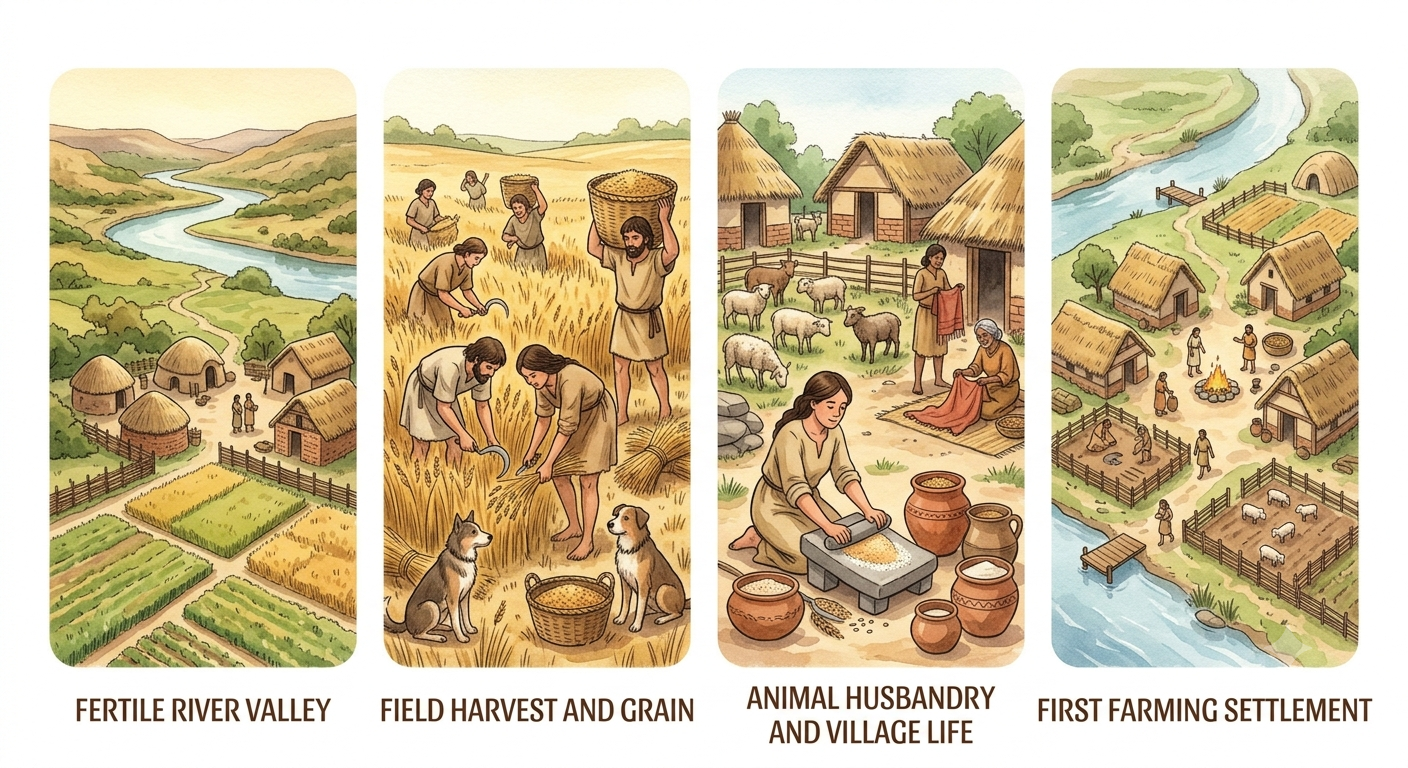
An early agricultural community beside a river — harvesting grain, herding animals, and making pots
💡 THINK ABOUT IT
- Both in the rock-shelter picture and this farming one, men and women are shown in certain roles. While these may appear ‘natural’, they are not necessarily accurate and do not cover all situations. In a rock shelter, women may have helped prepare colours for painting or done some of the painting; in both scenes, men may have done some cooking or helped care for children.
- Keeping in mind that we have only limited information, think about such roles and discuss in class.
Show Answer
The pictures show men hunting or ploughing and women cooking or grinding, but this is only an artist’s guess. In reality, tasks were probably shared far more flexibly — women likely hunted, painted and made tools too, and men cooked and cared for children. Because we have limited evidence, we should not assume rigid ‘natural’ roles; history teaches us to question such assumptions.
🔍 LET’S EXPLORE
Observe the farming scene. It depicts an agricultural community from a few millenniums ago. List the main activities you can identify.
Show Answer
Main activities: harvesting grain/wheat with sickles; carrying bundles of grain; herding sheep and keeping a dog; grinding grain and preparing food; making and using pots; and living in thatched huts near a river. These show a settled farming life very different from the earlier hunter-gatherer camps.
- As communities grew, so did their social complexity. Leaders or ‘chieftains’ were responsible for the well-being of the people, and everyone collectively worked towards the community’s welfare. For example, there was no sense of individual ownership; the lands were collectively sowed and harvested.
- As time went by, hamlets grew into sizeable villages that exchanged goods — mostly food, clothing and tools. Networks of communication and exchange were established, and some villages grew into small towns.
- New technologies appeared — for example pottery, for making pots and clay objects; and the use of metal (copper first, iron later), which helped make durable tools, objects of daily use and ornaments.
- We will see in Chapter 6 how this stage prepared for the emergence of what is called ‘civilisation’. This early progress of humanity had to face many challenges — at some critical times, humanity could have almost disappeared, as some earlier species did.
🔑 Key Terms
- Welfare: Health, prosperity and well-being.
- Hamlet: A small settlement or small village.
📝 Practice Questions — Sources & Human History
LOTS What is a source of history? Name the five main types of sources.
Show Answer
A source of history is a place, person, text or object from which we gather information about a past event or period. The five main types: Archaeological sources, Oral sources, Literary sources (Indian literature), Foreign accounts, and Artistic sources.
Medium How did the way early humans lived change after the last Ice Age?
Show Answer
Before, during the Ice Age, humans were mainly hunter-gatherers living in temporary camps and caves. After the last Ice Age ended (around 12,000 years ago), the climate warmed and humans began settling down, cultivating cereals and grains, and domesticating animals. With more food, communities grew and settled near rivers, leading to villages, pottery, metal tools and eventually towns.
HOTS Why did early farming communities choose to settle near rivers?
Show Answer
They settled near rivers for two main reasons: (1) rivers provided a reliable supply of water for drinking, for animals and for crops; (2) the soil near rivers was more fertile (enriched by silt), making it easier to grow crops and get good harvests. Water and fertile soil together made river banks the best place for farming and for growing communities.
HOTS The textbook says historians are like puzzle-solvers with missing pieces. What does this tell us about how history is written?
Show Answer
It tells us that history is reconstructed from incomplete evidence. Historians gather clues from many sources; sometimes they agree, sometimes they contradict, and many pieces are lost forever. So history is not a fixed, perfect record but a careful interpretation — historians must weigh sources, decide which to trust, and stay open to new evidence that could change the picture. This is why history can be revised as new sources are found.
📌 Before We Move On…
- We have explored ways to learn about our past. The concept of a timeline helps us understand the sequence of historical events at different times.
- There are different ways of measuring time: years, decades, centuries, millenniums.
- Sources of history are many; they help us reconstruct and interpret historical events.
- We also had a brief look into the lives of early humans and how human societies grew more complex in time.
📝 Questions, Activities and Projects
1. As a project, write the history of your family (or village if you live in one), using sources of history at your disposal. Ask your teacher to guide you.
Show Answer
Project guidance: Interview elders for oral history; collect old photographs, letters, ID cards, and documents (written sources); note old objects, jewellery or houses (archaeological-type sources); and build a family tree. Write your family’s story across three generations — names, occupations, places lived — mentioning the source for each fact, just as a real historian does.
2. Can we compare historians to detectives? Give reasons for your answer.
Show Answer
Yes, historians are very much like detectives. Both gather clues (sources/evidence), examine them carefully, check whether different clues agree or contradict, decide which to trust, and then reconstruct what happened. Just as a detective solves a case from partial evidence, a historian pieces together the past from incomplete sources — often with some pieces of the puzzle missing.
3. A few exercises with dates:
Show Answer
(a) Place chronologically: 1900 BCE → 100 BCE → 323 BCE → 100 CE → 323 CE → 1090 CE → 2024 CE. (Remember: larger BCE numbers are older; then CE increases forward.)
(b) King Chandragupta born 320 CE → belongs to the 4th century CE (301–400 CE). Years after the Buddha’s birth (560 BCE): 560 + 320 − 1 = 879 years after the Buddha.
(c) Rani of Jhansi born 1828 → belongs to the 19th century CE (1801–1900). Years before India’s Independence (1947): 1947 − 1828 = 119 years before Independence.
(d) ‘12,000 years ago’ as a date: 12,000 − 2024 = about 9976 BCE (roughly 10,000 BCE).
4. Plan a visit to a nearby museum: prepare with prior research on the exhibits, keep notes during the visit, and write a brief report afterwards highlighting what was unexpected / interesting / fun.
Show Answer
Activity guidance: Before the visit, find out what the museum holds (coins, sculptures, weapons, manuscripts). During the visit, note the oldest and most interesting exhibits and which sources of history they represent. Afterwards, write a short report: what you expected, what surprised you, your favourite object, and what it taught you about the past.
5. Invite to your school an archaeologist or a historian and ask them to speak on the history of your region and why it’s important to know it.
Show Answer
Activity guidance: With your teacher, invite a local historian, archaeologist or museum expert. Prepare questions in advance — about local historical sites, how they study the past, and why knowing regional history matters. Take notes and later write down the three most interesting things you learned.