
CLASS 9 SCIENCE · CHAPTER 6
How Forces Affect Motion
Study notes to score 100% — concepts, definitions, examples & self-check.
🧠 What This Chapter Covers
How Forces Affect Motion
Force & Net Force
- Force = push/pull
- SI unit = newton (N)
- Balanced vs unbalanced
Newton’s 1st Law
- Inertia
- Friction
- No net force → no change
Newton’s 2nd Law
- F = ma
- a ∝ F, a ∝ 1/m
- F = mg
Newton’s 3rd Law
- Action = reaction
- Walking, rockets
- System of objects
6.1 The Concept of Force
- A force is a push or a pull.
- A force can: make an object move from rest · change its speed · change its direction · change its shape.
- Every force has a direction — so force needs both magnitude and direction.
- SI unit = newton (N) — small ‘n’ for the unit, capital N for the symbol.
Force 1 mark
A push or pull that can change the state of rest or motion, or the shape, of an object. It has magnitude and direction. SI unit = newton (N).
A push or pull that can change the state of rest or motion, or the shape, of an object. It has magnitude and direction. SI unit = newton (N).
📌 Note
If the magnitude or direction (or both) of a force changes, its effect also changes.
6.1.1 Measuring a Force
- Force is measured with a spring balance.
- Weight = the gravitational force with which Earth pulls an object — also read on a spring balance.
- Pulling the free end shows the force applied on the spring inside.
6.2 Balanced and Unbalanced Forces
- Usually more than one force acts on an object at once (e.g. push + friction; gravity + buoyancy).
- Balanced forces: equal in magnitude, opposite in direction → no net force → motion does not change (tug-of-war rope stays still).
- Unbalanced forces: unequal → non-zero net force → motion changes (rope moves toward the larger force).
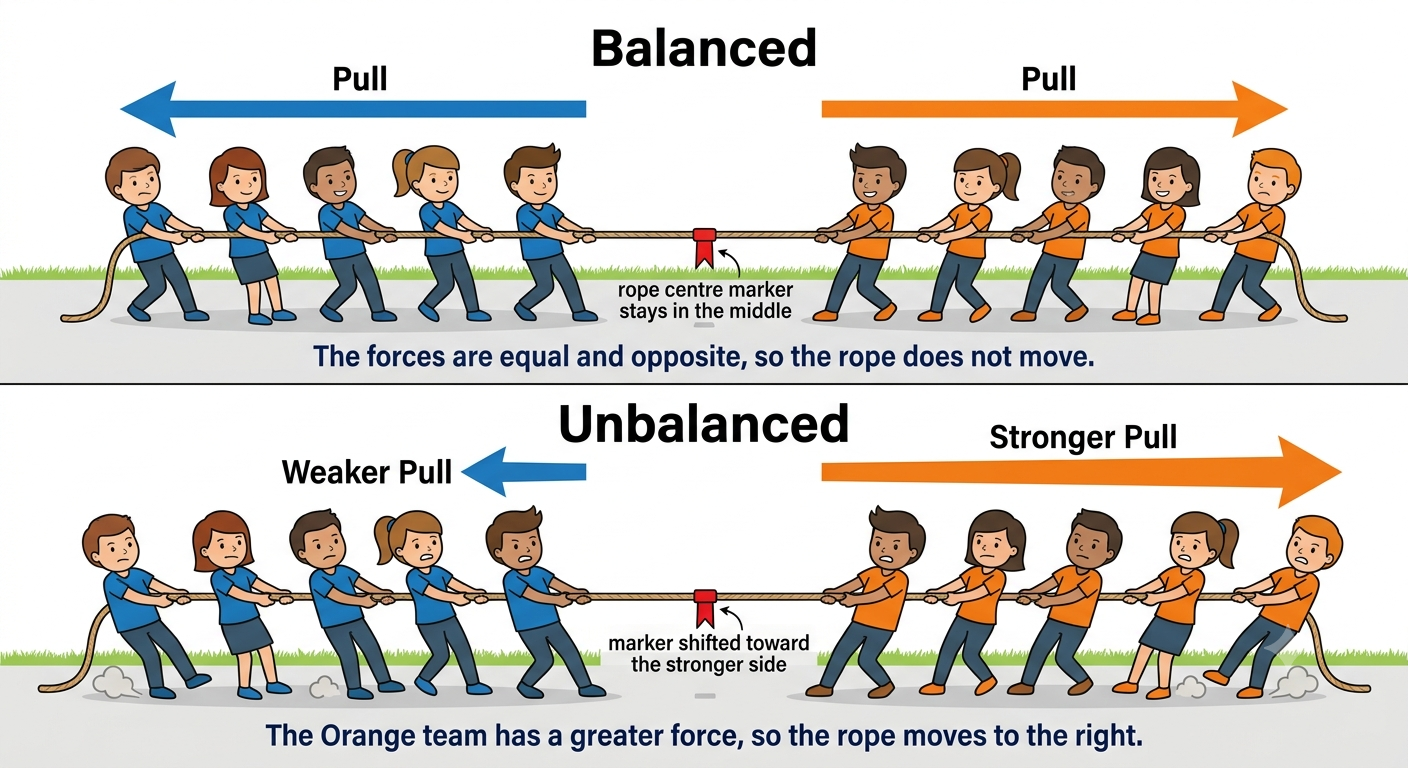
👀 LOOK HERE: Equal pulls → rope still (balanced). Unequal pulls → rope moves to the stronger side (unbalanced).
Balanced & Unbalanced Forces 2 marks
Balanced: equal & opposite → net force zero → no change in motion.
Unbalanced: unequal → non-zero net force → motion changes.
Balanced: equal & opposite → net force zero → no change in motion.
Unbalanced: unequal → non-zero net force → motion changes.
Finding the Net Force
- Same direction → net force = sum (same direction).
- Opposite direction → net force = difference, toward the larger force.
Net Force
Same dir → ADD · Opposite → SUBTRACT
Motion depends only on the net force
✍️ Example 6.1 (method — study this)
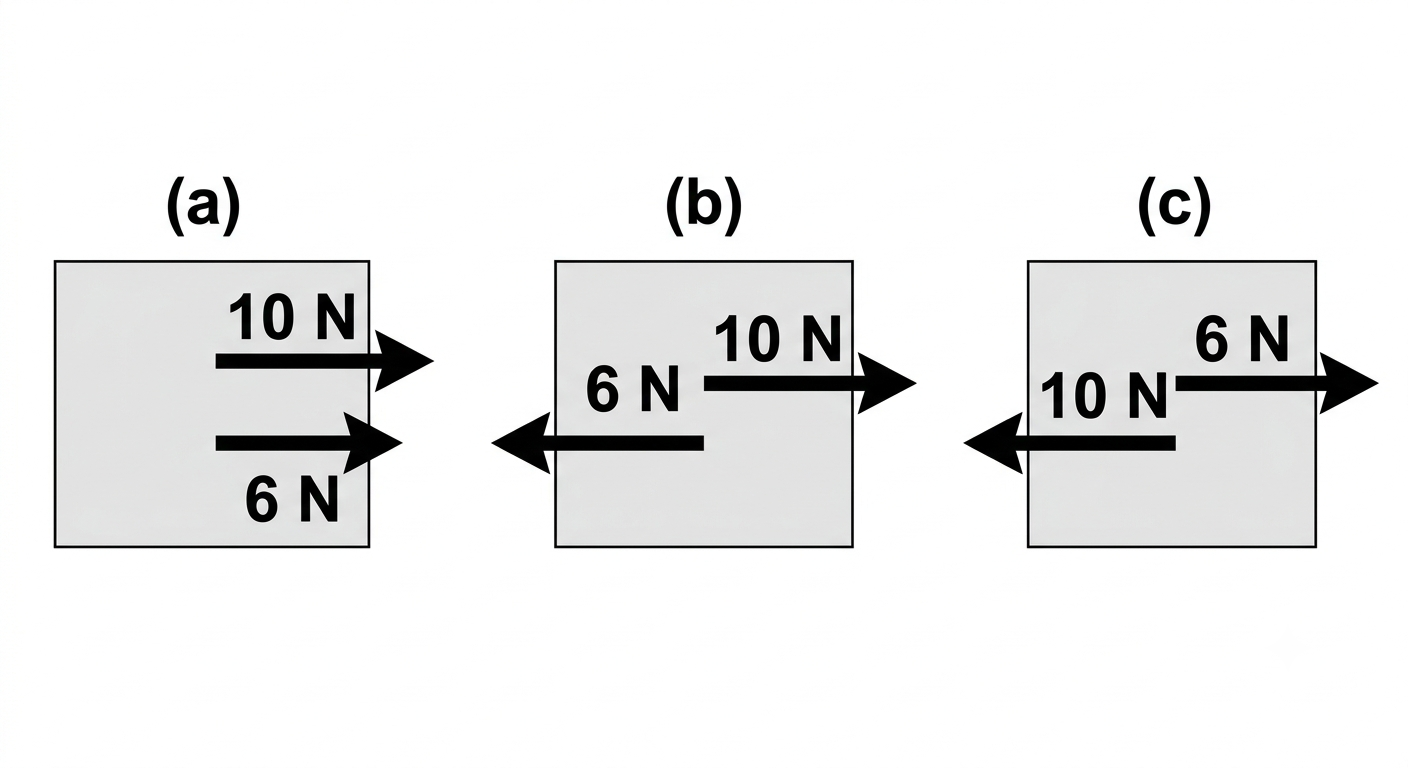
Two forces of 10 N and 6 N act on a block in three ways. Find the net force in each.
Fig 6.6: Two forces on a block — three cases.
(a) Both right: 10 + 6 = 16 N right.
(b) 10 N right, 6 N left: 10 − 6 = 4 N right.
(c) 6 N right, 10 N left: 10 − 6 = 4 N left.
(b) 10 N right, 6 N left: 10 − 6 = 4 N right.
(c) 6 N right, 10 N left: 10 − 6 = 4 N left.
📝 Check Your Concepts
QWhat is a force? Give its SI unit.
A push or pull that changes the state of rest/motion or shape of an object. It has magnitude and direction. SI unit = newton (N).
QDifference between balanced and unbalanced forces?
Balanced: equal & opposite, net force zero, no change in motion. Unbalanced: unequal, non-zero net force, motion changes.
QHow do you find net force when two forces act in opposite directions?
Net force = difference of the two forces, acting in the direction of the larger force.
🧮 Numerical Practice — try, then tap to check
NForces of 12 N and 8 N act on a box in opposite directions. Find the net force.
Net force = 12 − 8 = 4 N, toward the 12 N force.
NForces of 7 N and 5 N act on a block in the same direction. Find the net force.
Net force = 7 + 5 = 12 N, in the same direction.
PART 2
Friction & Newton’s First Law of Motion
Friction & Newton’s First Law of Motion
🧠 Section at a Glance
Friction & the First Law
Friction
- Opposes motion
- Depends on surface
- Smoother → less friction
Other Forces
- Weight (down)
- Normal force (up)
- These two balance
First Law
- Inertia
- No net force → no change
- Rest stays rest
Graphs
- Rest → flat lines
- Constant v → slanted P–T
- Constant v → flat V–T
6.3 The Force of Friction
- Friction acts between two surfaces in contact and opposes motion.
- A box moves only when the push is greater than friction → net force acts in the direction of motion.
- Four forces act on a pushed box: applied force, friction (opposite), weight (down), normal force (up).
- Weight and normal force are equal and balanced.
- Stop pushing → friction brings the object to rest. To keep steady speed, keep applying force to cancel friction.
Force of Friction 1 mark
The force between two surfaces in contact that opposes the relative motion between them; always acts opposite to the direction of motion.
The force between two surfaces in contact that opposes the relative motion between them; always acts opposite to the direction of motion.
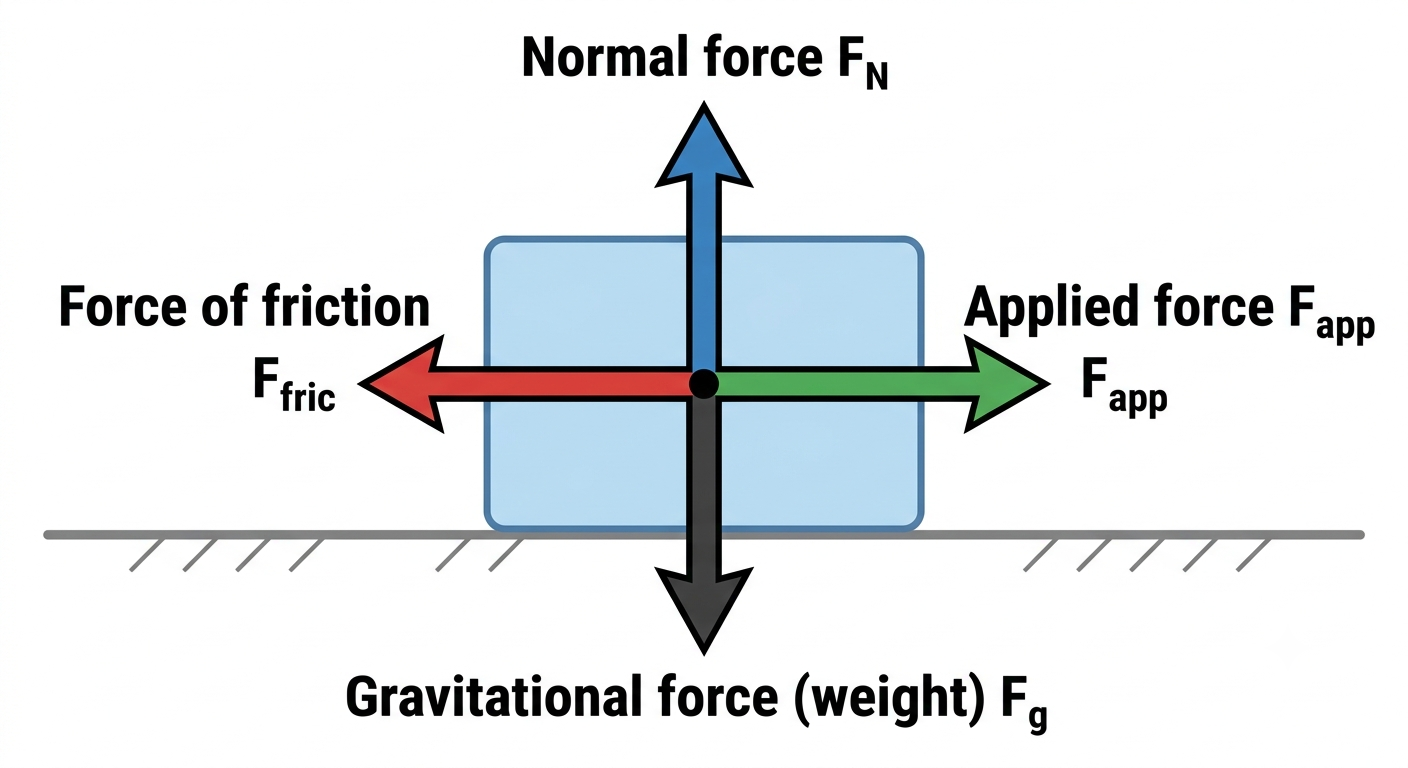
👀 LOOK HERE: Applied force (→) vs friction (←); weight (↓) and normal force (↑) balance each other.
🔬 Activity 6.1 & 6.2 — key takeaway
- A coin-stack launched by a rubber band travels farther on smoother surfaces.
- Spring-balance reading is smallest where the coins travelled farthest.
- Conclusion: less friction → velocity drops slowly → longer distance.
📌 Think as a Scientist
If friction were zero, a moving object would never stop — it would keep moving forever at constant velocity. This is the idea behind Newton’s First Law.
6.4 Newton’s First Law of Motion
- Galileo showed a body keeps moving if all resistance (friction) is removed.
- Newton called the resistance to change inertia and framed the first law (1687).
Newton’s First Law EXAM · 2 marks
An object at rest stays at rest, and an object in motion continues with constant velocity, unless a net force acts on it.
An object at rest stays at rest, and an object in motion continues with constant velocity, unless a net force acts on it.
Inertia 1 mark
The tendency of an object to resist any change in its state of rest or of uniform motion.
The tendency of an object to resist any change in its state of rest or of uniform motion.
📌 Note
“At rest” = zero velocity. “Constant velocity” = no change in magnitude or direction. Net force zero → acceleration zero.
✍️ Example 6.2 (method — study this)
A person pushes a moving box with a force equal to friction. Will it keep moving or stop?
Friction (back) = push (forward) → balanced → net force = 0 → by the first law, the box keeps moving with constant velocity.
✍️ Example 6.3 (method — study this)
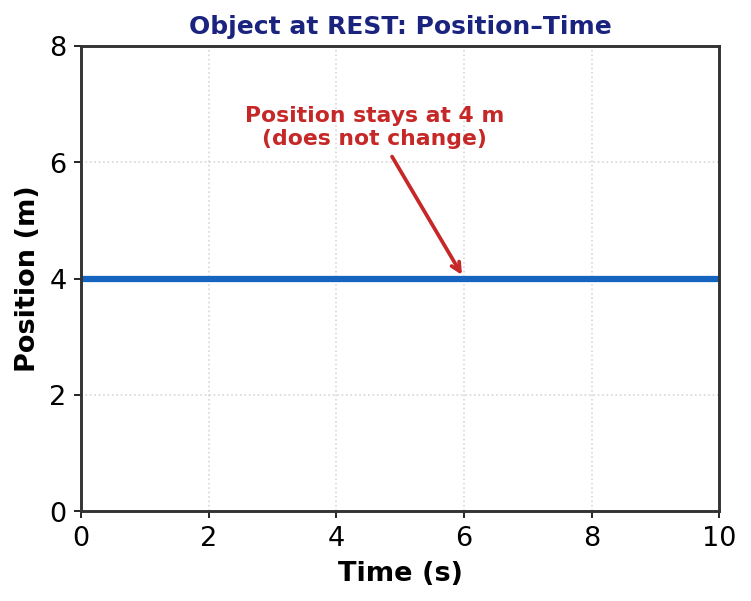
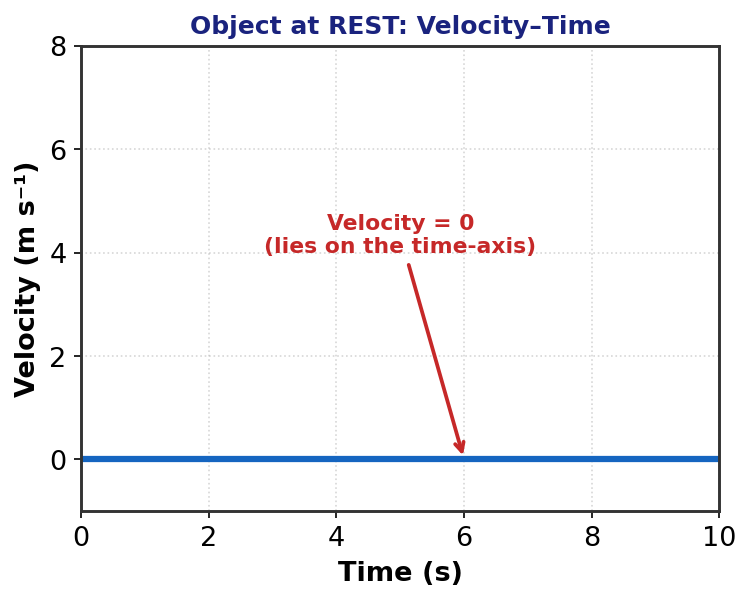
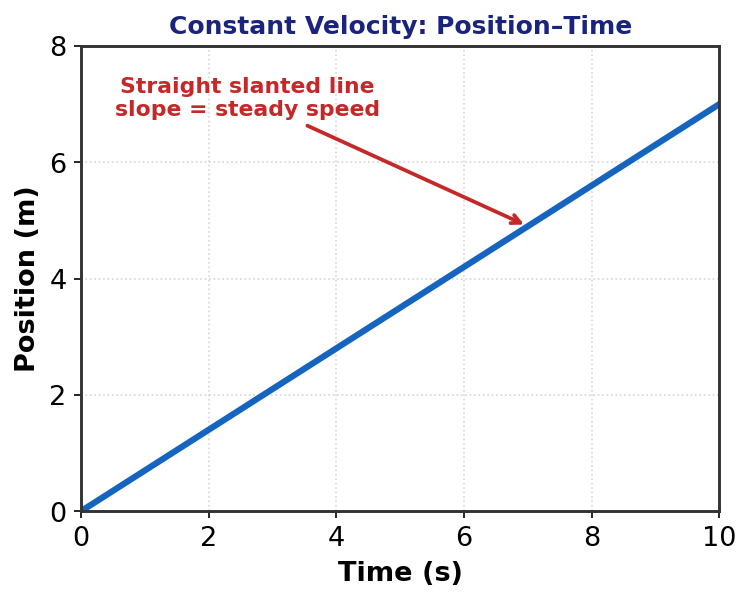
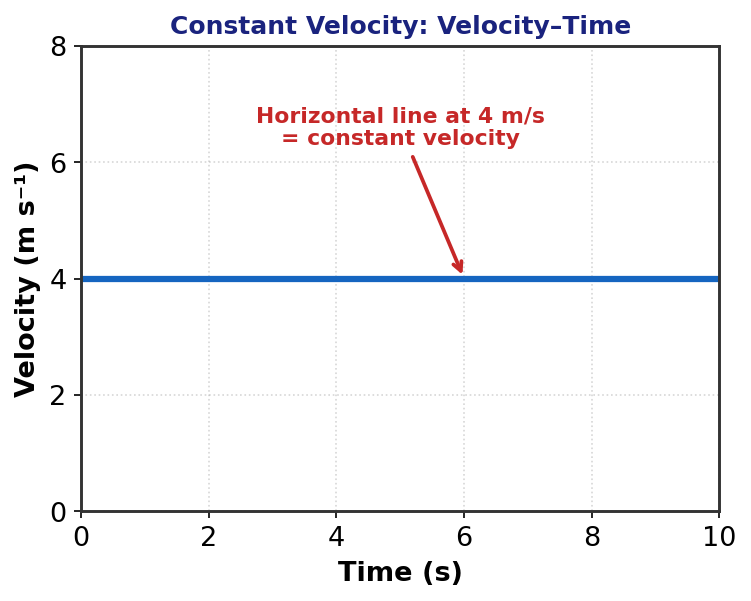
Graphs when no net force acts: object is either at rest or at constant velocity.
👀 At rest → position is a flat line.
👀 At rest → velocity on the time-axis (v = 0).
👀 Constant velocity → position is a slanted straight line.
👀 Constant velocity → velocity is a flat line above zero.
📝 Check Your Concepts
QDefine friction. In which direction does it act?
The force between surfaces in contact that opposes relative motion; it acts opposite to the direction of motion.
QState Newton’s first law of motion.
An object at rest stays at rest and an object in motion keeps moving with constant velocity, unless a net force acts on it.
QWhat is inertia?
The tendency of an object to resist any change in its state of rest or uniform motion.
QWhat does a horizontal velocity-time line above zero represent?
Motion with constant velocity (no acceleration, net force zero).
PART 3
Newton’s Second Law of Motion
Newton’s Second Law of Motion
🧠 Section at a Glance
Force, Mass & Acceleration
The Idea
- Force → acceleration
- a ∝ F (same mass)
- a ∝ 1/m (same force)
The Formula
- a = F/m
- F = ma
- F = mg
The Newton
- 1 N = 1 kg·m/s²
- g = 9.8 m/s²
- Weight = mg
Real Life
- Cricket catch
- Airbags
- Coconut
6.5 Newton’s Second Law of Motion
- A net force produces acceleration.
- Same object, more force → more acceleration → a ∝ F.
- Same force, more mass → less acceleration → a ∝ 1/m.
- Acceleration is in the same direction as the net force.
Newton’s Second Law EXAM · 3 marks
When a net force acts on an object, it accelerates in the direction of the force. Acceleration is directly proportional to force and inversely proportional to mass.
When a net force acts on an object, it accelerates in the direction of the force. Acceleration is directly proportional to force and inversely proportional to mass.
a = F/macceleration
F = maforce
F = mgweight
🔬 Activity 6.3 & 6.4 — key takeaway
- Cart + pulley: more force on the same cart → more acceleration (a ∝ F).
- Same force on a heavier cart → less acceleration (a ∝ 1/m).
One Newton & Weight
- 1 N = force that gives 1 kg an acceleration of 1 m/s².
- Acceleration due to gravity: g = 9.8 m/s² (use 10 for quick estimates).
- Weight = mg; g does not depend on the object’s mass.
Weight of an object
F = mg
g = 9.8 m s⁻² near Earth’s surface
✍️ Example 6.4 (method — study this)
Barbell: 10 kg each side + 10 kg bar. Force to hold it steady?
Total mass = 30 kg. Weight = mg = 30 × 9.8 = 294 N down. To hold steady, apply 294 N upward.
✍️ Example 6.5 (method — study this)
25 kg block, friction 50 N. Displacement in 2 s if pushed with (i) 50 N, (ii) 55 N.
(i) Push = friction → net force 0 → block stays still.
(ii) Net = 55 − 50 = 5 N. a = 5/25 = 0.2 m/s². s = ut + ½at² = 0 + ½ × 0.2 × 2² = 0.4 m forward.
(ii) Net = 55 − 50 = 5 N. a = 5/25 = 0.2 m/s². s = ut + ½at² = 0 + ½ × 0.2 × 2² = 0.4 m forward.
✍️ Example 6.6 (method — study this)
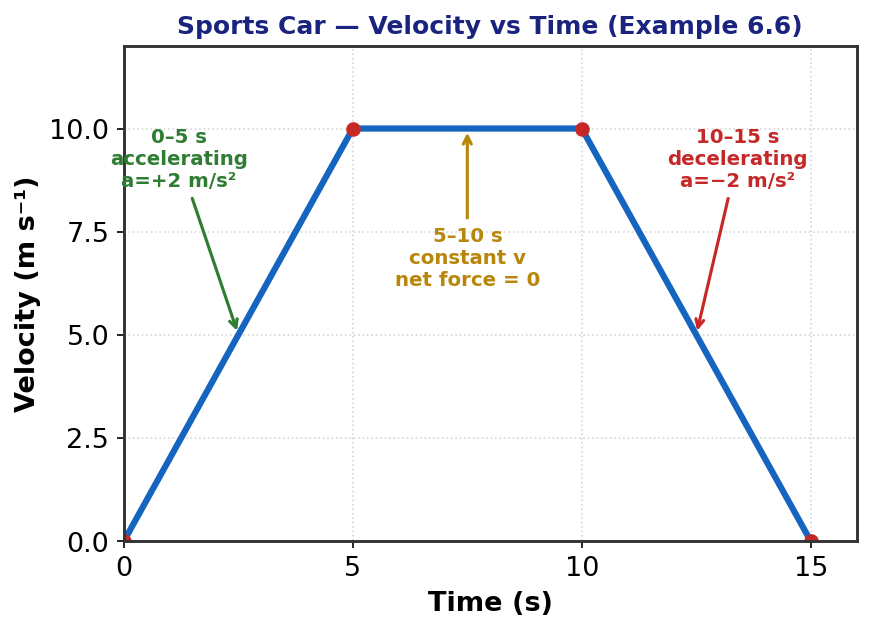
1500 kg car, velocity-time graph shown. Force during (i) 0–5 s, (ii) 5–10 s, (iii) 10–15 s.
👀 Slanted up = accelerating · Flat = constant v · Slanted down = decelerating.
(i) a = 10/5 = 2 m/s². F = 1500 × 2 = 3000 N east.
(ii) constant v → a = 0 → no force.
(iii) a = −10/5 = −2 m/s². F = 1500 × (−2) = −3000 N (3000 N west).
(ii) constant v → a = 0 → no force.
(iii) a = −10/5 = −2 m/s². F = 1500 × (−2) = −3000 N (3000 N west).
🌍 Real Life (second law)
- Cricket catch: pull hands back → more time → less force → less hurt.
- Airbags: increase stopping time → reduce force on body.
- Coconut: stops in very short time → ground exerts large force → shell breaks.
📝 Check Your Concepts
QState Newton’s second law and give its formula.
Net force produces acceleration in its direction; a ∝ F and a ∝ 1/m, so F = ma.
QDefine one newton.
The force that gives a 1 kg mass an acceleration of 1 m s⁻². (1 N = 1 kg·m/s²)
QWhy do we pull our hands back while catching a fast ball?
To increase the stopping time, which reduces acceleration and hence the force — so the hands are not hurt.
🧮 Numerical Practice — try, then tap to check
NA 4 kg object has a net force of 12 N. Find its acceleration.
a = F/m = 12/4 = 3 m/s².
NFind the weight of a 6 kg object (g = 9.8 m/s²).
Weight = mg = 6 × 9.8 = 58.8 N.
NA force of 20 N acts on a 5 kg body. Find the acceleration and the distance in 3 s from rest.
a = 20/5 = 4 m/s². s = ut + ½at² = 0 + ½ × 4 × 3² = 18 m.
PART 4
Newton’s Third Law & Systems of Objects
Newton’s Third Law & Systems of Objects
🧠 Section at a Glance
Action, Reaction & Systems
Third Law
- Action = reaction
- Equal & opposite
- On two objects
Everyday Proof
- Walking, cycling
- Rowing
- Rocket, balloon
Unequal Effect
- Same force, diff. mass
- Diff. acceleration
- Earth–fruit, gun recoil
System
- Treat as one
- Ignore internal forces
- a = F/(m₁+m₂)
6.6 Newton’s Third Law of Motion
- A force needs two objects interacting.
- Push a ball → the ball pushes back on your foot.
Newton’s Third Law EXAM · 2 marks
When one object exerts a force on a second, the second simultaneously exerts an equal and opposite force on the first.
When one object exerts a force on a second, the second simultaneously exerts an equal and opposite force on the first.
📌 Note
Action & reaction act on two different objects — so they do not cancel. (Only equal & opposite forces on the same object balance.)
Everyday Examples
- Walking: feet push ground back; ground pushes you forward (friction helps).
- Rowing: paddle pushes water back; water pushes canoe forward.
- Climbing a tree: legs push trunk down; friction pushes person up.
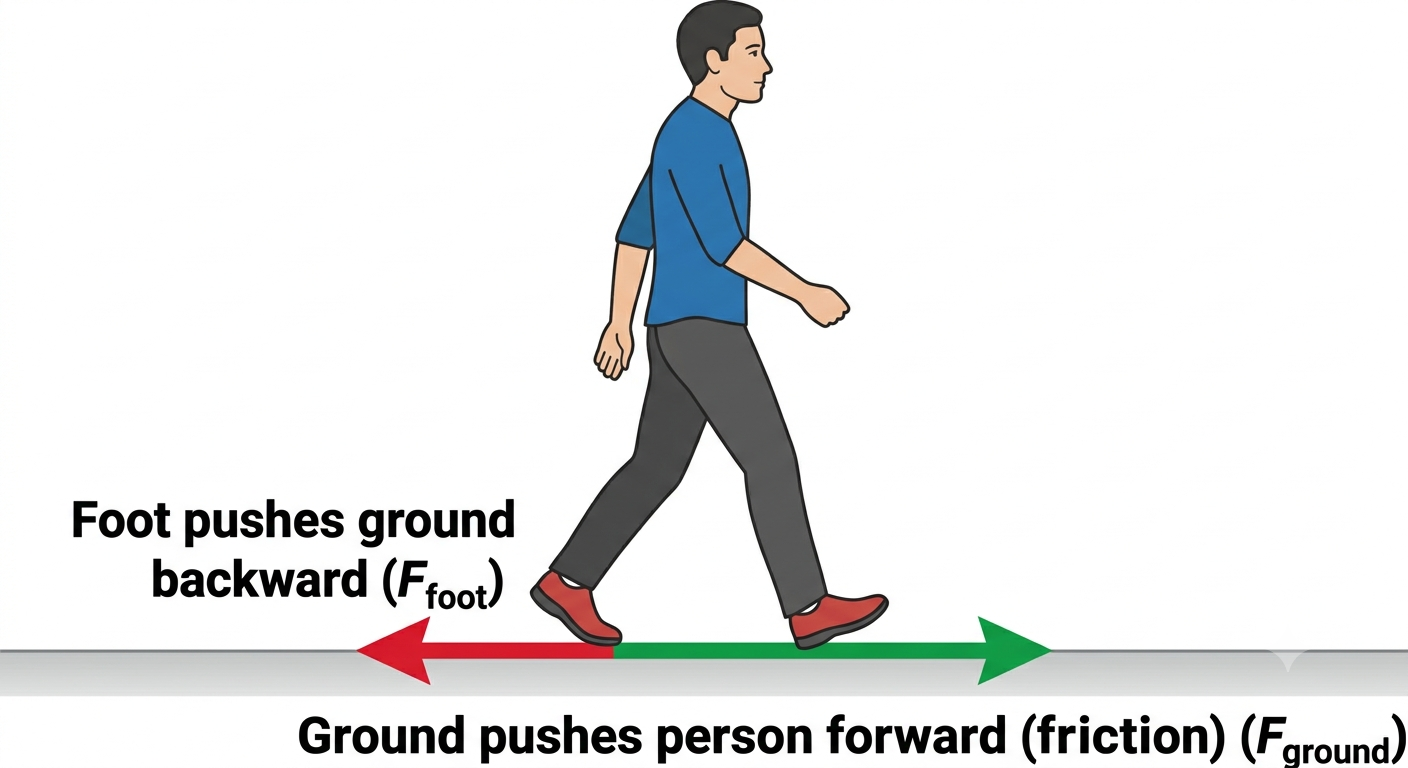
👀 Foot pushes ground backward; ground pushes you forward (friction).
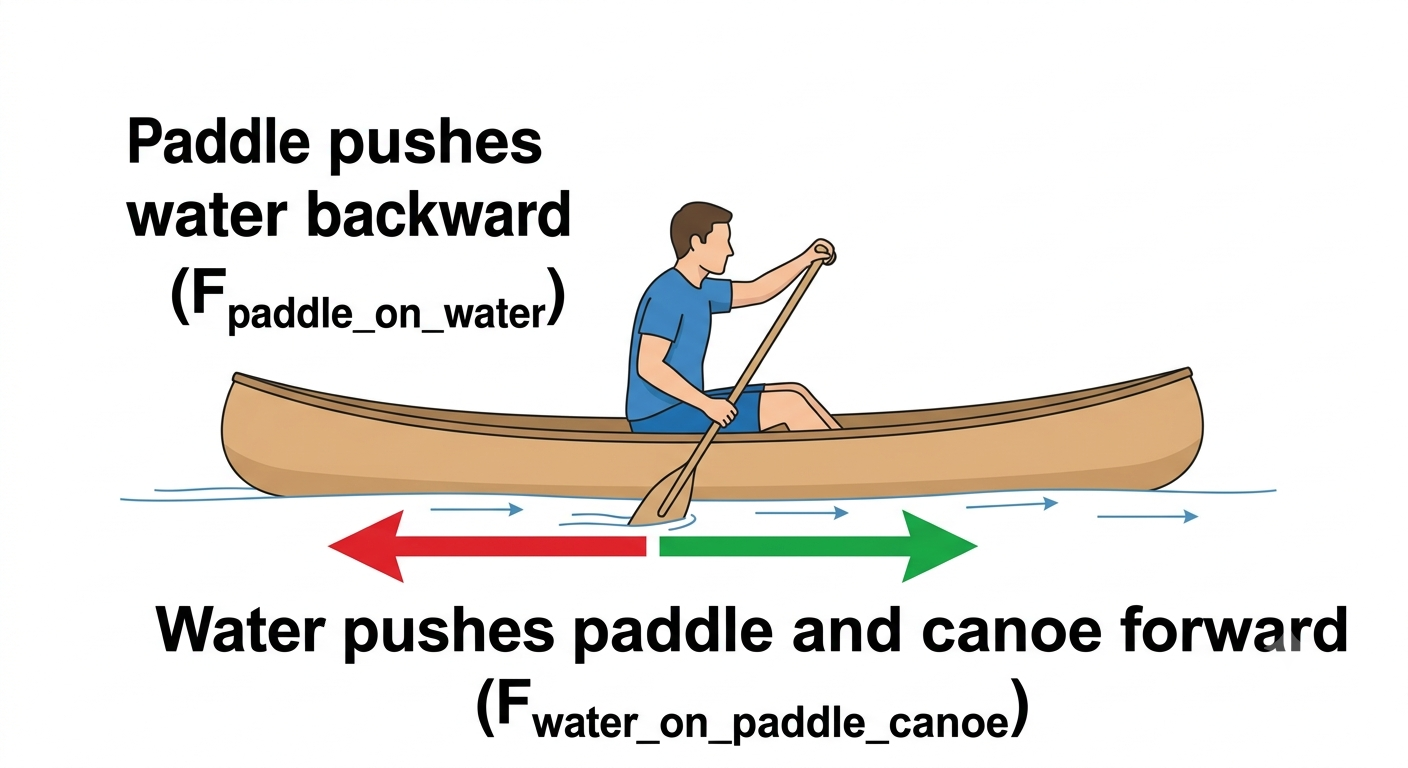
👀 Paddle pushes water back; water pushes paddle & canoe forward.
🚀 Rocket & Chandrayaan-3
Engine expels gas down; gas pushes rocket up. When upward force > weight, the rocket lifts off. Chandrayaan-3’s Vikram lander fired its engine to slow down for a soft landing near the Moon’s south pole.
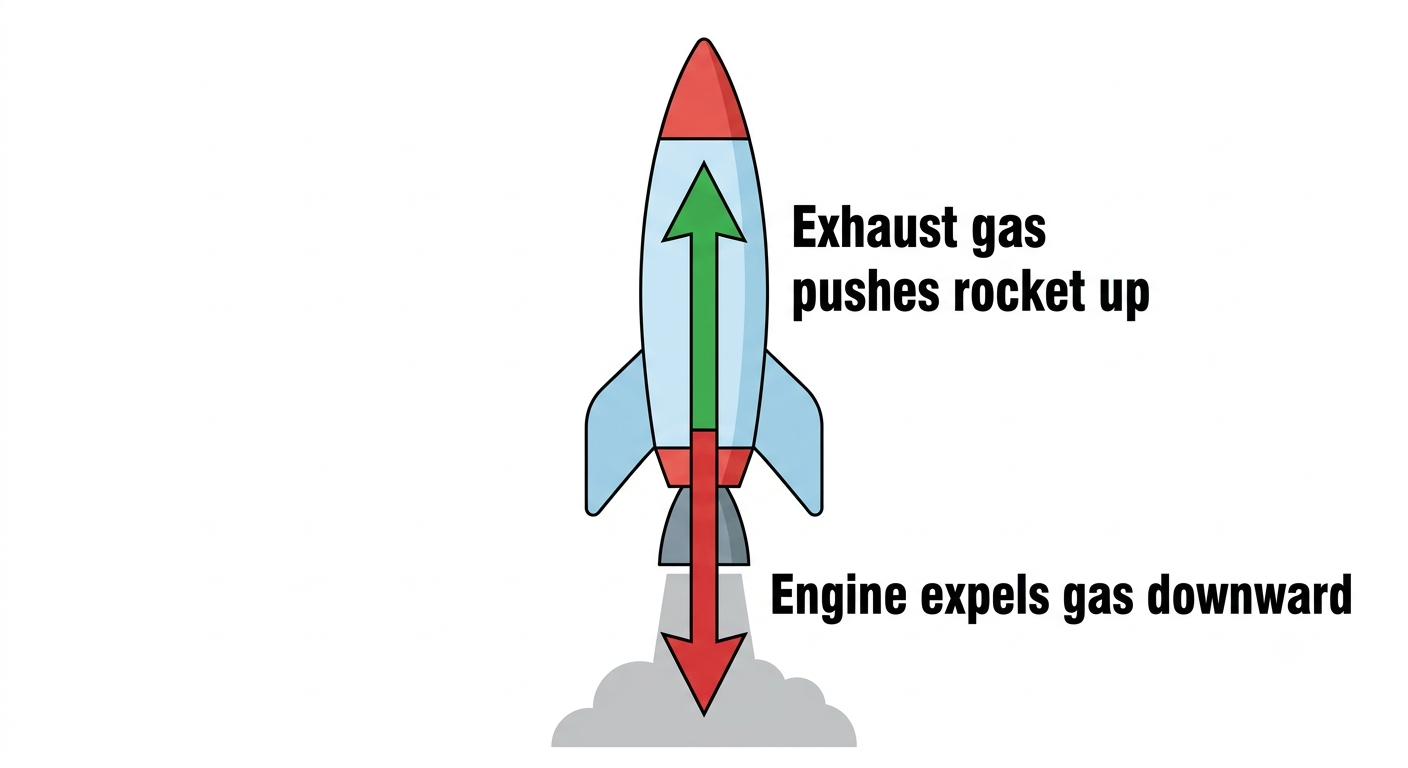
👀 Engine expels gas down; gas pushes rocket up with equal force.
✍️ Example 6.7 (method — study this)
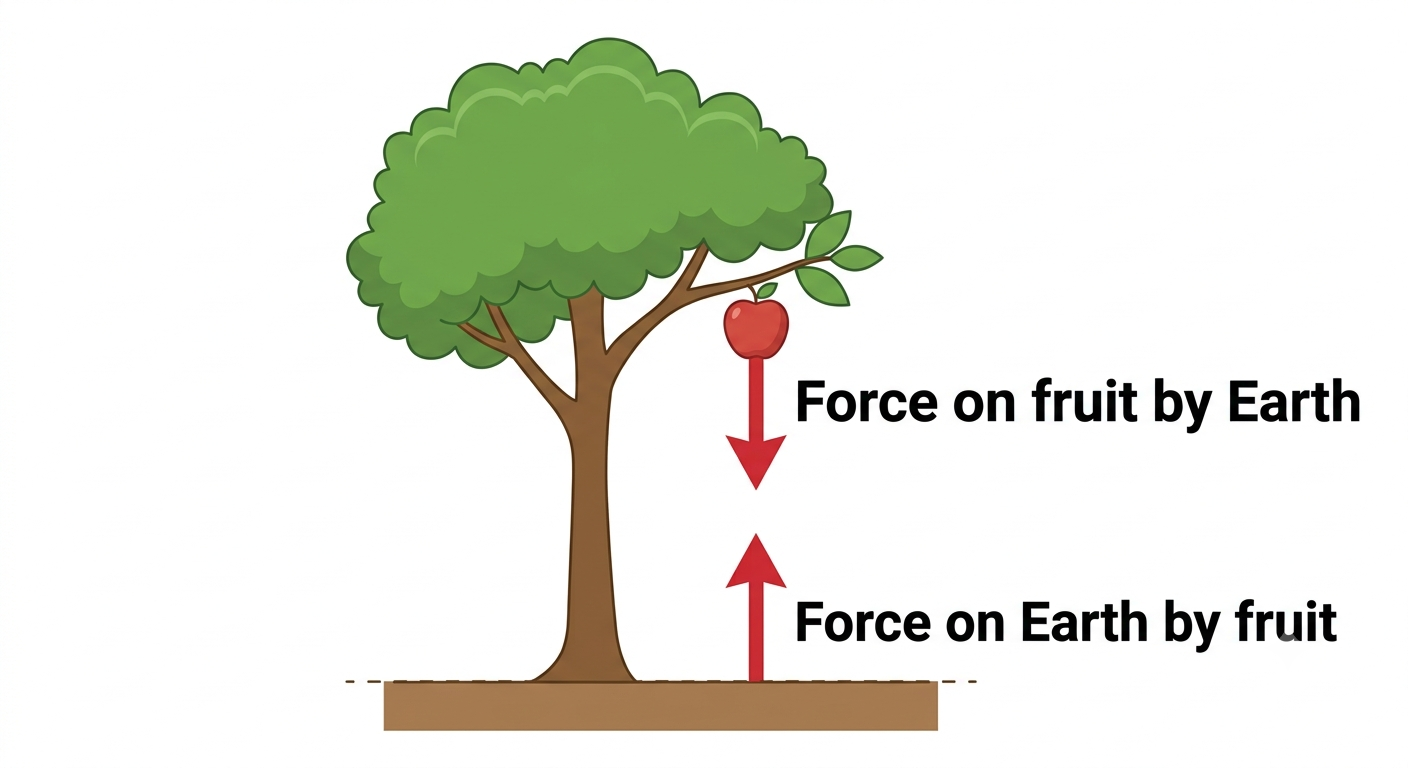
Earth and fruit pull each other equally. Why does the fruit move, not the Earth?
Forces equal, but a = F/m. Earth’s mass is huge → its acceleration is negligible. The light fruit accelerates a lot.
👀 Both forces equal; the fruit moves because it is light, the Earth barely moves because it is heavy.
✍️ Example 6.8 (method — study this)
0.1 kg bullet from a 5 kg gun, force 2 N. Find the accelerations.
Recoil force on gun = 2 N (third law).
Gun: a = 2/5 = 0.4 m/s². Bullet: a = 2/0.1 = 20 m/s². Forces equal, accelerations differ (mass differs).
Gun: a = 2/5 = 0.4 m/s². Bullet: a = 2/0.1 = 20 m/s². Forces equal, accelerations differ (mass differs).
6.7 System of Objects
- Two boxes joined by a string, pulled by force F.
- String tension T is an internal force → ignore it.
- Only the external force F matters → system acts like one object of mass m₁ + m₂.
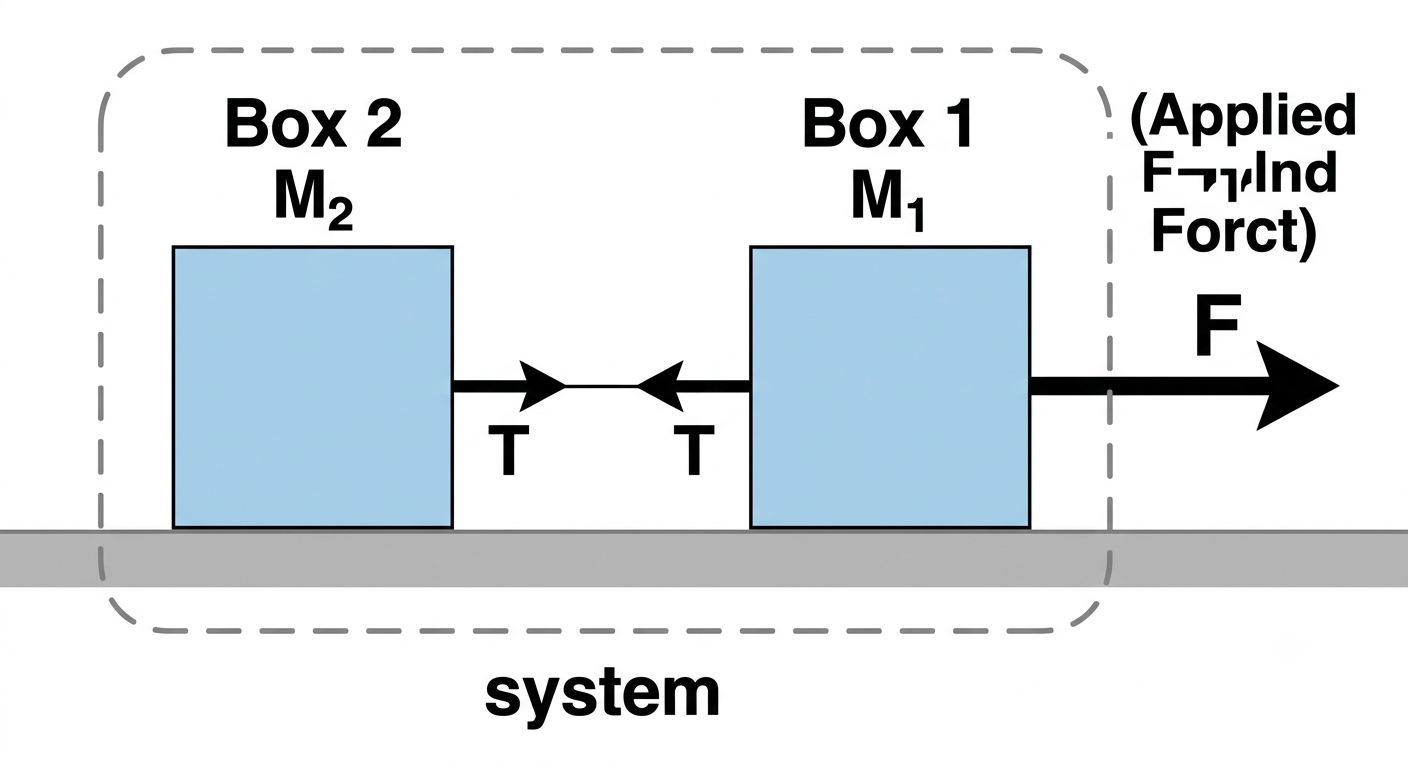
👀 Tension T is internal (cancels); only external F moves the system.
Acceleration of a system
a = F / (m₁ + m₂)
Ignore internal forces
📋 At a Glance — Summary
- Friction acts opposite to motion.
- 1st law: no net force → rest stays rest, motion stays constant velocity.
- 2nd law: F = ma; a ∝ F, a ∝ 1/m.
- 3rd law: action = reaction, equal & opposite, on two objects.
🌙 Night-Before Quick Recap
- Force: push/pull; unit newton (N).
- Balanced → net 0 → no change. Unbalanced → net ≠ 0 → changes.
- Net force: same dir add, opposite subtract.
- Friction opposes motion; smoother → less friction.
- 1st law: inertia; no net force → no change.
- 2nd law: F = ma · a = F/m · weight = mg (g = 9.8).
- 1 N = 1 kg × 1 m/s².
- 3rd law: action = reaction on two different bodies.
- Equal forces ≠ equal accelerations if masses differ.
- System: a = F/(m₁+m₂).
⚠️ Common Mistakes
- newton (unit, small n) vs N (symbol, capital).
- Action–reaction act on different objects → never cancel.
- Constant velocity → net force is zero, not pushing.
- Equal forces ≠ equal acceleration (depends on mass).
- Deceleration → acceleration/force is negative.
- Mass in kg; weight = mg in newtons.
📝 Check Your Concepts
QState Newton’s third law.
When one object exerts a force on a second, the second exerts an equal and opposite force on the first.
QWhy don’t action and reaction cancel each other?
Because they act on two different objects, not the same one.
QWrite the acceleration of a system of two connected boxes pulled by force F.
a = F / (m₁ + m₂), ignoring the internal string tension.
🧮 Numerical Practice — try, then tap to check
NA 0.2 kg ball is fired with 4 N. A 2 kg gun recoils. Find both accelerations.
Ball: a = 4/0.2 = 20 m/s². Gun: a = 4/2 = 2 m/s².
NTwo boxes (3 kg and 2 kg) joined by a string are pulled by 10 N. Find the acceleration.
a = F/(m₁+m₂) = 10/(3+2) = 2 m/s².
PART 5
Revise, Reflect, Refine — All Questions Solved
Revise, Reflect, Refine — All Questions Solved
Every NCERT end-of-chapter question, fully worked. Tap to reveal each solution.
1A table is moved at constant velocity by a horizontal force F. How much is the frictional force?
Constant velocity → net force = 0 → the forces balance. So friction = F (equal to the applied force, opposite in direction).
2For a ball on a smooth frictionless surface, choose the correct option.
(i) No net force → velocity will remain the same.
(ii) Net force in the direction of motion → velocity will increase.
(iii) Net force opposite to motion → velocity will decrease.
(ii) Net force in the direction of motion → velocity will increase.
(iii) Net force opposite to motion → velocity will decrease.
3Blocks P (forces 5 N and 4 N in opposite directions) and Q (constant velocity). Which statement is correct?
P has unequal opposite forces → net force = 5 − 4 = 1 N ≠ 0. Q moves at constant velocity → net force = 0. So (i) P experiences a net force and Q does not.
4In a snake-boat race, 95 oarsmen row backward, 5 row the opposite way; each applies 200 N. Net force on the boat?
Forward force = 95 × 200 = 19,000 N.
Backward force = 5 × 200 = 1,000 N.
Net force = 19,000 − 1,000 = 18,000 N in the forward direction.
Backward force = 5 × 200 = 1,000 N.
Net force = 19,000 − 1,000 = 18,000 N in the forward direction.
5When a net force acts on an object, it accelerates:
(iv) in the direction of force, with acceleration proportional to the force acting on the object. (This is Newton’s second law: a ∝ F, in the direction of F.)
6From the position-time graphs of A, B, C, D (Fig 6.37), a net force acts on:
A net force means the velocity is changing — i.e., a curved position-time graph. A (straight slanted) and B (flat) have constant velocity/rest → no net force. D (straight, decreasing) is also constant velocity. Only C (curved) shows changing velocity → (iii) Object C.
7A sailor jumps from a small boat to the shore. Will the boat move? Which way and why?
Yes. As the sailor pushes forward to jump, by Newton’s third law the boat is pushed backward (away from the shore) with an equal and opposite force. So the boat moves backward.
8Why is a landing mat or sand bed placed for a high jumper?
The soft mat increases the time over which the jumper stops. A longer stopping time → smaller acceleration → smaller force on the body → less chance of injury (second law).
9A loaded hand cart collides with an identical empty cart. During the collision:
(iv) both carts exert an equal magnitude of force on each other. (Newton’s third law — the forces are always equal and opposite, whatever the masses.)
10The acceleration-mass graph (Fig 6.40) is given. Plot the force-mass graph.
Since F = ma and the acceleration-mass graph comes from a constant force, the force is the same for every mass. So the force-mass graph is a horizontal straight line (F constant, independent of mass).
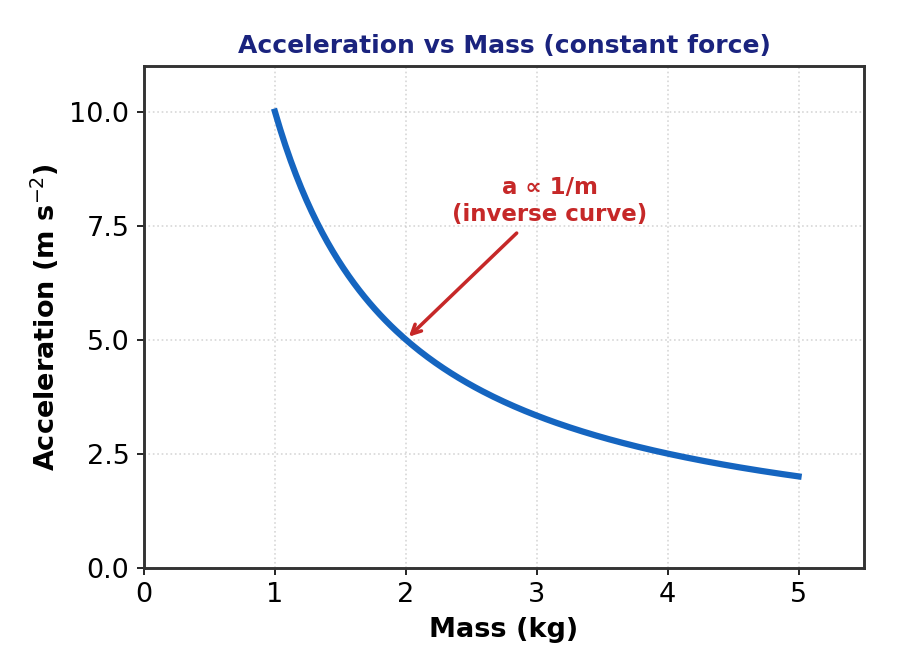
👀 LOOK HERE: a ∝ 1/m (curve). Since F = ma stays constant, the force–mass graph is a flat horizontal line.
11From the velocity-time graph (Fig 6.41), a 10 kg object. Calculate the force.
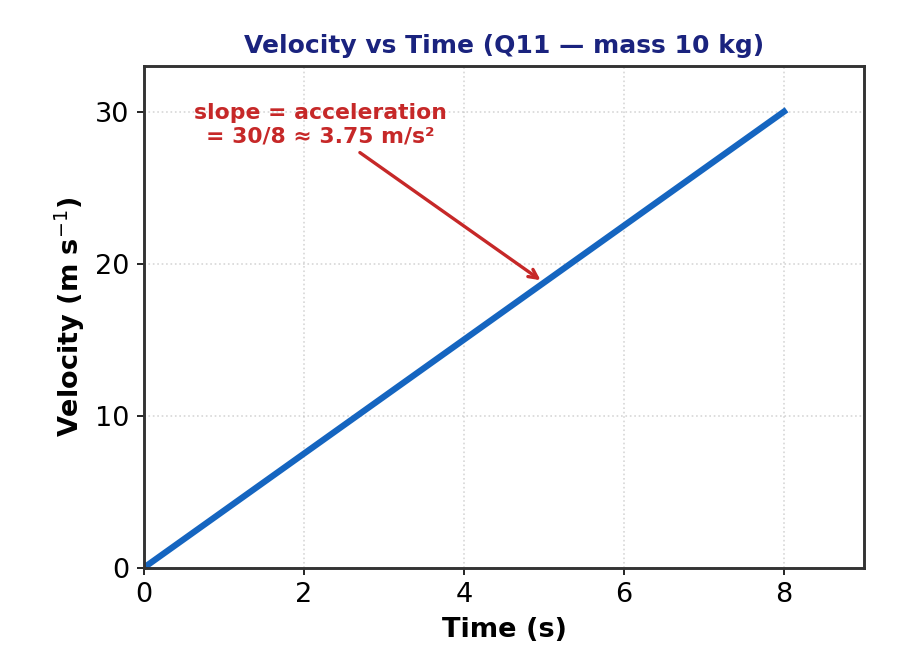
👀 LOOK HERE: slope of a v-t graph = acceleration.
a = 30 ÷ 8 = 3.75 m/s².
F = ma = 10 × 3.75 = 37.5 N.
12A 50 g bullet at 100 m/s stops after penetrating 50 cm into a block. Estimate the stopping force.
m = 0.05 kg, u = 100 m/s, v = 0, s = 0.5 m.
Using v² = u² + 2as: 0 = (100)² + 2a(0.5) → a = −10000 m/s².
F = ma = 0.05 × (−10000) = −500 N. The stopping force is 500 N (opposing motion).
Using v² = u² + 2as: 0 = (100)² + 2a(0.5) → a = −10000 m/s².
F = ma = 0.05 × (−10000) = −500 N. The stopping force is 500 N (opposing motion).
13A footballer kicks a ball (0.4 kg) to 108 km/h; force imparted 800 N. Find the contact time.
108 km/h = 108 × (5/18) = 30 m/s.
a = F/m = 800 ÷ 0.4 = 2000 m/s².
From v = u + at, with u = 0: t = v/a = 30 ÷ 2000 = 0.015 s.
a = F/m = 800 ÷ 0.4 = 2000 m/s².
From v = u + at, with u = 0: t = v/a = 30 ÷ 2000 = 0.015 s.
14A 2 kg object at 10 m/s meets a rough patch: friction 7 N plus an extra 3 N opposing force. How far does it travel before stopping?
Total opposing force = 7 + 3 = 10 N.
a = F/m = 10 ÷ 2 = 5 m/s² (deceleration, so a = −5 m/s²).
Using v² = u² + 2as: 0 = (10)² + 2(−5)s → 0 = 100 − 10s → s = 10 m.
a = F/m = 10 ÷ 2 = 5 m/s² (deceleration, so a = −5 m/s²).
Using v² = u² + 2as: 0 = (10)² + 2(−5)s → 0 = 100 − 10s → s = 10 m.
15A tractor pulls a harrow (mass m₁, accel a₁) and a trolley (mass m₂, accel a₂) separately with force F. With the harrow on the trolley, find the resulting acceleration.
From F = ma: m₁ = F/a₁ and m₂ = F/a₂.
Combined mass = m₁ + m₂ = F/a₁ + F/a₂.
Resulting acceleration a = F ÷ (m₁ + m₂) = F ÷ (F/a₁ + F/a₂) = a₁a₂ / (a₁ + a₂).
Combined mass = m₁ + m₂ = F/a₁ + F/a₂.
Resulting acceleration a = F ÷ (m₁ + m₂) = F ÷ (F/a₁ + F/a₂) = a₁a₂ / (a₁ + a₂).
16A bar magnet and a compass needle exert equal and opposite forces. Why does the needle move but the magnet doesn’t?
The forces are equal (third law), but acceleration = F/m. The compass needle has a very small mass, so it accelerates a lot and visibly moves. The bar magnet is much heavier, so its acceleration is negligible and it appears not to move.
🧪 Test Yourself — 25-Question Quiz