
Work, Energy, and Simple Machines
- W = F × s
- Unit: joule (J)
- Positive / negative / zero
- Capacity to do work
- Kinetic = ½mv²
- Potential = mgh
- KE + PE = constant
- Power = W/t
- Unit: watt (W)
- Pulley, inclined plane, lever
- Mechanical advantage
- MA = load/effort
- In science, work has a precise meaning — it is done only when a force moves an object.
- Lifting a bag to a height needs an upward force = mg; the force acts through the displacement → work is done.
- A larger force over the same distance → proportionally more work (3 bags = 3× work).
- The same force over a larger distance → proportionally more work (1 bag to 3 m = 3× work).
Work done by a constant force = force applied × displacement in the direction of the force. W = F × s
- SI unit of work = joule (J).
- 1 J = 1 N × 1 m — work done when 1 N moves an object 1 m in the direction of the force.
- 1 J = 1 kg m² s⁻².
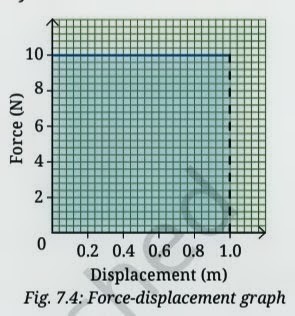
- Work is zero if force = 0.
- Work is zero if displacement = 0 — e.g. pushing a rigid wall.
- Work is zero if force is perpendicular to displacement — e.g. carrying a box while walking.
- You feel tired pushing a wall, but scientifically no work is done — muscles use internal energy.
- Positive work: displacement in the same direction as force — pushing a wheelchair.
- Negative work: displacement opposite to force — a goalkeeper stopping a ball.
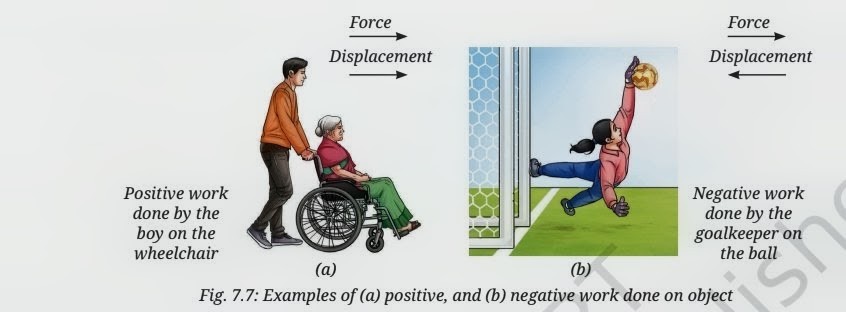
A girl lifts a dumbbell and slowly lowers it. When is the work positive/negative?
Lowering down: force (up) opposite to displacement → negative work.
A goalkeeper hand moves back 15 cm stopping a ball with 200 N. Work done on the ball?
QDefine work and give its SI unit.
QGive three cases when work done is zero.
QWhen is work positive and when negative?
NA force of 15 N moves a box 4 m in its direction. Find the work done.
NA player stops a ball applying 250 N; the ball moves 0.2 m against the force. Work done on the ball?
Work-Energy Theorem & Kinetic Energy
- Capacity to do work
- Unit: joule (J)
- Many forms
- Work = change in energy
- Holds for systems too
- Mechanical, thermal
- Light, sound, electrical
- Nuclear, chemical
- Energy of motion
- K = ½mv²
- Doubles v → 4× KE
- When positive work is done on an object, it gains energy.
- An object with the capacity to do work is said to possess energy.
- A thrown ball or a raised flowerpot gains energy from the work done on it, and can then do work on something else.
Work done on an object = change in its energy. It holds for a system of objects and even when forces are not constant.
- SI unit of energy = joule (J) — same as work.
In carrom, a striker hits the white coin, which hits the black coin. Identify the work and energy changes.
- Energy exists in many forms and can be converted from one to another.
- Examples: electrical → light (bulb); chemical (food) → mechanical (muscles); mechanical → sound (bell).
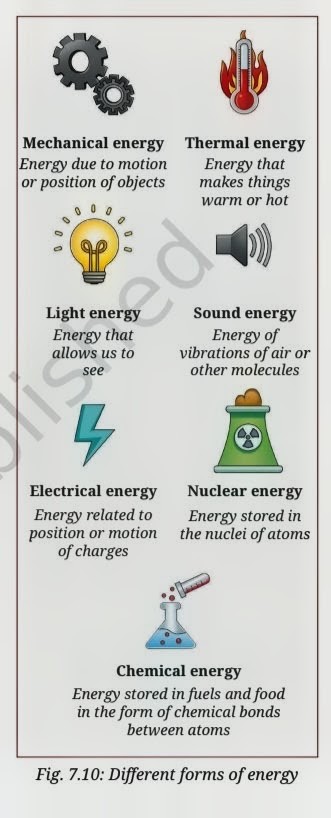
- Mechanical energy = energy due to an object’s motion or position.
- It has two types: kinetic energy (motion) and potential energy (position).
- Kinetic energy = energy possessed by an object due to its motion.
- All moving objects have kinetic energy (a rolling ball, a moving bicycle).
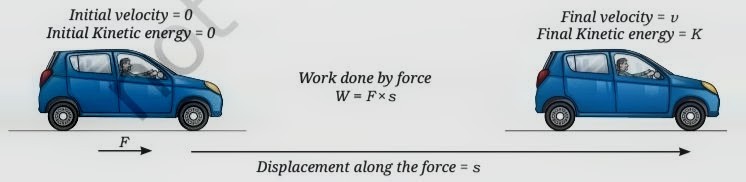
The energy an object has due to its motion. For mass m and velocity v:
K = ½ m v² (SI unit: joule)
- KE has no direction. More positive work → more speed → more KE.
- If v doubles, KE becomes 4 times (since KE ∝ v²).
If a vehicle’s velocity doubles, what happens to its kinetic energy?
A cricket ball of mass 0.2 kg is bowled at 154.8 km/h. Find its kinetic energy.
K = ½mv² = ½ × 0.2 × 43² = 184.9 J.
A 15000 kg jet lands and is stopped in 100 m by a wire exerting 367500 N backward. Find its landing velocity.
By work-energy theorem this equals the change in KE (0 − ½mv²).
½ × 15000 × v² = 367500 × 100 → v² = 4900 → v = 70 m/s (252 km/h).
QState the work-energy theorem.
QDefine kinetic energy and give its formula.
QIf the speed of a body doubles, how does its KE change?
NFind the KE of a 2 kg ball moving at 10 m/s.
NTwo objects of mass m and 4m have the same KE. Find the ratio of their speeds.
Potential Energy & Conservation of Energy
- Energy of position/shape
- U = mgh
- Unit: joule (J)
- Stretched band, spring
- Separated magnets/charges
- Raised object (gravity)
- KE + PE
- Stays constant
- If no external force
- Falling body: PE→KE
- Pendulum swing
- ME = mgh throughout
- A stretched rubber band or bent bow stores energy — released, it does work on an object (gives it KE).
- A stretched/compressed spring stores energy in its deformed shape.
- Separated magnets or charges store energy due to their relative positions.
- A raised object + Earth store energy due to their separation.
The energy stored in an object due to its deformation, or in a system due to the relative positions of objects.
- The simplest case: the Earth–ball system. Since Earth barely moves, we call it the PE of the ball.
- Raising a ball higher needs more work → it stores more PE (drops deeper into sand).
- Work to raise mass m to height h = mg × h → this becomes the PE.
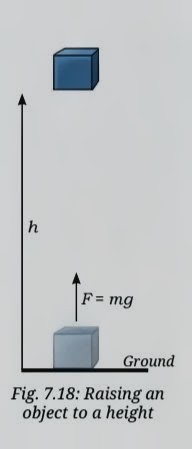
A fielder throws a 200 g ball 10 m high. Find its PE at the top (g = 10 m/s²).
- Mechanical energy = KE + PE.
- For a freely falling body, as it drops: PE decreases, KE increases — but their sum stays constant.
- At the top: all PE (= mgh), KE = 0. As it falls, PE converts to KE. Total ME = mgh throughout.
When only the gravitational force acts (no friction/external force), the total mechanical energy (KE + PE) stays constant.
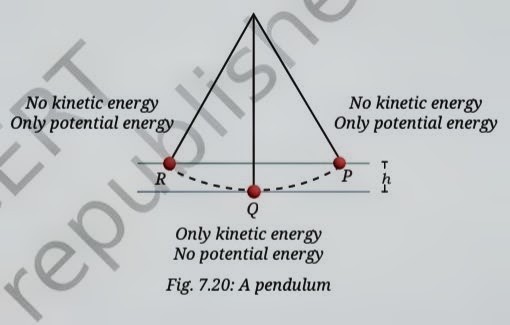
- Pendulum: at the extreme points, KE = 0, PE = max; at the bottom, PE = 0, KE = max.
- In real life a pendulum slows down — energy is lost to friction and air resistance.
Find the speed of a child reaching the bottom of a slide of height h.
½mv² = mgh → v = √(2gh).
Speed depends only on height h, not on the slide’s shape or the child’s mass.
A 10000 kg truck at 72 km/h runs onto a 30° sand ramp; sand exerts 50000 N. Find the ramp length to stop it (g = 10, rises 1 m per 2 m along ramp).
Along distance d: height = d/2, so final PE = mg(d/2) = 10000 × 10 × d/2 = 50000d.
Work by sand = −50000d = final energy − initial energy = 50000d − 2000000.
2000000 = 100000d → d = 20 m.
QDefine potential energy and give the formula for gravitational PE.
QState the law of conservation of mechanical energy.
QWhy does a real pendulum eventually stop?
NFind the PE of a 5 kg object raised to 4 m (g = 10 m/s²).
NA body falls from height 20 m. Find its speed just before hitting the ground (g = 10 m/s²).
Power & Simple Machines
- Rate of doing work
- P = W/t
- Unit: watt (W)
- Make work easier
- MA = load/effort
- Don’t reduce total work
- Fixed pulley: MA = 1
- Incline: MA = L/h
- Fulcrum, load, effort
- MA = effort arm/load arm
- 3 classes
- Power = the rate at which work is done.
- Running upstairs in 1 minute vs walking in 5 minutes — same work, but different power.
The rate of doing work: P = W / t. SI unit = watt (W); 1 W = 1 J s⁻¹.
A weightlifter lifts 75 kg by 2 m in 5 s. Find the power (g = 10).
A 1000 kg car reaches 72 km/h from rest in 10 s. Find the engine power.
Power = W/t = 200000 ÷ 10 = 20000 W.
- Total work can’t be reduced, but a simple machine makes a task easier by changing the magnitude or direction of the force.
- The force we apply = effort; the force to overcome = load.
The ratio of load to effort: MA = load / effort. It shows how much a machine multiplies the applied force.
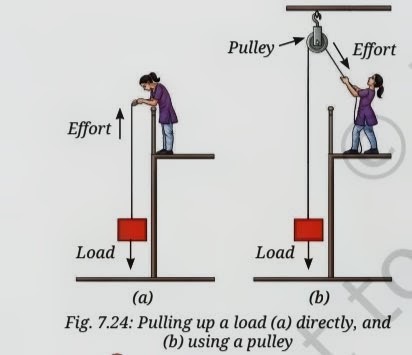
- A pulley is a grooved wheel that guides a rope.
- A fixed pulley only changes the direction of the force (pull down to lift up) — easier, but MA = 1 (load = effort).
- Movable/compound pulleys can give MA > 1 (used in cranes, elevators).
- An inclined plane (ramp) helps move a heavy load to a higher level with less force.
- Longer/shallower ramp → smaller effort, but you push over a larger distance.
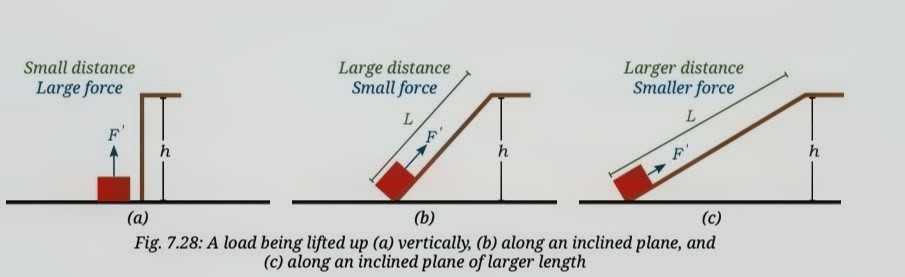
A ramp raises an object over a 30 cm step; ramp width 40 cm, length 50 cm. Find the MA.
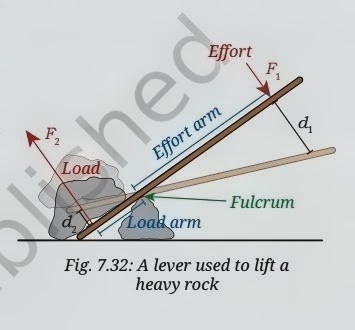
- A lever is a rigid bar that rotates about a fixed point (fulcrum).
- Three parts: fulcrum (pivot), load (force to overcome), effort (force applied).
- Distance of load from fulcrum = load arm; distance of effort from fulcrum = effort arm.
- Balance condition: effort × effort arm = load × load arm.
A seesaw has seats A, B, D, E; fulcrum C; AC = EC = 2 m, BC = DC = 1 m. Where should 15 kg and 30 kg children sit to balance it?
So the 30 kg child sits at seat D (1 m from the fulcrum).
- Work is done when a force displaces an object in the direction of the force.
- An object able to do work possesses energy.
- Work-energy theorem: work done = change in energy.
- Kinetic energy = ½mv² (motion); potential energy = mgh (position).
- Power = rate of doing work = W/t.
- Simple machines make work easier by changing the size or direction of force — they don’t reduce total work.
- Work: W = F × s; unit joule (J); zero if F=0, s=0, or F⊥s.
- Positive work: force & displacement same way; negative: opposite.
- Work-energy theorem: work = change in energy.
- Kinetic energy: K = ½mv²; double v → 4× KE.
- Potential energy: U = mgh.
- Conservation: KE + PE = constant (no friction); falling body ME = mgh.
- Power: P = W/t; unit watt (W); 1 hp = 746 W.
- MA: load/effort. Fixed pulley MA = 1; incline MA = L/h; lever MA = effort arm/load arm.
- Lever balance: effort × effort arm = load × load arm.
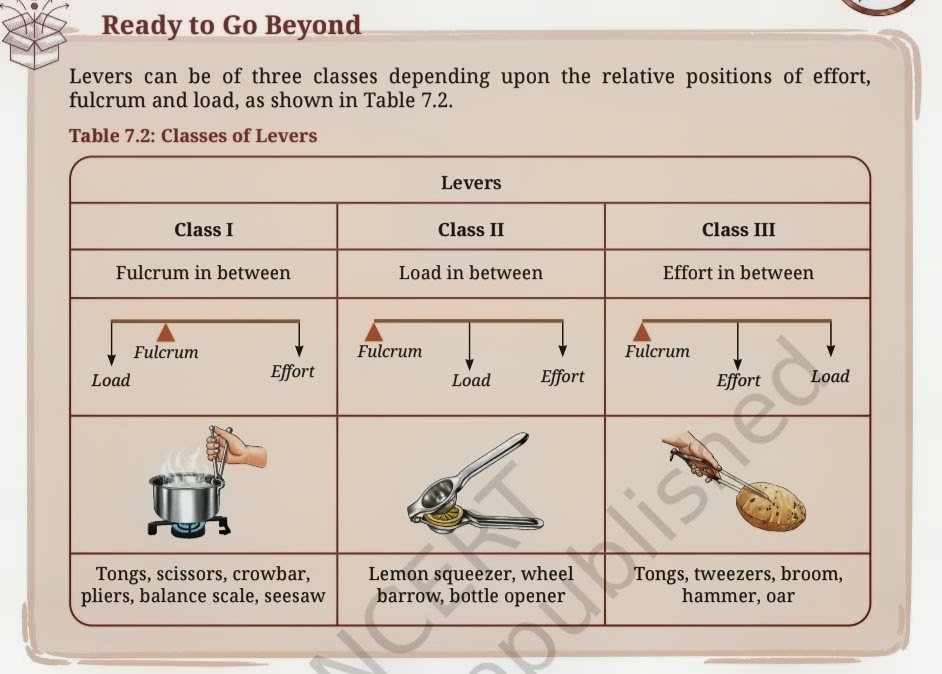
- 3 lever classes: I fulcrum-middle, II load-middle, III effort-middle.
- Work ≠ effort/tiredness: pushing a wall = zero work (no displacement).
- KE ∝ v² not v: double the speed → four times the KE.
- joule vs watt: joule = energy/work; watt = power (J/s).
- Simple machines don’t reduce work — they only change the force’s size/direction.
- Negative work sign: remember the minus when force opposes displacement.
- MA of a fixed pulley = 1 (it only changes direction, not force).
QDefine power and give its SI unit.
QWhat is mechanical advantage? Give the formula for a lever.
QWhy is the mechanical advantage of a fixed pulley 1?
NA machine does 600 J of work in 4 s. Find its power.
NA ramp of length 3 m raises a load to a height of 1 m. Find its mechanical advantage.
Revise, Reflect, Refine — All Questions Solved
Every NCERT end-of-chapter question. Try first, then tap to reveal the answer.
1State True or False.
(ii) Lifting a bucket vertically upward = positive work — True.
(iii) SI unit for both work and energy is joule (J) — True.
(iv) A motionless stretched rubber band has kinetic energy — False (it has potential energy).
(v) Energy can change from one form to another — True.
2Fill in the blanks.
(ii) 1 joule when a force of 1 newton displaces an object by 1 metre.
(iii) Kinetic energy of a body = ½mv².
(iv) Potential energy at height h = mgh.
(v) Power is the rate at which work is done.
3When a ball thrown upward reaches its highest point, which statements are correct?
4Identify the energy transformation in each situation.
(ii) Unwinding watch spring: potential (elastic) → kinetic.
(iii) Photosynthesis: light → chemical.
(iv) Water flowing from a dam: potential → kinetic.
(v) Burning matchstick: chemical → heat + light.
(vi) Firecracker explosion: chemical → heat + light + sound.
(vii) Speaking into a microphone: sound → electrical.
(viii) Glowing bulb: electrical → light + heat.
(ix) Solar panel: light → electrical.
5A 50 kg student is lifted (elevator) and later climbs stairs to height h = 72.5 m (g = 10). Find PE gains and the conclusion.
(ii) Climbing stairs to the same top: PE = mgh = 36250 J (same).
(iii) Conclusion: gravitational PE depends only on the height, not on the path taken.
6A crane lifts mass m to the 10th floor in time t, then to the 20th floor in double the time. How much more energy and power?
Power = work/time. Double work in double time → power = same. Power: unchanged.
7Which factors decide the energy to raise a flag by pulley? Does raising it slowly/quickly change the work? If speed doubles, how does power change?
Power = work/time. If speed doubles, time halves → power doubles.
8A 60 kg man rides a 100 kg scooter to speed v. Next day his 40 kg son joins. Same speed, same time. Ratio of fuel used on the two days?
Day 1 mass = 60 + 100 = 160 kg. Day 2 mass = 160 + 40 = 200 kg.
Ratio = 160 : 200 = 4 : 5.
9On a seesaw, an adult weighs twice the child, yet it balances. Draw the distances from the fulcrum.
10A 2 kg ball is thrown up at 20 m/s.
(ii) Ideal height (no air) = v²/2g = 20²/(2×10) = 20 m. Actual = 19.4 m, so 0.6 m less.
Work by air resistance = −mg × (height lost as KE) ≈ energy difference = mg × 20 − mg × 19.4 = 2 × 10 × 0.6 = −12 J (approx, energy lost to air).
11A 10 kg block, KE = 180 J at 0 m; force applied per Fig 7.37 from 0 to 4 m. Find speed at 0 m and at 4 m; any negative acceleration?
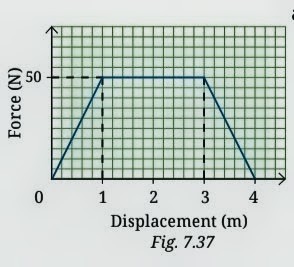
Work = area of trapezoid = ½ × (sum of parallel sides) × height. Here area ≈ ½ × (4 + 2) × 50 = 150 J (using the graph’s shape).
(ii) KE at 4 m = 180 + work done = 180 + 150 = 330 J → v = √(2×330/10) = √66 ≈ 8.1 m/s.
The force is always in the direction of motion (positive), so there is no negative acceleration in this region.
12Moon’s gravity ≈ 1/6 of Earth’s. A ball thrown up reaches 8 m on Earth. How high on the Moon (same speed)?
Height on Moon = 8 × 6 = 48 m.
13A 1000 kg car: speed-time graph (Fig 7.38). (i) motion A→B, (ii) KE at A, (iii) work by brakes B→C, (iv) what KE transforms into.
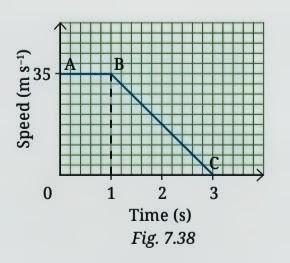
(ii) KE at A = ½ × 1000 × 35² = 612500 J.
(iii) Work by brakes = change in KE = 0 − 612500 = −612500 J.
(iv) The car’s KE transforms mainly into heat (in the brakes) and some sound.
14PE-displacement graph of a 0.5 kg ball (Fig 7.39). At O, v = 0 and PE = 30 J. Find v at P, Q, R.
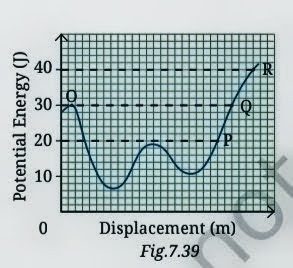
At P (PE = 20 J): KE = 10 J → v = √(2×10/0.5) = √40 ≈ 6.3 m/s.
At Q (PE = 30 J): KE = 0 → v = 0 m/s.
At R (PE = 40 J): KE would be −10 J — impossible, so the ball cannot reach R.
15A 1.5 kg coconut falls from a 10 m tree onto sand (g = 10).
(ii) All energy = mgh = 1.5 × 10 × 10 = 150 J goes into the depression. Sand force 3000 N × depth d = 150 → d = 150/3000 = 0.05 m (5 cm).