

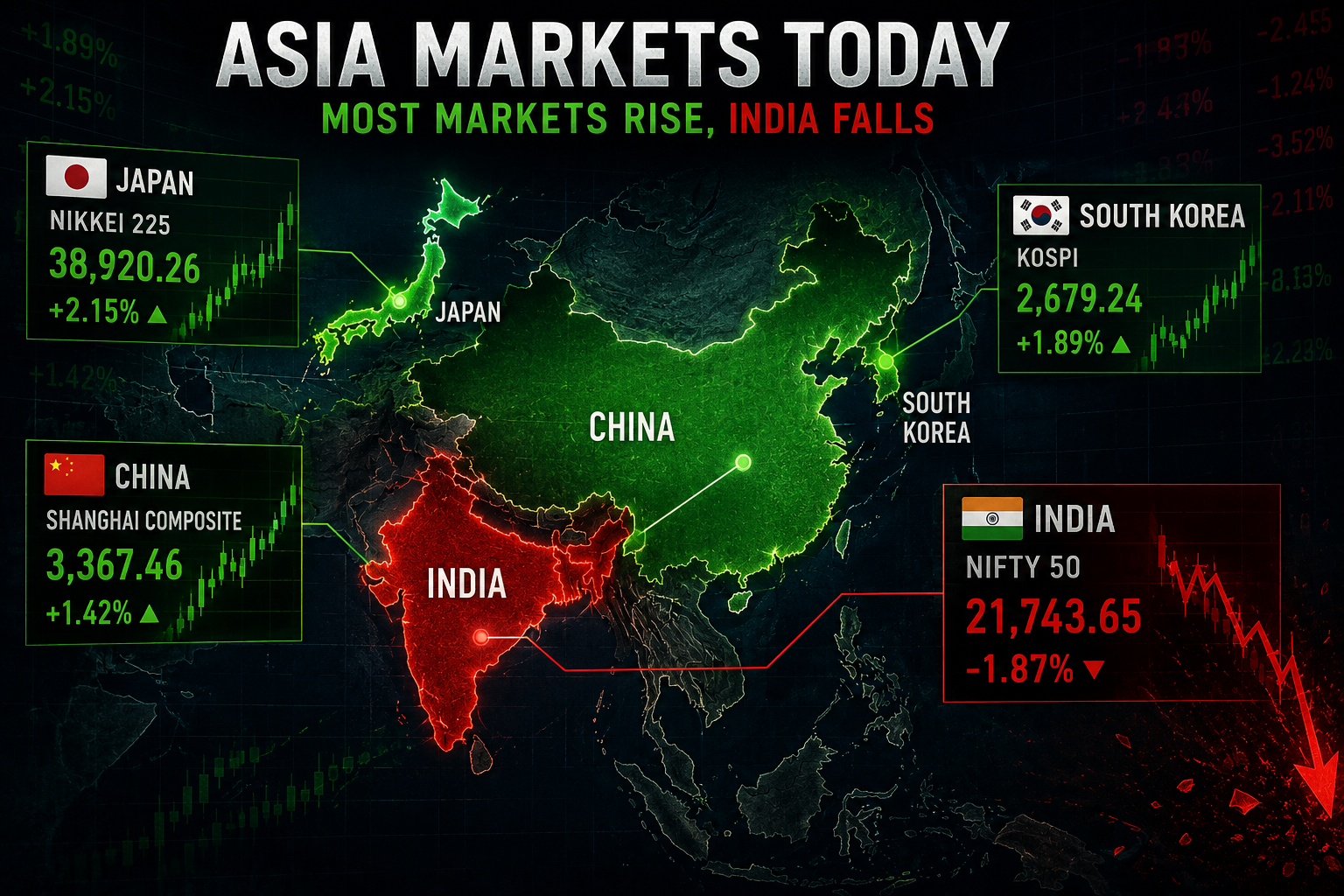
On June 1, 2026, while India was celebrating RCB’s back-to-back IPL title, something deeply alarming was happening in the world of finance that most Indians had no idea about. In Tokyo, the Nikkei 225 hit a fresh record high. In Seoul, the KOSPI surged on the back of a 169% jump in semiconductor exports. In Shanghai, Chinese stocks rallied for the fourth consecutive month. And in Mumbai? The Sensex had just completed its worst month in two years. Foreign investors had pulled out ₹55,963 crore from Indian stocks in May alone. The rupee was sitting at a record low of nearly 97 per dollar. Asia was partying. India was bleeding. And the most terrifying question of all is this — why?

📉 The Numbers That Should Alarm Every Indian
Let us start with the cold hard facts because they are more frightening than any opinion.
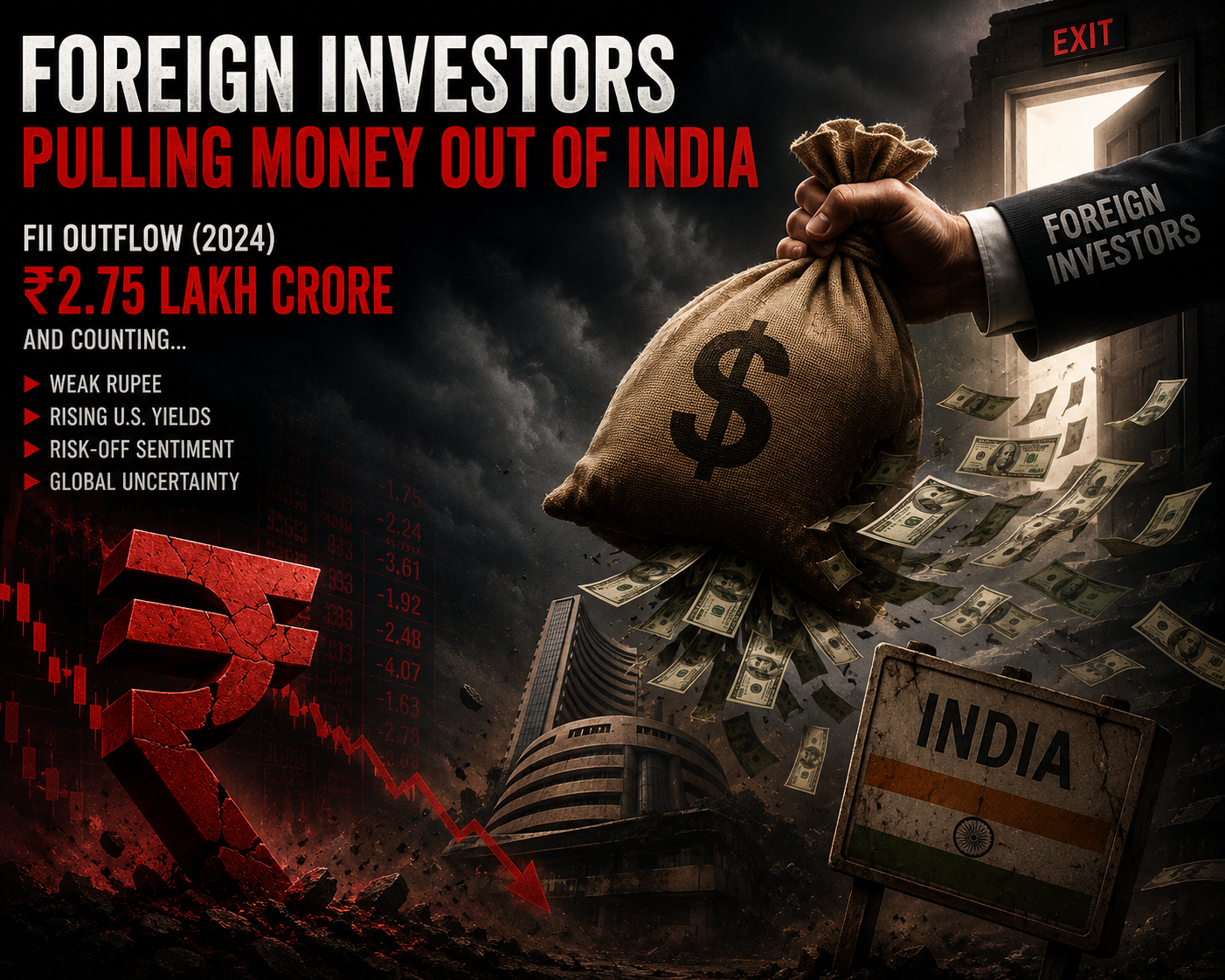
In March 2026, foreign investors pulled a record $12 billion from Indian stocks in a single month — the largest monthly outflow ever recorded. In May 2026, they sold another ₹55,963 crore worth of Indian equities. The FII outflows that started in October 2024 have now been running for over 18 months. The rupee hit a record low of 96.96 per dollar in May 2026 — down nearly 10% in a single financial year. India’s private sector activity in March 2026 slowed to its weakest level since October 2022.
And while all of this was happening in India, the rest of Asia was doing the opposite.
Japan’s Nikkei 225 delivered a 24% return in 2025 and hit fresh record highs in June 2026. South Korea’s KOSPI surged as semiconductor exports jumped 169% year-on-year to a record $87.8 billion in May 2026 alone. Hong Kong’s Hang Seng delivered its best year since 2017, rising 29%. China’s markets rallied on AI innovation, policy stimulus and rebounding consumer sentiment. Taiwan and South Korea captured 30% of global AI capital expenditure between them.
The contrast is not subtle. It is brutal. Asia is experiencing one of its greatest bull markets in a decade. India — supposedly the fastest growing major economy in the world — is the odd one out.
🤔 Why Is Money Running Away From India?
To understand why foreign money is leaving India, you need to understand how global investors think.
Foreign Institutional Investors — the pension funds, hedge funds and asset managers of the world — do not have emotional attachments to any country. They move billions of dollars to wherever they get the best risk-adjusted return. When India gives them better returns than alternatives, they pour money in. When something better appears on the horizon, they leave. Simple, cold, brutal.
So what happened? Why did they start leaving India in October 2024 and why have they not stopped?
Reason 1 — India became too expensive. By late 2024, Indian stocks were trading at valuations that were among the highest in the world — more than double the price-to-earnings ratio of China and South Korea. When a market is that expensive, even good news is already priced in. Any disappointment — slower earnings, global shock, currency weakness — triggers selling.
Reason 2 — China and South Korea became cheap and exciting simultaneously. As Indian valuations peaked, Chinese stocks offered valuations at historic lows with the government deploying massive stimulus. South Korea and Taiwan were sitting at the centre of the global AI revolution — semiconductors, memory chips, advanced manufacturing — sectors where earnings were exploding. Global funds rotated out of expensive India and into cheap, high-growth alternatives.
Reason 3 — The Middle East war hit India harder than anyone else. When the US-Iran conflict erupted in early 2026 and crude oil prices surged 44%, India — which imports over 85% of its oil — was uniquely vulnerable. Brent crude crossed $100 a barrel. Every dollar rise in oil costs India approximately $1.5 billion extra annually in import bills. Higher oil prices meant higher inflation, a wider current account deficit, more pressure on the rupee, and slower growth. India’s private sector activity hit its weakest reading since October 2022.
Reason 4 — The rupee kept falling. When a currency weakens, it silently destroys returns for foreign investors. Even if Indian stocks hold their value in rupee terms, a falling rupee means those returns are worth less when converted back to dollars or euros. A foreign fund that invested in India when the rupee was at 84 and is now looking at 97 has already lost 15% before the stock price even moves. This makes India increasingly unattractive for dollar-benchmarked global funds.
Reason 5 — Weak private investment sent a signal. Former Chief Economic Adviser Arvind Subramanian asked a devastating question in May 2026: if India is genuinely growing at 7-8%, why are global investors not putting money in? The answer, he suggested, lies in deeper concerns about governance, institutional independence, and whether India’s investment climate is truly open and fair to all players equally. When the most respected former economic adviser to the government raises these questions publicly, global investors hear it — and factor it in.
🌏 What Asia Is Doing That India Is Not
The divergence between India and the rest of Asia in 2026 is not just about oil prices or currency moves. It is about strategic positioning in the global economy.
South Korea identified the AI revolution early. It positioned TSMC and Samsung at the heart of the global semiconductor supply chain. When the world needed AI chips, it needed South Korea and Taiwan. Their exports surged 169% in a single month. Their stock markets hit record highs. Their currencies strengthened. Their young people had jobs.
Japan pursued aggressive corporate governance reforms — forcing companies to use their cash piles, improve returns on equity, and treat shareholders fairly. Foreign investors responded by pouring money into Japanese equities for the first time in decades. The Nikkei hit 40-year highs.
China deployed massive fiscal and monetary stimulus — cutting interest rates, supporting the property sector, boosting consumer spending. It bet on AI innovation and domestic consumption to drive the next phase of growth. Global fund managers rotated billions from India to China as valuations reset.
Singapore doubled down on wealth management, digital transformation, and becoming the financial hub of Southeast Asia. Hong Kong leveraged its unique position between China and global capital. Vietnam and Indonesia captured manufacturing orders that were leaving China, positioning themselves as the next factory of the world.
And India? India has been running on the promise of its demographic dividend and domestic market. Both are real. But promises without execution have an expiry date. And global investors are increasingly asking: where is the execution?
🏭 The Manufacturing Dream That Has Not Fully Arrived
India’s biggest economic opportunity of this decade is capturing global manufacturing that is leaving China. The Production Linked Incentive scheme, Make in India, and infrastructure investment have all been aimed at this goal. Apple now manufactures some iPhones in India. Several global companies have set up facilities. This is genuine progress.
But the numbers tell a sobering story. Vietnam — a country with a fraction of India’s size, population and resources — has captured more manufacturing foreign direct investment than India in recent years. Bangladesh built a $50 billion garment export industry that India — with far more resources and a larger workforce — has never matched. The gap between India’s manufacturing potential and manufacturing reality remains vast.
The State of Working India 2026 report revealed why this matters so deeply: India produces 5 million graduates every year but only 2.8 million find employment. The manufacturing sector — which in China, South Korea, Taiwan and Vietnam absorbed hundreds of millions of workers into decent jobs — has not grown fast enough in India to do the same. The result is educated unemployment, wasted human capital, and a generation of young people whose potential is being squandered.
💰 What The Rupee Is Telling You
There is an old saying in financial markets: currencies do not lie.
When a currency falls, it is the collective judgment of millions of investors, traders, businesses and central banks about the relative attractiveness of that economy. The Indian rupee has fallen from around 84 per dollar at the start of the financial year to nearly 97 — a decline of approximately 15%. It lost nearly 10% in a single financial year. Analysts are now discussing the possibility of 100 rupees per dollar with 41% probability by year end.
What does a weak rupee do to ordinary Indians? It makes petrol more expensive. It makes cooking gas more expensive. It makes every imported electronic device — your phone, your laptop, your air conditioner — more expensive. It makes medicines that use imported raw materials more expensive. It increases the import bill for the entire country, which eventually shows up as higher prices for everything.
And here is the cruel irony: while a weak rupee hurts importers and consumers, it should theoretically help exporters — their goods become cheaper for foreign buyers. But India’s export response has been muted because India does not yet have the manufacturing depth to rapidly scale up exports when currency conditions favour it. The rupee is weak. The export boom has not arrived. Ordinary Indians are paying the price of both.
🔔 The Warning India Cannot Afford to Ignore
In May 2026, Arvind Subramanian — former Chief Economic Adviser who sat at the highest table of Indian economic policymaking — wrote in The Indian Express that India needs to change the people in charge of its economy. Not a new scheme. Not a new policy announcement. Change the people.
“Sameness of personnel and staleness of ideas are fatal for all political systems,” he wrote. “The truth is that this leopard has to change its spots or else the Indian economy will continue paying the price.”
He identified India’s core problem as weak private corporate investment — businesses not building new factories, not expanding capacity, not creating jobs. And he pointed to the investment climate as the reason: when businesses fear the state apparatus will be weaponised against them, when only politically connected groups feel safe investing, capital stays away.
This is a structural problem that no interest rate cut, no government scheme, and no infrastructure announcement can fix on its own. It requires something harder — a genuine signal that India’s institutions are independent, its rules apply equally to everyone, and its future belongs to whoever works hardest and creates the most value rather than whoever has the right connections.
🌅 Is There Hope? Yes — But Only With Honest Reckoning
India’s strengths are real and should not be dismissed.
India has the world’s largest young population — 65% of its people are under 35. It has a growing middle class with rising consumption. It has a world-class IT and services sector. It has 750 million internet users — a digital market that every global tech company needs to be present in. It has $700 billion in foreign exchange reserves providing genuine macroeconomic stability. It has democratic institutions that, imperfect as they are, provide a foundation for accountability and change.
JP Morgan’s Private Bank described India as “one of our top implementation ideas outside of the US” for 2026, citing a compelling entry point given recent valuation corrections. ICICI Direct analysts have compared the current correction to the Russia-Ukraine episode of 2022 and expect Auto, Financials and Metals to lead a recovery. The domestic investor base — Indian retail investors and mutual funds — has shown remarkable resilience, continuing to buy even as foreign investors sold, providing a crucial cushion.
But hope and reality are not the same thing. The gap between India’s potential and India’s performance has been visible for years. The rest of Asia is not waiting for India to close that gap — they are running ahead while India debates and deliberates.

⚡ The Moment of Truth
India stands at a crossroads in 2026 that it has stood at before — and sometimes squandered.
The global AI revolution is creating a new economic order. Countries that supply the semiconductors, the software, the data centres, and the skilled labour for this revolution are growing explosively. Taiwan, South Korea, Japan, Singapore — they positioned themselves for this moment years ago. Their markets reflect it today.
India has the talent — its engineers and data scientists are building AI systems for every major global tech company. But the value is being captured in San Jose and Seattle, not in Bengaluru and Hyderabad. India’s challenge is to capture that value at home — to build the companies, the infrastructure and the institutions that turn Indian talent into Indian wealth.
The rupee at 97. The Sensex bleeding while the Nikkei records highs. Foreign investors voting with their feet. A former Chief Economic Adviser publicly calling for leadership change. A generation of graduates without jobs. A manufacturing sector that has not fulfilled its promise.
These are not reasons to despair about India. India has faced harder moments and emerged stronger. But they are reasons to demand honest answers from those in power — and honest reckoning from ourselves about what kind of country we are building and for whom.
Asia is not waiting. The world is not waiting. And India’s greatest resource — its young people — cannot wait either.
The question is no longer whether India has potential. Everyone knows it does. The question is whether India has the will, the leadership, and the institutional courage to finally turn potential into reality.
The markets are watching. The rupee is watching. And 1.4 billion Indians — whether they know it or not — are waiting for the answer.