
CBSE Class 9 Science (Exploration) · Complete Notes · Read only this page → score 100%
- Water ≠ hydrogen + oxygen in properties
- But mass of water = mass of H + O
- Does mass stay the same?
- Salt dissolved in water
- Mass of solution = water + salt
- No mass change
- Vinegar + baking soda
- Balloon NOT fixed
- Final ≠ initial (gas escapes)
- Balloon fixed with thread
- Gas trapped inside
- Final = initial ✅
- Water can be obtained from various sources. Are all these samples of water chemically identical?
- Oxygen is sometimes represented as O and sometimes as O₂. What is the difference between these symbols?
- Why does dissolved salt in water conduct electricity, but sugar does not?
Where this chapter starts
- In Chapter 8 you learnt: atoms with an octet of electrons in their valence shell are stable; atoms can lose, gain or share electrons to achieve an octet.
- Many properties of elements are not retained when they form a compound.
- Example: hydrogen and oxygen are gases — but the substance they form, water, is a liquid at ordinary temperatures.
- Hydrogen gas is combustible; oxygen supports combustion; but water neither burns nor helps in burning — it extinguishes fire.
- However — the mass of the water formed equals the sum of the masses of the hydrogen and oxygen that combined to form it.
Activity 9.1: Let us investigate a physical change
- Place a clean and dry 100 mL beaker on a digital weighing balance.
- Set the balance reading to zero by pressing the tare or reset button.
- Pour about 50 mL of water into the beaker.
- Add a spatula full of common salt to the water in the beaker.
- Record the reading on the weighing balance (Fig. 9.1a).
- Swirl until the added salt dissolves and record your observations (Fig. 9.1b).
The mass of the solution is equal to the sum of the masses of water and salt taken. There is practically no change in mass during the formation of a solution, which is a physical change. This is true for all physical changes.
Repeat idea: weigh a piece of paper before and after tearing it into pieces — the mass does not change.
Activity 9.2: Let us investigate a chemical change
Recall what happened when baking soda was added to vinegar — a gas, carbon dioxide, was formed. The reaction is represented as:
Let us explore whether the mass remains the same before and after this chemical change.
Experimental set-up 1
- Place a clean, dry 100 mL conical flask and a medium-sized balloon on a weighing balance.
- Set the balance reading to zero by pressing the tare or reset button.
- Pour about 20 mL of vinegar or lemon juice into the conical flask.
- Take about 2 g of baking soda (sodium hydrogencarbonate) and put it into the balloon.
- Keep the balloon filled with baking soda on the weighing balance next to the conical flask. Record the initial reading (Fig. 9.2a).
- Carefully transfer the baking soda from the balloon into the conical flask containing vinegar (Fig. 9.2b).
- Place the conical flask and balloon back on the weighing balance, and record the final reading (Fig. 9.2c).
- What do you observe? Are the initial and the final readings same?
Experimental set-up 2
- Place a clean, dry 100 mL conical flask and a medium-sized balloon on a weighing balance.
- Set the balance reading to zero using the tare or reset button.
- Pour about 20 mL of vinegar or lemon juice into the conical flask.
- Place about 2 g of baking soda (sodium hydrogencarbonate) in the balloon.
- Fix the balloon to the mouth of the conical flask using a thread, without allowing the baking soda to mix with the vinegar.
- Weigh the conical flask containing vinegar and the balloon containing baking soda, and record the reading (Fig. 9.3a).
- Lift the other end of the balloon upwards, allowing the baking soda to fall into the vinegar (Fig. 9.3b).
- What do you observe? As in set-up 1, a brisk effervescence occurs, which inflates the balloon during the reaction.
- Record the final reading (Fig. 9.3c). Are the initial and final readings same in this case?
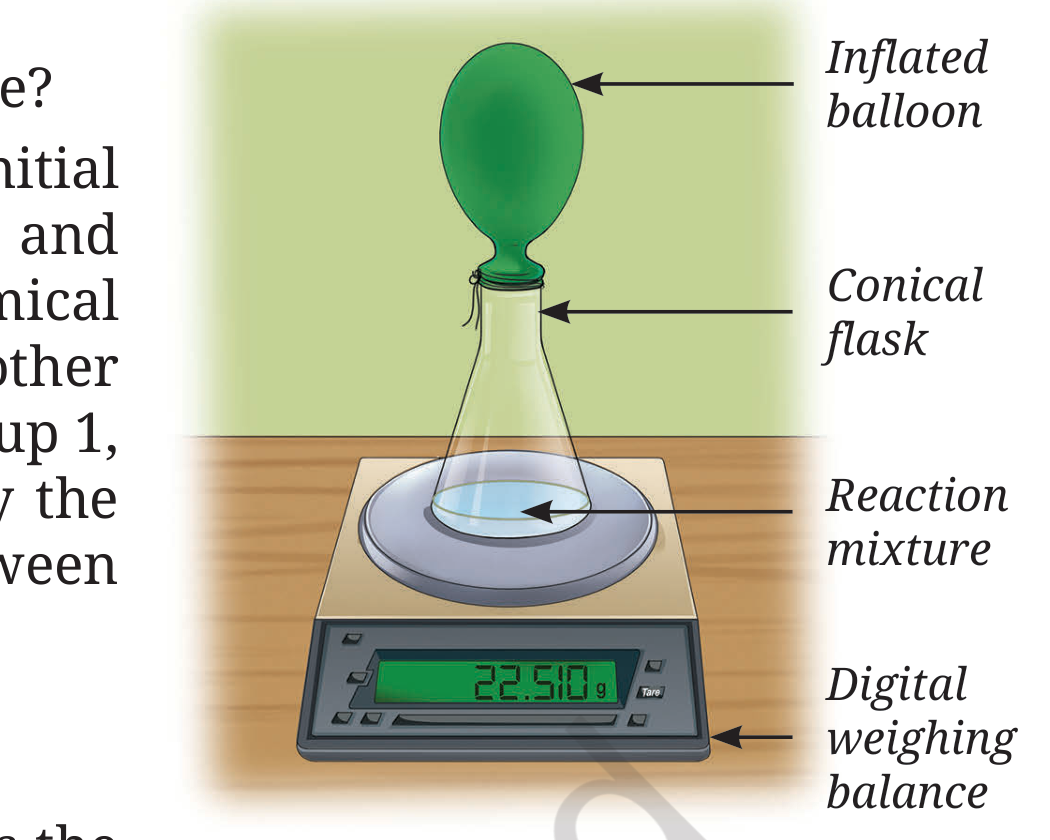
In set-up 2, the final reading matches the initial reading. The total mass of vinegar and baking soda before the reaction equals the total mass of carbon dioxide and other substances formed after the reaction.
Why set-up 1 failed: the mass difference occurs because the gas produced escapes into the air (open system), resulting in a difference between the initial and final readings.
📝 Check Your Concepts — Part 1
Show Answer
Show Answer
Show Answer
Show Answer
Show Answer
- Lavoisier, 1789
- Matter neither created nor destroyed
- Applies to every chemical reaction
- Sodium sulfate + Barium chloride
- White precipitate forms
- Mass unchanged
- Gas formed → use closed system
- No gas → open system is fine
- Mass of reactants = mass of products
- Unitary method for ratios
9.1 Law of Conservation of Mass
- Activity 9.2 demonstrates that the total mass remains the same before and after a chemical reaction.
- So, matter can neither be created nor destroyed in a chemical reaction.
Law of Conservation of Mass: matter can neither be created nor destroyed in a chemical reaction — proposed by Antoine Lavoisier in 1789.
- Known as the Father of Modern Chemistry.
- Proposed the Law of Conservation of Mass, which applies to every chemical reaction.
- He proposed that in every operation an equal quantity of matter exists both before and after the operation.
Activity 9.3: Let us verify the law — Group activity
- Place two clean and dry 100 mL conical flasks on a weighing balance, and mark them A and B.
- Set the balance reading to zero using the tare or reset button.
- Pour about 10 mL of 1% m/v sodium sulfate solution into Conical Flask A.
- In Conical Flask B, pour about 10 mL of 1% m/v barium chloride solution.
- Leave both flasks on the weighing balance undisturbed, and record the total mass of both solutions (Fig. 9.4a).
- Transfer the solution from Flask B to Flask A and mix the two solutions carefully. What do you observe?
- Place both flasks A and B on the balance again (Fig. 9.4b), and note the reading.
- Do you observe any change in the reading after mixing the solutions?
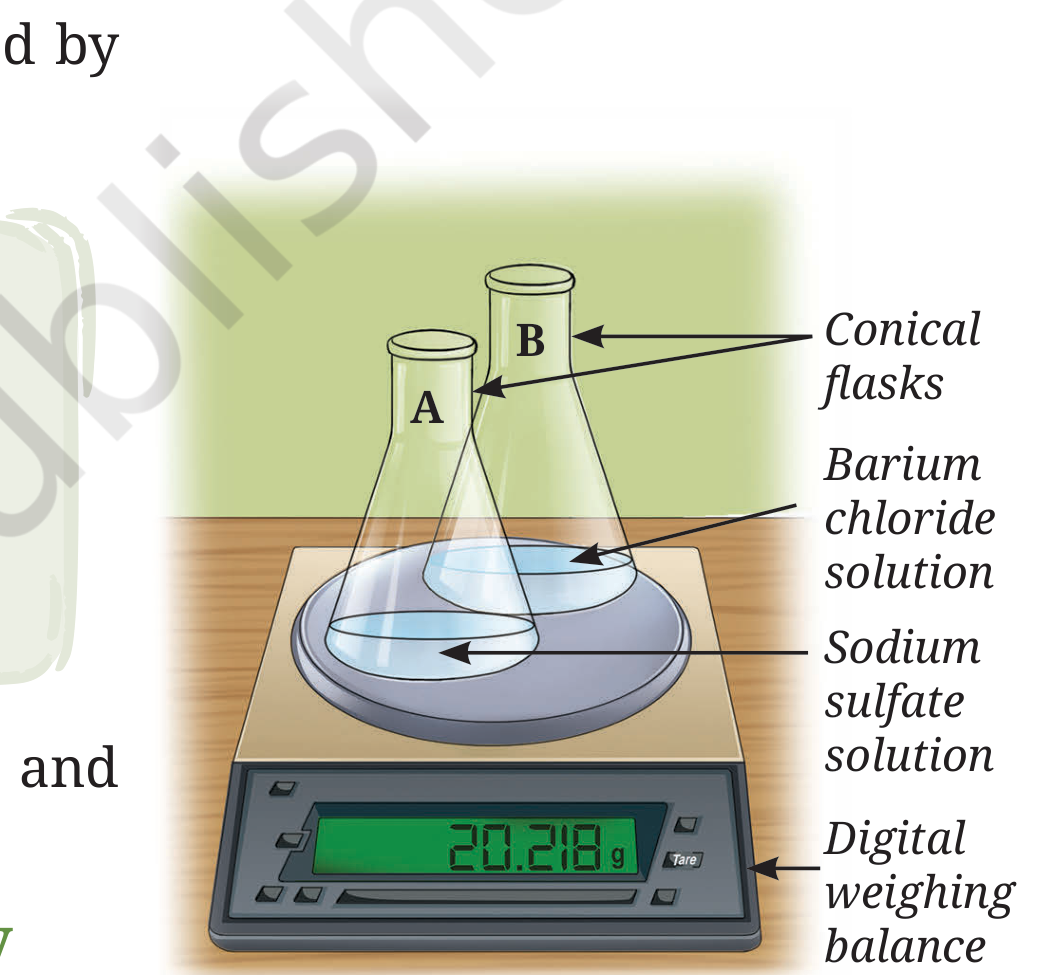
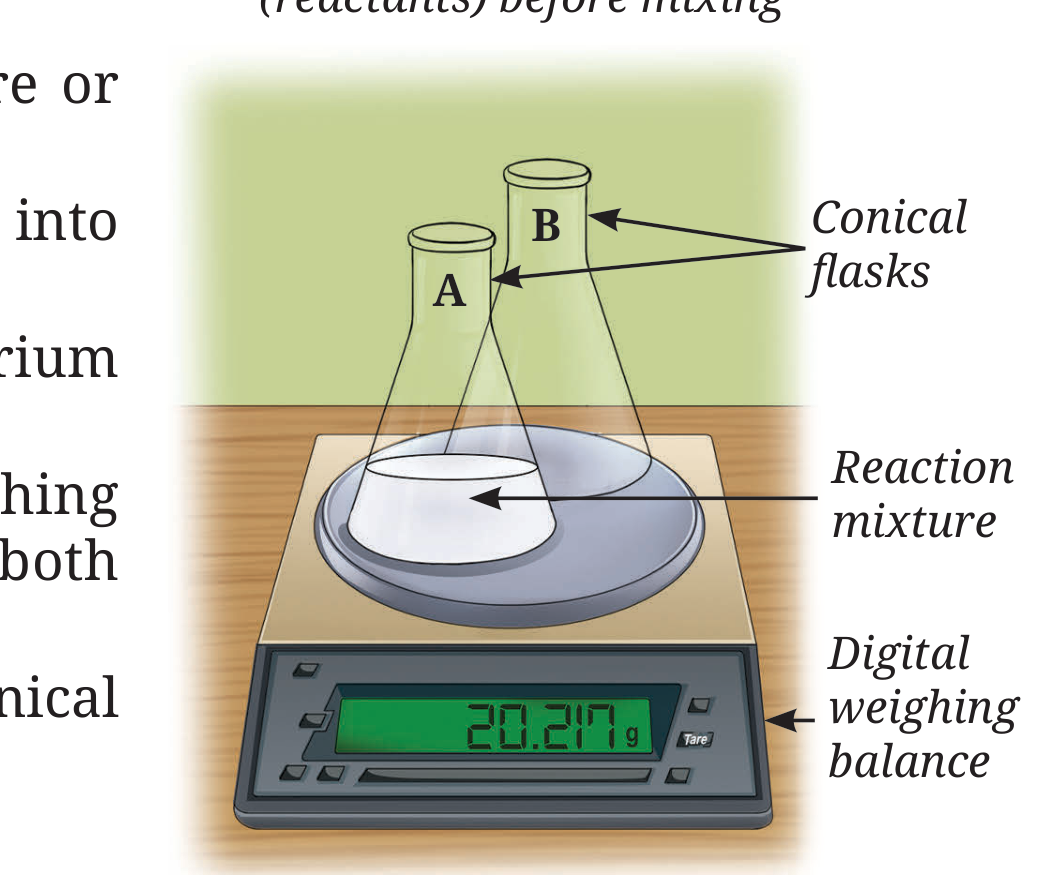
- Observation: when solutions of sodium sulfate and barium chloride are mixed, a white precipitate of barium sulfate is formed along with sodium chloride.
Based on Activity 9.2, it was established that weight — and hence mass — is conserved during a chemical change.
- Keep both conical flasks on the digital weighing balance. This prevents the error caused by a small amount of solution that may remain stuck to the walls of the flask during transfer.
- This reaction has been carried out in the open system, since no gas is formed.
You are given a chemical reaction in which zinc reacts with dilute hydrochloric acid to form zinc chloride and hydrogen gas.
Design and perform an experiment to test the hypothesis that mass is conserved during the chemical reaction. You may use a set-up different from the one shown in Activity 9.2.
Show Expected Answer
- Since hydrogen gas is produced, the experiment MUST be done in a closed system, or the gas will escape and the mass will appear to decrease.
- Design: take dilute HCl in a conical flask and zinc granules in a balloon. Fix the balloon tightly on the mouth of the flask with thread. Weigh the whole set-up → initial reading.
- Lift the balloon so the zinc falls into the acid. Effervescence occurs and the balloon inflates with hydrogen. Weigh again → final reading.
- Result: initial reading = final reading → mass is conserved, hypothesis verified.
Q: Students place 4.0 g of calcium carbonate with 2.92 g of hydrochloric acid in a closed container. After the reaction, they measured 1.76 g of carbon dioxide, 0.72 g of water, and 4.44 g of calcium chloride. Verify whether the Law of Conservation of Mass is obeyed.
Solution:
- Mass of calcium carbonate = 4.0 g · Mass of hydrochloric acid = 2.92 g
- Total mass of reactants = 4.0 g + 2.92 g = 6.92 g
- Mass of carbon dioxide = 1.76 g · water = 0.72 g · calcium chloride = 4.44 g
- Total mass of products = 1.76 + 0.72 + 4.44 = 6.92 g
- Mass of reactants = Mass of products → the Law of Conservation of Mass is obeyed.
Q: 12 g of carbon combines with 32 g of oxygen to form 44 g of carbon dioxide. If 2.4 g of carbon reacts completely with oxygen, how much carbon dioxide will be produced?
- 1 g of carbon will give = 44/12 g of carbon dioxide
- 2.4 g of carbon will give = (44/12) × 2.4 = 8.8 g of carbon dioxide
🧮 Numerical Practice (NCERT Pause and Ponder) — try first!
Show Answer
- No, the law is not violated.
- Ethanol burns to form carbon dioxide and water vapour, which are gases that escape into the air from the open beaker.
- If the reaction were carried out in a closed container and the mass of oxygen used plus the gaseous products were counted, the total mass before = total mass after.
Show Answer
📝 Check Your Concepts — Part 2
Show Answer
Show Answer
Show Answer
Sodium sulfate + Barium chloride → Barium sulfate + Sodium chloride
Show Answer
- Fixed ratio by mass
- Water always H : O = 1 : 8
- Irrespective of source
- Law of Constant Proportions
- Law of Definite Proportions
- Proust’s Law
- Matter = tiny atoms
- Atoms indivisible in reactions
- Combine in whole number ratios
- Explains both laws logically
- Atoms merely rearrange
9.2 Law of Constant Proportions
- Soon after Lavoisier, Joseph Proust proposed that in any compound formed by two or more elements, the elements combine in a fixed ratio by mass.
- In other words, elements in a compound have definite proportions irrespective of its source.
- Example — water: water collected from rivers, borewells or the ocean, when purified and analysed, is always found to contain hydrogen and oxygen in a mass ratio of 1 : 8.
- Meaning: if 9 g of purified water from any source is decomposed, 1 g of hydrogen and 8 g of oxygen are always obtained.
This is known as the Law of Constant Proportions, or the Law of Definite Proportions, or sometimes as Proust’s Law.
- A prominent French chemist known for his careful experimental work.
- Contributed to the Law of Definite Proportions by showing that chemical compounds always contain elements in fixed ratios by mass.
- Studied the composition of copper carbonate — showing it always contains copper, carbon and oxygen in the same proportion by mass, no matter how it was prepared or where it was found.
- In many ancient civilisations, a red pigment derived from rocks was widely used in painting and as a colouring agent.
- In India it was known as hingula; in Latin and English, as cinnabar.
- Heating cinnabar yields two elements — mercury and sulfur — in mass percentages of about 86.22% and 13.78% respectively.
- Most civilisations also found that grinding mercury and sulfur together in this same ratio could form cinnabar — an early demonstration of constant proportions! (The toxic nature of both prevented the process from becoming widespread.)
Q: Sodium chloride (NaCl) contains sodium and chlorine in the mass ratio of 23 : 35.5. If 46 g of sodium reacts completely, how much chlorine is needed to form NaCl?
Solution: Mass of chlorine required = (35.5 ÷ 23) × 46 = 71 g
🧮 Numerical Practice (NCERT Pause and Ponder) — try first!
Show Answer
If sulfur = 20 g, oxygen = (3/2) × 20 = 30 g of oxygen.
Show Answer
Show Answer
- In a compound, elements are chemically combined in a fixed ratio by mass, which never changes regardless of source or method of preparation.
- In a mixture, components are simply physically mixed in any proportion — e.g., a sugar solution can be dilute or concentrated. Hence no fixed ratio exists, and the law does not apply.
Show Answer
- Yes. Simplify Y’s ratio: 8 : 2 = 4 : 1.
- Both students obtained the same ratio of copper to oxygen by mass, even though they used different amounts.
- This is exactly what the Law of Constant Proportions states — the compound has a definite composition irrespective of the quantity taken.
9.3 Dalton’s Atomic Theory
- The two laws above formed the basis of Dalton’s Atomic Theory.
- The theory logically explains why substances combine in fixed proportions and why there is no loss or gain of mass during a chemical reaction.
- Dalton explained these by proposing that during a chemical reaction, atoms are indivisible and merely rearrange, rather than being created or destroyed.
A postulate is a fundamental assumption accepted as truth without formal proof, from which further ideas are formed or developed.
John Dalton postulated that:
- All matter is made up of very tiny particles called atoms, which participate in chemical reactions.
- Atoms are indivisible particles, which cannot be created or destroyed in a chemical reaction.
- Atoms of a given element are identical in mass and chemical properties.
- Atoms of different elements have different masses and chemical properties.
- Atoms combine in the ratio of simple whole numbers to form compounds.
- The relative number and kinds of atoms are constant in a given compound.
- Example: hydrogen and oxygen atoms combine to form water, but the atoms themselves are not destroyed or changed into something else.
- Example: when magnesium burns in air, a white powder of magnesium oxide forms — showing atoms of magnesium have combined with those of oxygen.
- Born in England. In 1793 he moved to Manchester to teach mathematics, physics and chemistry at a college.
- He spent most of his life teaching and researching there.
- In 1808 he presented his atomic theory, which proved to be a turning point in the study of matter.
Show Answer
📝 Check Your Concepts — Part 3
Show Answer
Show Answer
Show Answer
Show Answer
Show Answer
- Sharing of electrons
- Transfer of electrons
- H₂ — single bond
- Cl₂ — single bond
- O₂ — double bond
- HCl — H shares with Cl
- H₂O — two H share with O
- Prefixes mono-, di-, tri-…
- Second element ends in -ide
9.4 How Atoms Combine?
- Atoms of an element can combine to form a molecule of that element — e.g., a hydrogen molecule consists of two hydrogen atoms.
- Atoms of different elements combine to form a molecule of a compound — e.g., one hydrogen atom + one chlorine atom form a molecule of hydrogen chloride.
A molecule is an electrically neutral entity consisting of more than one atom that is capable of independent existence and shows all the properties of that substance.
Note: some elements, such as helium, exist only as atoms because their atoms are already stable.
- From Chapter 8: atoms with 8 electrons in the outermost (valence) shell — or 2 electrons if the K-shell is outermost — are stable.
- If the valence shell has fewer than eight electrons, atoms share, gain or lose electrons to complete their valence shell and become stable. In this process, atoms combine to form compounds. This takes place in two ways:
- Sharing of electrons — share a few or all of their valence electrons with another atom.
- Transfer of electrons — transfer one or more valence electrons to another atom, or accept one or more electrons from some other atom.
When atoms combine, the total energy of the system becomes lower than the sum of the energies of the individual atoms, making the arrangement more stable. The force that holds atoms together is called a chemical bond.
9.4.1 Bonding by sharing of electrons — Covalent Bond
A. Molecules of elements
Formation of a hydrogen molecule:
- Electronic configuration of hydrogen (atomic number 1): only one electron in the K-shell.
- Since the K-shell can hold a total of two electrons, it needs one more electron to become stable.
- Thus a hydrogen atom shares one electron with another hydrogen atom to form a hydrogen molecule (H₂).
- The shared pair of electrons attracts both the nuclei and makes the molecule stable.
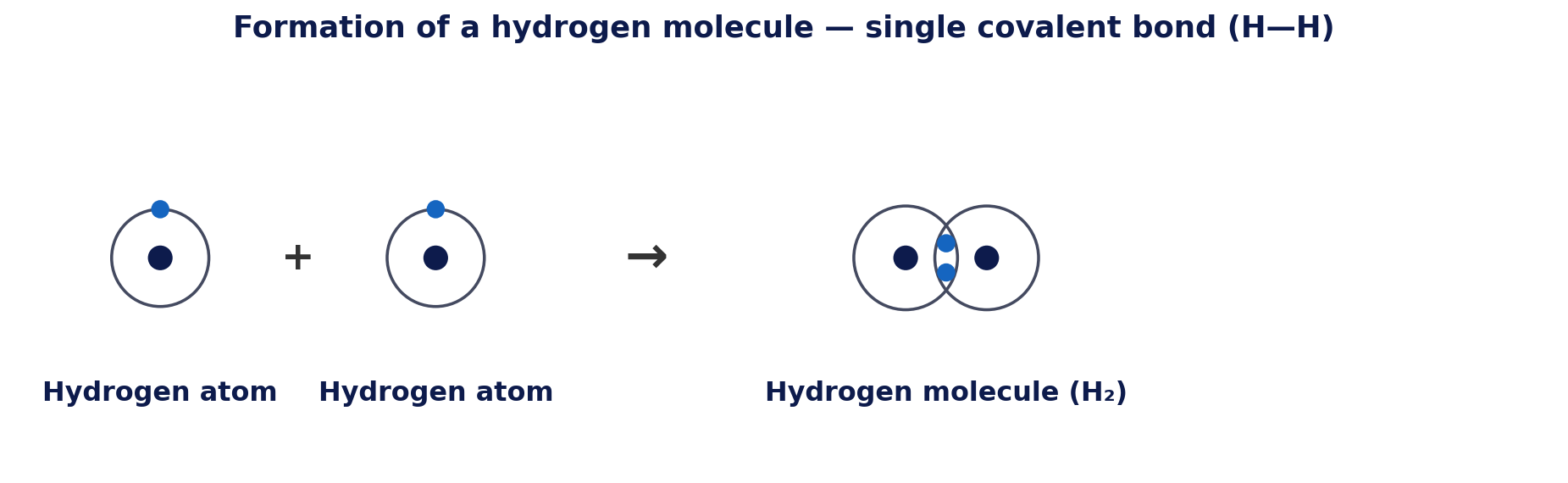
The interaction between atoms through a shared pair of electrons is called a covalent bond. If two atoms are joined by sharing one electron each, they are joined by a single bond, depicted by a single line: H—H.
Formation of a chlorine molecule:
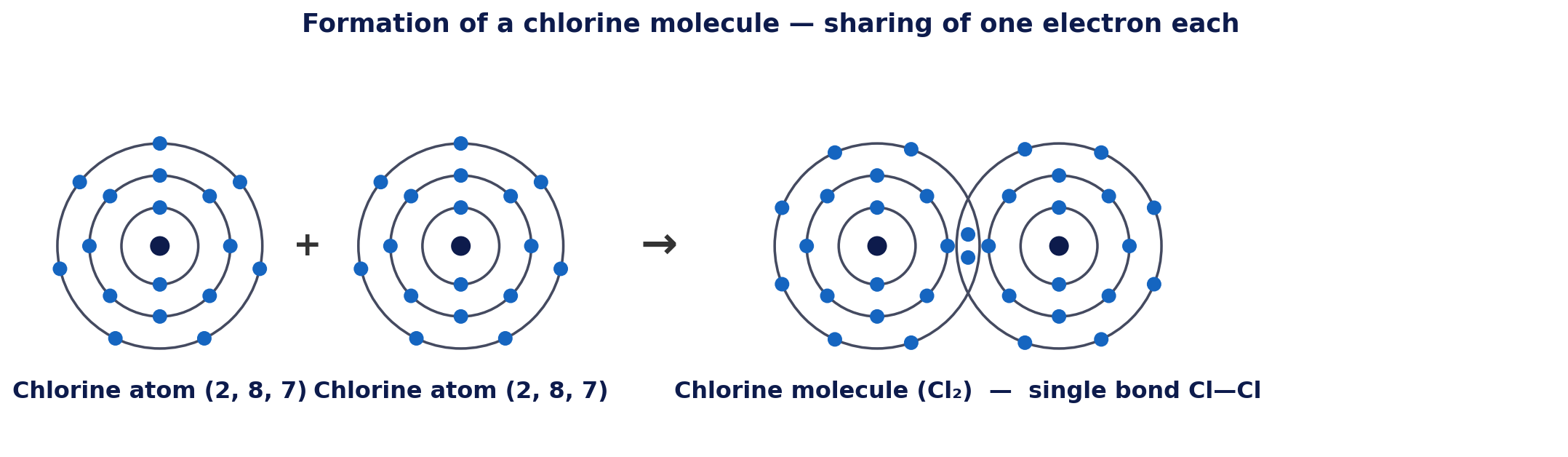
- The chlorine atom has seven electrons in its valence shell (2, 8, 7).
- Each chlorine atom requires one electron to attain a stable electronic configuration.
- A chlorine molecule forms by the sharing of one electron each by two chlorine atoms. This shared pair holds the two atoms together.
- Single covalent bond → chlorine (Cl₂) is represented as Cl—Cl.
Formation of an oxygen molecule:
- Electronic configuration of oxygen (atomic number 8): 2, 6 — the valence shell has six electrons and requires two more to complete its octet.
- So two oxygen atoms share two electrons each, forming an oxygen molecule (O₂).
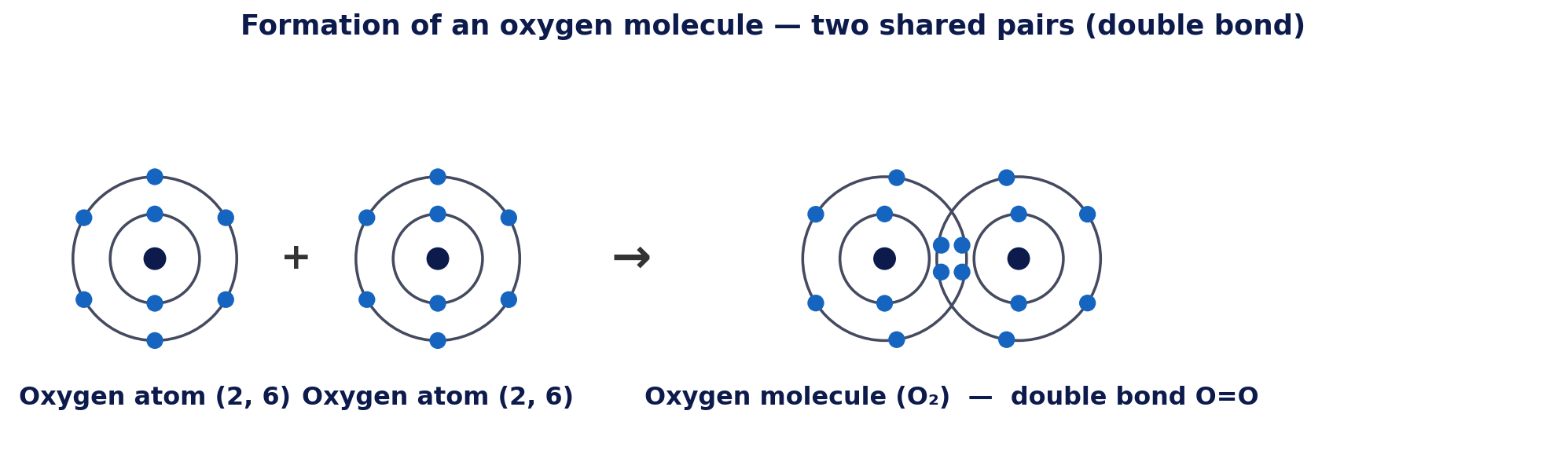
In O₂, the two atoms are joined by two pairs of shared electrons and are held together by a double bond, depicted by two lines: O=O.
Show Answer
- Nitrogen (Z = 7) has configuration 2, 5 → needs 3 more electrons to complete its octet.
- So two nitrogen atoms share three electrons each → three shared pairs.
- This is a triple bond, written as N≡N.
- Drawing: two circles overlapping, each nitrogen showing 2 non-shared electrons on the outer side, and 6 dots (3 pairs) in the overlap region.
Show Answer
- Fluorine (Z = 9) has configuration 2, 7 → needs one electron to complete its octet.
- Two fluorine atoms each share one electron, forming one shared pair.
- Both atoms now effectively have 8 valence electrons → stable. It is a single covalent bond: F—F.
B. Molecules of compounds
Formation of hydrogen chloride (HCl): follow these steps —
- Write the electronic configurations of hydrogen and chlorine (H = 1; Cl = 17 → 2, 8, 7).
- Calculate the electrons required by chlorine to complete its octet and by hydrogen to complete its duplet.
- Both hydrogen and chlorine need one electron each → both share one electron each to form a molecule of hydrogen chloride.
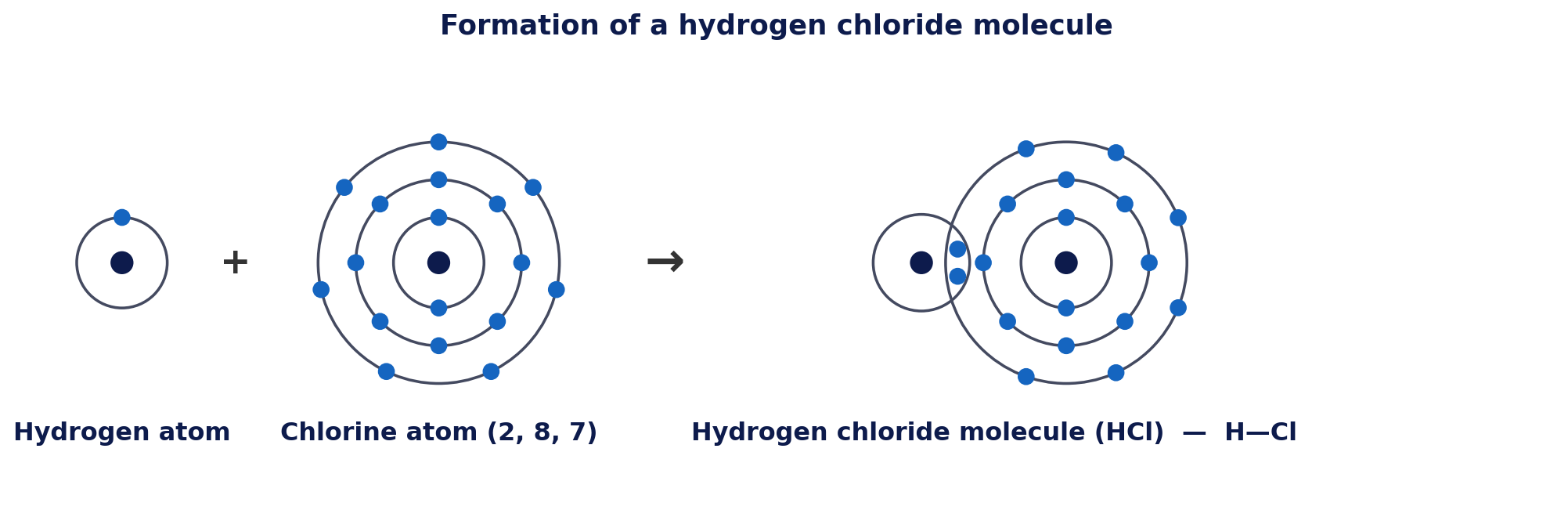
- Since H and Cl bond by sharing electrons, HCl is a covalent compound.
- They share one pair of electrons → bonded by a single bond, depicted as H—Cl.
Formation of water (H₂O):
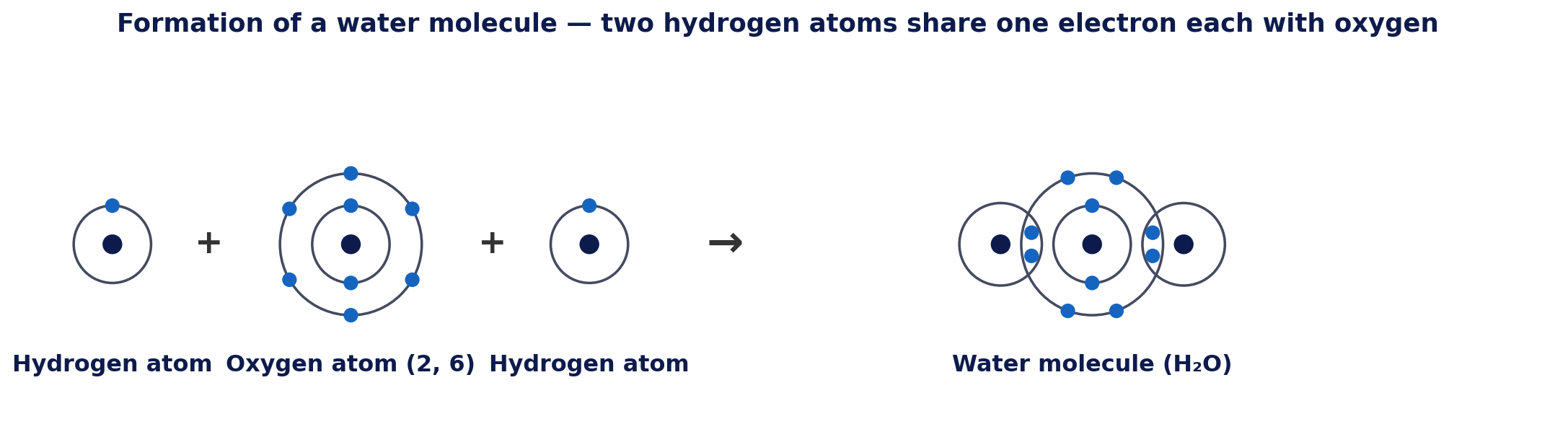
- Hydrogen needs only one electron; oxygen needs two electrons for stable configurations.
- Solution: two hydrogen atoms each share an electron with one oxygen atom.
Show Answer
- (i) CO₂: Carbon (2, 4) needs 4 electrons; each oxygen (2, 6) needs 2. Carbon shares two electrons with each oxygen → two double bonds: O=C=O.
- (ii) H₂S: Sulfur (2, 8, 6) needs 2 electrons; each hydrogen needs 1. Two hydrogen atoms share one electron each with sulfur → two single bonds: H—S—H.
- (iii) NH₃: Nitrogen (2, 5) needs 3 electrons; each hydrogen needs 1. Three hydrogen atoms share one electron each with nitrogen → three single bonds. Nitrogen also keeps one non-bonded pair.
Show Answer
- Atoms can release enormous energy when their nuclei split or combine to form new elements — called atomic or nuclear energy.
- Beyond electricity generation, it is used in medicine, scientific research and space exploration.
- In nuclear power plants, thermal energy from nuclear reactions produces steam that drives turbines and generates electricity — a cleaner alternative to fossil fuels.
- In India, scientists like Raja Ramanna (often called the Father of the Indian Nuclear Programme) made significant contributions in developing the nation’s Nuclear Energy Programme and promoting its peaceful use for development.
C. Naming covalent compounds
- Covalent compounds are named by indicating the number of atoms of each element using a prefix system.
- The first element retains its regular name; the second element ends in -ide.
- Prefixes: mono- (1), di- (2), tri- (3), tetra- (4), penta- (5), hexa- (6), etc.
- mono- is usually omitted for the first element but used for the second element.
- If a prefix ends with ‘o’ or ‘a’ and the element starts with a vowel, drop the last vowel (e.g., monoxide, pentoxide).
- If the prefix ends with ‘i’, keep it for pronunciation (e.g., dioxide, trioxide).
- CO → carbon monoxide (not monooxide)
- CO₂ → carbon dioxide (not monocarbon dioxide)
- CS₂ → carbon disulfide, showing two sulfur atoms
- PCl₃ → phosphorus trichloride, showing three chlorine atoms
- SF₆ → sulfur hexafluoride, showing six fluorine atoms
- N₂O₄ → dinitrogen tetroxide (not tetraoxide)
- N₂O₅ → dinitrogen pentoxide
- When hydrogen is the first element in the formula, no prefix is added before hydrogen, irrespective of the number of its atoms. Example: H₂S is hydrogen sulfide, not dihydrogen sulfide.
- A few binary compounds are known only by their common names: H₂O (would be hydrogen monoxide) is commonly known as water; NH₃ (actually nitrogen trihydride) is known as ammonia.
📝 Check Your Concepts — Part 4
Show Answer
Show Answer
Show Answer
Show Answer
Show Answer
- < 4 valence e⁻ → donates
- Na → Na⁺ + e⁻
- Positive = cation
- > 4 valence e⁻ → accepts
- Cl + e⁻ → Cl⁻
- Negative = anion
- Electrostatic force of attraction
- Between opposite charges
- Na⁺ + Cl⁻ → NaCl
- Cation first, then anion
- Simple anions end in -ide
- Polyatomic ions: exceptions
9.4.2 Bonding by electron transfer — Ionic bond
- If the valence shell of an atom has less than four electrons, it generally donates its valence electrons to achieve a stable electronic configuration.
- Atoms with more than 4 valence electrons usually gain or share electrons to complete an octet.
- Example: sodium chloride (common salt), chemical formula NaCl.
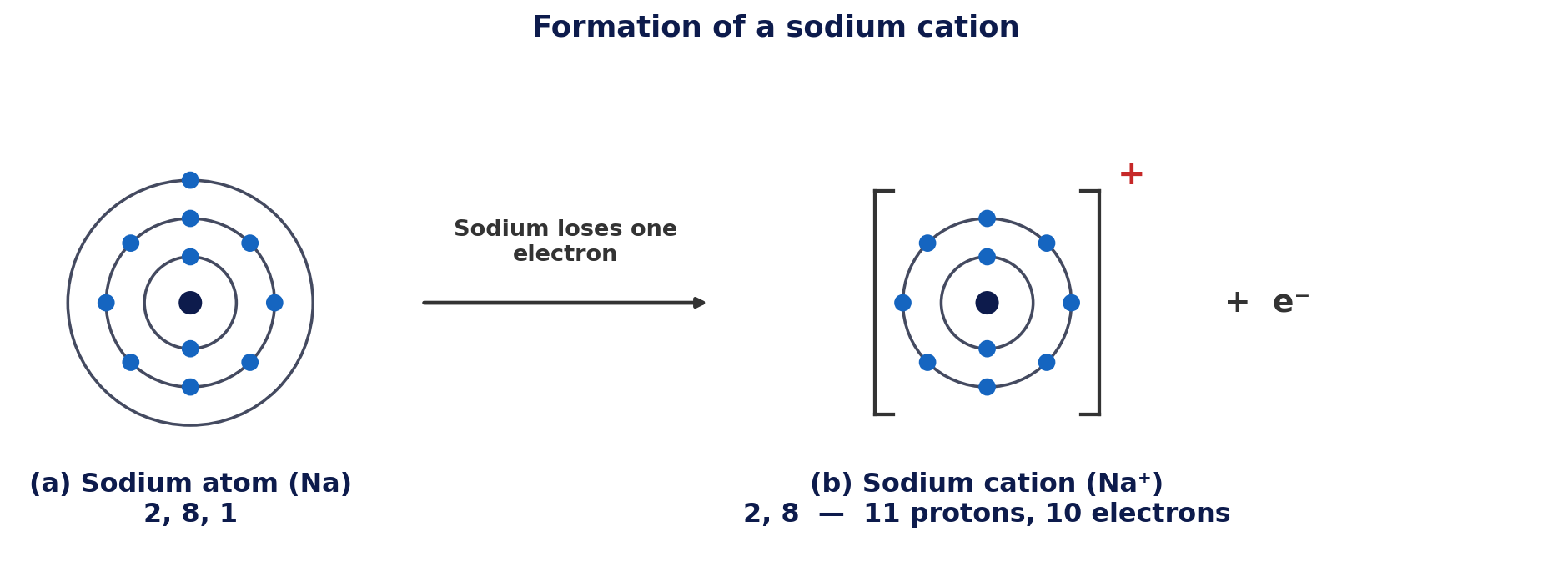
Formation of the sodium cation (Na⁺)
- Atomic number of sodium is 11 → configuration 2, 8, 1. Its valence shell contains only one electron.
- It attains a stable configuration after losing this valence electron.
- After losing one electron it has 11 protons and 10 electrons → it becomes a positively charged species, called a sodium cation, represented as Na⁺.
Formation of the chloride anion (Cl⁻)
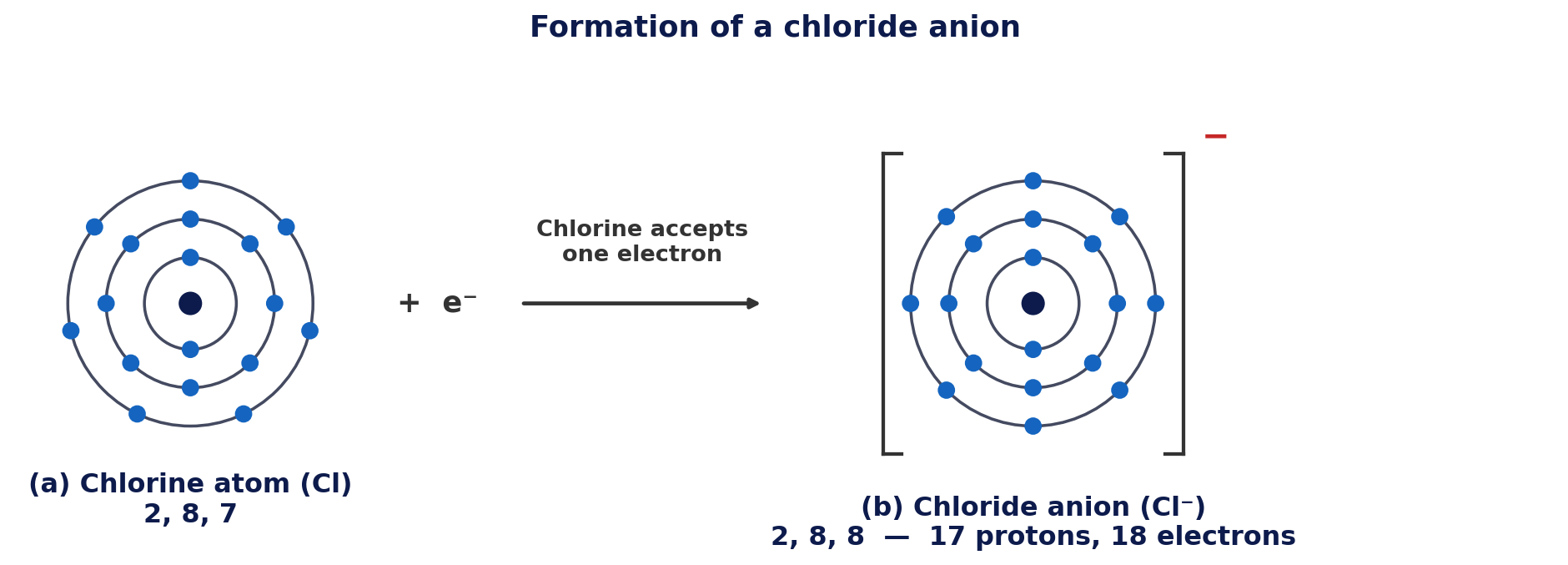
- Chlorine has seven valence electrons (2, 8, 7).
- It attains a stable configuration by gaining one electron from another atom.
- After gaining one extra electron it acquires a negative charge and is called a chloride anion, represented as Cl⁻.
Cations and anions are collectively called ions. Once sodium and chloride ions form, they are held together by the electrostatic force of attraction due to their opposite charges.
The electrostatic force of attraction between oppositely charged ions that holds them together is called an ionic bond.
Fig. 9.13: Formation of sodium chloride by transfer of electron
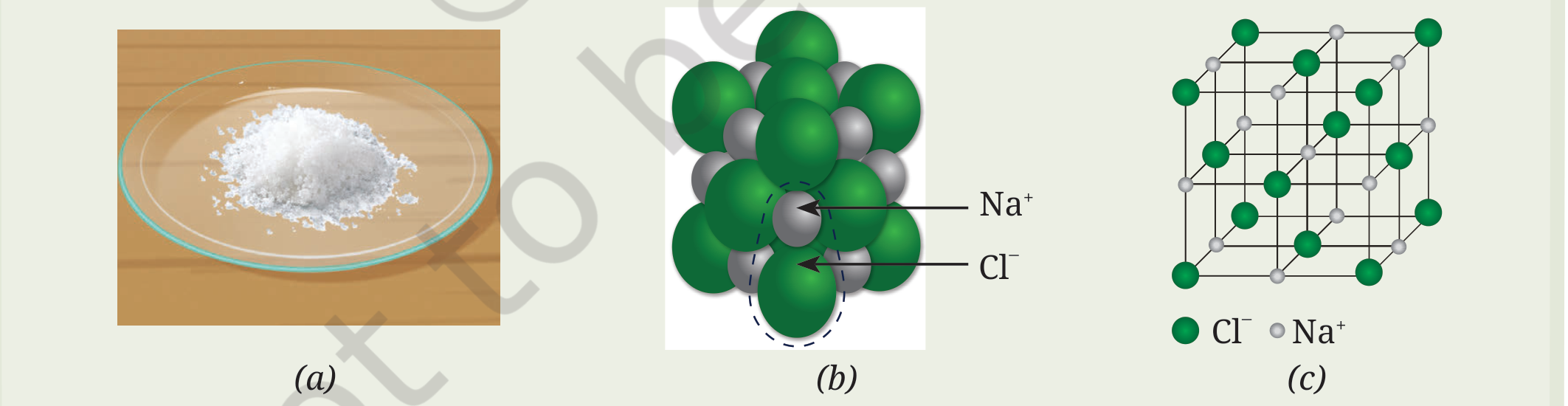
- Ionic compounds usually do not remain as single units. They form three-dimensional (3-D) crystals in which ions are arranged in a repeating pattern.
- In sodium chloride, each Na⁺ is surrounded by six Cl⁻ ions, and each Cl⁻ is surrounded by six Na⁺ ions.
- This regular, repeating 3-D pattern is known as a crystal structure.
- The crystal structure is represented as a crystal lattice, with ions depicted as points or dots — it helps visualise the arrangement of ions in the crystal.
- Some elements like sulfur have six electrons in their outer shell and need to gain two electrons to complete their octet. On gaining two electrons, sulfur acquires two units of negative charge and is represented as S²⁻.
Show Answer
Show Answer
Show Answer
- Potassium (Z = 19): 2, 8, 8, 1 → loses 1 electron → K⁺ (2, 8, 8). It gives that electron to one chlorine atom → Cl⁻. Formula: KCl.
- Calcium (Z = 20): 2, 8, 8, 2 → loses 2 electrons → Ca²⁺ (2, 8, 8). Those 2 electrons go to two chlorine atoms → 2 Cl⁻. Formula: CaCl₂.
- Drawing: show the metal atom’s shells before and after (in square brackets with + or 2+), and each chlorine as 2, 8, 8 in brackets with a − sign.
Show Answer
- Sodium (2, 8, 1) loses 1 electron → Na⁺. Sulfur (2, 8, 6) needs 2 electrons → S²⁻.
- So two sodium atoms each donate one electron to one sulfur atom.
- Two Na⁺ ions and one S²⁻ ion are held by an ionic bond → formula Na₂S.
A. Naming ionic compounds
- The name of the cation is written first, followed by the name of the anion.
- Names of simple anions end with -ide.
- Generally, metals form cations and non-metals form anions.
- Ionic compounds are typically formed when metals combine with non-metals — e.g., sodium chloride, calcium oxide, magnesium sulfide.
- Some ions are formed by the combination of atoms of two or more elements — these are called polyatomic ions. Names of polyatomic ions generally do not end with -ide.
| Name of ion | Formula | Valency |
|---|---|---|
| Sodium | Na⁺ | 1 |
| Lithium | Li⁺ | 1 |
| Potassium | K⁺ | 1 |
| Silver | Ag⁺ | 1 |
| Calcium | Ca²⁺ | 2 |
| Barium | Ba²⁺ | 2 |
| Iron (Ferrous) | Fe²⁺ | 2 |
| Iron (Ferric) | Fe³⁺ | 3 |
| Copper (Cuprous) | Cu⁺ | 1 |
| Copper (Cupric) | Cu²⁺ | 2 |
| Magnesium | Mg²⁺ | 2 |
| Zinc | Zn²⁺ | 2 |
| Aluminium | Al³⁺ | 3 |
| Fluoride | F⁻ | 1 |
| Chloride | Cl⁻ | 1 |
| Bromide | Br⁻ | 1 |
| Iodide | I⁻ | 1 |
| Oxide | O²⁻ | 2 |
| Sulfide | S²⁻ | 2 |
| Name of ion | Formula | Valency |
|---|---|---|
| Hydroxide | OH⁻ | 1 |
| Nitrate | NO₃⁻ | 1 |
| Hydrogencarbonate | HCO₃⁻ | 1 |
| Carbonate | CO₃²⁻ | 2 |
| Sulfate | SO₄²⁻ | 2 |
| Ammonium | NH₄⁺ | 1 |
📝 Check Your Concepts — Part 5
Show Answer
Show Answer
Show Answer
Show Answer
Show Answer
- Write symbols
- Write valencies
- Criss-cross as subscripts
- Cation first, then anion
- Charges under symbols
- Criss-cross numbers only
- Divide by common factor
- Valency 1 is not written
- Mg₂O₂ → simplified to MgO
- Charges never shown in formula
- 2 or more same polyatomic ions
- Al(OH)₃ not AlOH₃
- One ion → no bracket
9.5 Writing Chemical Formulae
You have learnt to write formulae by finding the number of electrons shared or transferred. There is a quicker way — the criss-cross method.
9.5.1 Writing chemical formulae of covalent compounds
- (i) Write the symbols of the constituent elements of the compound.
- (ii) Write the valencies of these elements (refer to Table 9.1).
- (iii) Crossover the valencies of the combining atoms and write them as subscripts after the symbols of elements.
Symbol of element: H Cl
Valency: 1 ✕ 1
Criss-cross → H₁Cl₁ → the formula of the compound would be HCl.
Rule: if the valency is one after criss-crossing, it is not written.
Symbol of element: H S
Valency: 1 ✕ 2
Criss-cross → the formula of the compound would be H₂S.
Symbol of element: C Cl
Valency: 4 ✕ 1
Criss-cross → the formula of the compound would be CCl₄.
9.5.2 Writing chemical formulae of ionic compounds
- (i) Write the symbol of the cation first, followed by the symbol of the anion.
- (ii) Write the charges under the symbols rather than as superscripts.
- (iii) Crossover the charges (only the numbers) to obtain the formula.
- (iv) The chemical formula gives the simplest ratio of the elements. After criss-crossing, the subscripts are divided by a common factor, if any. Example: subscripts 2 and 4 are divided by 2 → 1 and 2.
Symbol: Ca Cl
Charge: 2+ ✕ 1−
Formula: CaCl₂
Thus, in calcium chloride there are two chloride ions (Cl⁻) for each calcium ion (Ca²⁺). The positive and negative charges must balance each other, and the overall structure must be neutral.
Symbol: Al O
Charge: 3+ ✕ 2−
Formula: Al₂O₃
Symbol: Mg O
Charge: 2+ ✕ 2−
Criss-cross gives Mg₂O₂ — but here the valencies of the two elements are the same, so it is simply written as MgO.
This method can also be used to write formulae of compounds of metals with polyatomic ions, such as calcium carbonate.
Symbol: Ca CO₃
Charge: 2+ ✕ 2−
Formula: CaCO₃
Here the valencies of the two ions are the same, so Ca₂(CO₃)₂ is simply written as CaCO₃.
Symbol: Mg OH
Charge: 2+ ✕ 1−
Formula: Mg(OH)₂
Thus in magnesium hydroxide there are two hydroxide ions (OH⁻) for each magnesium ion (Mg²⁺).
Use brackets ( ) when there are two or more polyatomic ions of the same type in a formula.
Example: in aluminium hydroxide, the bracket around OH with subscript 3 indicates three hydroxide ions bound to one aluminium ion.
Brackets are NOT required when only one polyatomic anion is present.
Symbol: Al OH
Charge: 3+ ✕ 1−
Formula: Al(OH)₃
⚠️ Note: the formula is Al(OH)₃, NOT AlOH₃.
Symbol: Al SO₄
Charge: 3+ ✕ 2−
Formula: Al₂(SO₄)₃
🧮 Numerical Practice (NCERT Pause and Ponder) — try first!
Show Answer
Show Answer
- (i) Na⁺ + HCO₃⁻ → NaHCO₃
- (ii) Sulfur dioxide → SO₂
- (iii) Fe³⁺ + Cl⁻ → FeCl₃
- (iv) Cu⁺ + O²⁻ → Cu₂O
Show Answer
- (i) Fe³⁺ and OH⁻ → criss-cross → Fe(OH)₃ (brackets needed — three hydroxide ions)
- (ii) K⁺ and CO₃²⁻ → criss-cross → K₂CO₃ (no brackets — only one carbonate ion)
📝 Check Your Concepts — Part 6
Show Answer
Show Answer
Show Answer
Show Answer
- Ionic → soluble in water
- Covalent → soluble in kerosene/petrol
- Ionic solid → no
- Ionic in water → yes (free ions)
- Covalent → no
- Ionic → high
- Covalent → low
- Covalent → molecular mass
- Ionic → formula unit mass
9.6 Properties of the Ionic and the Covalent Compounds
Activity 9.4: Let us experiment
- Collect samples of some compounds, such as camphor, sodium chloride, copper sulfate, sugar and naphthalene.
(A) Solubility in (i) water, (ii) kerosene, and (iii) petrol
- Try dissolving each sample separately in water, kerosene and petrol.
- Record your observations in Table 9.2.
(B) Electrical conductivity in the water
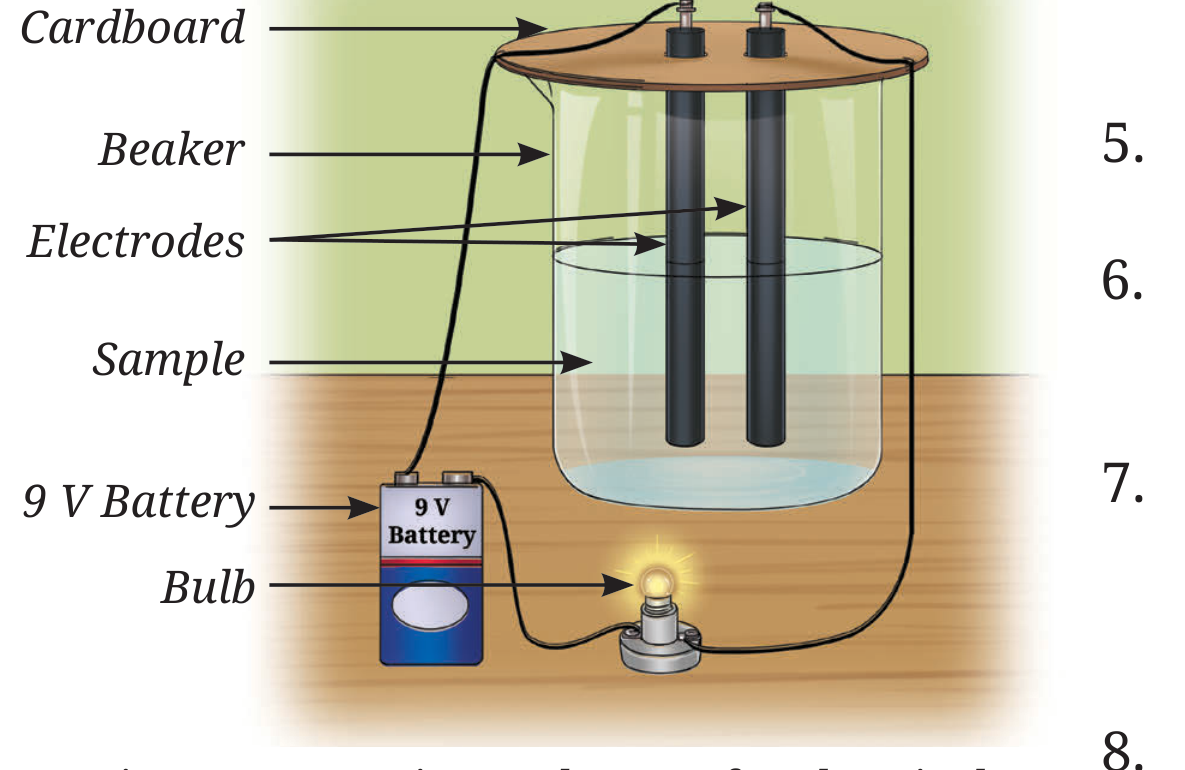
- Take two carbon or metal electrodes and insert them into a piece of cardboard by drilling two holes.
- Connect one end of each electrode to the terminals of the 9 V battery and to the light bulb.
- Test the electrical conductivity of each solid sample and observe whether the bulb glows. Record your observations.
- Test the electrical conductivity of each sample dissolved in water by transferring the solution to the beaker one at a time and observing whether the bulb glows.
- Record your observations with other samples given in Table 9.2.
- Group the compounds showing similar properties listed in Table 9.2.
| Compound | Solubility in | Electrical conductivity of compounds in | |||
|---|---|---|---|---|---|
| water | kerosene | petrol | solid state | water | |
| Camphor | Insoluble | Soluble | Soluble | No | No |
| Sodium chloride | Soluble | Insoluble | Insoluble | No | Yes |
| Copper sulfate | Soluble | Insoluble | Insoluble | No | Yes |
| Sugar | Soluble | Insoluble | Insoluble | No | No |
| Naphthalene | Insoluble | Soluble | Soluble | No | No |
Conclusions from Activity 9.4
- Ionic compounds like sodium chloride and copper sulfate are generally soluble in water but insoluble in solvents such as kerosene and petrol.
- Most covalent compounds, such as camphor and naphthalene, are insoluble in water but dissolve in kerosene and petrol.
- Ionic compounds do not conduct electricity in the solid state because their ions are held in fixed positions by strong forces.
- To conduct electricity, ions must be free to move — which occurs only when ionic compounds are dissolved in water.
- Some covalent compounds, such as sugar, are soluble in water but do not provide ions in solution — therefore they do not conduct electricity.
- Other covalent compounds, such as camphor and naphthalene, also do not conduct electricity.
- Ionic compounds generally have high melting and boiling points due to strong inter-ionic attractions, whereas covalent compounds usually have low melting and boiling points.
Show Answer
- Ionic compounds: YES. On melting, the strong forces holding the ions in fixed lattice positions are overcome — the ions become free to move and carry current.
- Covalent compounds: NO. They contain no ions at all, so even in the molten state there are no charged particles free to carry current.
Show Answer
Show Answer
- The metal has 2 electrons in the M shell → configuration 2, 8, 2 → it is magnesium (Mg), valency 2. Oxygen valency 2.
- (i) Formula: MO (i.e., MgO — criss-cross gives M₂O₂, simplified to MO).
- (ii) Type of bond: ionic (metal + non-metal, formed by transfer of two electrons).
- (iii) Conductivity: its aqueous solution conducts electricity, because the dissolved portion provides free-moving ions (though it is only slightly soluble, so conductivity is weak).
9.7 Molecular Mass of Covalent Compounds
Since you know the formulae of covalent compounds, you can find the masses of their molecules by simply adding up the masses of the atoms present in them.
Molecular mass of water (H₂O)
Atomic mass — H = 1 u; O = 16 u
Molecular mass of H₂O = (1 u × 2) + (16 u × 1) = 18 u
Molecular mass of carbon dioxide (CO₂)
Atomic mass — C = 12 u; O = 16 u
Molecular mass of CO₂ = (12 u × 1) + (16 u × 2) = 44 u
9.8 Formula Unit Mass of Ionic Compounds
In ionic compounds, the collection of the simplest whole number ratio of ions is termed a formula unit. The mass of a formula unit is called the formula unit mass.
Formula unit mass of sodium oxide (Na₂O)
Atomic mass — Na = 23 u; O = 16 u
Formula unit mass of Na₂O = (23 u × 2) + (16 u × 1) = 62 u
Formula unit mass of calcium nitrate, Ca(NO₃)₂
Atomic mass — Ca = 40 u; N = 14 u; O = 16 u
Formula unit mass = (40 u × 1) + {(14 u × 1) + (16 u × 3)} × 2
= 40 + {14 + 48} × 2 = 40 + 124 = 164 u
👉 Note how the bracket contents are calculated first, then multiplied by the subscript outside.
🧮 Numerical Practice (NCERT Pause and Ponder) — try first!
Show Answer
Show Answer
Show Answer
Show Answer
At a Glance (NCERT Summary)
- Mass can neither be created nor destroyed in a chemical reaction. This is known as the Law of Conservation of Mass.
- A compound always contains the same elements combined in a fixed ratio by mass, no matter how it is formed or from where it is obtained. This is called the Law of Definite Proportions.
- A molecule is defined as an electrically neutral entity consisting of more than one atom that can exist independently and shows all its chemical properties.
- Atoms combine to form molecules of elements or compounds to become stable. Atoms are held together by a force called a chemical bond.
- A covalent bond is formed by the sharing of electrons between atoms.
- An ionic bond is formed by the transfer of electrons between atoms, where one atom loses electrons and the other gains electrons to form cations and anions, respectively.
- The chemical formula of a covalent compound represents the elements and number of atoms of each element present in it.
- The chemical formula of an ionic compound represents the simplest whole number ratio of atoms of different elements present in it.
- Molecular mass is the total mass of a molecule, calculated by adding the atomic masses of all the atoms constituting it.
- Formula unit mass of an ionic compound is the sum of the atomic masses of all the atoms present in a formula unit (simplest whole number ratio of ions in an ionic compound).
📝 Check Your Concepts — Part 7
Show Answer
Show Answer
Show Answer
Show Answer
Show Answer
Revise, Reflect, Refine (NCERT Exercises)
Show Answer
- (i) A tends to give 1 electron.
- (ii) It forms a cation, Na⁺.
- (iii) B tends to take 2 electrons.
- (iv) It forms an anion, O²⁻.
- (v) An ionic bond (electrons transferred from metal to non-metal).
- (vi) Criss-cross Na⁺ and O²⁻ → Na₂O.
Show Answer
- (i) X needs 2 more electrons to complete its octet. Two X atoms each share two electrons, so both attain 8 → they exist as a stable diatomic molecule (X₂).
- (ii) A covalent bond — specifically a double bond (two shared pairs).
- (iii) Structure: two overlapping circles, each atom showing 4 non-shared electrons, with 4 dots (2 pairs) in the overlap → O=O.
- (iv) Y (Be, 2 valence electrons) shares its 2 electrons with X → each Be–O link is a shared pair. Structure: Be in the centre sharing electrons with O, drawn as Be=O (or in the ionic view Be²⁺ and O²⁻ giving BeO).
Show Answer
- (i) 2 × 3+ = 6+ but 3 × 1− = 3− ❌ (not balanced)
- (ii) 3 × 2+ = 6+ but 1 × 3− = 3− ❌
- (iii) 2 × 3+ = 6+ and 3 × 2− = 6− ✅
- (iv) 3 × 2+ = 6+ but 2 × 2− = 4− ❌
Show Answer
- (i) ❌ False. Correction: elements are made up of atoms (which may exist as molecules of the same kind), and compounds are made up of molecules containing atoms of different elements.
- (ii) ❌ False. Correction: the molecule of a compound is made up of two or more atoms of different kinds.
- (iii) ❌ False. Correction: one molecule of nitrogen gas contains two nitrogen atoms (N₂).
- (iv) ✅ Correct. Water (H₂O) has two hydrogen atoms covalently bonded to one oxygen atom.
Show Answer
- (i) Al³⁺ + NO₃⁻ → Al(NO₃)₃ (brackets — three nitrate ions)
- (ii) Ca²⁺ + O²⁻ → criss-cross gives Ca₂O₂ → simplified to CaO
- (iii) Fe³⁺ + O²⁻ → Fe₂O₃
Show Answer
- (i) CaBr₂
- (ii) Al₂(CO₃)₃ (brackets — three carbonate ions)
- (iii) K₂SO₄ (no brackets — only one sulfate ion)
- (iv) NH₄Cl
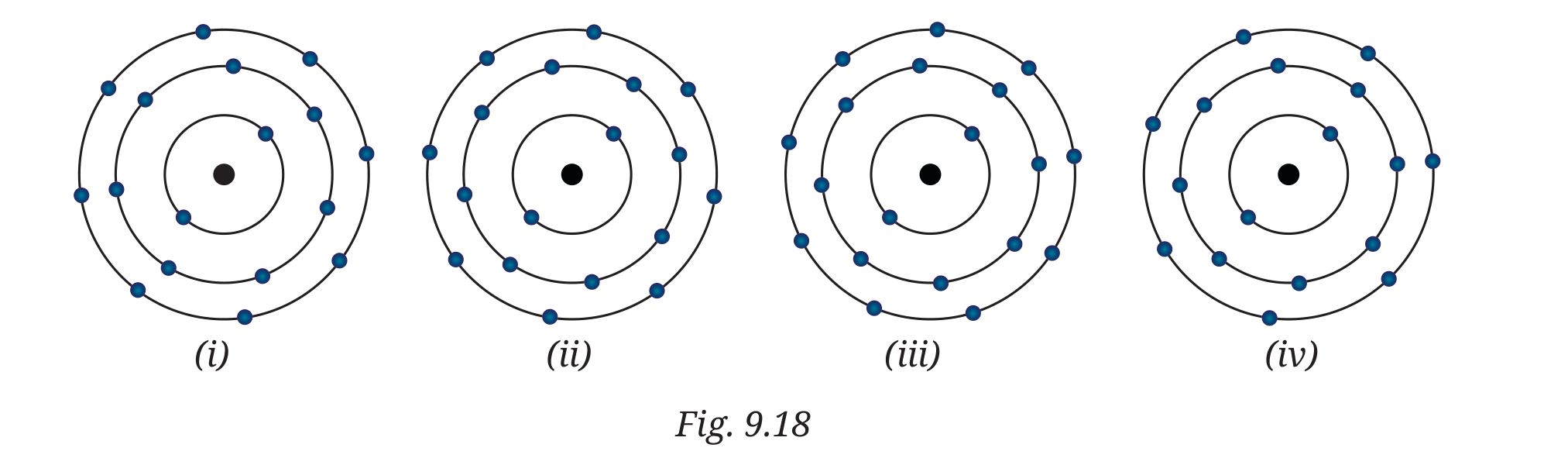
Show Answer
- A chlorine atom has 17 electrons (2, 8, 7). The Cl⁻ ion has gained one electron → 18 electrons, arranged as 2, 8, 8.
- Option (ii) shows exactly 2, 8, 8 = 18 electrons ✅
- The other options show the wrong total number of electrons (they represent the neutral atom or incorrect arrangements), so they cannot be the chloride ion.
Show Answer
- (i) NH₄NO₃ = 14 + (1×4) + 14 + (16×3) = 14 + 4 + 14 + 48 = 80 u
- (ii) H₃PO₄ = (1×3) + 31 + (16×4) = 3 + 31 + 64 = 98 u
- (iii) NaHCO₃ = 23 + 1 + 12 + (16×3) = 23 + 1 + 12 + 48 = 84 u
Show Answer
- (i) Mg²⁺ and N³⁻ → Mg₃N₂ (magnesium nitride)
- (ii) Li⁺ and N³⁻ → Li₃N (lithium nitride)
- (iii) Na⁺ and S²⁻ → Na₂S (sodium sulfide)
- (iv) Al³⁺ and O²⁻ → Al₂O₃ (aluminium oxide)
Show Answer
| NO₃⁻ | SO₄²⁻ | PO₄³⁻ | |
|---|---|---|---|
| NH₄⁺ | NH₄NO₃ | (NH₄)₂SO₄ | (NH₄)₃PO₄ |
| Li⁺ | LiNO₃ | Li₂SO₄ | Li₃PO₄ |
| Al³⁺ | Al(NO₃)₃ | Al₂(SO₄)₃ | AlPO₄ |
| Cu²⁺ | Cu(NO₃)₂ | CuSO₄ | Cu₃(PO₄)₂ |
Show Answer
- Total mass of reactants = 5.3 g + 6.0 g = 11.3 g
- Total mass of products = 2.2 g + 0.9 g + 8.2 g = 11.3 g
- Mass of reactants = Mass of products → the Law of Conservation of Mass is valid.
Show Answer
- (i) Atomic number = protons = 11; Mass number = 11 + 12 = 23.
- (ii) It is a cation — it has 11 protons but only 10 electrons, so there is one extra positive charge (charge = +1).
- (iii) With 10 electrons: 2, 8.
- (iv) The species is the sodium ion, Na⁺.
Show Answer
- (i) B is more reactive — it needs only one electron to complete its octet, whereas A needs three. The closer an atom is to a complete octet, the more readily it reacts.
- (ii) Both are non-metals and both need to gain electrons — neither can donate easily. So they achieve stability by sharing electrons → a covalent bond. A shares one electron with each of three B atoms.
- (iii) Valency of A = 3, valency of B = 1 → formula AB₃ (i.e., PCl₃).
Show Answer
- A is true: molten copper sulfate conducts; solid copper sulfate does not.
- R is false because it states the situation backwards. The correct statement: ions are fixed in the lattice in the SOLID state, and move freely in the MOLTEN state.
Show Answer
| Species | Protons | Electrons | Neutrons (A − p) |
|---|---|---|---|
| ²⁷Al (neutral) | 13 | 13 | 27 − 13 = 14 |
| ⁸⁰Br⁻ (gained 1 e⁻) | 35 | 36 | 80 − 35 = 45 |
| ²⁰¹Hg²⁺ (lost 2 e⁻) | 80 | 78 | 201 − 80 = 121 |
The Journey Beyond (NCERT Activities)
- Design and perform an experiment to show and compare that water always contains hydrogen and oxygen in the same ratio, regardless of its source.
- Compare atoms and ions of any three elements. Show the number of electrons before and after ion formation using bar graphs.
- Make a card game with cations and anions. Possible ideas may include — picking cards from the pile or from open cards and matching them with cards in your hand to form compounds (you may discard any unwanted cards); and asking other players for cards to form compounds using the cards they already have.
- To learn more about molecules you can explore: phet.colorado.edu/sims/html/build-a-molecule/latest/build-a-molecule_all.html
Are there any chemical changes that do not obey the Law of Conservation of Mass?