
⚙ Chapter 5: Exploring Forces
CBSE Class 8 Science — Curiosity Textbook
🎯 Learning Objectives
- Define force and identify it as a push or pull resulting from interaction between objects.
- Describe the effects a force can have on an object — change in speed, direction, shape, or state of motion.
- Explain that forces result from interaction between at least two objects.
- Classify forces into contact forces (muscular, friction) and non-contact forces (magnetic, electrostatic, gravitational).
- Explain friction, its causes, and factors affecting it.
- Distinguish between weight and mass, and use a spring balance to measure weight.
- Explain buoyant force and Archimedes Principle, and apply them to floating and sinking.
- Solve numerical problems on force, weight, and buoyancy.
|
⚙ 5.1 What Is a Force?
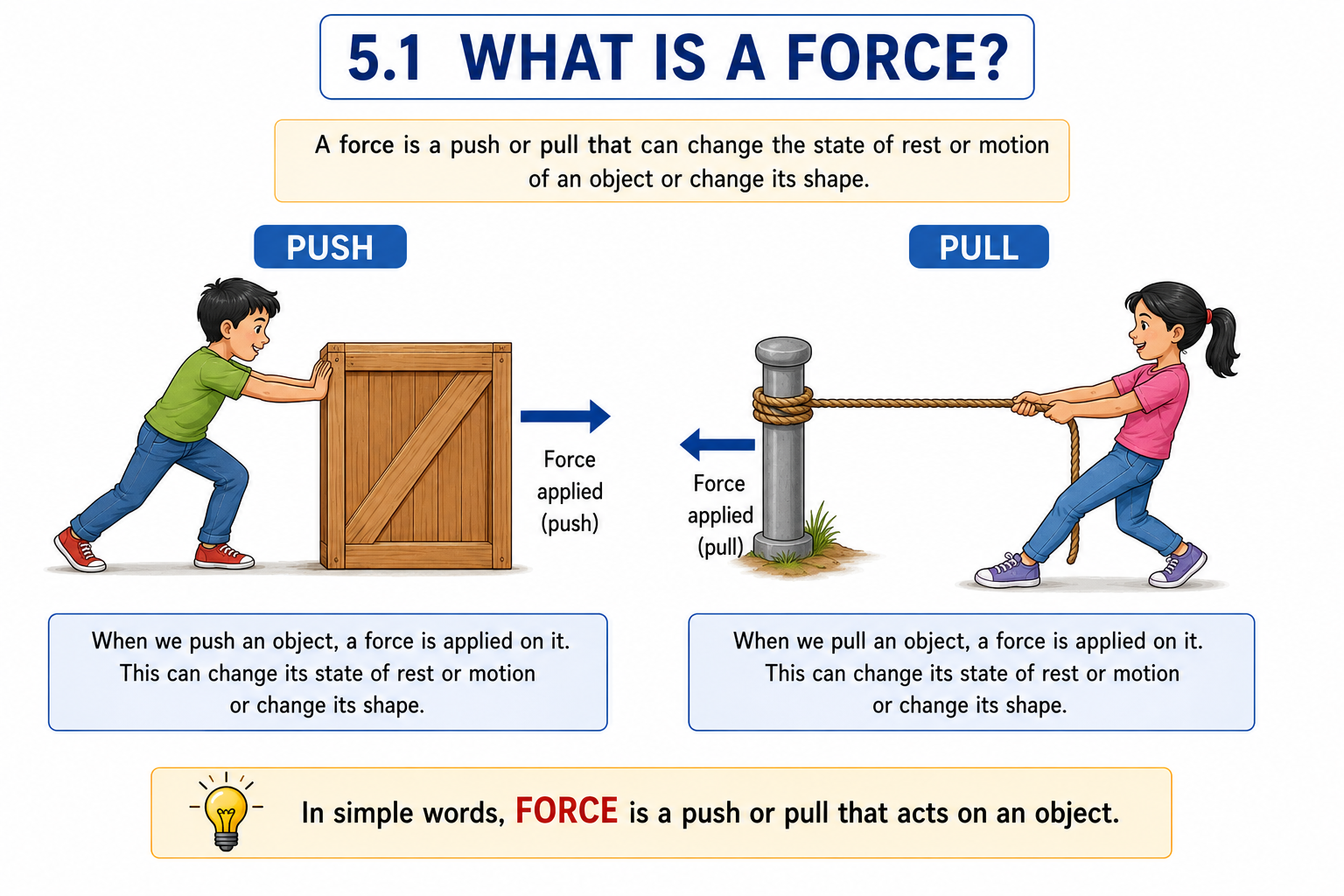
🔬 Activity 5.1: Let us explore
🔢 Numerical Questions
💡 Remember: Force = Push or Pull. SI unit = Newton (N). At least two objects must interact.
⚙ 5.2 What Can a Force Do to the Objects on Which It Is Applied?
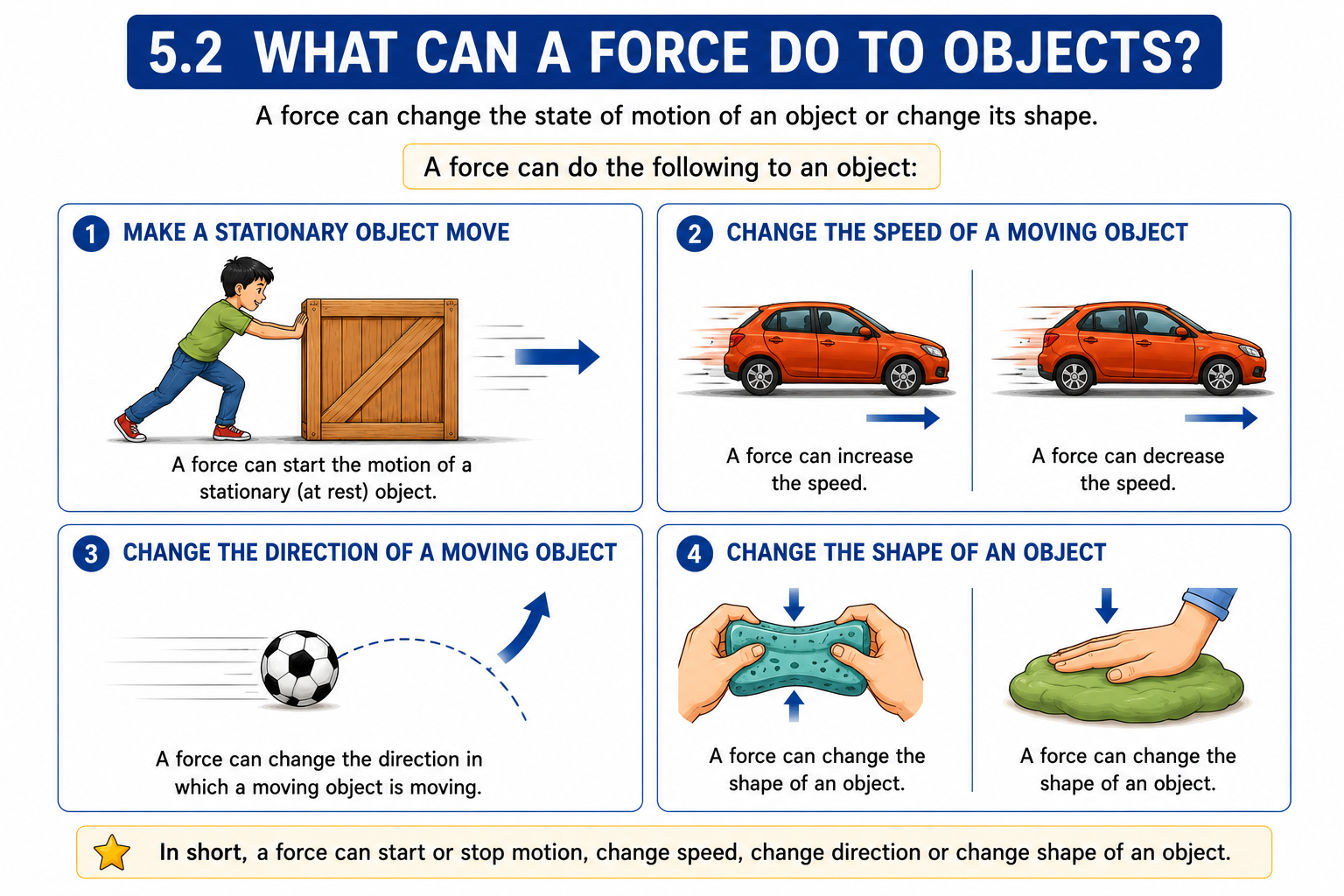
🔬 Activity 5.2: Let us analyse
🔢 Numerical Questions
💡 Remember: Force can — Start motion, Stop motion, Change speed, Change direction, Change shape.
⚙ 5.3 Are Forces an Interaction Between Two or More Objects?
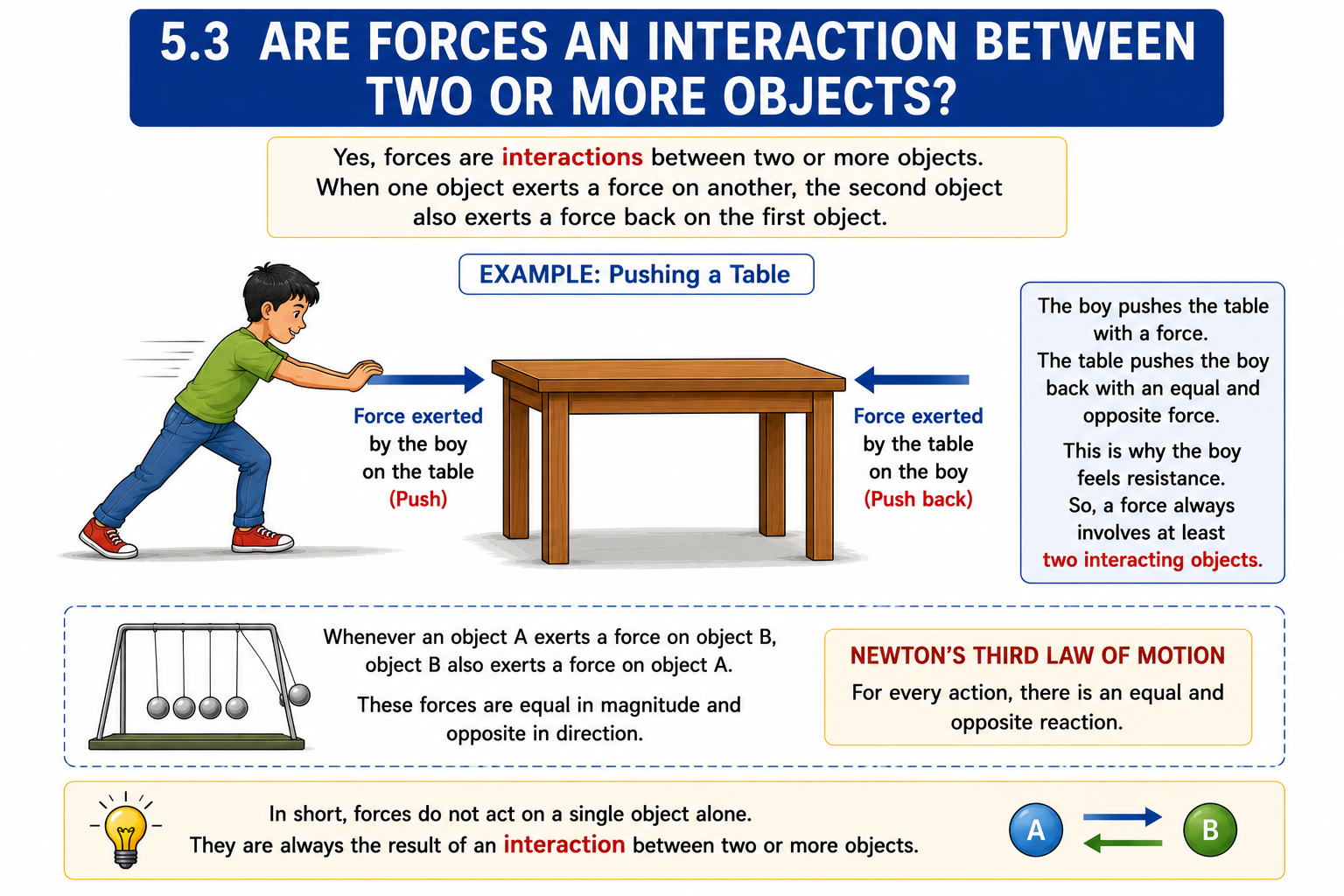
🔢 Numerical Questions
💡 Remember: Force requires at least 2 interacting objects. Object at rest = balanced forces, NOT no force.
⚙ 5.4 What Are the Different Types of Forces?
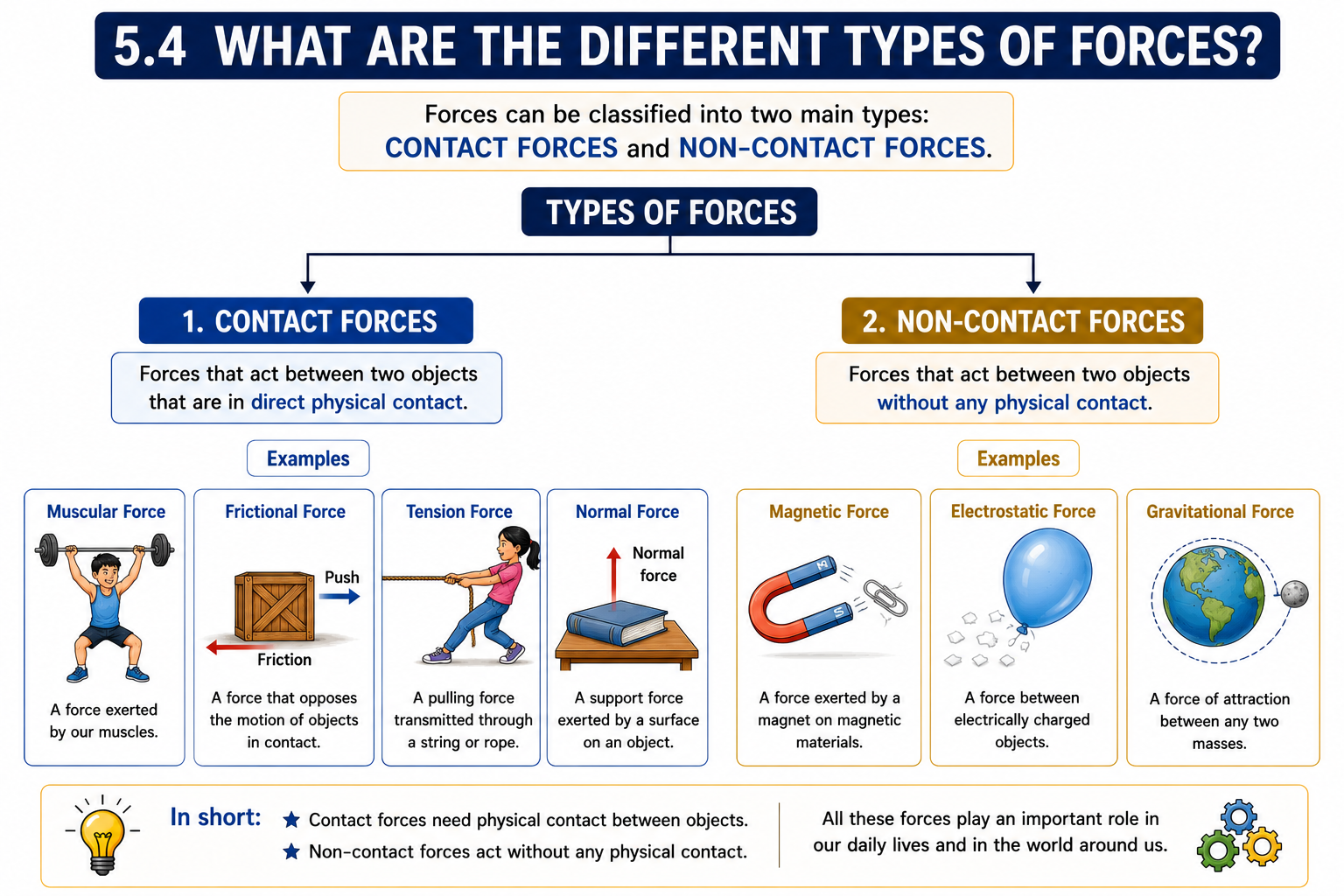
🔢 Numerical Questions
💡 Remember: Contact forces need physical touch. Non-contact forces act from a distance.
⚙ 5.4.1 Contact Forces
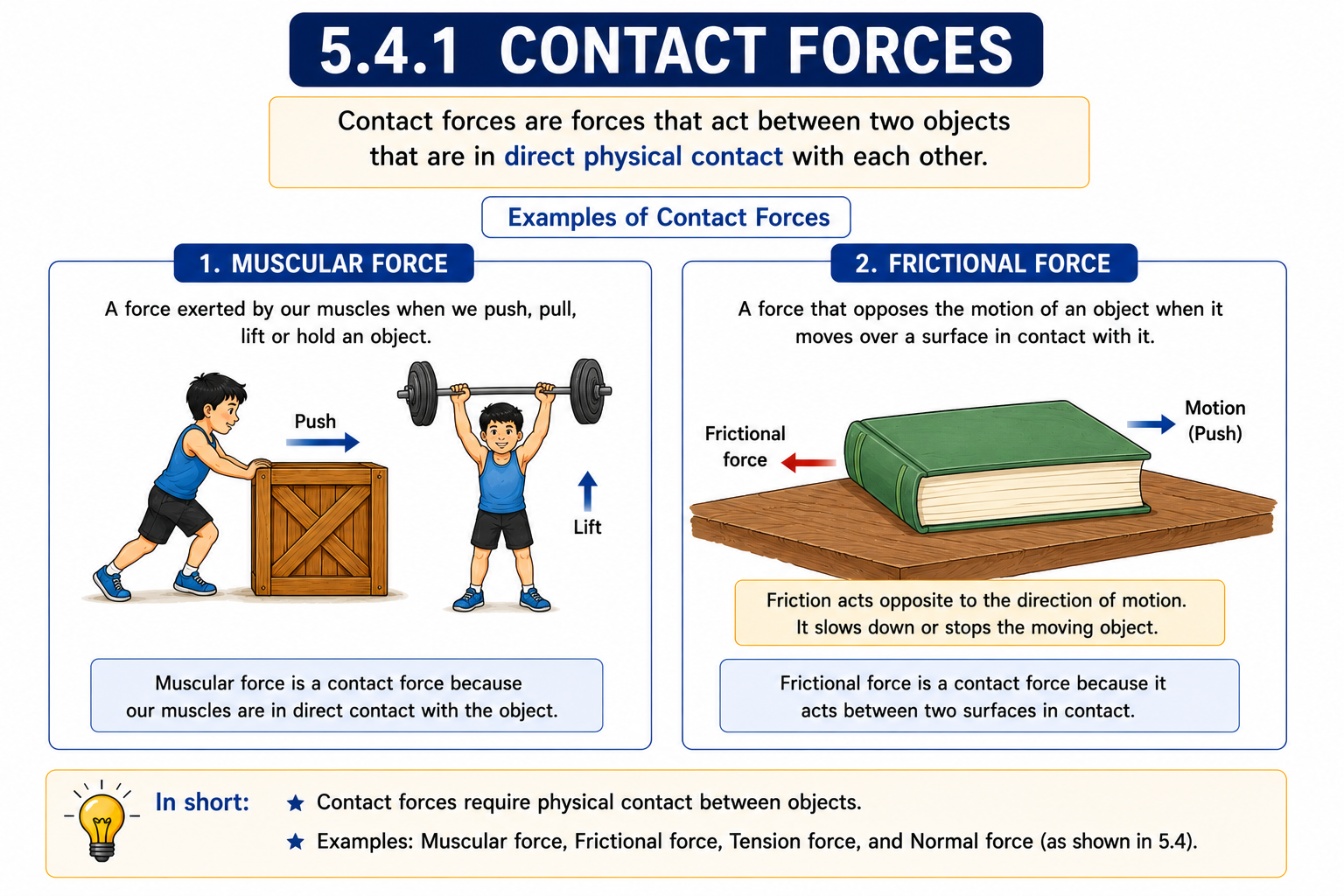
🔬 Activity 5.3: Let us investigate
🔬 Activity 5.4: Let us explore
🔢 Numerical Questions
💡 Remember: Friction opposes motion. More rough surface = more friction. Friction acts between surfaces in contact.
⚙ 5.4.2 Non-contact Forces
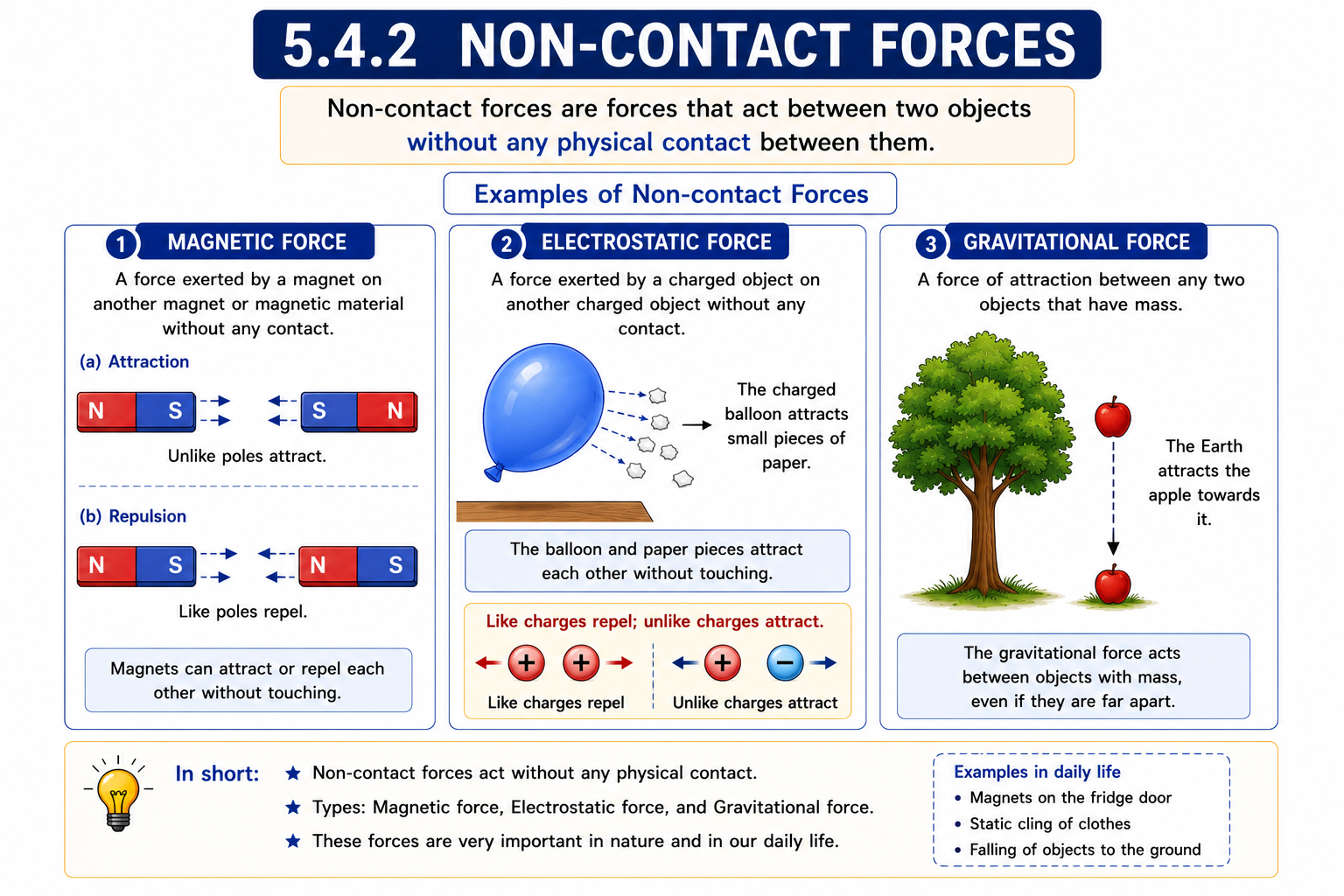
🔬 Activity 5.5: Let us test (Magnetic Force)
🔬 Activity 5.6: Let us experiment (Electrostatic Force)
🔬 Activity 5.7: Let us experiment (Electrostatic — Charges)
🔬 Activity 5.8: Let us observe (Gravitational Force)
🔢 Numerical Questions
💡 Remember: Magnetic and Electrostatic — can attract or repel. Gravitational — always attractive. All three act without contact.
⚙ 5.5 Weight and Its Measurement
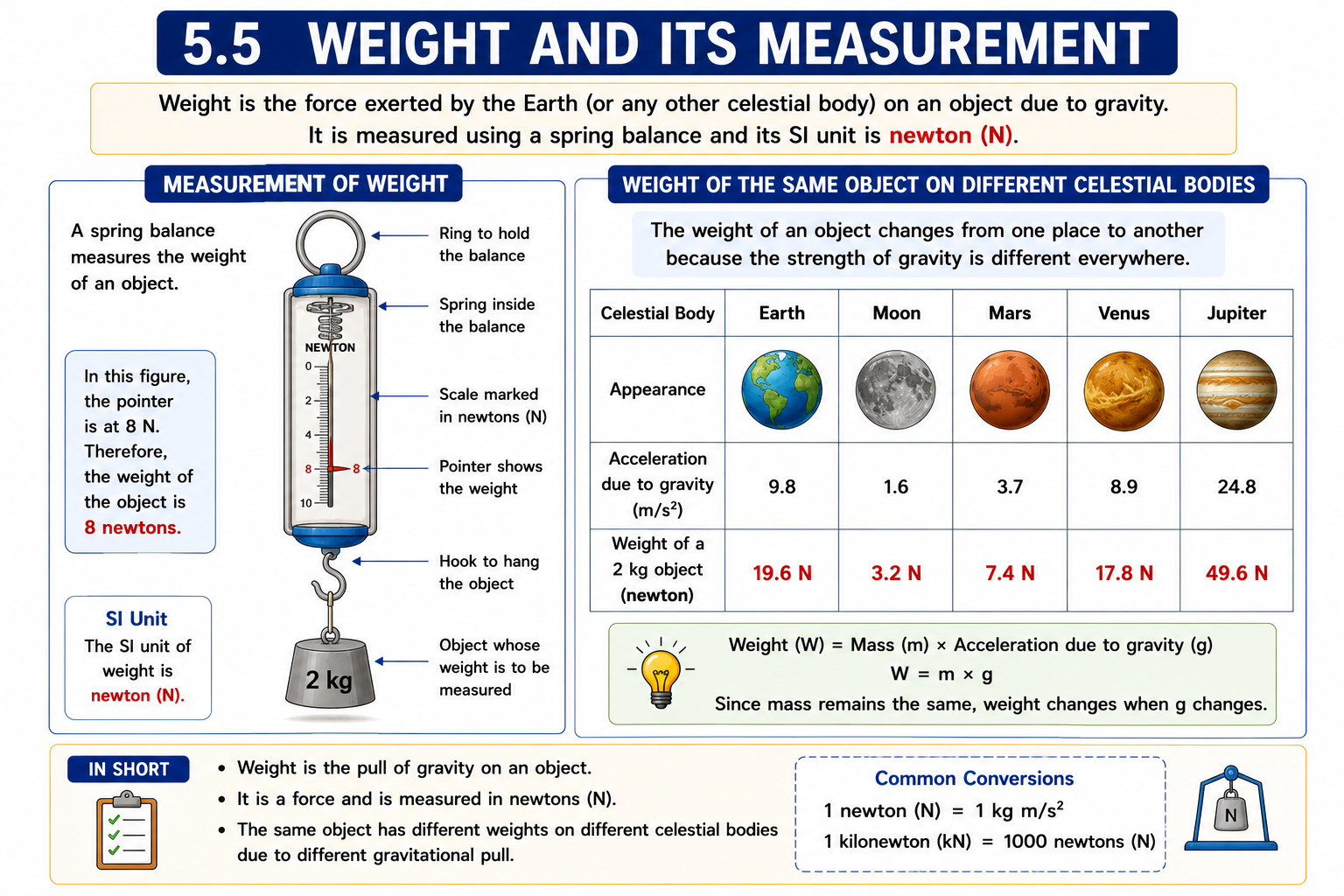
🔬 Activity 5.9: Let us explore
🔬 Activity 5.10 & 5.11: Reading the Spring Balance
🔬 Activity 5.12: Let us measure
🔢 Numerical Questions
💡 Remember: Mass = same everywhere (kg). Weight = varies with gravity (N). Weight on Moon = Weight on Earth ÷ 6.
⚙ 5.6 Floating and Sinking
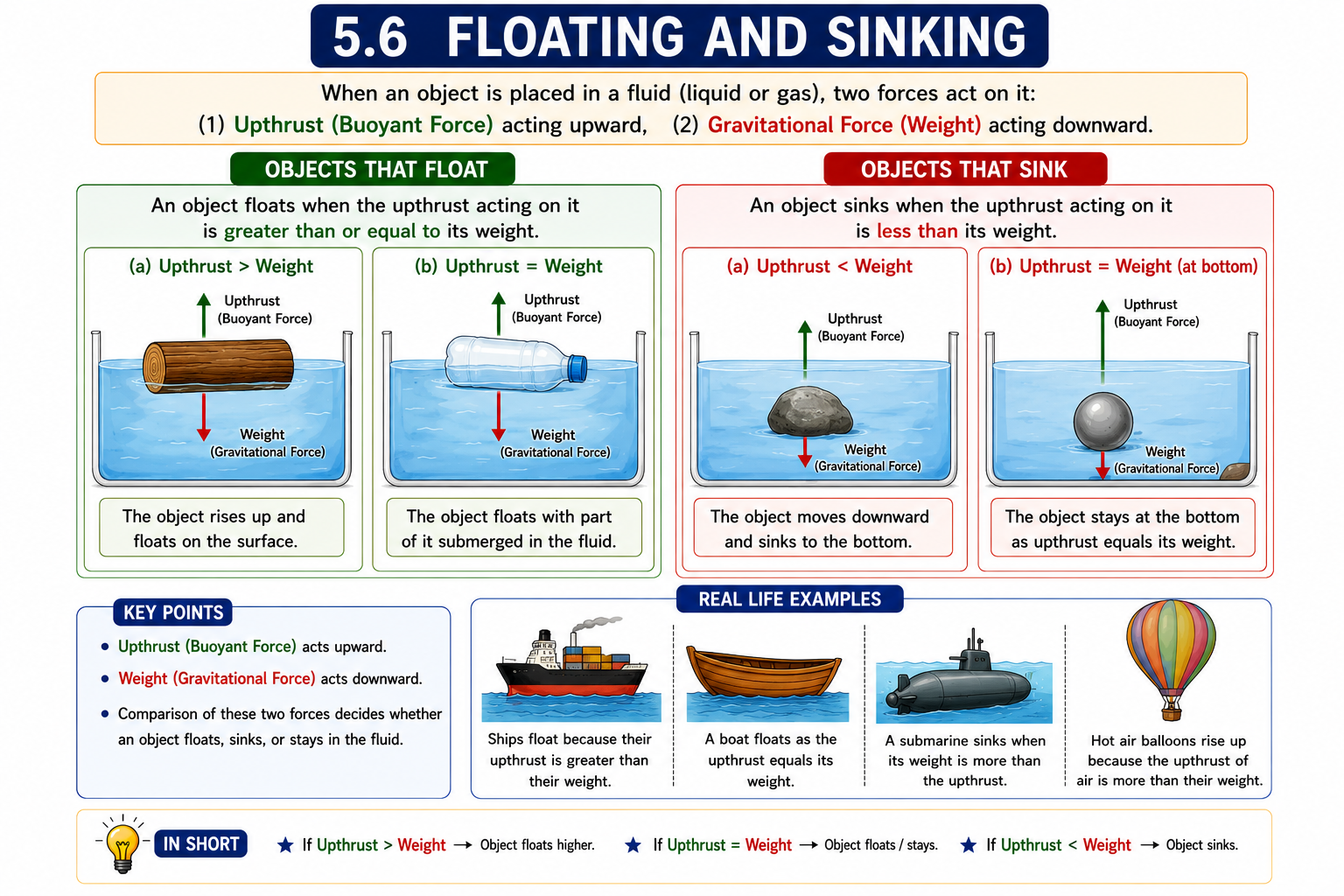
🔬 Activity 5.13: Let us investigate
🔢 Numerical Questions
💡 Remember: Upthrust = Weight of liquid displaced (Archimedes). Float: Buoyant force ≥ Weight. Sink: Buoyant force < Weight.
📝 Chapter 5 Practice Quiz — 25 Questions
|
5.1 What Is a Force?
LOTS
What is a force? What is its SI unit?
Show AnswerA force is a push or pull on an object resulting from its interaction with another object. The SI unit of force is newton (N).
Medium
Give three examples of force from daily life.
Show AnswerPushing a box, pulling a rope, kicking a football, lifting a bag, applying brakes on a bicycle (any three).
HOTS
A person pushes a wall with 50 N force but the wall does not move. Is force applied? Explain.
Show AnswerYes, 50 N force is applied on the wall. The wall applies an equal and opposite reaction force of 50 N on the person. The forces are balanced so the wall does not move.
HOTS
Why do cyclists find it harder to ride against the wind than with the wind?
Show AnswerWind pushes against the cyclist (opposing force). Riding against wind means the cyclist must apply more muscular force to overcome both friction and wind force. Riding with wind means wind force aids the cyclist, reducing the effort needed.
5.2 What Can a Force Do?
LOTS
List four effects a force can have on an object.
Show AnswerForce can: (1) Make an object move from rest. (2) Change speed. (3) Change direction of motion. (4) Change shape of an object.
Medium
A ball is hit by a bat and changes direction. Which effect of force is shown?
Show AnswerChange in direction of motion. The bat applies force on the moving ball, causing it to move in a new direction.
HOTS
A rubber ball and a clay ball are dropped from the same height. The rubber ball bounces but clay ball does not. Explain using effects of force.
Show AnswerWhen the rubber ball hits the floor, force changes its direction (it bounces back). Clay ball deforms permanently — force changes its shape instead of direction. Clay absorbs the force by changing shape; rubber restores its shape and redirects the force.
HOTS
Can force cause change in shape without change in motion? Give an example.
Show AnswerYes. When you press a lump of clay, it changes shape but does not move from its place. The force changes the shape without causing any motion.
5.3 Forces as Interaction
LOTS
How many objects are needed for a force to come into play?
Show AnswerAt least two objects must interact for a force to come into play.
Medium
A book rests on a table. Is any force acting on the book? Explain.
Show AnswerYes. Gravity pulls the book downward with 10 N (its weight). The table pushes the book upward with 10 N (normal force). Both forces are equal and opposite — the book remains at rest due to balanced forces.
HOTS
When you push a wall, you feel a force on your hand too. Why does this force disappear when you stop pushing?
Show AnswerForces exist only when two objects interact. When you push the wall, interaction occurs and both feel a force. The moment you stop pushing, the interaction ceases and the force disappears.
HOTS
Two teams in a tug-of-war pull with equal force. Why does the rope not move even though force is applied?
Show AnswerThe forces are equal and opposite — they balance each other. Net force = 0. According to the concept of balanced forces, an object does not move when net force is zero.
5.4 Types of Forces
LOTS
What is the difference between contact and non-contact forces?
Show AnswerContact forces act only when there is physical contact between objects (e.g., muscular force, friction). Non-contact forces act even without physical contact (e.g., magnetic, electrostatic, gravitational force).
Medium
Classify: (a) Friction (b) Gravity (c) Muscular force (d) Magnetic force.
Show Answer(a) Friction — Contact. (b) Gravity — Non-contact. (c) Muscular force — Contact. (d) Magnetic force — Non-contact.
HOTS
A crane uses an electromagnet to lift scrap iron. Which type of force does it use? Why is this better than using a hook?
Show AnswerElectromagnetic (magnetic) force — a non-contact force. It is better than a hook because the magnet can pick up large amounts of scattered scrap iron without needing to attach each piece individually. It can also be switched off to release the load.
HOTS
Can an object experience both contact and non-contact forces at the same time? Give an example.
Show AnswerYes. A bicycle in motion experiences friction (contact force between tyres and road) and gravity (non-contact gravitational force pulling it down) simultaneously.
5.4.1 Contact Forces
LOTS
What is friction? In which direction does it act?
Show AnswerFriction is the force that comes into play when an object moves or tries to move over another surface. It always acts in a direction opposite to the direction of motion.
Medium
Why do aeroplanes and high-speed trains have streamlined shapes?
Show AnswerAir exerts friction on objects moving through it. Streamlined shapes are designed to reduce air friction (air resistance), allowing aeroplanes and trains to move faster with less energy consumption.
HOTS
A ball rolls further on a tile floor than on a carpet. Explain why using the concept of friction.
Show AnswerThe carpet has a rougher surface with more irregularities than the tile floor. Greater roughness means greater friction. More friction decelerates the ball faster, making it stop sooner on carpet than on the smoother tile floor.
HOTS
Friction is both useful and harmful. Give one example of each.
Show AnswerUseful: Friction between vehicle tyres and road allows vehicles to brake and stop safely. Without friction, vehicles would skid. Harmful: Friction between machine parts causes wear and tear, generates heat, and wastes energy as heat rather than useful work.
5.4.2 Non-contact Forces
LOTS
What is gravitational force? Is it always attractive?
Show AnswerGravitational force is the force with which the Earth attracts objects towards itself. Yes, gravity is always attractive — unlike magnetic or electrostatic force which can be repulsive too.
Medium
What are static charges? How are they produced?
Show AnswerStatic charges are electrical charges that build up on the surface of objects when two objects of certain materials are rubbed together. The object that acquires static charges is called a charged object.
HOTS
The Moon does not fall onto the Earth even though gravity attracts it. Why?
Show AnswerThe Moon is moving in an orbit around the Earth. The gravitational force of Earth acts as a centripetal force that keeps the Moon in its circular orbit rather than pulling it straight down. The Moon’s orbital speed balances the gravitational pull.
HOTS
Two charged balloons rubbed with woollen cloth repel each other. What does this tell us about the charges on them?
Show AnswerSince both balloons were rubbed with woollen cloth in the same way, they acquired similar (like) charges. Like charges repel each other. The woollen cloth acquires the opposite type of charge from the balloons.
5.5 Weight and Its Measurement
LOTS
What is the difference between mass and weight?
Show AnswerMass is the amount of matter in an object — measured in kg, same everywhere. Weight is the gravitational force pulling the object — measured in N, varies from place to place.
Medium
How does a spring balance work to measure weight?
Show AnswerWhen an object is hung from the hook of a spring balance, the spring stretches due to the object’s weight. The amount of stretching is indicated on the scale in newtons, giving the weight of the object.
HOTS
An astronaut weighs 600 N on Earth. What is his weight on the Moon and on Mars? (Moon gravity = 1/6 of Earth, Mars gravity = 3/8 of Earth)
Show AnswerWeight on Moon = 600 ÷ 6 = 100 N. Weight on Mars = 600 × 3/8 = 225 N. Mass remains 60 kg everywhere.
HOTS
Why is it incorrect to say the weight of a wheat bag is 10 kg in scientific terms?
Show AnswerIn science, weight is a force measured in newtons (N), not kilograms. 10 kg is the mass of the wheat bag. Its weight on Earth = 10 kg × 10 N/kg = 100 N. Saying weight = 10 kg mixes up mass and weight.
5.6 Floating and Sinking
LOTS
What is buoyant force? When does an object float?
Show AnswerBuoyant force (upthrust) is the upward force applied by a liquid on an immersed object. An object floats when buoyant force equals or exceeds its weight (gravitational force).
Medium
State Archimedes’ Principle.
Show AnswerWhen an object is fully or partially immersed in a liquid, it experiences an upward force (buoyant force) equal to the weight of the liquid it displaces.
HOTS
A steel ship floats but a solid steel ball sinks. Explain using buoyant force and density.
Show AnswerA ship is hollow, displacing a large volume of water. The weight of water displaced equals the ship’s weight, so buoyant force = weight and it floats. A solid steel ball is dense and displaces very little water. Buoyant force is less than its weight, so it sinks.
HOTS
Why does an object feel lighter when immersed in water compared to in air?
Show AnswerIn water, the object experiences an upward buoyant force in addition to the downward gravitational force. This reduces the net downward force (apparent weight). So the object feels lighter in water than in air where no buoyant force acts.
|