CBSE Class 8 Social Science — Exploring Society: India and Beyond | Part 1
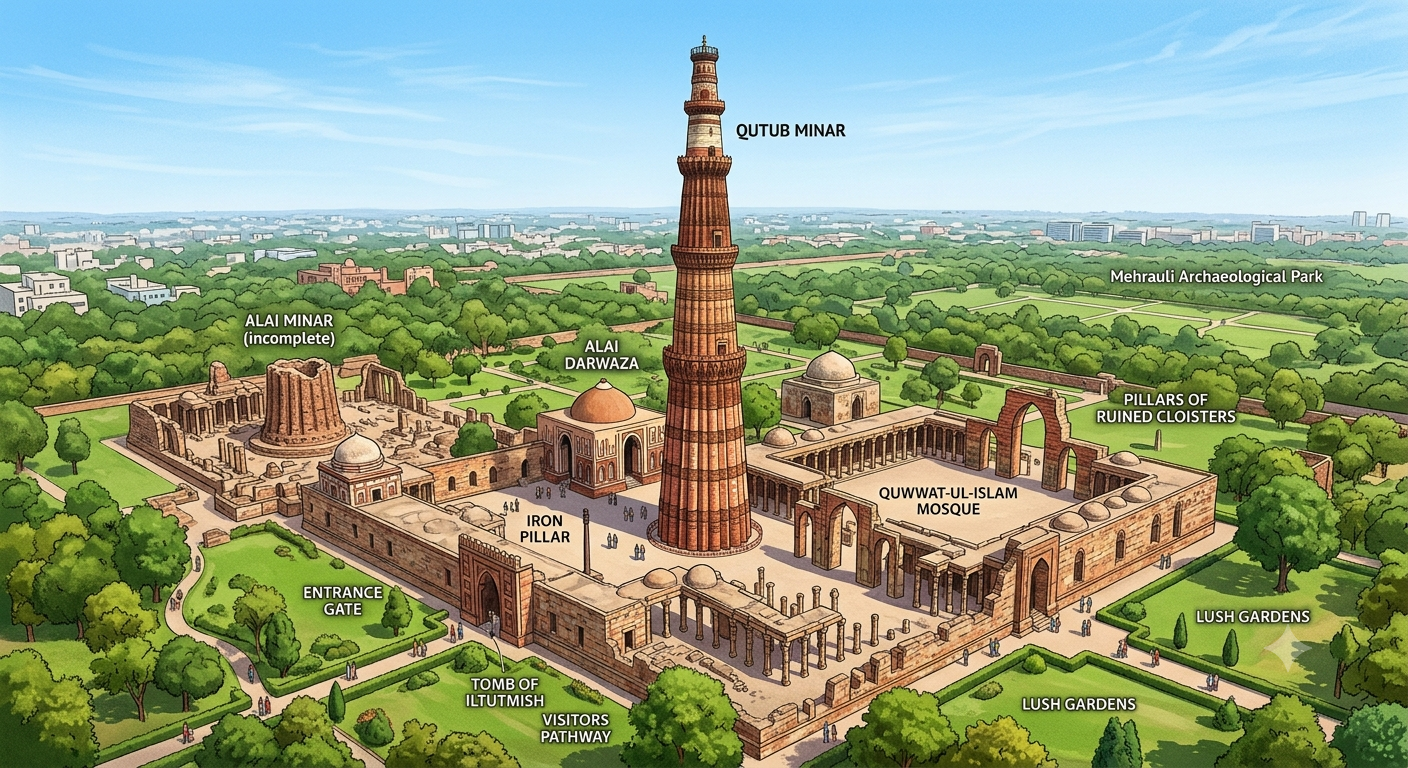
Fig. 2.1: An aerial view of the Qutub Minar complex, Delhi
🎯 The Big Questions
How did foreign invasions and the rise of new dynasties reshape India’s political boundaries during this period?
How did Indian society respond to invasions? How did India’s economy adapt during times of political instability?
What impact did this period have on the lives of the people?
About this chapter: The period covered here is often called the latter part of the medieval period of Indian history — from the 11th to the 17th centuries. We explore the ever-changing political landscape of India from the 13th century onward, including invasions, new empires, resistance movements, administration, and the lives of ordinary people.
Delhi Sultanate formed in 1206 after the defeat of King Prithviraj Chauhan in 1192 by Turkic-Afghan invaders.
Five successive foreign dynasties of Turkic-Afghan origin ruled the Sultanate: Mamluks (Slave dynasty), Khiljis (Khaljis), Tughlaqs, Sayyids, and Lodis (Lodhis).
The term Sultanate means a territory ruled by a Sultan — a title adopted by some Muslim rulers.
Neighbouring kingdoms like the Eastern Gangas in the east and the Hoysalas in the south resisted the Sultanate and emerged as thriving centres of art, culture and administration.
The Sultanate period was marked by political instability combined with efforts at territorial expansion — resulting in military campaigns that raided, plundered, and destroyed temples and seats of learning.
Successions were often violent — almost two sultans out of three seized power by eliminating their predecessor, so the average reign was hardly more than nine years!
Ala-ud-din Khilji conducted military campaigns over large areas of north and central India, repelled Mongol invasions, and his slave-general Malik Kafur expanded the Sultanate southward, attacking Hindu centres like Srirangam, Madurai, Chidambaram and Rameswaram.
Muhammad bin Tughlaq expanded territories further — for the first time since the Mauryan Empire, most of the Subcontinent came under one ruler. However, his ambitious schemes often misfired: he shifted the capital from Delhi to Daulatabad (Devagiri) causing great loss of life, and introduced token copper currency which caused economic confusion and decline.
Sultans levied the jizya — a discriminatory tax on non-Muslim subjects — creating economic burden and social incentive for conversions.
In 1398, Timur, a brutal Turkic-Mongol conqueror, invaded and devastated Delhi, killing and enslaving thousands. He withdrew with huge plunder leaving chaos behind.
The Lodis emerged as the last dynasty of the Delhi Sultanate, but by then its territory had shrunk considerably.
Iconoclasm (destruction of religious images) motivated many attacks on Buddhist, Jain and Hindu temples — not just for plunder but for religious reasons.
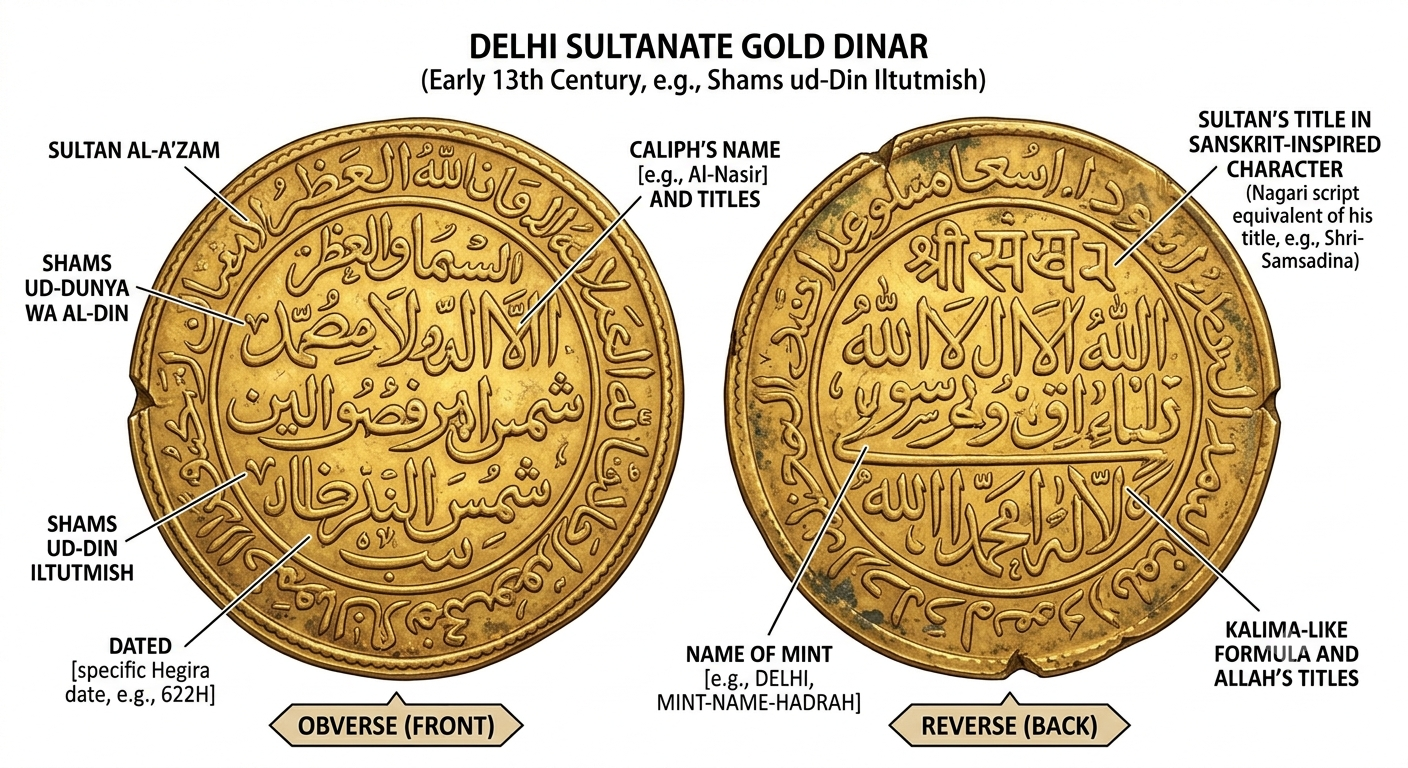
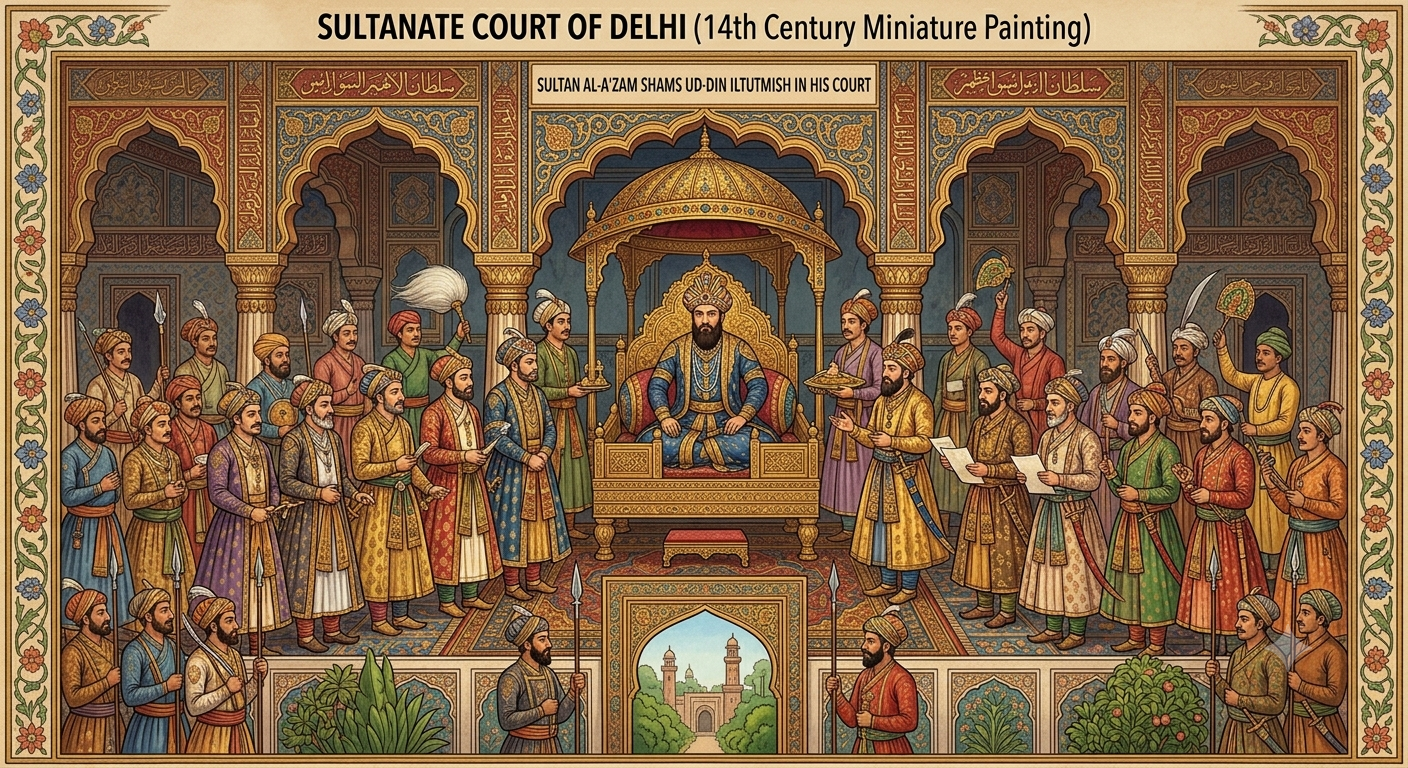
Fig. 2.6: Coin minted by Ala-ud-din KhiljiFig. 2.7: A painting depicting Muhammad bin Tughlaq in his court
💡 Think About It
Ala-ud-din Khilji called himself ‘Sikander Sani’ meaning ‘the second Alexander’. Why do you think he chose this title? What does it tell us about his ambitions?
💡 Think About It
Why do we use the term ‘image’ rather than ‘idol’ or ‘icon’? The latter two terms are considered pejorative in Judaism, Christianity and Islam. India’s classical texts used words like mūrti, vigraha, pratimā, rūpa — neutral words in English translated as ‘image’.
📍 Resistance to the Delhi Sultanate
Throughout its rule, the Delhi Sultanate faced resistance from many quarters.
The Eastern Ganga kingdom of Kalinga (present-day Odisha, parts of Bengal and Andhra Pradesh) successfully resisted the Sultanate.
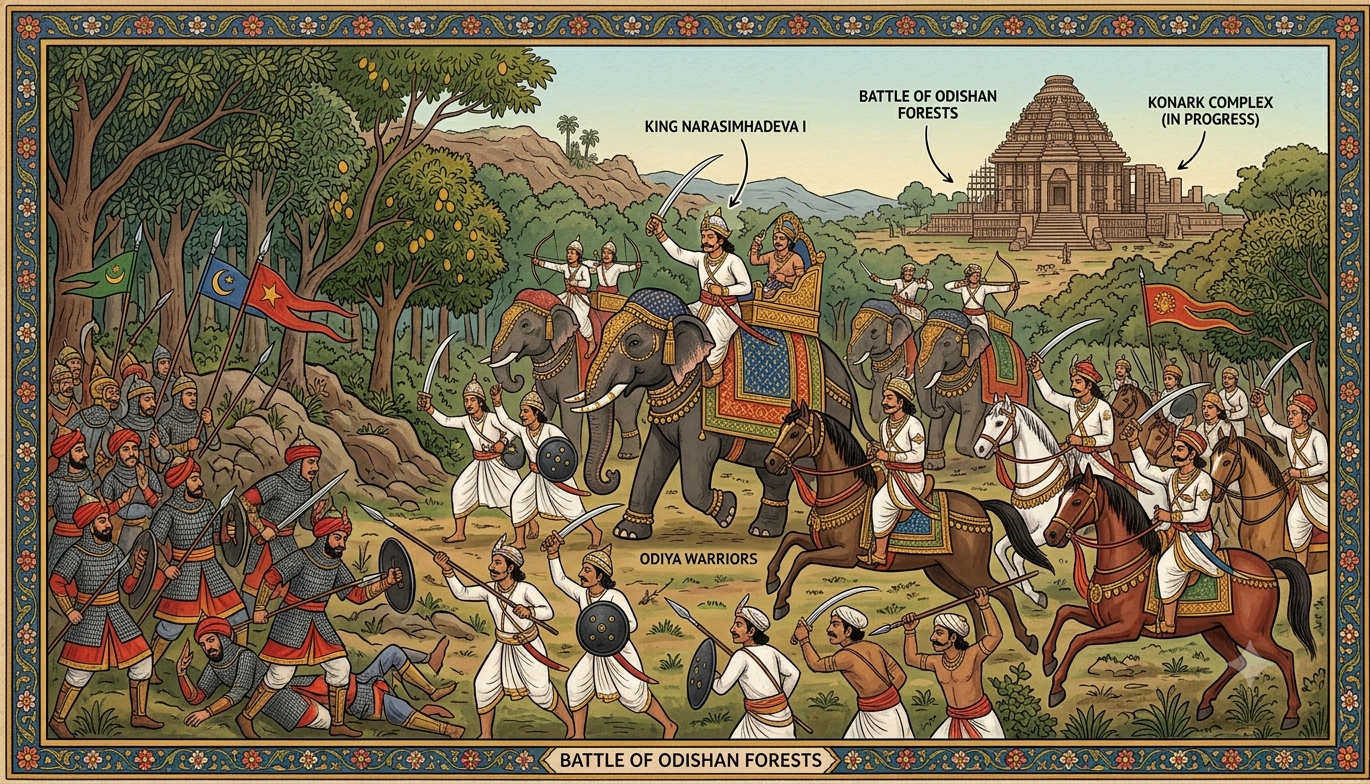
Narasimhadeva I (mid-13th century ruler of Eastern Ganga) was noted for military strength and cultural brilliance. He repelled multiple inroads of the Sultanate, defeated the Sultanate’s governor of Bengal, and partly to commemorate these victories, built the famed Sūrya temple at Konark.
The Musunuri Nayakas, Telugu chieftains, rallied over 75 chieftains of the region and formed a confederacy that expelled Muhammad bin Tughlaq’s army from Warangal (present-day Telangana) around 1330–1336.
The Hoysalas ruled parts of southern India (mostly present-day Karnataka) and fended off several attacks from the Delhi Sultanate — remaining the only independent kingdom in the south for a time. However, weakened by these attacks and internal conflicts, the Hoysala kingdom eventually declined and was absorbed into the Vijayanagara Empire.
The Bahmani Sultanate rose in the mid-14th century as an independent power controlling much of the Deccan.
Powerful Sultanates also emerged in Gujarat, Bengal and other regions, leading to complex alliances and frequent wars.
Parts of Rajasthan remained beyond the reach of the Delhi Sultanate. In the 15th century, Rana Kumbha of the Mewar kingdom stiffly resisted invasions from the Sultanates.
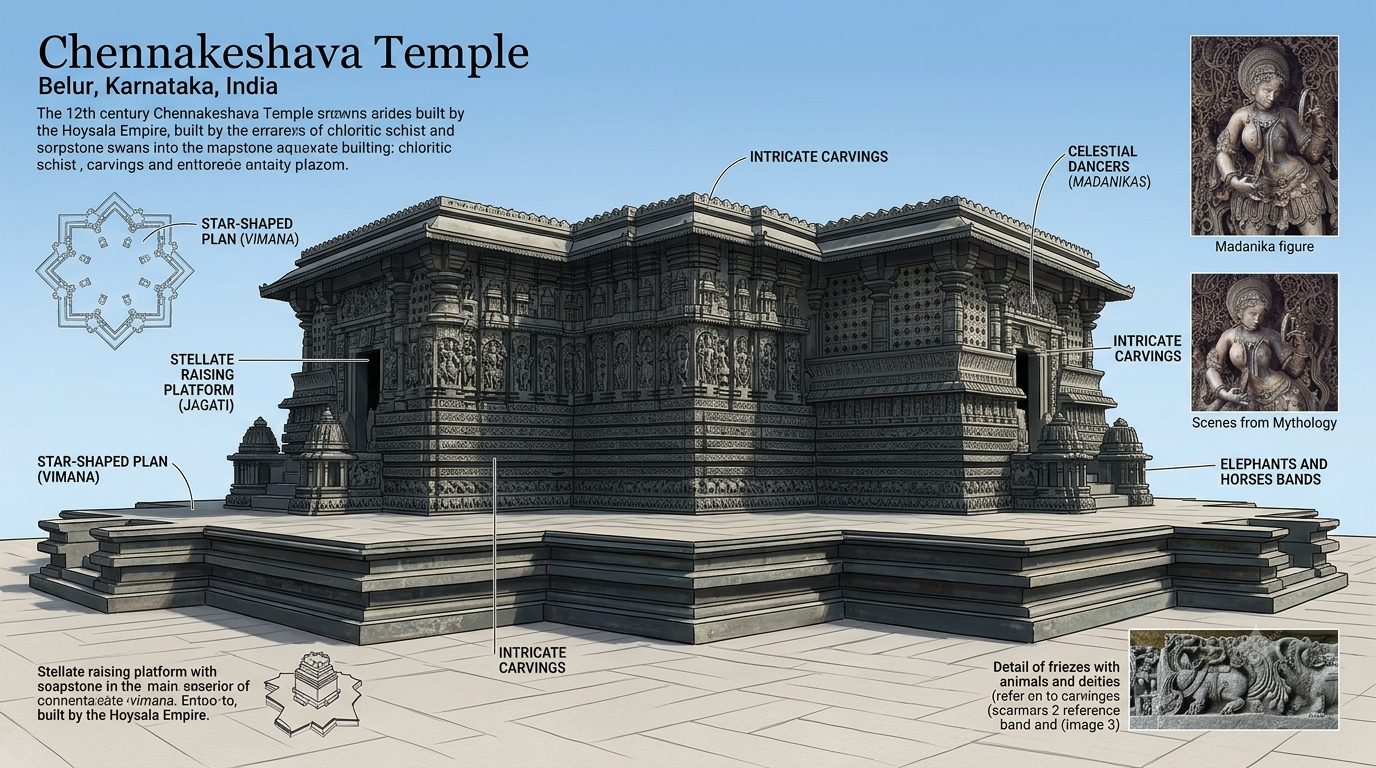
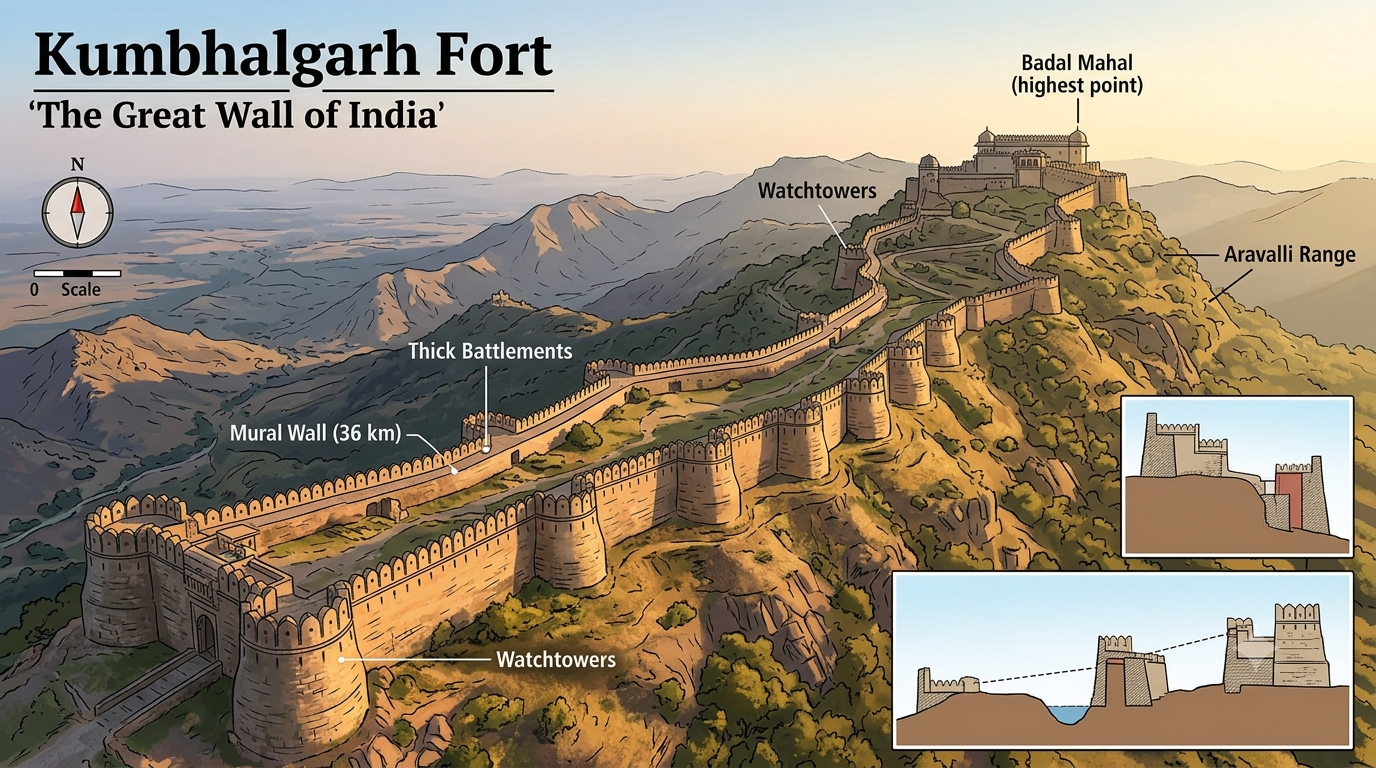
Fig. 2.8: Resistance to the Delhi SultanateFig. 2.9: The Hoysalas built magnificent temples with intricate carvingsFig. 2.10: Kumbhalgarh Fort with its 36-kilometre-long wall
⚠ Don’t Miss Out
The sculpture at Belur narrates the story behind the Hoysala emblem. Kannada folklore recounts the story of Sala, a young man who fought a lion to save his guru, giving the dynasty its name — ‘Hoy (strike)! Sala’.
⚠ Don’t Miss Out
Kumbhalgarh Fort was built by Rana Kumbha in the 15th century in the Aravalli hills, serving as a stronghold for Mewar rulers. It is famous for its massive 36-kilometre-long wall — one of the longest continuous walls in the world.
🔎 Let’s Explore
Why do you think such hilltop locations were chosen for many medieval forts? Discuss the pros and cons — think about strategy, security, vulnerability, and supply lines.
📍 The Vijayanagara Empire
While the Delhi Sultanate grew politically unstable, a new centre of power emerged in the south in the 14th century.
Two brothers, Harihara and Bukka, who had served as governors under Muhammad bin Tughlaq, eventually rejected Delhi’s authority and established the Vijayanagara Empire.
According to popular folklore, they witnessed a remarkable sight at Hampi (present-day Karnataka) — a hare turning around and chasing a pack of hounds. Their guru Vidyaranya interpreted this as a symbol of resilience and bravery, and advised them to establish their capital there.
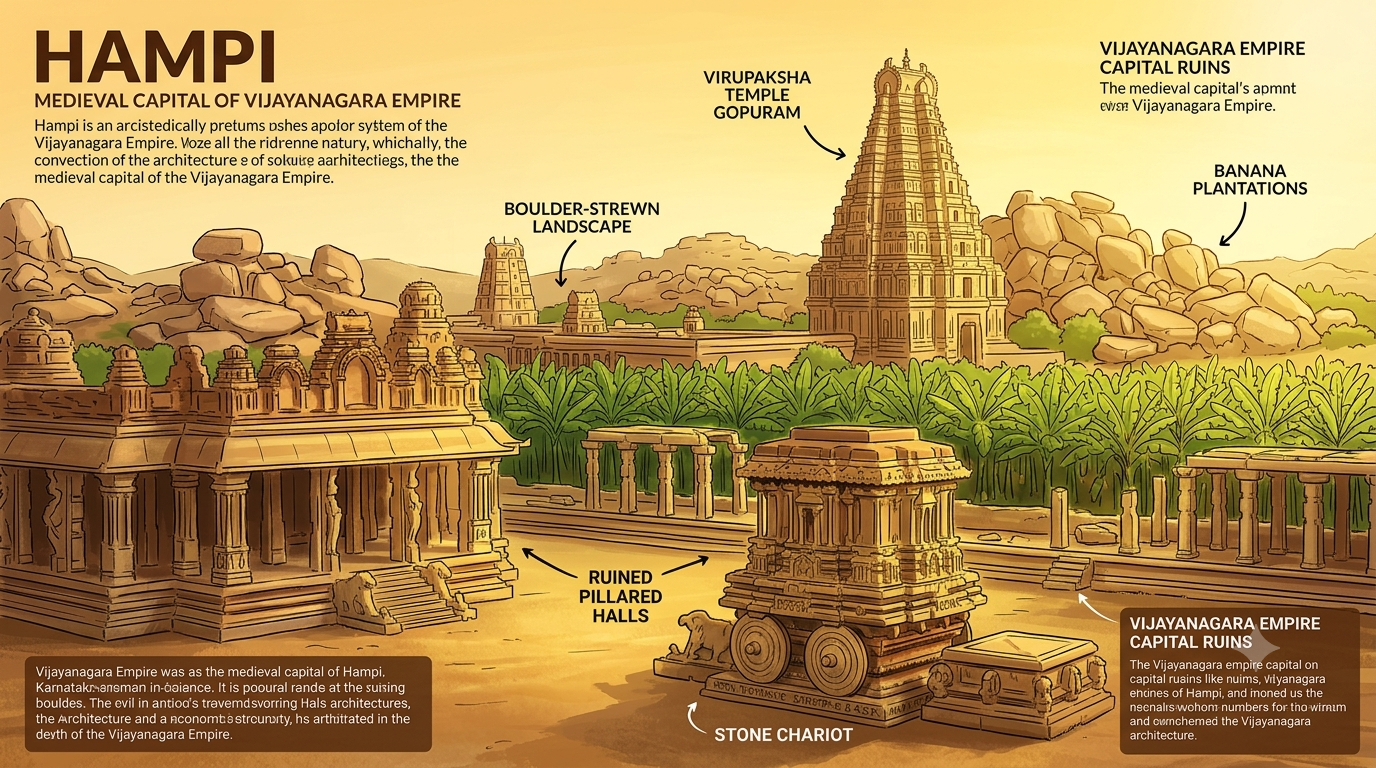
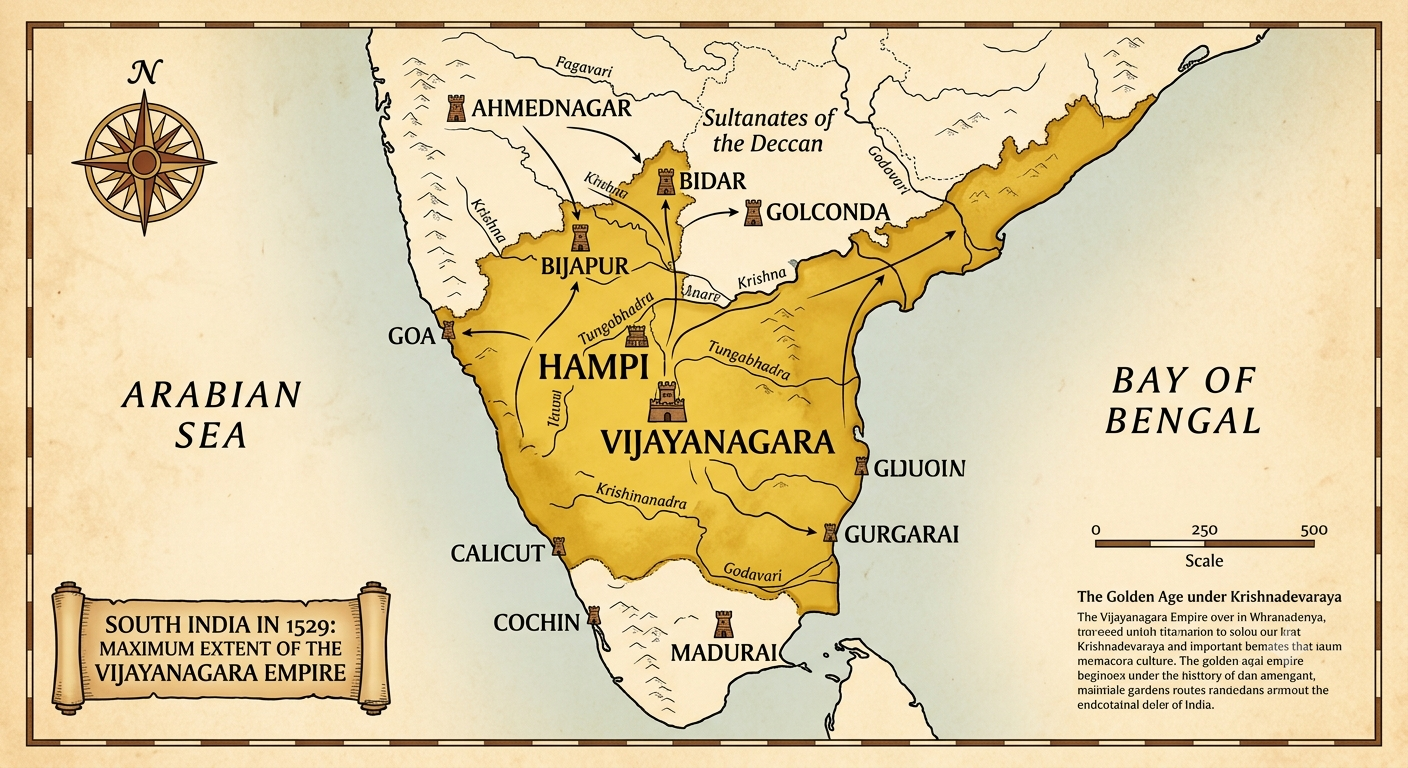
The empire’s capital Vijayanagara (Hampi) became one of the greatest cities of the medieval world — described by Portuguese traveller Domingo Paes as being ‘as large as Rome’ and the ‘best provided city in the world’.
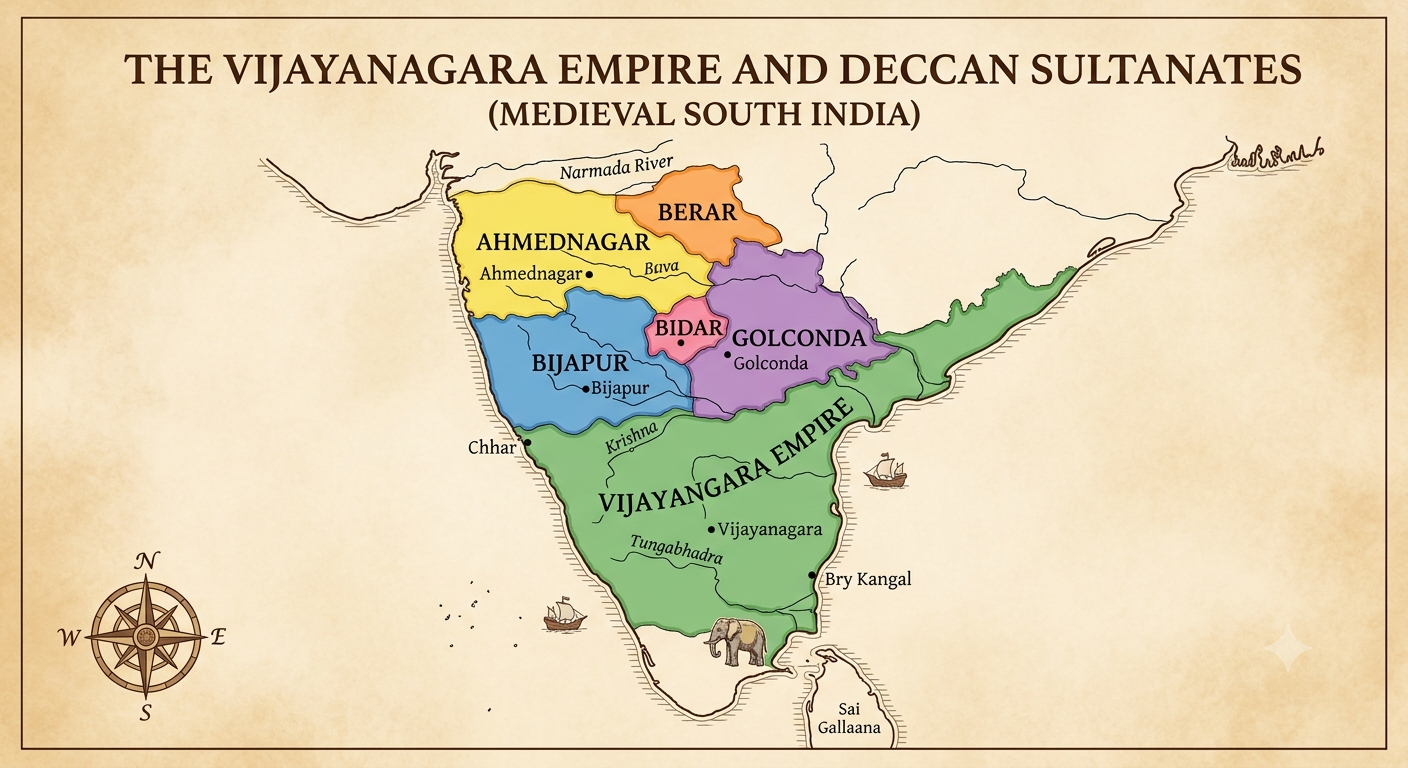
To the north, the Bahmani Sultanate was a major rival — it eventually fragmented into five independent states called the ‘Deccan Sultanates’: Bijapur, Golconda, Berar, Ahmednagar, and Bidar.
The Vijayanagara rulers also battled the Gajapati rulers of Odisha in the east.
The term pati meaning ‘lord’ or ‘master’ was used by many dynasties: Vijayanagara kings were called ‘Narapati’, Bahmani rulers ‘Ashwapati’, Maratha rulers ‘Chhatrapati’.
Fig. 2.11: Ruins of Vijayanagara city, present-day HampiFig. 2.12 (part 1): Map showing the Vijayanagara Empire and Deccan kingdomsFig. 2.12 (part 2): Extent of Vijayanagara Empire under Krishnadevaraya (1529)
⚠ Don’t Miss Out
Foreign travellers visited Vijayanagara for trade. Portuguese travellers were very well treated as they came to sell horses — and the king did not want them selling those precious horses to enemy kingdoms! Domingo Paes left a detailed record describing the city as ‘the best provided city in the world’ with countless people and abundant goods.
📍 Krishnadevaraya
In the 16th century, the Vijayanagara Empire reached its peak under its celebrated ruler Krishnadevaraya.
He expanded and secured the empire’s dominance over the Deccan, achieving both military power and cultural renaissance.
He patronised poets and scholars in Sanskrit, Telugu and Kannada.
He himself composed an epic poem in Telugu — Āmuktamālyada — on the story of the Tamil poet-saint Āṇḍāl. One section of this work is a Rājanīti (‘royal policy’) where he expounded his ideas of good governance.
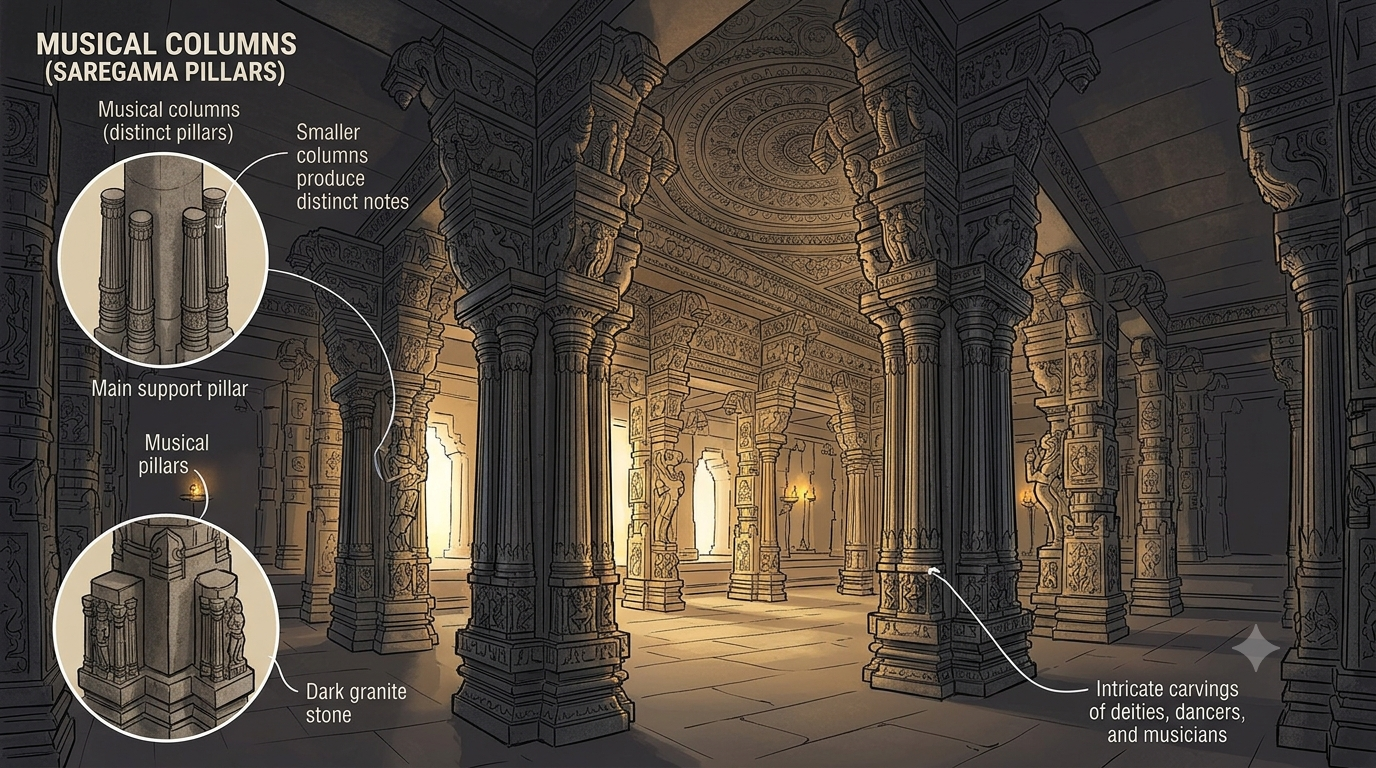
Krishnadevaraya provided grants to many temples including Tirupati in Andhra Pradesh and the Vitthala temple in his capital Vijayanagara.
The Vitthala temple is famous for its musical pillars — when struck, the smaller columns of each pillar give out different musical notes.
Krishnadevaraya died of illness in 1529.
In 1565, the Deccan Sultanates formed a coalition and defeated the Vijayanagara forces led by Ramaraya (Krishnadevaraya’s son-in-law) at the Battle of Talikota. The city was sacked over several months — houses, temples, palaces destroyed and much of the civilian population massacred. The empire fragmented into smaller regions ruled by Nayakas (former military governors) and came to an end in the mid-17th century.
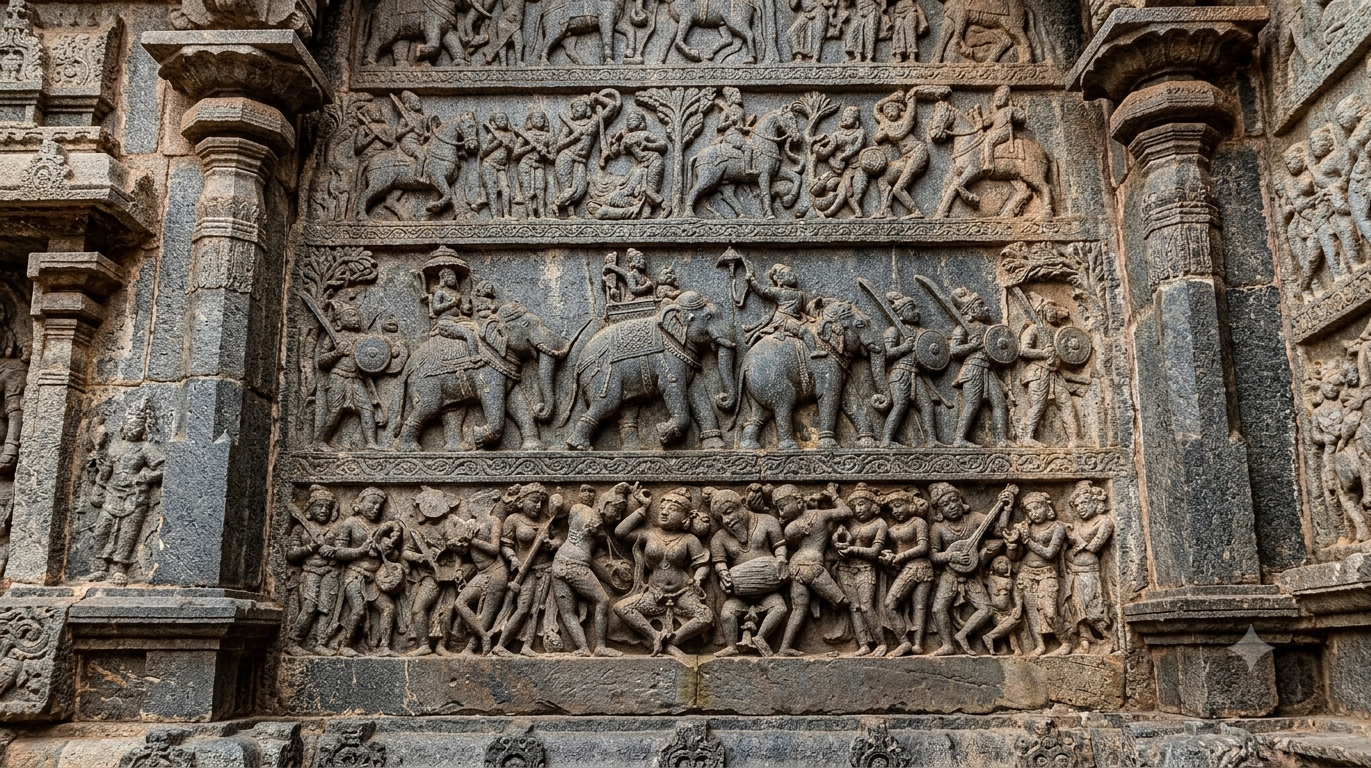
Fig. 2.13: The Vitthala temple with finely sculpted monolithic musical pillarsFig. 2.14: Stone panel carvings showing scenes of daily life in Vijayanagara
🔎 Let’s Explore
In Fig. 2.14, what elements do you observe in the stone panel? What do they tell you about life in Vijayanagara? (Hint: observe the weapons, the animals, the activities.)
📍 The Mughals
Babur, a Turkic-Mongol ruler and military strategist, was thrown out of Samarkand (modern-day Uzbekistan) and turned his sights to India.
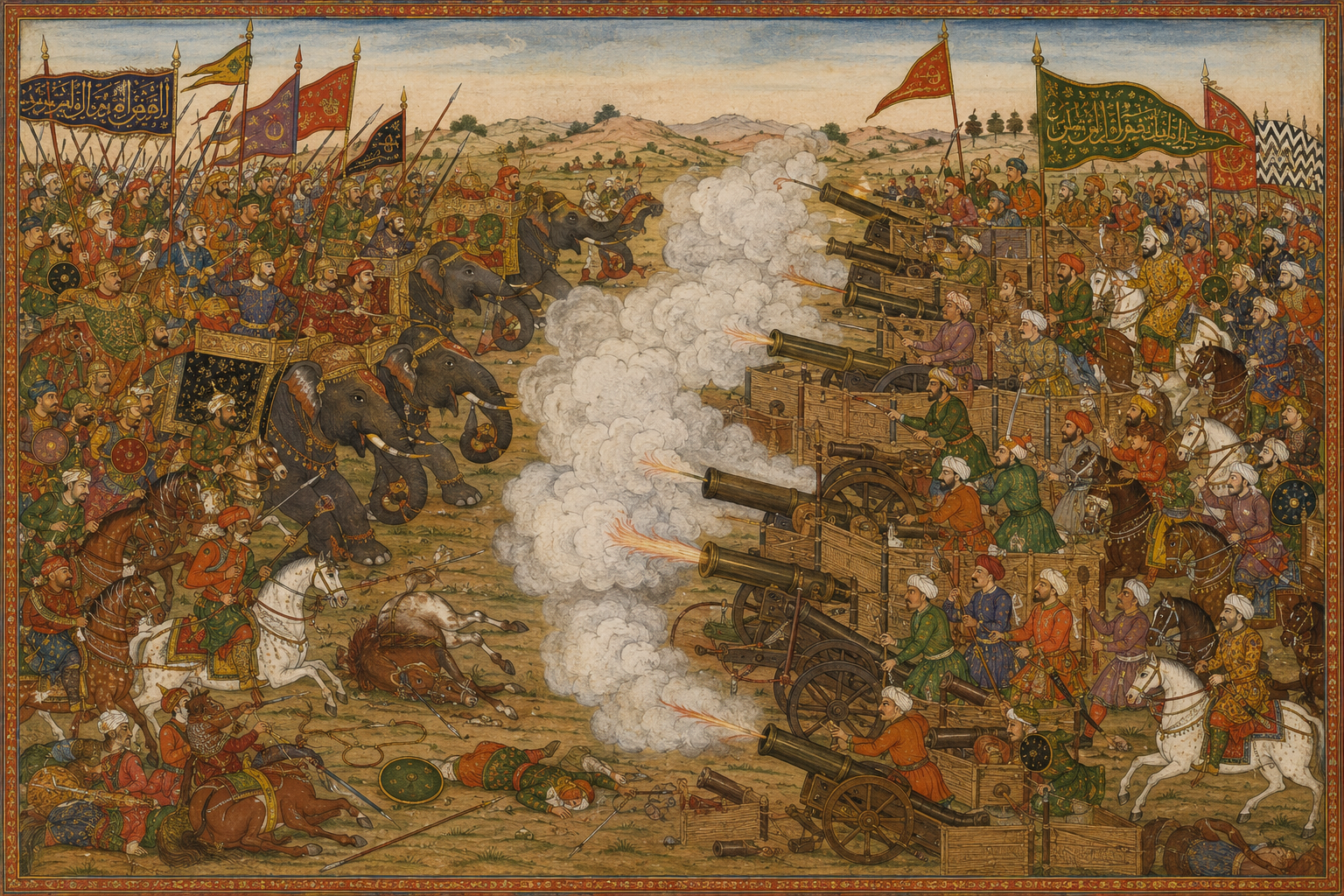
A descendant of Timur, Babur defeated Ibrahim Lodi at Panipat in 1526 — the First Battle of Panipat. This battle relied heavily on gunpowder, field artillery and matchlock guns — recently introduced in Indian warfare.
This defeat ended the Delhi Sultanate and laid the foundation of the Mughal Empire as Babur assumed control of the Delhi throne.
Babur left an autobiography of great historical value — the Baburnama (‘Babur’s Memoirs’). He comes across as cultured and intellectually curious, but also a brutal conqueror who slaughtered populations and erected ‘towers of skulls’.
Babur found India to be a ‘country of few charms’ but acknowledged: ‘Hindustan is a large country and has masses of gold and silver… There are countless artisans and workmen of every sort.’ He decided to stay and build his empire.
After Babur’s death in 1530, his son Humayun struggled to hold the empire together.
Sher Shah Suri, a powerful Afghan leader, established the Sur Empire over large parts of north India and introduced many lasting reforms; but Humayun reconquered the lost ground.
Himu (Hemu), a skilled military commander and chief minister, captured Delhi and ruled briefly as Hemchandra Vikramaditya. He was defeated at the Second Battle of Panipat by Babur’s grandson Akbar and was beheaded. Akbar then reclaimed Delhi for the Mughals.
Fig. 2.15: The Battle of Panipat as depicted in the Baburnama
💡 Think About It
What strikes you in Babur’s impressions of India? Though he found India to be a ‘country of few charms’, he chose to stay. What does this tell us about his motivations?
📍 Akbar
Akbar was declared emperor at the age of 13 upon his father Humayun’s accidental death. His reign was a blend of brutality and tolerance, shaped by ambition and strategy.
In early conquests, Akbar besieged the fort of Chittor (Chittorgarh, Rajasthan) for more than five months. Rajput soldiers resisted but the fort fell. Akbar ordered the massacre of 30,000 civilians and enslaved the surviving women and children. Hundreds of Rajput women committed jauhar (jumping into mass fires to avoid capture).
Jauhar was considered a heroic act of final resistance by Rajput women to preserve honour when facing conquest by Turkic or Mughal armies.
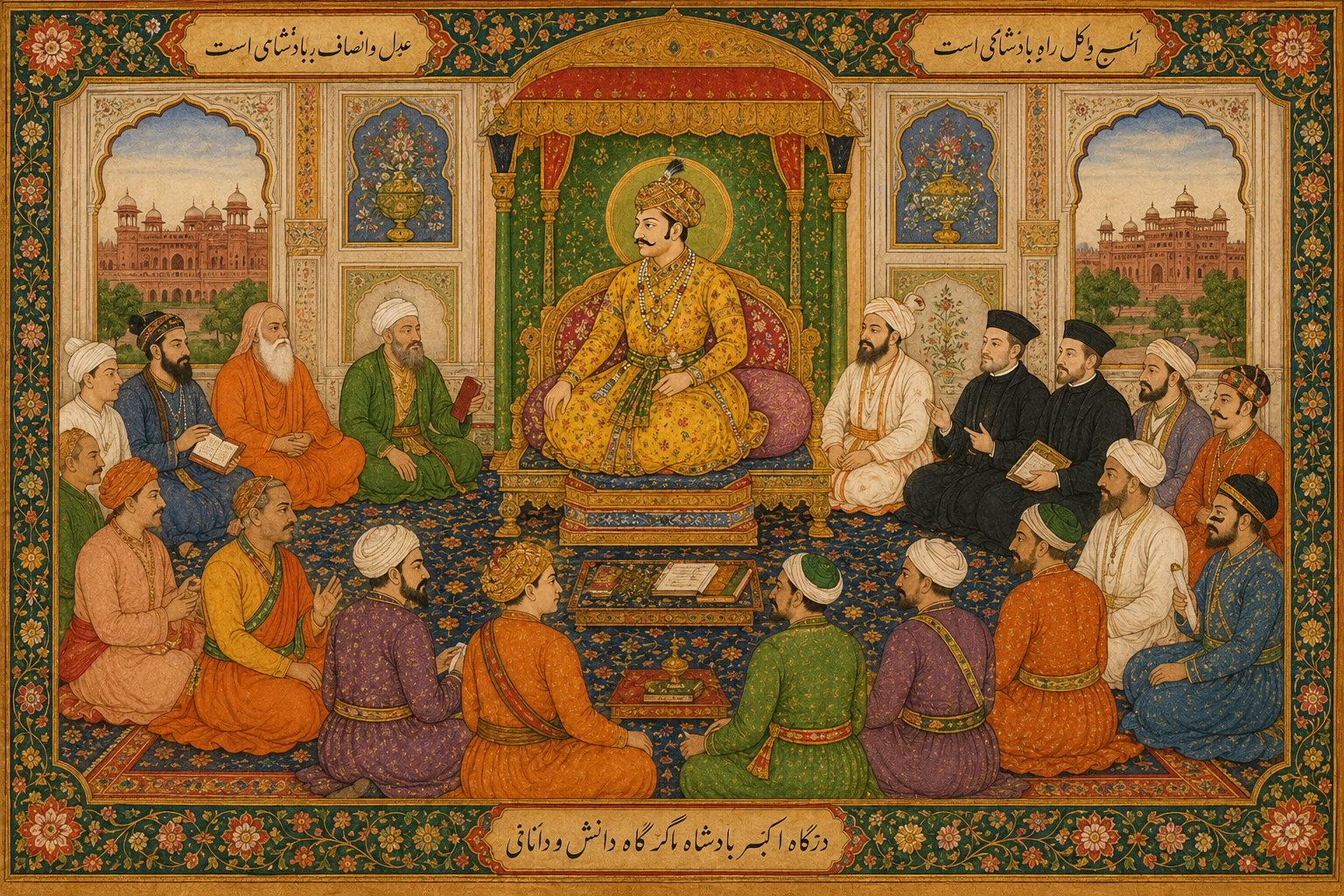
As his empire grew, Akbar increasingly used political strategies: entered into marriage alliances with neighbouring kingdoms’ princesses, welcomed Rajput and regional leaders into his court, abolished the jizya, and promoted the doctrine of sulh-i-kul (‘peace with all’ or tolerance of all faiths).
Through interfaith dialogues, appointment of Hindu officials in high positions and other reforms, Akbar expanded and stabilised his empire.
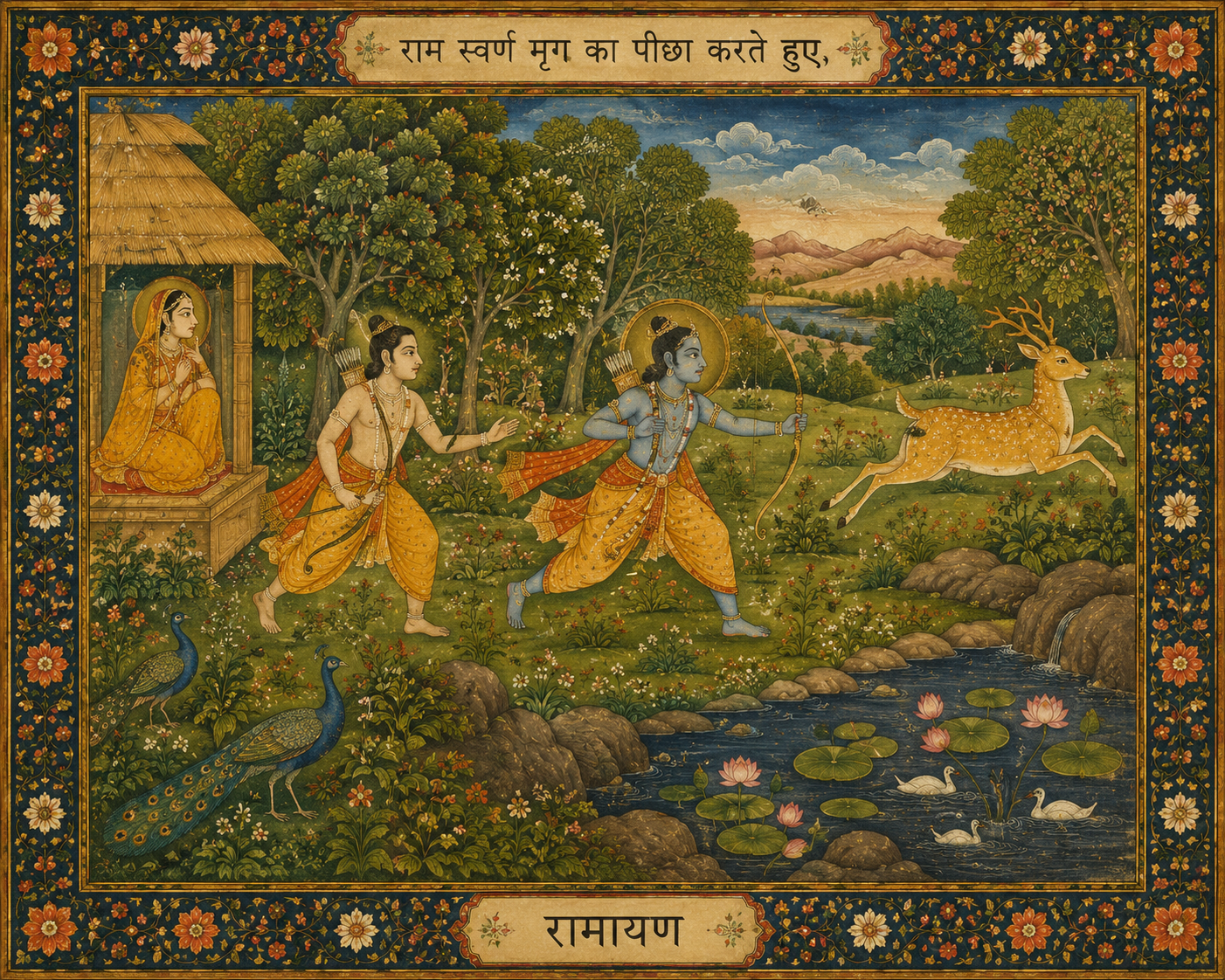
Despite being illiterate, Akbar became keen to explore Persian and Indian texts. He established a ‘house of translation’ at Fatehpur Sikri where major Sanskrit texts were translated into Persian — including the Mahābhārata (Razmnama), the Rāmāyaṇa, the Bhagavad Gītā, and the Pañchatantra.
His court historian and biographer Abul Fazl recorded his evolution: ‘Formerly I persecuted men into conformity with my faith… As I grew in knowledge, I was overwhelmed with shame.’
His long reign lasted almost 50 years (1556–1605). The middle period was relatively peaceful; the final 15 years saw campaigns in Kashmir, Sindh, the Deccan and Afghanistan.
Akbar’s son Jahangir shared his father’s love for art and architecture and tried to expand into the Deccan.
His son Shah Jahan is best remembered as the builder of the Taj Mahal at Agra — recognised even today as one of the great architectural marvels of the world. This period saw the peak of Mughal art and architecture, including Humayun’s tomb, the Red Forts in Delhi and Agra, and remarkable works of calligraphy and miniature painting.
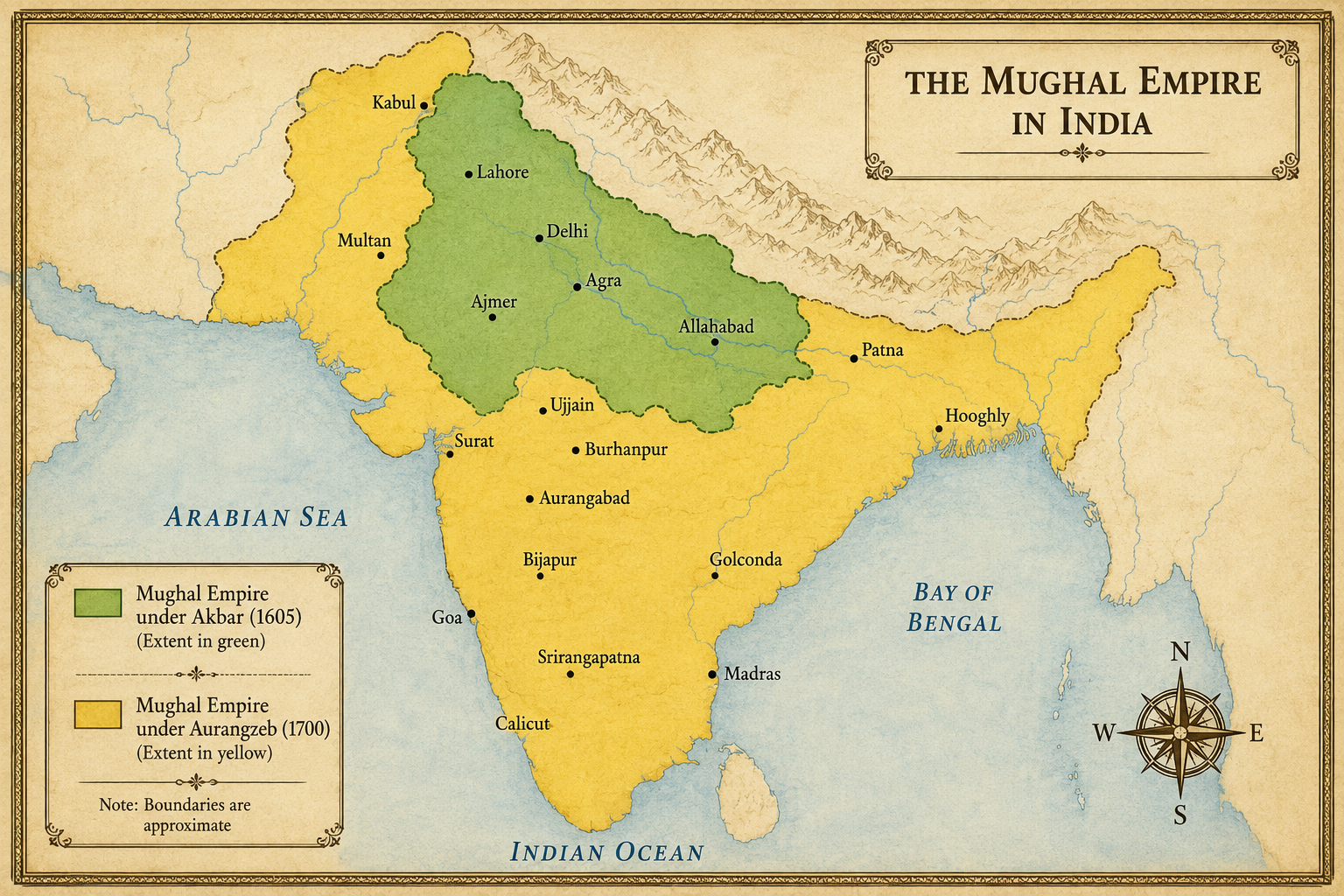
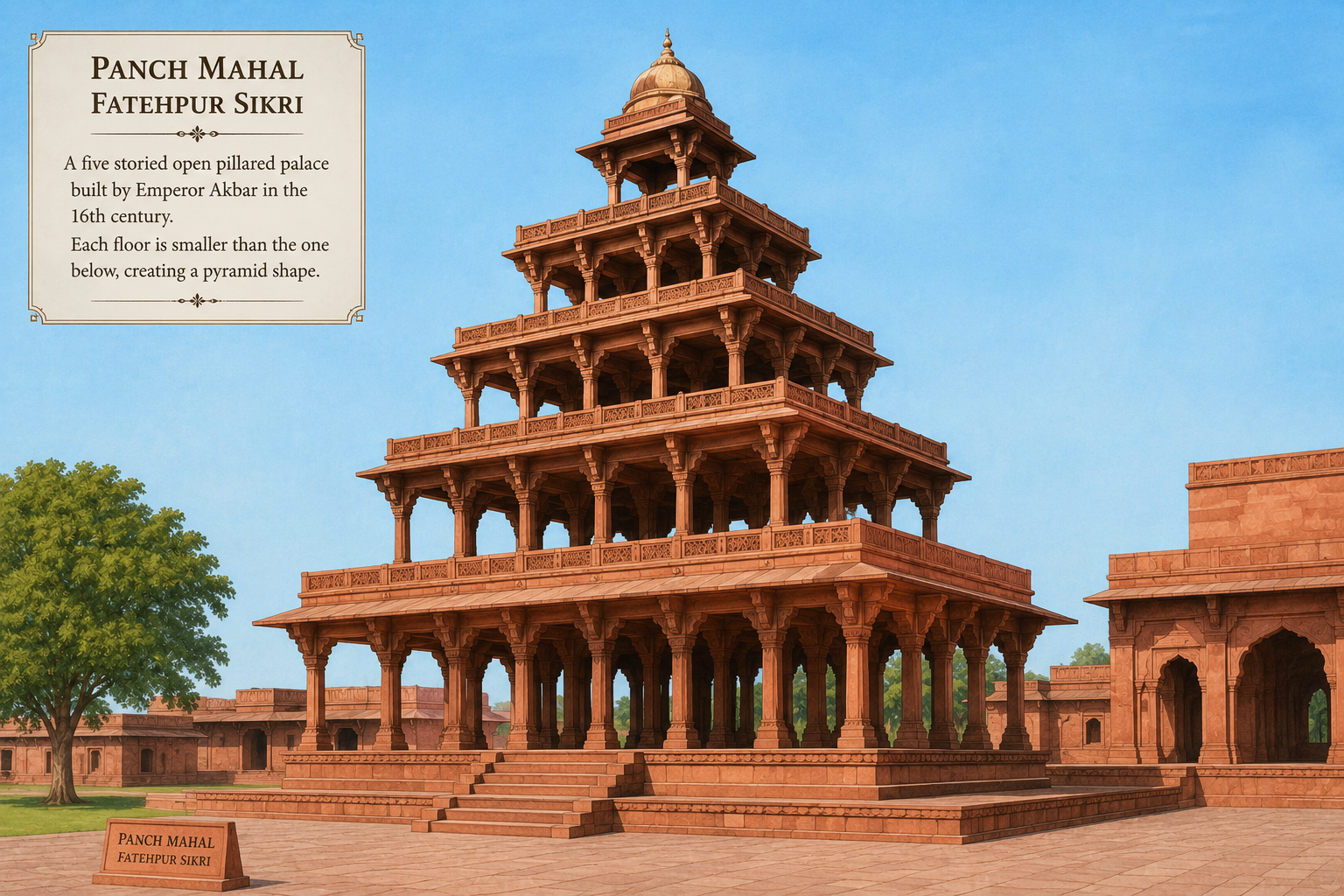
Fig. 2.16: The Mughal Empire under Akbar (1605) and expansion under Aurangzeb (1700)Fig. 2.17: Akbar receiving scholars of different faithsFig. 2.18: The five-storied Panch Mahal at Fatehpur Sikri built by AkbarFig. 2.19: A miniature painting from the Persian Ramayana
💡 Think About It
Why do you think Akbar employed different strategies — diplomacy, marriage alliances, abolishing jizya, interfaith dialogue — to expand his empire, while earlier Delhi rulers relied mostly on military might?
🔎 Let’s Explore
Compare the maps showing the Delhi Sultanate territories, the Vijayanagara Empire, and the Mughal Empire. What differences do you notice? What is the ‘reshaping’ that has occurred over these centuries?
📍 Aurangzeb
Aurangzeb defeated and executed his brother Dara Shikoh (Shah Jahan’s preferred heir) in a series of battles, imprisoned his father Shah Jahan in the Agra Fort, and crowned himself emperor in 1658. He named himself ‘Alamgir’ or ‘conqueror of the world’ and ruled for almost 49 years.
Aurangzeb conducted many campaigns, conquering parts of the South. Under his reign the Mughal Empire reached its greatest territorial expansion — but it constantly faced significant rebellions.
He spent the last 25 years of his life fighting war after war in the Deccan. Maintaining large armies depleted the empire’s treasury and strained administration — widely considered a key factor in the rapid decline of Mughal power after his death in 1707.
Aurangzeb belonged to Islam’s Sunni sect and led an austere life. Unlike Akbar, he banned music and dance in his court and reimposed the jizya tax on non-Muslims as well as a pilgrimage tax on Hindus.
In 1669, he ordered governors of all provinces ‘to demolish schools and temples of the infidels and put down their teachings and religious practices.’ Temples at Banaras (Varanasi), Mathura, Somnath and many others were destroyed, as well as Jain temples and Sikh gurudwaras.
He also persecuted Muslims of other sects including Sufis, and Zoroastrians.
In his last letters to his sons, Aurangzeb wrote: ‘I came alone and am going away alone. I know not who I am and what I have been doing… I have not done well for the country and the people.’ — expressing deep regret.
Some scholars argue Aurangzeb’s motives were primarily political; others point to his own farmans (edicts) as evidence of personal religious motivation. Both factors likely played a role.
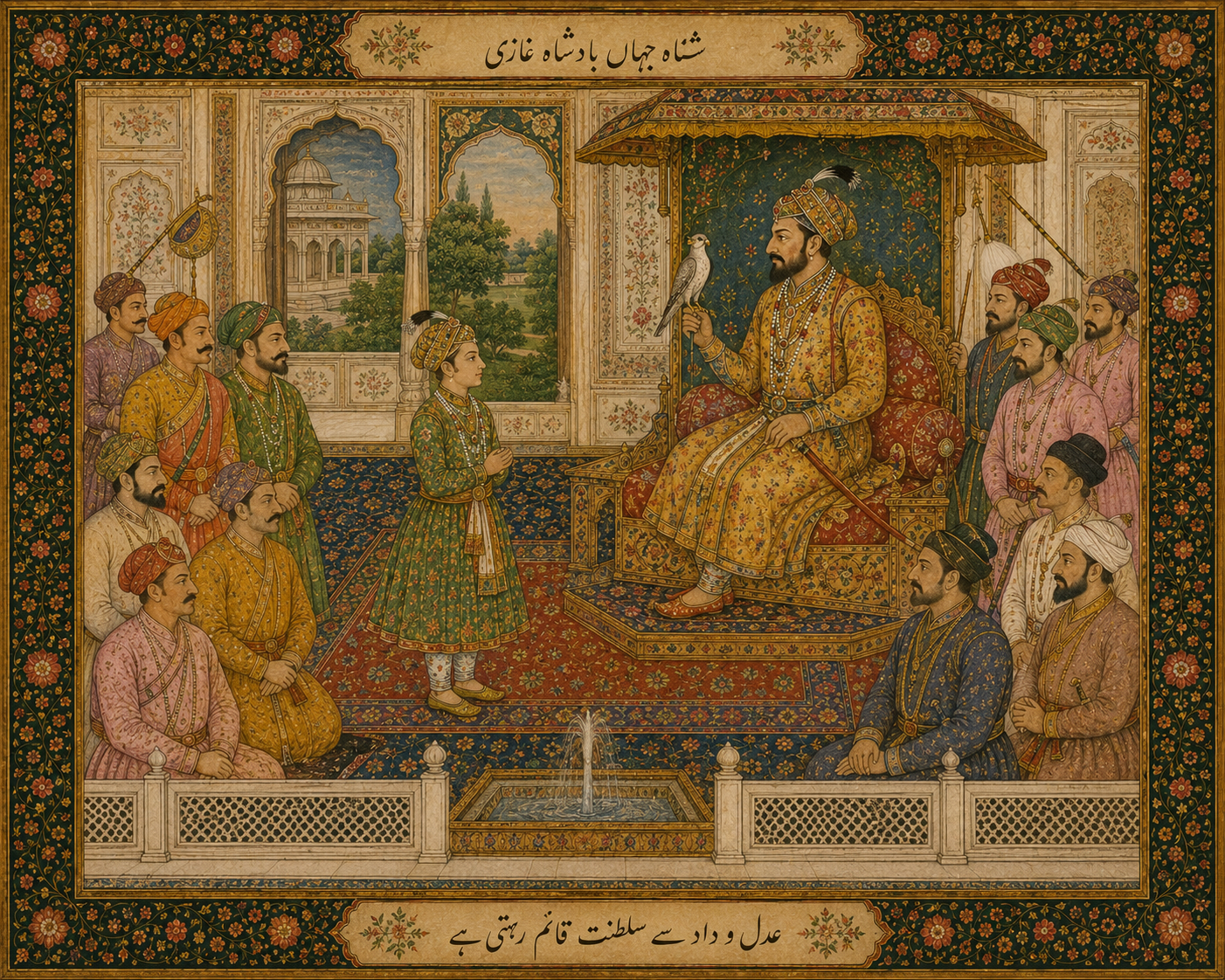
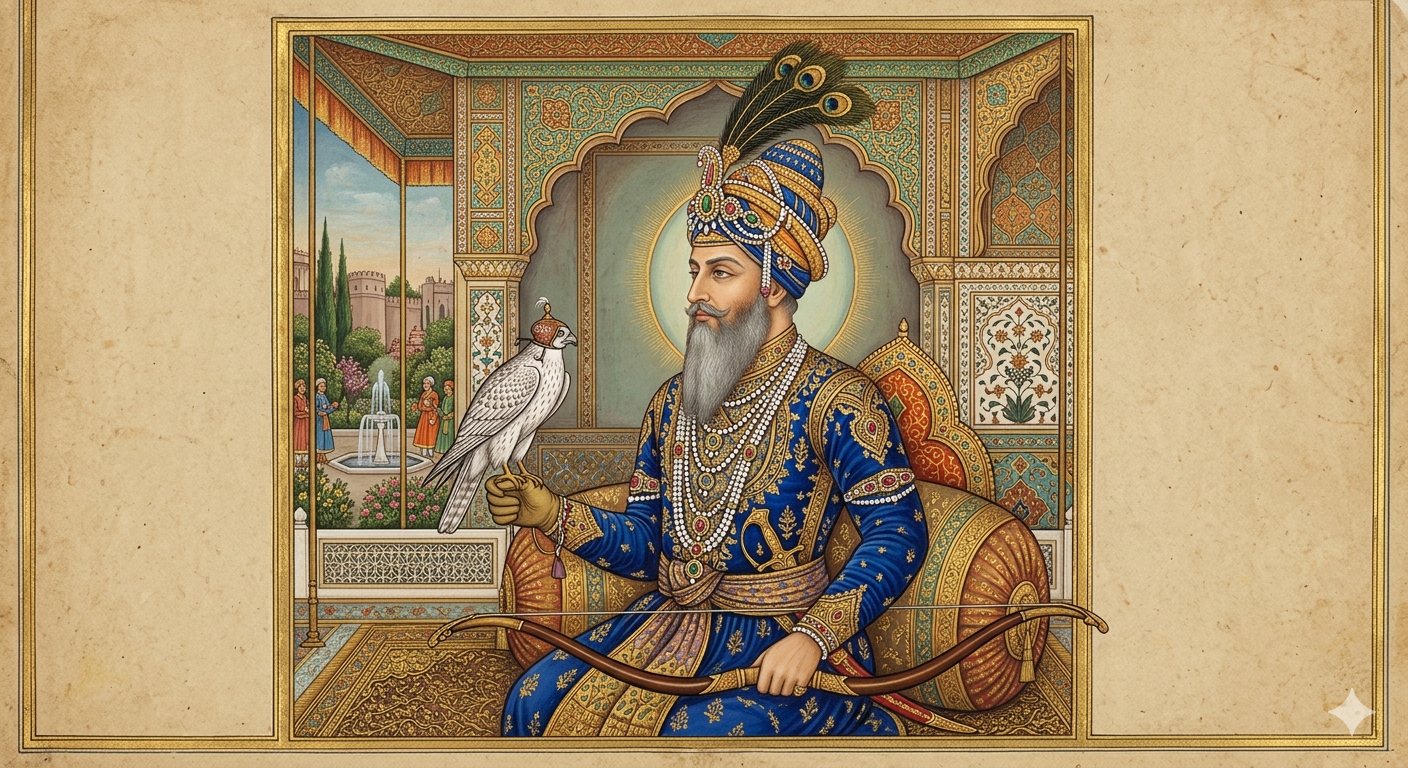
Fig. 2.20: Aurangzeb in court holding a hawk (17th-century painting)
💡 Think About It
Delhi Sultanate sultans’ average reign: about 9 years. Mughal emperors up to Aurangzeb: 27 years. All Mughal rulers: 16 years. What do these numbers tell us about political stability across the two empires?
🔎 Let’s Explore
In his last letters, Aurangzeb wrote: ‘I came alone and am going away alone… I have not done well for the country and the people.’ What do these words tell us about Aurangzeb? How do you feel about them?
💡 Think About It
Some invaders and rulers mentioned in this chapter committed terrible deeds. We must keep in mind that this is about people in the past, not people of today. The victims of these atrocities deserve our respect and remembrance. But it is important to remember that we, today, bear no responsibility for actions of individuals hundreds of years ago.
📍 Resistance to the Mughals
Over the centuries, many communities rebelled against harsh Mughal exploitation.
Jat peasantry (present-day western UP, Haryana and eastern Rajasthan) in the 17th century managed to kill an oppressive Mughal administration officer. In a subsequent battle, 20,000 men confronted the Mughal army but their leader was killed and the rebellion suppressed.
Many tribal groups — the Bhils, the Gonds, the Santhals, the Kochs — fought back against attempts to annex their territory or impose taxes. Those inhabiting forested, hilly or remote regions managed to maintain some degree of independence.
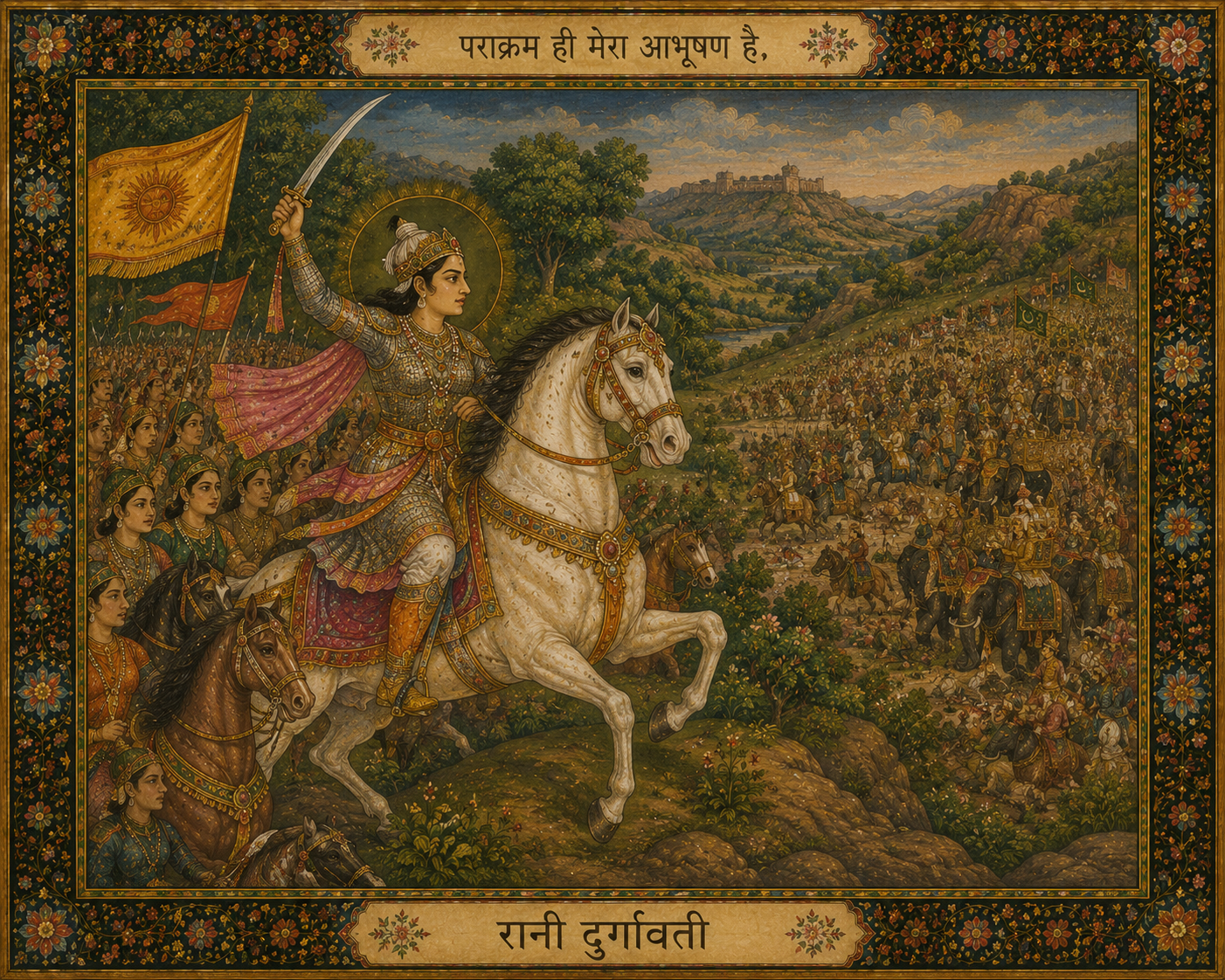
Rani Durgavati was the valiant queen of the Garha kingdom (a Gond kingdom in central India). She ruled wisely, made her kingdom prosperous, and kept an army of 20,000 soldiers and 1,000 elephants. When a general sent by Akbar attacked in 1564, despite being outnumbered and outmatched in weaponry, she led her troops bravely. Wounded, she took her own life on the battlefield to avoid capture — she was only 40. Her sacrifice became a symbol of regional pride and resistance.
Fig. 2.21: An artist’s impression of Rani Durgavati
📍 Surge of the Rajputs
The Rajputs were often battling the invading forces from beyond the Subcontinent, inheriting proud traditions from earlier dynasties like the Pratiharas who had resisted the Arab invasions of Sindh.
Two major Rajput clans emerged in the Mewar and Marwar regions. Inspirational stories of their heroic deeds are still told today, particularly through popular ballads.
Rana Kumbha (15th century) resisted the Delhi Sultanate and built Kumbhalgarh Fort.
Rana Sanga (early 16th century) unified several Rajput clans, won many battles against sultans, but ultimately met defeat against Babur at the Battle of Khanwa.
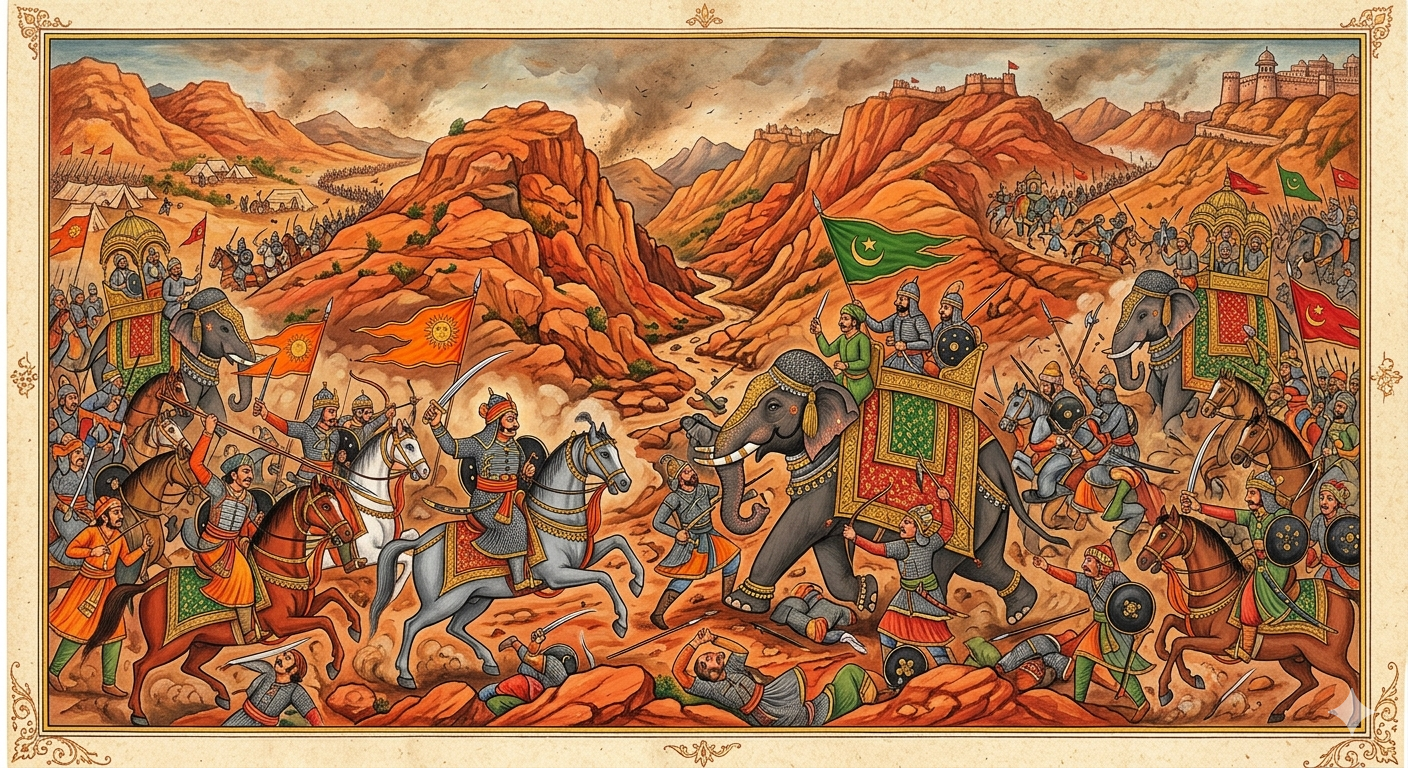
Maharana Pratap of Mewar refused to accept Mughal suzerainty and became the face of Rajput resistance. A confrontation took place at the Haldighati pass in the Aravallis in 1576. Although the Mughal army had the upper hand, Maharana Pratap escaped and pursued guerrilla warfare against the Mughals from the Aravalli hills for years, living in harsh conditions but firm on his independence.
Guerrilla warfare is a style of fighting where small groups with knowledge of the terrain carry out surprise attacks and ambushes to defeat bigger armies.
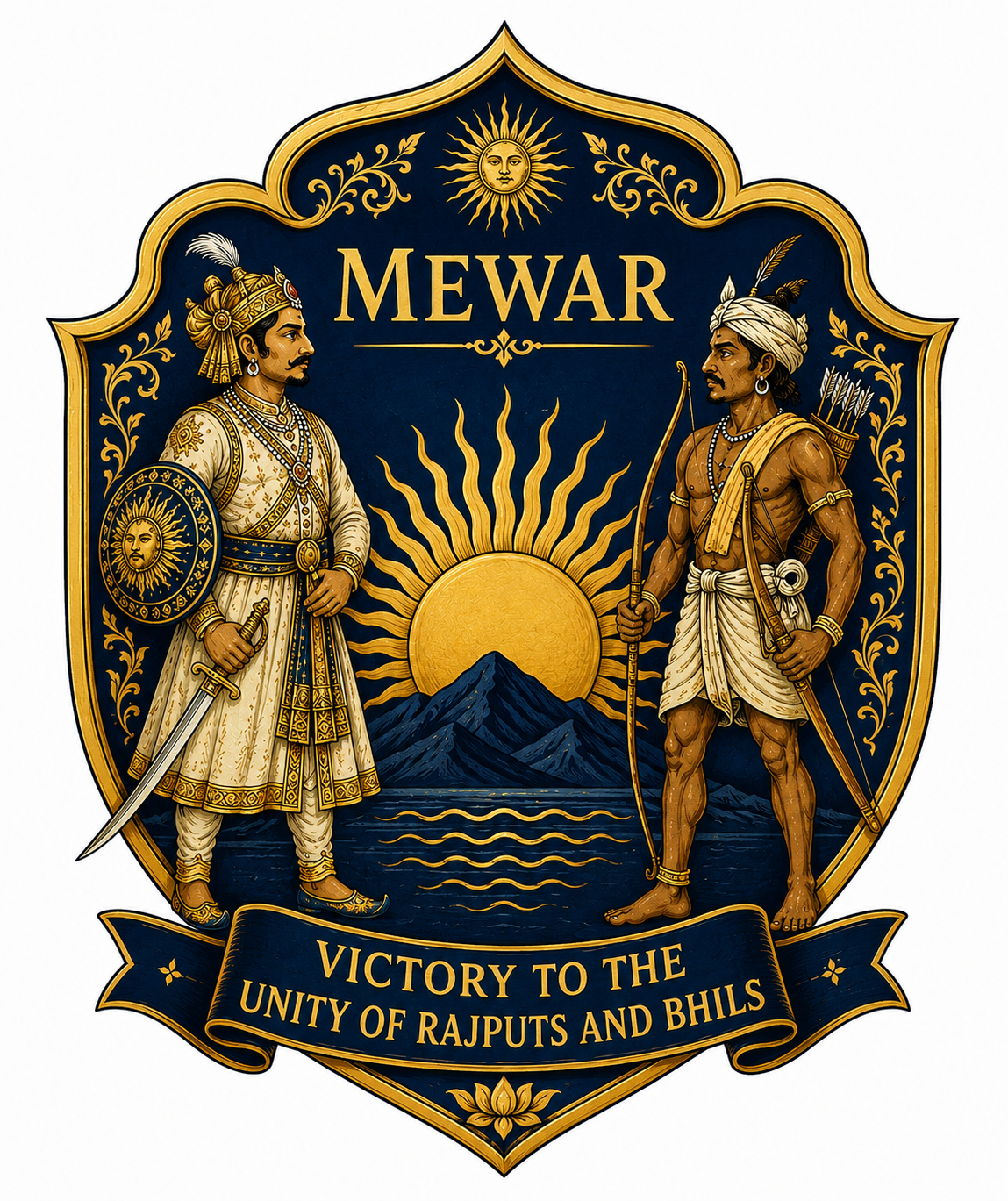
Maharana Pratap received strong support from the Bhils, who joined his troops as archers and contributed their knowledge of the terrain. Their service earned them a respected place in Mewar’s military tradition, as shown in the Mewar emblem.
While some Rajput states allied with the Mughals through diplomacy and marriage alliances, Mewar especially did not accept Mughal dominance. During Aurangzeb’s reign, Rajput nobles including Durga Das Rathore of Marwar rebelled. Mughal authority remained limited in Rajasthan.
Fig. 2.22: The Mewar emblem showing the Bhil warriorFig. 2.23: The Battle of Haldighati — Maharana Pratap vs the Mughal army, 1576
📍 The Ahoms
In the 13th century, the Ahom ethnic group migrated from present-day Myanmar to the Brahmaputra Valley and formed the Ahom kingdom.
During both the Sultanate and Mughal periods, the Ahom rulers offered stiff resistance to attempts at expansion into the Northeast.
Their unique paik system called on every able-bodied man to provide service to the state through labour or military duty in exchange for land rights. This allowed rulers to create public infrastructure and maintain a large standing force without a permanent army.
Over time, the Ahoms assimilated local culture, promoted agriculture, encouraged diverse faiths, and contributed to the rich traditions of Assam.
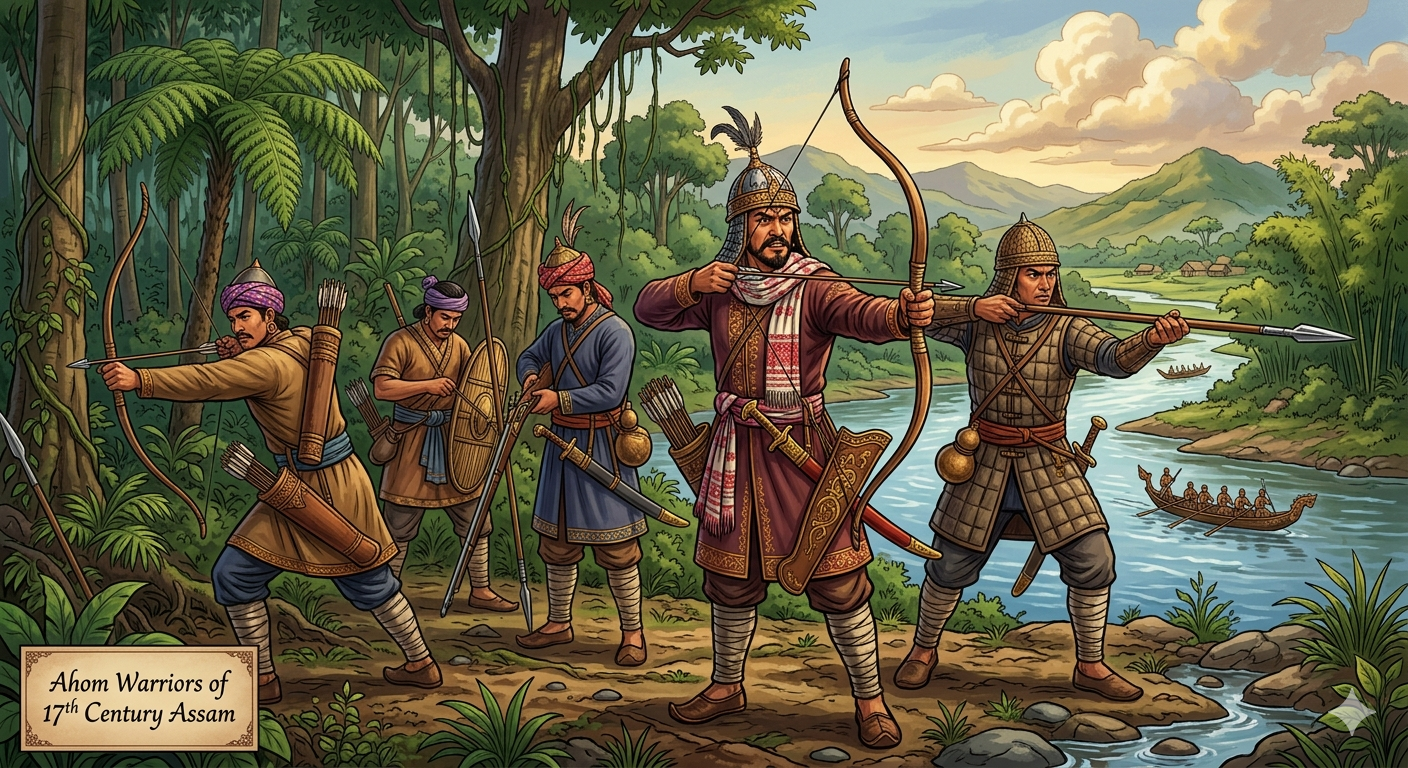
In the 17th century, when Aurangzeb sent Mughal forces that briefly captured the Ahom capital Garhgaon, the Ahoms used their knowledge of the terrain — dense forests, hills and rivers — and persistent guerrilla tactics to repulse the attack.
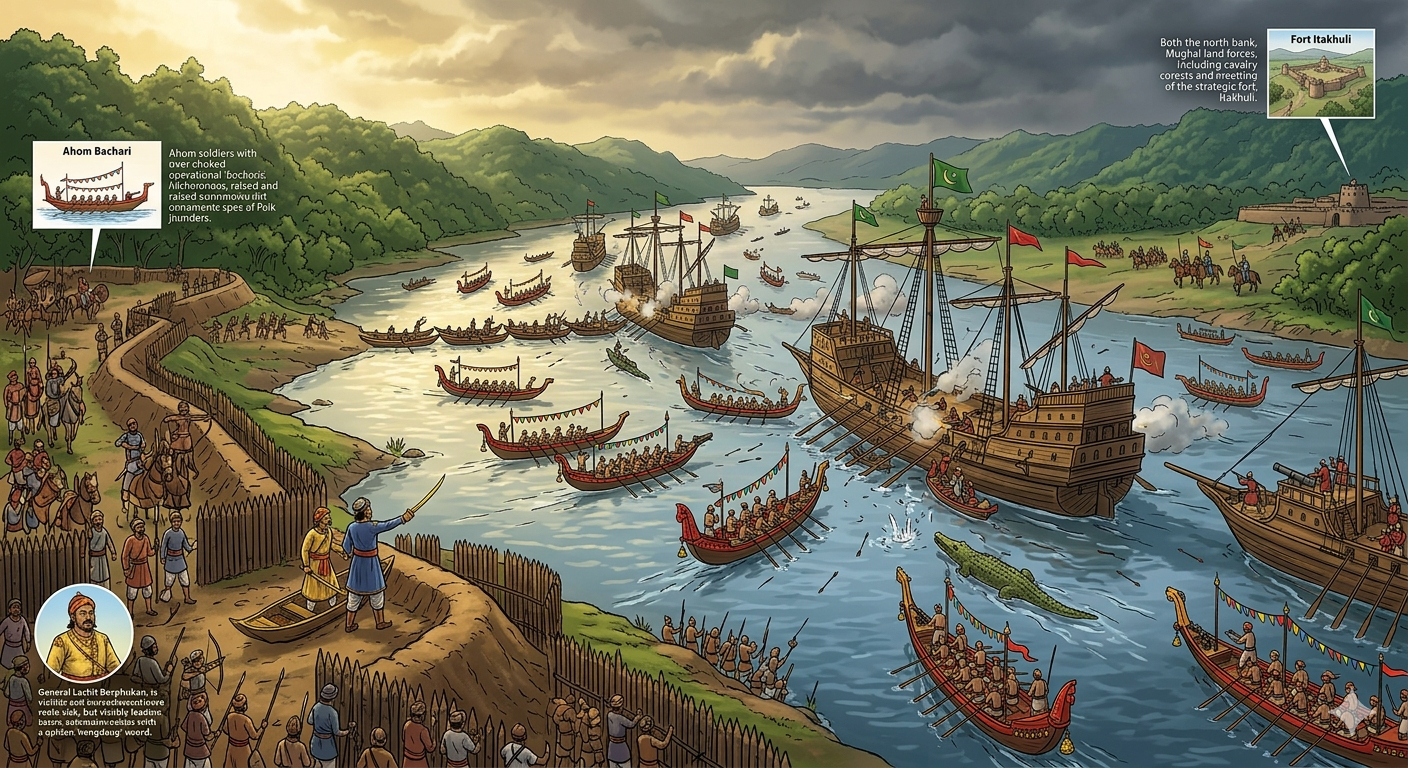
In the Battle of Saraighat (1671), fought on the Brahmaputra River near present-day Guwahati, Ahom military commander Lachit Borphukan and his 10,000 men defeated a Mughal force of 30,000 soldiers. The Ahoms preserved their independence.
The Mughal general Ram Singh praised the Ahom warriors: ‘Every Assamese soldier is expert in rowing boats, in shooting arrows, in digging trenches, and in wielding guns and cannons. I have not seen such specimens of versatility in any other part of India.’
Fig. 2.24: The Battle of Saraighat 1671 — Ahom boats defeating the Mughal fleetFig. 2.25: Ahom warriors skilled in river warfare and guerrilla tactics
🔎 Let’s Explore
Discuss in class how the paik system affected the daily lives of people in the Ahom kingdom — both challenges and benefits — and how it helped the king manage both army and economy.
🔎 Let’s Explore
How did the Ahoms use the rivers, hills and forests of Assam to their advantage? Can you think of ways in which the geography helped them build defences and fight wars?
📍 The Rise of the Sikhs
In 15th century Punjab, Guru Nanak spread the message of equality, compassion, and the oneness of God (Ik Onkār). His followers came to be known as Sikhs.
Although Sikhism began purely as a spiritual movement, later Sikh Gurus had to respond to growing intolerance and persecution under some Mughal rulers.
When Emperor Jahangir found out that Guru Arjan had supported his rebellious son, he had Guru Arjan tortured to death.
This prompted Guru Arjan’s son and successor, Guru Hargobind, to introduce martial training and form a Sikh army, which fought several battles against the Mughal forces.
The Sikhs’ sacred text, Guru Granth Sahib, was first compiled by Guru Arjan; Guru Tegh Bahadur’s hymns were added later. It stresses one God for all and enjoins Sikhs to practise truthfulness, compassion, humility and self-control.
In 1675, a group of Kashmiri Pandits approached Guru Tegh Bahadur seeking protection from religious persecution. The Guru decided to stand with them; arrested by Aurangzeb and ordered to convert to Islam, he refused despite torture. He was publicly beheaded in Chandni Chowk, Delhi.
The Gurudwara Sis Gunj Sahib in Chandni Chowk marks the site of this martyrdom. The Sikh Regiment has saluted it before the President in the Republic Day parade each year since 1979.
In response, Guru Tegh Bahadur’s son Guru Gobind Singh — the 10th and last Guru — established the Khalsa in 1699 — a martial brotherhood committed to justice, equality and defence of the faith.
As the Mughal Empire declined, several Sikh confederacies emerged in Punjab. They were unified by Maharaja Ranjit Singh at the turn of the 19th century. His military acumen, diplomatic skill and religious tolerance allowed him to establish a strong, centralised Sikh Empire that spanned much of the Northwest including parts of Kashmir. Till the mid-19th century, this empire resisted both Mughal remnants and later British expansion.
Fig. 2.26: The 10th Sikh Guru who established the Khalsa in 1699
💡 Think About It
Why do you think Guru Tegh Bahadur endured torture rather than convert? Why did he think his sacrifice would make a difference? What values did the Sikh Gurus and the Khalsa embody? How are they relevant today?
📍 Administering India
▶ Administration under the Delhi Sultanate
The Delhi Sultanate introduced a political system centred on the Sultan, who possessed absolute authority as the political and military head. His duties included defending territories, collecting taxes, and keeping in touch with public affairs.
The Sultan was assisted by a council of ministers in charge of various departments.
The iqta system assigned territories to nobles (iqtadars) to collect taxes which, minus expenses, went to the Sultan’s treasury — mainly to maintain the army. These posts were not hereditary.
While taxes were levied on trade at every stage, the burden fell most heavily on the peasantry. Some contemporary accounts report considerable cruelty in extracting revenue.
▶ The Mughal Administrative Framework
Aiming at greater control and efficiency, Akbar reorganised his administrative machinery.
The Diwan took care of finances; the Mir Bakhshi looked after military matters; the Khan-i-Saman was in charge of public works, trade, industry, agriculture and the royal household; the Sadr was responsible for justice, religious and educational matters.
Such ministers were assigned to each of the empire’s twelve provinces (subahs), which were further subdivided, with effective checks and balances.
At the village level, traditional structures of self-governance continued more or less undisturbed.
Akbar instituted the mansabdari system. Mansabdars (officers) according to their mansab (rank) were expected to maintain a precise number of elephants, horses, camels and troops for the state — making it possible to assemble an army at short notice without a permanent centralised army.
Mansabdars were paid by being assigned land (jagirs) and were also known as jagirdars.
Todar Mal, Akbar’s finance minister, introduced an efficient revenue system — making detailed surveys for crop yields and prices, and initiating a systematic survey of all land in the empire.
Despite Akbar’s growing tolerance, non-Muslims were kept in a minority in the higher echelons of administration. Even among Muslim officials, those of foreign origin were generally favoured over those of Indian origin.
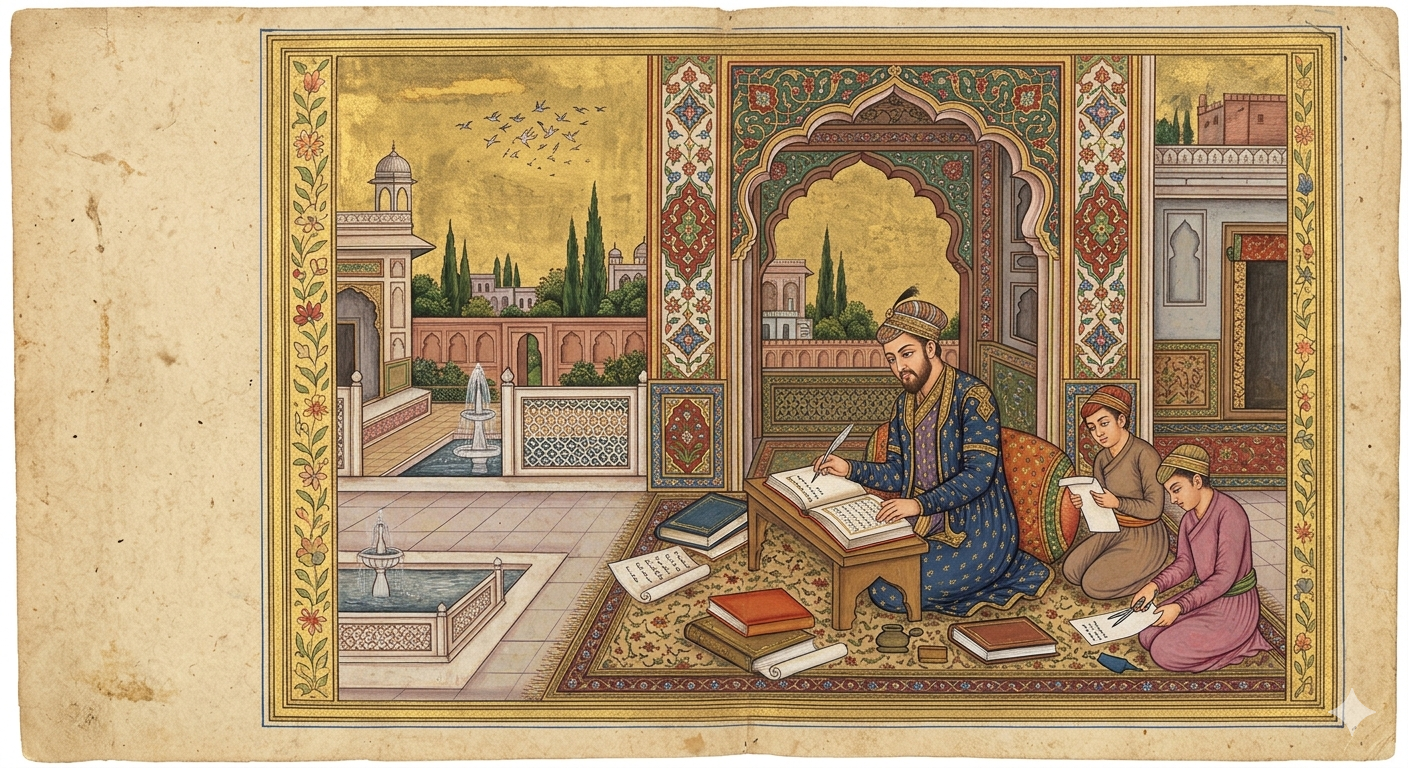
Fig. 2.28: A scholar completing the Ain-i-Akbari chronicles
📍 People’s Lives
Despite shifting political powers between the 13th and 17th centuries, India witnessed vibrant economic activity — thanks to its agrarian foundations, thriving artisanal industries, community-based and temple-based economies, and extensive trade networks.
Building on decentralised economic and social systems — such as śhreṇis (guilds), jātis (professionally defined communities), and systems for credit — the Subcontinent remained one of the wealthiest regions in the world.
The Sultanate period saw some progress in infrastructure: roads, bridges, canals, irrigation works, and new cities — all of which expanded considerably during the Mughal period.
New currency systems were introduced: the Mughals used a rupaya of silver and a dam of copper.
Agriculture was the mainstay of the Indian economy. Rulers relied on agrarian revenue — typically extracting land revenue at one-fifth of the produce, though some sultans raised it as high as one-half.
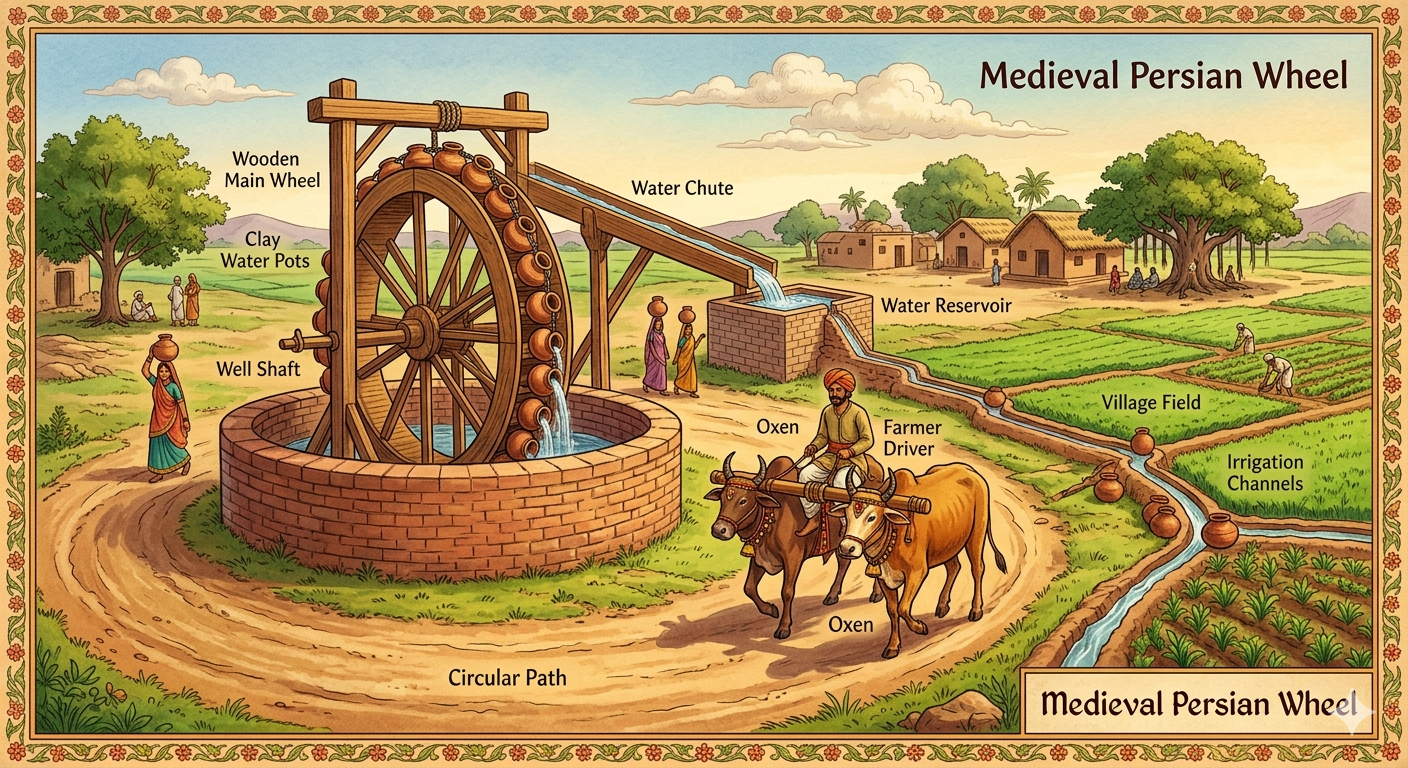
The expansion of irrigation systems increased agricultural productivity, allowing for multiple crops including food items (rice, wheat, barley, pulses, sugarcane, spices) and non-food items (cotton, silk, wool, dyes, timber, jute).
The peasantry suffered several severe famines in this period; relief depended upon the particular ruler’s benevolence.
Craftspeople made a wide range of products — from weapons to utensils to ornaments and jewellery. Ship-building developed considerably for river and overseas trade.
Indian goods were exported through coastal towns such as Calicut, Mangalore, Surat, Masulipatnam and Hooghly. India imported silk, horses, metals and luxury goods.
The hundi system enabled merchants to transfer funds across political boundaries without physically transporting currency — a precursor to modern banking. Trader communities like the Marwaris developed parallel systems of credit and trust.
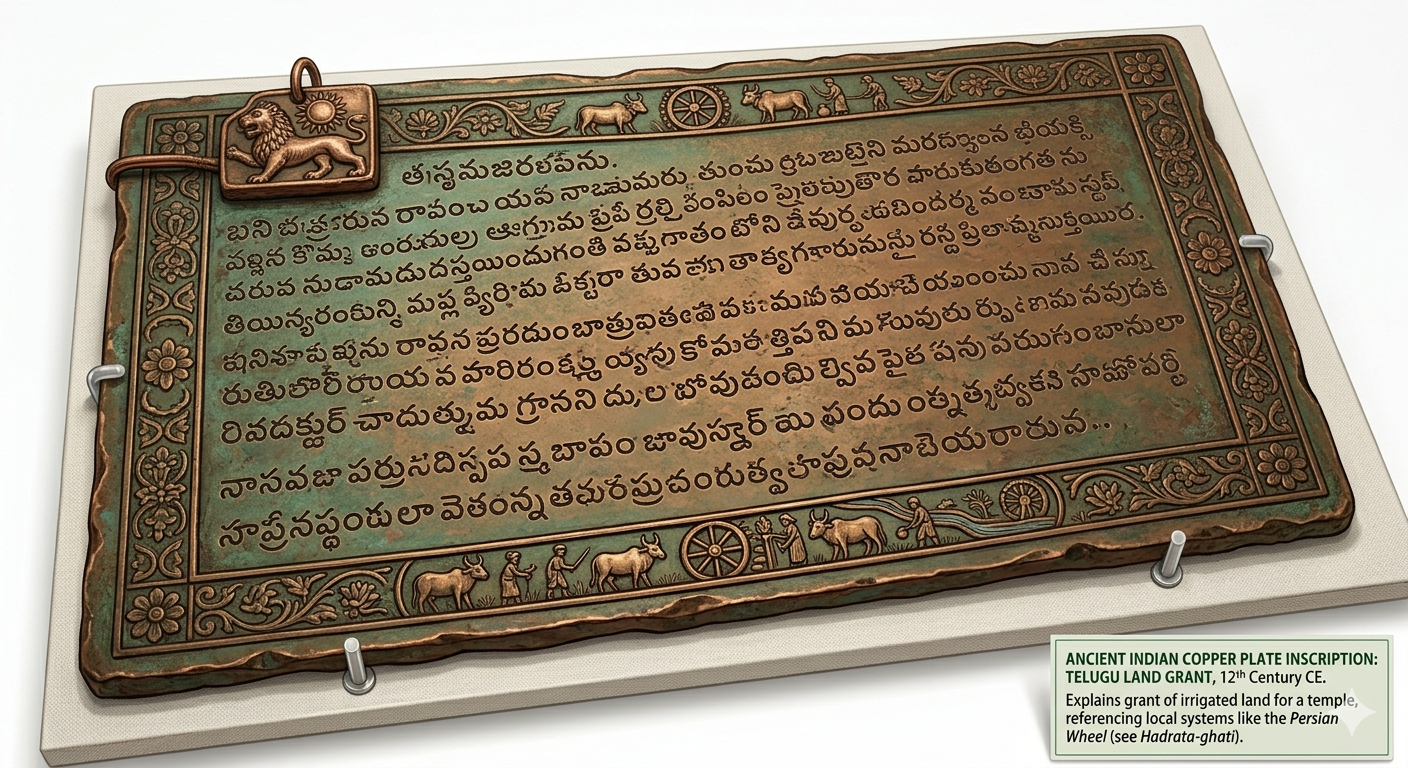
Fig. 2.29: A Persian wheel used to draw water from wells to irrigate fieldsFig. 2.30: A land grant inscribed on a copper plate
▶ Temples as Centres of Economic Activity
Many temples were more than centres for worship — they also created ecosystems with bustling markets.
Ruling classes donated land and wealth (dāna) to temple deities, held in trust by temple managers who developed community infrastructure (irrigation systems, tanks) and pilgrim accommodations (dharmaśhālās and chhatrams).
Temples provided merchants with credit and funded internal as well as maritime trade.
While early periods saw prosperity, the late 1600s witnessed economic stress. Peasants were often left with a small share of their produce after taxes, causing many to lose their land and become bonded labourers.
India was still a land of abundance as testified by Arab and European travellers, but wealth was largely concentrated in the hands of rulers, courtiers, high officials and the merchant class.
Frequent warfare caused forced displacement of population.
At the level of common people, by and large, people of different faiths and communities lived peacefully side by side, economically dependent on each other.
Even as rulers patronised the arts, communities strove to maintain or revive their traditions, creating a shared cultural heritage that blended indigenous and foreign elements.
⚠ Don’t Miss Out
A hundi was a written instruction to make payment to an individual. It could be carried across political borders and enabled financial transactions without the need to carry currency — a precursor to modern banking. These systems worked across trade networks without the participation of the ruling classes.
📝 Before We Move On — Key Takeaways
This period witnessed many foreign invasions led by Turkic, Afghan and Mughal forces, causing widespread destruction, fall of old dynasties, and rise and fall of kingdoms. Continuous warfare reshaped India’s political boundaries.
The period had many instances of religious intolerance — Buddhists, Jains, Hindus, Sikhs, Zoroastrians and tribals suffered severe persecution at times, though some rulers were more broad-minded.
Agriculture and trade expanded, enhancing India’s wealth and connectivity. Yet the economic condition of common subjects generally remained harsh.
Indian society showed adaptability and resilience in rebuilding towns, cities and temples, preserving cultural traditions, and blending indigenous and foreign elements. Many forms of art and culture — architecture, music, painting — flourished.
📝 Chapter 2 Practice Quiz — 30 Questions
Rise & Fall of Delhi Sultanate
LOTS
What were the five dynasties of the Delhi Sultanate?
Show Answer
The five dynasties were: (1) Mamluks (Slave dynasty), (2) Khiljis (Khaljis), (3) Tughlaqs, (4) Sayyids, and (5) Lodis (Lodhis). All were of Turkic-Afghan origin.
Medium
What mistakes did Muhammad bin Tughlaq make as sultan?
Show Answer
He made two major mistakes: (1) He shifted the capital from Delhi to Daulatabad over 1,000 km away, causing great loss of life. (2) He introduced token copper currency which caused economic confusion, encouraged counterfeiting, and led to economic decline.
HOTS
Why was the average reign of a Delhi Sultan only about nine years?
Show Answer
Almost two out of three sultans seized power by eliminating their predecessor through violence rather than peaceful succession. This political instability meant rulers were constantly under threat, leading to short and turbulent reigns.
HOTS
What was the jizya tax and why was it controversial?
Show Answer
The jizya was a tax on non-Muslim subjects granting them protection and exemption from military service. It was controversial because it was discriminatory — creating economic burden, public humiliation, and a financial incentive for subjects to convert to Islam. Akbar later abolished it.
Resistance to Delhi Sultanate
LOTS
How did Narasimhadeva I resist the Delhi Sultanate?
Show Answer
Narasimhadeva I of the Eastern Ganga kingdom repelled multiple inroads of the Delhi Sultanate, defeated the Sultanate’s governor of Bengal, and partly to commemorate these victories built the famous Surya temple at Konark.
Medium
Why did the Hoysala kingdom decline?
Show Answer
The Hoysala kingdom declined due to repeated attacks from the Delhi Sultanate combined with internal conflicts. Weakened by these attacks, it was eventually absorbed into the Vijayanagara Empire in the mid-14th century.
HOTS
How did the Musunuri Nayakas manage to expel the Delhi Sultanate from Warangal?
Show Answer
The Musunuri Nayakas, Telugu chieftains, rallied over 75 chieftains of the region and formed a confederacy — united resistance that was stronger than individual kingdoms acting alone. This collective effort allowed them to defeat and expel Muhammad bin Tughlaq’s army from Warangal around 1330-1336.
HOTS
Why was Kumbhalgarh Fort built in such a remote hilltop location?
Show Answer
Hilltop locations provided natural strategic advantages — the steep slopes and dense forests made it difficult for enemy armies to approach and attack. Rana Kumbha could monitor movement from a great height. The 36-km long wall further strengthened its defences. Though remote, such forts served as powerful strongholds for Mewar rulers.
Vijayanagara Empire
LOTS
How was the Vijayanagara Empire founded?
Show Answer
Two brothers, Harihara and Bukka, who had served as governors under Muhammad bin Tughlaq, rejected Delhi’s authority and established the Vijayanagara Empire in the 14th century. Their guru Vidyaranya advised them to establish their capital at Hampi, inspired by a hare chasing hounds — symbolising unexpected strength.
Medium
What were the Deccan Sultanates?
Show Answer
The Bahmani Sultanate eventually fragmented into five independent states called the Deccan Sultanates: Bijapur, Golconda, Berar, Ahmednagar, and Bidar — each ruled by former governors (tarafdars) who declared autonomy.
HOTS
Why did Vijayanagara treat Portuguese traders so well?
Show Answer
Vijayanagara rulers treated Portuguese traders very well because the Portuguese came to sell horses — a precious military commodity. The king did not want the Portuguese selling those horses to enemy kingdoms like the Deccan Sultanates. Keeping them friendly ensured Vijayanagara’s military advantage.
HOTS
What was the impact of the Battle of Talikota on South India?
Show Answer
The Battle of Talikota (1565) was catastrophic — the city of Vijayanagara was sacked over several months, temples, palaces and buildings destroyed, the civilian population massacred. The empire fragmented into smaller regions ruled by Nayakas. This ended a great era of South Indian cultural and political power.
Krishnadevaraya
LOTS
What were the achievements of Krishnadevaraya?
Show Answer
Krishnadevaraya expanded the Vijayanagara Empire’s dominance over the Deccan, patronised poets and scholars in Sanskrit, Telugu and Kannada, composed the epic poem Amuktamalyada, provided grants to temples including Tirupati and the Vitthala temple, and promoted both military power and cultural renaissance.
Medium
What are musical pillars and where are they found?
Show Answer
Musical pillars are monolithic stone pillars in the Vitthala temple at Hampi. When struck, their smaller columns give out different musical notes. They are masterpieces of Vijayanagara architecture and a remarkable example of medieval Indian craftsmanship.
HOTS
What does Krishnadevaraya’s Amuktamalyada reveal about him as a ruler?
Show Answer
The Amuktamalyada shows Krishnadevaraya was not just a warrior king but also an intellectual and poet. His section on Rajaniti (royal policy) reveals he thought deeply about good governance. Composing an epic poem in Telugu about a Tamil saint shows his respect for diverse cultural traditions — characteristic of a truly renaissance ruler.
The Mughals
LOTS
What was the First Battle of Panipat and its significance?
Show Answer
The First Battle of Panipat (1526) was fought between Babur and Ibrahim Lodi. Babur won using gunpowder, field artillery and matchlock guns. This victory ended the Delhi Sultanate and laid the foundation of the Mughal Empire.
Medium
What was the Baburnama?
Show Answer
The Baburnama was the autobiography written by Babur — one of the most candid and valuable historical documents of the medieval period. It reveals him as cultured, intellectually curious, with deep appreciation for architecture, poetry and nature, but also as a brutal conqueror who slaughtered populations.
HOTS
Babur found India to be a ‘country of few charms’ yet chose to stay. What does this tell us about his true motivations?
Show Answer
Despite missing Central Asia, Babur recognised India’s immense wealth — masses of gold and silver, countless skilled artisans, abundance of resources. His decision to stay rather than return shows that his primary motivation was conquest and accumulation of wealth and territory rather than any love for the land itself.
Akbar
LOTS
What was sulh-i-kul and how did Akbar practise it?
Show Answer
Sulh-i-kul means ‘peace with all’ or tolerance of all faiths. Akbar practised it by abolishing the jizya, entering marriage alliances with Rajput princesses, appointing Hindu officials to high positions, inviting scholars of all faiths to his court, and establishing a house of translation at Fatehpur Sikri to translate Sanskrit texts into Persian.
Medium
What was the significance of the house of translation at Fatehpur Sikri?
Show Answer
Akbar established it to translate major Sanskrit texts into Persian — including the Mahabharata (Razmnama), Ramayana, Bhagavad Gita, and Panchatantra. Despite being illiterate, Akbar was deeply curious about Indian wisdom and philosophy. This helped preserve and share Indian literary heritage across cultures.
HOTS
Why is Akbar considered a paradox — both ruthless and tolerant?
Show Answer
Akbar ordered the massacre of 30,000 civilians at Chittor in his youth and sent a message of destroying temples and establishing Islam. Yet in later years he abolished the jizya, promoted sulh-i-kul, appointed Hindu officials and said ‘it was unmeet to force others to become Muslim’. This transformation from religious intolerance to broad tolerance makes Akbar one of history’s most complex and paradoxical rulers.
HOTS
What was the mansabdari system and why was it effective?
Show Answer
The mansabdari system assigned ranks (mansab) to officers (mansabdars) who maintained specified numbers of elephants, horses, camels and troops for the state. This allowed an army to be assembled quickly without maintaining a permanent centralised force, reducing peacetime costs while ensuring military readiness. Payment through jagirs (land grants) further motivated compliance.
Aurangzeb
LOTS
What were Aurangzeb’s major policies that differed from Akbar?
Show Answer
Aurangzeb reimposed the jizya on non-Muslims, banned music and dance in his court, imposed a pilgrimage tax on Hindus, ordered destruction of temples and schools, and persecuted Sufis and Zoroastrians — reversing Akbar’s policy of sulh-i-kul and religious tolerance.
Medium
How did Aurangzeb’s Deccan campaigns contribute to the decline of the Mughal Empire?
Show Answer
Aurangzeb spent the last 25 years of his life fighting constant wars in the Deccan. Maintaining large armies depleted the empire’s treasury and put great strain on the administration. After his death in 1707, the empire rapidly declined — the endless wars had financially and administratively exhausted the Mughal state.
HOTS
What do Aurangzeb’s last letters to his sons reveal about his reign?
Show Answer
His words — ‘I came alone and am going away alone… I have not done well for the country and the people’ — reveal deep personal regret. Despite ruling for 49 years and achieving the greatest Mughal territorial expansion, he recognised that his policies of religious intolerance, constant warfare, and heavy taxation had damaged the country and its people.
Resistance to Mughals & Rajputs
LOTS
Who was Rani Durgavati and why is she remembered?
Show Answer
Rani Durgavati was the valiant queen of the Garha Gond kingdom in central India. She ruled wisely, kept an army of 20,000 soldiers and 1,000 elephants, and repelled several invasions. When Akbar’s general attacked in 1564, she fought bravely despite being outnumbered. Wounded, she took her own life to avoid capture. She was only 40 — her sacrifice symbolises regional pride and resistance.
Medium
What was the role of the Bhils in Maharana Pratap’s resistance?
Show Answer
The Bhils joined Maharana Pratap’s troops as archers and contributed their invaluable knowledge of the Aravalli terrain. This support was crucial for guerrilla warfare against the Mughals. Their service earned them a respected place in Mewar’s military tradition — the Mewar emblem itself shows a Bhil warrior.
HOTS
How did Maharana Pratap continue his resistance after the Battle of Haldighati despite losing?
Show Answer
Although the Mughal army had the upper hand at Haldighati (1576), Maharana Pratap escaped and continued guerrilla warfare from the Aravalli hills for years. He lived in harsh conditions in the forests and mountains, conducting surprise attacks using his knowledge of the terrain. His refusal to accept Mughal suzerainty became a powerful symbol of Rajput honour and resistance that inspired generations.
The Ahoms & Rise of Sikhs
LOTS
What was the paik system of the Ahoms?
Show Answer
The paik system called on every able-bodied Ahom man to provide service to the state through labour or military duty in exchange for land rights. This allowed rulers to create public infrastructure and maintain a large standing force without a permanent expensive army.
Medium
How did the Ahoms defeat the Mughals at the Battle of Saraighat?
Show Answer
Ahom commander Lachit Borphukan used knowledge of the Brahmaputra River, dense forests, hills and persistent guerrilla tactics. Though outnumbered (10,000 Ahom vs 30,000 Mughal soldiers), the Ahoms outmaneuvered the Mughal river fleet. Their home terrain advantage was decisive.
HOTS
Why did Guru Gobind Singh establish the Khalsa?
Show Answer
After his father Guru Tegh Bahadur was publicly beheaded by Aurangzeb for refusing to convert to Islam, Guru Gobind Singh established the Khalsa in 1699 — a martial brotherhood committed to justice, equality and defence of the faith. It was a direct response to Mughal religious persecution, transforming Sikhism from purely a spiritual movement into a community capable of armed resistance to protect its values.
HOTS
How did Maharaja Ranjit Singh unify the Sikh confederacies?
Show Answer
As the Mughal Empire declined, several Sikh confederacies emerged in Punjab. Ranjit Singh used military acumen, diplomatic skill and religious tolerance to unite them at the turn of the 19th century, establishing a strong centralised Sikh Empire spanning much of the Northwest including parts of Kashmir — resisting both Mughal remnants and British expansion until the mid-19th century.
Administering India
LOTS
What was the iqta system of the Delhi Sultanate?
Show Answer
The iqta system assigned territories to nobles (iqtadars) to collect taxes. The taxes, minus expenses, were supposed to go to the Sultan’s treasury. It created a network of local administrators loyal to the Sultan. Importantly, the posts were NOT hereditary — distinguishing it from feudal systems.
Medium
Who was Todar Mal and what was his contribution?
Show Answer
Todar Mal was Akbar’s finance minister. He introduced an efficient revenue system by making detailed surveys of crop yields and prices, determining prices for each crop, and initiating a systematic survey of all land in the empire. This boosted revenue collection and strengthened the state administration.
HOTS
Compare the administrative systems of the Delhi Sultanate and the Mughal Empire.
Show Answer
Delhi Sultanate: Sultan had absolute power, assisted by a council; iqta system for revenue (non-hereditary); tax burden fell heavily on peasantry; some cruelty in revenue extraction. Mughal Empire: More organised — Diwan (finance), Mir Bakhshi (military), Khan-i-Saman (public works), Sadr (justice); mansabdari system for army; twelve subahs (provinces); jagirdari for payment; Todar Mal’s systematic land survey. The Mughals were more structured and systematic.
People’s Lives
LOTS
What was the hundi system and why was it important?
Show Answer
A hundi was a written instruction to make payment to an individual. It enabled merchants to transfer funds across political boundaries without physically carrying currency, reducing the risk of plunder. It functioned like a banking instrument — a precursor to modern banking — and worked independently of ruling class structures.
Medium
What role did temples play in the medieval Indian economy?
Show Answer
Temples were not just religious centres — they were economic hubs. Ruling classes donated land and wealth (dana) to them; temple managers developed irrigation systems, tanks and pilgrim accommodations. Temples provided merchants with credit and funded internal and maritime trade, creating bustling market ecosystems around them.
HOTS
Despite constant political instability, why did the Indian economy remain vibrant during the 13th-17th centuries?
Show Answer
India’s economy was built on decentralised foundations — shreṇis (guilds), jatis (communities), and credit systems like hundis — that functioned independently of political structures. Agriculture, diverse crafts, ship-building and extensive trade networks created resilience. Even when rulers changed, these community-based systems continued functioning, keeping India one of the wealthiest regions in the world.
HOTS
How did the common people experience the medieval period differently from rulers and nobles?
Show Answer
Rulers and nobles lived in luxury from plunder, taxes and trade. Common people — peasants, craftspeople, labourers — faced heavy taxes (sometimes up to half their produce), severe famines, forced displacement due to wars, and economic hardship. Yet at the community level, people of different faiths largely lived peacefully side by side, economically dependent on each other, maintaining cultural traditions through this period of political turmoil.