

A degree in one hand. A rejection email in the other. This is the daily reality for millions of young Indians — and something unexpected is growing in the silence.
Picture this. A 24-year-old from Bareilly spends five years earning an MCA degree. He moves to Delhi full of ambition, sends out hundreds of applications, attends interviews, waits. And waits. Then quietly packs his bags and returns home — not with a job offer, but with something heavier: the crushing weight of a system that promised everything and delivered nothing.
His name is Shashank Singh. His story is not an exception. It is a pattern.
India is sitting on a paradox so large it should dominate every newspaper front page, yet it rarely does. The country is the world’s fastest-growing major economy. Its GDP story is celebrated globally. And yet, walking through the streets of any Indian city or town, you will find something that does not fit that headline — millions of educated, ambitious, capable young people with nowhere to go.
This is the story of India’s jobless generation. And hidden inside that crisis is something nobody expected: a quiet, stubborn, unstoppable revolution.
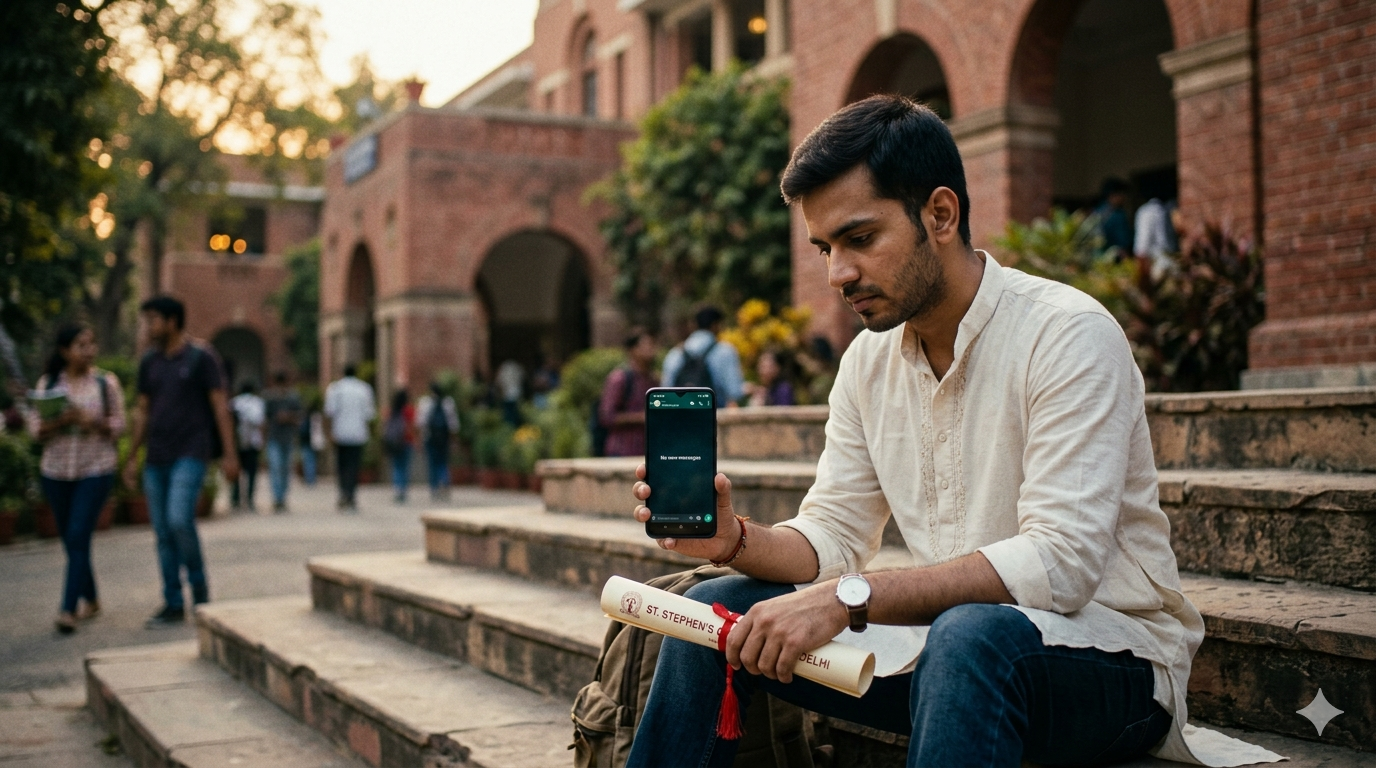
📊 The Numbers India Doesn’t Want to Face
India’s youth unemployment rate stood at 16.03% in 2024, according to World Bank estimates. That sounds manageable until you dig deeper.
Despite an official overall unemployment rate of just 4–6%, a staggering 66% of India’s unemployed are graduates or postgraduates. In other words, the more educated you are in India, the more likely you are to be jobless.
Let that sit for a moment.
According to the Periodic Labour Force Survey 2023, the unemployment rate among urban youth aged 15–29 was 17.5%, with the highest concentration of joblessness falling on graduates themselves. Even more alarming: only 42.6% of Indian graduates are considered employable right after college.
The numbers tell an almost surreal story: in 2024, over 46,000 graduates and postgraduates applied for sanitation worker positions in Haryana. In Rajasthan, 12,000 qualified professionals competed for just 18 peon posts. Even 2 out of every 5 IIT graduates in 2024 left campus without a placement offer.
India’s most celebrated institutions. Its most driven students. Still stuck.
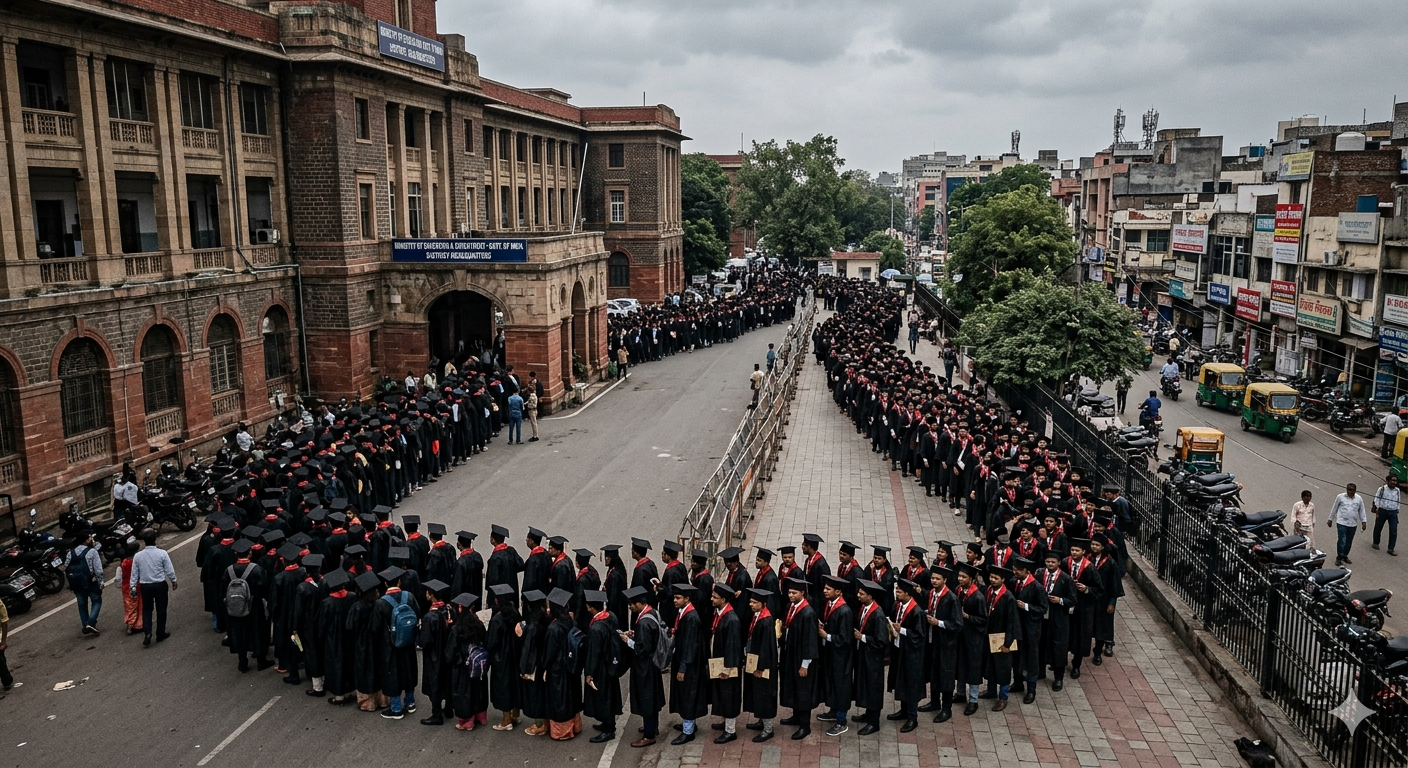
💼 Jobless Growth: The Economy’s Dirty Secret
India’s GDP growth is real. The infrastructure boom is real. The startup unicorns are real. So why are young people not finding work?
Economists have a phrase for it: jobless growth. And it explains everything.
India’s GDP is fuelled largely by low labour-intensive sectors like finance and technology. Net job creation continues to be concentrated in construction, informal services, logistics, and petty trade — sectors that provide livelihoods but do not require or reward general degrees.
The economy is growing, but it is growing in ways that do not need the people being produced by India’s universities. Manufacturing has grown in output but not in employment intensity. High-productivity services — IT, finance, professional services — remain geographically and numerically narrow.
Meanwhile, India’s leading IT firms cut 64,000 jobs in FY24, while average graduate salaries remain stagnant at ₹3–4 lakh per annum, barely moved in nearly a decade.
The math is brutal. Nearly two-thirds of India’s 1.43 billion people are under 35 years of age, and 12 million additional young people reach employment age every single year. The economy cannot absorb them. And the education system is not preparing them for what does exist.
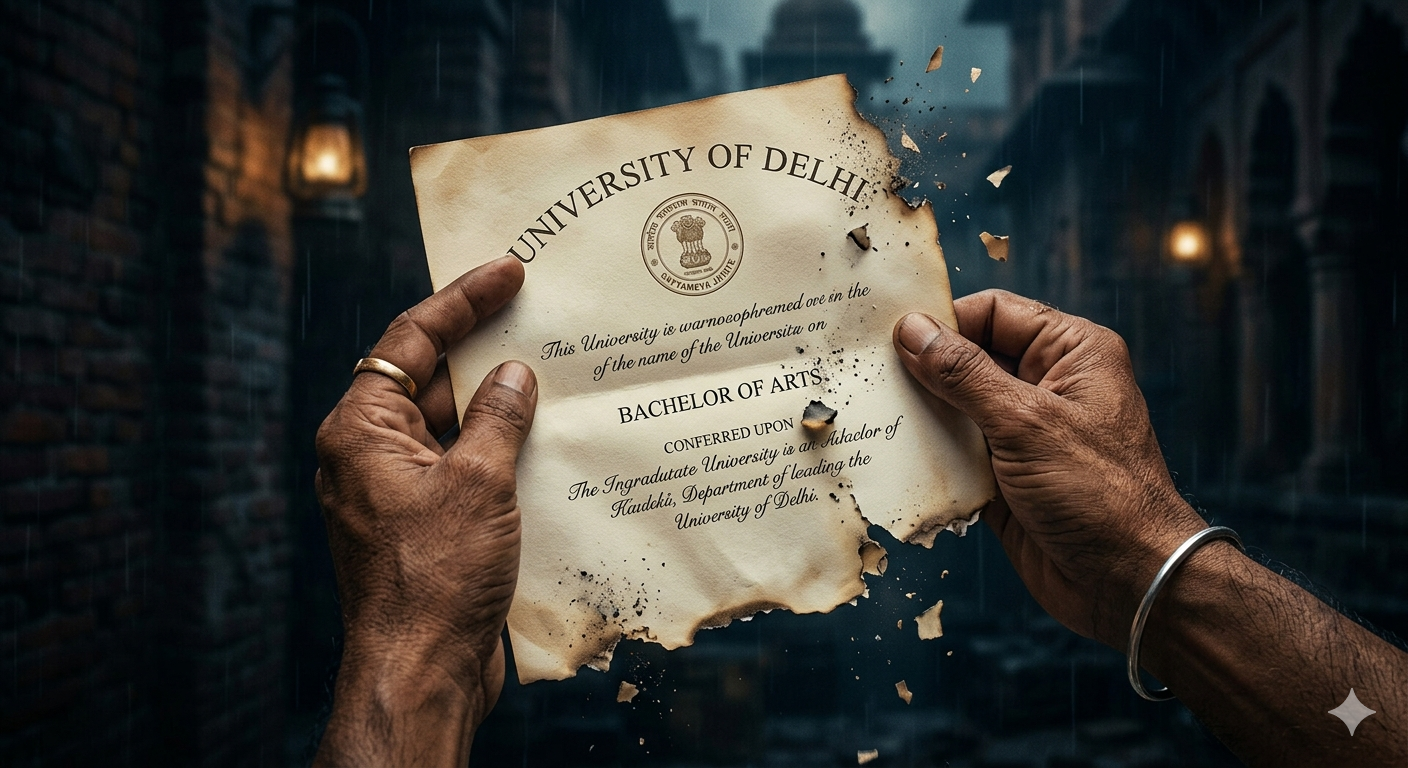
🎓 The Degree Trap: When Education Becomes a Liability
Here is the uncomfortable truth Indian parents do not want to hear: in today’s India, a degree is increasingly a financial risk, not a guarantee.
In metro cities, parents spend over ₹2 lakh annually to educate their children from Class 1 through Class 12. Private institutions operate in an unregulated commercial space, pushing costs up without guaranteeing employment outcomes.
The result? Young people who have invested years and family savings into an education that does not connect to economic reality.
A full 33% of graduates cite skills not aligned with industry needs as the core reason for their unemployment. Engineering colleges are producing coders with no practical project exposure. Universities are measuring success by placement statistics, not by whether students actually build anything meaningful.
The ILO has pointed out that India’s economy has not been able to create enough remunerative jobs in non-farm sectors for new educated youth entering the labour force — and this is reflected in high and increasing unemployment rates specifically among the educated.
The cruellest irony: staying in school longer actually increases your chances of being unemployed in India. Education has been decoupled from opportunity.

🔥 The Hidden Revolution: What Gen Z Is Actually Doing About It
Now here is where the story turns. Because India’s Gen Z is not simply sitting idle, scrolling through job portals, waiting to be rescued.
They are building something.
India is observing a silent but profound career revolution. The linear pathway of completing education, securing a stable job, and climbing the corporate ladder is now being actively dismantled by Generation Z. Across Indian campuses, young people are increasingly choosing freelancing, side hustles, portfolio careers, and entrepreneurial experiments over traditional 9-to-5 employment.
This is not a trend. It is a structural shift in how a generation understands work and survival.
Gen Z makes up over 25% of India’s population. They are not just consumers — they are creators, influencers, and disruptors. Their choices are influencing everything from product design to marketing strategies, and now, the very way businesses are built and scaled.
A 2024 Adobe survey found that 62% of Gen Z respondents either already earn money from content creation or plan to within the next year — not as a side hustle, but as their primary income. The creator economy crossed $250 billion globally in 2024, with projections pointing toward $480 billion by 2027.
Young Indians are not waiting for Infosys to call them back. They are building YouTube channels in Tamil Nadu, dropshipping businesses from Jaipur, freelancing on Upwork from Tier-3 towns, and launching Instagram brands from shared apartments in Pune.

🌟 The Faces of the Revolution
The macro picture is important. But the revolution has faces.
Zepto, the 10-minute grocery delivery unicorn, was founded by two Stanford dropouts who chose to come back to India and build something real. Zerodha’s Nikhil Kamath disrupted the brokerage industry before most of his peers had filed their first tax return. Meesho gave housewives and students in small towns the ability to run businesses through WhatsApp.
These are not outliers. They are early signals of a generation that has looked at the traditional system, found it broken, and started writing new rules.
Entrepreneurship has become central to campus life in India. Students are launching startups, freelancing, and building real experience before graduation. College incubation centres and mentorship programs are feeding an entrepreneurial spirit unlike anything seen in previous generations.
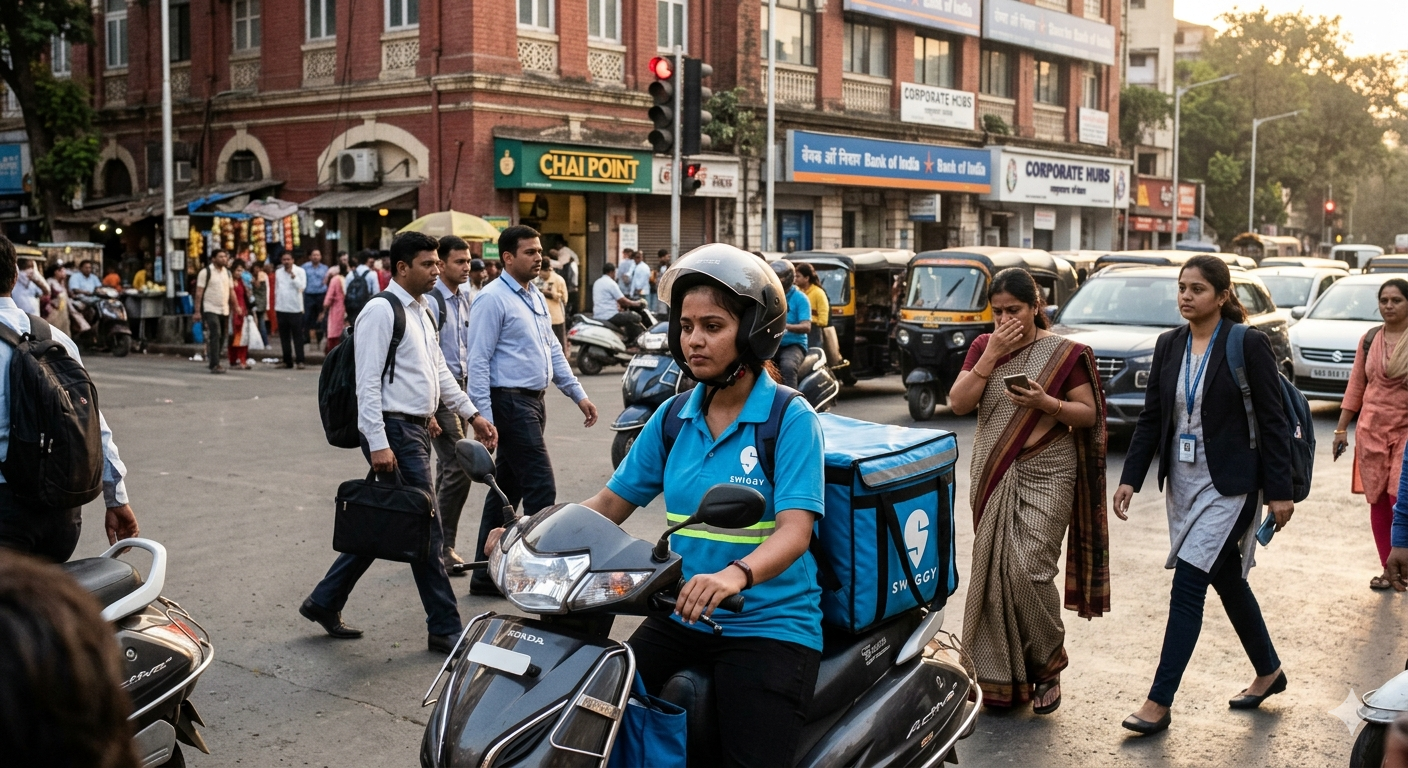
⚠️ The Risks Nobody Is Acknowledging
This revolution is real, but it is not without shadows.
Research points to serious challenges for freelancers: pay comes unevenly, benefits are absent, and financial planning is rarely taught. The gig economy provides income, but not security.
The ILO has specifically cautioned about the rise of gig jobs — food delivery drivers, temporary digital workers — where platforms blur the line between employee and self-employed, creating new challenges for worker well-being and stability.
There is also a gender gap that demands attention. Women account for 76.7% of India’s educated unemployed youth, and India has one of the lowest female labour force participation rates in the world, at around 25%. The revolution is not reaching everyone equally.
And for every young Indian who successfully pivots into the creator economy or freelancing, there are many more who are genuinely struggling — not by choice, but because the infrastructure of opportunity has failed them.
🛠️ What Needs to Change — And What You Can Do Now
For policymakers: Stop measuring economic success in GDP alone. Track youth employment quality. Fund vocational and digital skills programs at scale, not just in metros.
For universities: Placement rates are a vanity metric. Track how many graduates are financially independent at 25. Integrate real entrepreneurship, not just a “startup club.”
For parents: The ₹3.5 LPA government job your child is chasing may not exist in five years. Encourage them to build one skill that the market actually needs right now.
For young Indians reading this: Your degree is not your destiny. The economy does not owe you a job. But the internet has never given you more tools to build one yourself. Start before you feel ready.

🎯 The Lesson That Cannot Be Ignored
India’s youth unemployment crisis is not a story of lazy or unambitious young people. It is a story of a system — built for a different era — that has not kept pace with the people it was supposed to serve.
But inside that crisis, a generation is refusing to be a statistic. They are not waiting for the system to fix itself. They are building around it, through it, and sometimes despite it.
The revolution is not on the news. It is in the comments section of a YouTube tutorial at 2 AM. It is in a WhatsApp catalogue. It is in a Canva design submitted to a client in London from a rented room in Lucknow.
India’s Gen Z was handed a broken system. Their response has been to quietly build a new one.
Whether the country notices — and decides to support it — may be the most important economic question of the next decade.
❓ FAQs: What People Are Actually Asking
Why are educated Indians unemployed when the economy is growing?
Because India’s economic growth is concentrated in sectors that do not need large numbers of degree holders. GDP growth and job creation are no longer moving together.
Is the government doing anything about youth unemployment?
Programs like Startup India and Digital India have created some pathways. But structural reform in education and labour-intensive manufacturing remains insufficient.
Is freelancing a real career option in India?
Increasingly, yes — but it requires financial discipline, skill development, and a high tolerance for income instability. It is not a perfect solution, but for many, it is the most viable one available.
What skills actually get young Indians hired or earning today?
Data analysis, digital marketing, coding, content creation, UI/UX design, and cloud computing consistently lead to better outcomes than general degrees alone.
📚 Sources
- Statista — India Youth Unemployment Rate
- InsightsIAS — Unemployment of the Educated in India
- Centre for Public Policy Research — Degrees That Don’t Pay
- IJNRD — Jobless Growth in India
- Policy Circle — Educated Youth Unemployment
- Deccan Herald — Youth Unemployment Crisis in India
- InsightfulTake — India’s Job Crisis
- Fortune — Young Indians More Likely Unemployed if Educated
- The Pioneer — Gen Z Wishes to Become Job Creators
- FilingPro — How Gen Z is Changing India’s Startup Ecosystem
- The Hans India — Gen Z Creators Skipping Traditional Jobs
- EvePaper — Gen Z College Life India
- Gulf News — Young Indians More Likely Jobless if Educated