

You set the alarm for 10:30 PM. You were in bed by 11. You slept a full eight hours. And yet when the alarm rang at 7 AM, your body felt like it had been hit by a truck. Sound familiar? If you wake up tired every single morning despite sleeping enough hours, the problem is not how long you sleep — it is the quality of what happens inside your body during those hours. And the fix is not another cup of coffee.
According to a 2026 survey of over 43,000 Indians by LocalCircles, nearly 6 out of 10 Indian adults get less than six hours of uninterrupted sleep — and the numbers have been getting worse every year since 2022. Morning fatigue is not a personal weakness. It is a national health crisis hiding in plain sight, affecting students, working professionals, homemakers and senior citizens equally. The reasons you wake up tired are specific, measurable and — most importantly — completely fixable.

Reason 1 — You Are Sleeping But Never Reaching Deep Sleep
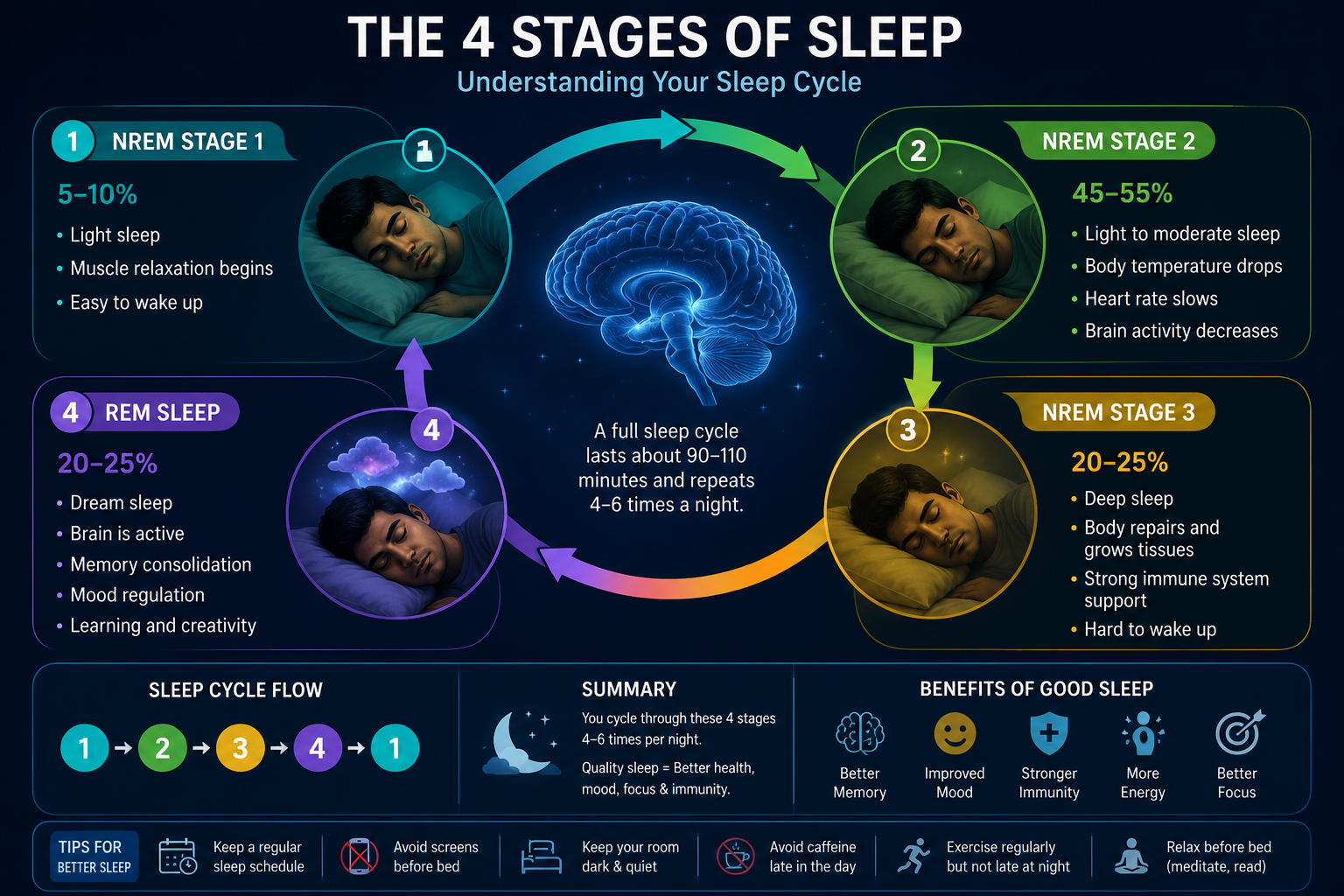
Your body goes through four to six sleep cycles every night. Each cycle lasts roughly 90 minutes and contains four stages — light sleep, deeper sleep, deepest sleep and REM sleep. The stage that actually repairs your body, consolidates memory and restores energy is deep sleep — also called slow-wave sleep. This happens toward the end of each cycle, roughly 45 to 60 minutes after you fall asleep.
Here is the problem. If anything disturbs you during those 90-minute cycles — a sound, a notification, a light, the urge to use the washroom — your body is yanked back to light sleep and the cycle restarts. You spend eight hours in bed but never accumulate enough deep sleep to feel restored. Research from the University of Michigan confirms that people who experience micro-arousals — tiny awakenings lasting seconds that they do not even remember — wake up feeling as exhausted as someone who barely slept at all.
This is why the number of hours you sleep is less important than the number of complete, uninterrupted sleep cycles you complete. Six hours of deep, unbroken sleep will leave you far more refreshed than nine hours of fragmented, interrupted sleep. Just as understanding compounding in India’s financial system requires looking beneath the surface numbers, understanding morning fatigue requires looking beyond the surface hours.
Reason 2 — Your Phone Is Destroying Your Sleep From the Inside
Most people blame their phone for keeping them awake at night — and they are right, but not for the reason they think. The real damage is not the content you watch. It is the blue light emitted by your phone screen, which directly suppresses melatonin — the hormone your brain produces to signal that it is time to sleep. When you scroll through Instagram or YouTube at 11 PM, your brain receives the same signal it would from afternoon sunlight. It genuinely believes it is still daytime.
As a result, your body delays its natural sleep cycle by 60 to 90 minutes. You may fall asleep at midnight, but your brain’s internal clock — called the circadian rhythm — is still set to 1 AM. When your alarm rings at 7 AM, your body is still in the middle of a sleep cycle it was supposed to complete by 8 AM. You have essentially given yourself biological jet lag every single night without leaving your bedroom.
The 2026 LocalCircles India sleep survey found that mobile phone interruptions accounted for only 6% of reported sleep disruptions — but that number is deeply deceptive. The phone does not just interrupt your sleep directly. It delays when your sleep begins, which means every cycle that follows is shifted later, and your morning wake-up cuts those cycles short. The phone problem is not about the 3 AM notification — it is about the 10:30 PM Instagram scroll that nobody counts.

Reason 3 — You Are Dehydrated Before You Even Open Your Eyes
During eight hours of sleep, your body loses between 0.5 to 1 litre of water through breathing and sweat — without drinking a single drop to replace it. You wake up in a state of mild dehydration every single morning. Even mild dehydration — as little as 1 to 2% of body weight — causes measurable drops in concentration, mood and physical energy. That foggy, heavy feeling in the first hour of morning is partly your brain running on insufficient hydration.
Most Indians reach for tea or coffee first thing in the morning. Both are diuretics — they cause your kidneys to expel more water, deepening the dehydration instead of fixing it. The solution is simple but counterintuitive: drink one full glass of water — approximately 400 to 500 ml — within five minutes of waking up, before tea, before coffee, before your phone. This single habit reduces morning fatigue noticeably within three to five days of consistent practice according to sleep researchers.
Reason 4 — Weekend Sleep Changes Are Breaking Your Internal Clock
Monday to Friday you sleep at 11 PM and wake at 7 AM. Saturday night you sleep at 2 AM and wake at 10 AM. Sunday night you sleep at 1 AM because you are not tired — and Monday morning you feel terrible even though the alarm rings at the same 7 AM as always. This pattern has a name in sleep science: social jet lag. It affects over 60% of working adults globally and is one of the most overlooked causes of chronic morning fatigue.
Your circadian rhythm is a precise biological clock controlled by light exposure, meal timing and consistent wake-up times. When you shift your sleep schedule by even 90 minutes on weekends, you reset this clock — exactly like crossing two time zones. Monday morning, your body is still on Saturday night time. It takes two to three days to readjust. By the time it does, it is Friday again and the weekend disruption repeats. You are never fully rested because you are never fully adjusted.
Reason 5 — Nutrient Deficiencies Are Silently Draining Your Energy
India has some of the highest rates of iron deficiency and Vitamin B12 deficiency in the world — and both directly cause chronic morning fatigue that no amount of sleep can fix. Iron deficiency reduces the blood’s ability to carry oxygen to cells. Even when you sleep perfectly, your cells are not getting the oxygen they need to restore energy during sleep. You wake up feeling like your body ran out of fuel overnight despite eight full hours in bed.
Vitamin B12 deficiency — extremely common in vegetarians and vegans — disrupts the formation of red blood cells and the functioning of the nervous system. Early symptoms include persistent tiredness, brain fog and difficulty concentrating in the morning. Magnesium deficiency, equally widespread in India due to processed food consumption, disrupts deep sleep quality directly — your muscles cannot fully relax, causing restlessness and light sleep throughout the night regardless of how many hours you spend in bed.
A simple blood test checking haemoglobin, serum B12, serum ferritin and serum magnesium can identify all four deficiencies in one sitting. If you have been experiencing morning fatigue for more than three months despite good sleep habits, get this test done before trying any other solution. Just as systematic monitoring helps Indian families manage EMI and loan changes, systematic health monitoring is the only way to identify silent deficiencies draining your morning energy.
Reason 6 — Your Bedroom Is Not Actually a Sleep Environment
Sleep science has established very clearly that the human brain associates environments with behaviours. If you work from your bed, watch movies in bed, eat in bed and scroll your phone in bed — your brain has learned that the bed is a place of activity, not rest. When you lie down to sleep, your brain receives contradictory signals, takes longer to transition into sleep and when it does, the sleep is lighter because the brain remains partially alert in an environment it associates with wakefulness.
The ideal sleep environment has three non-negotiable qualities. First — complete darkness. Even small amounts of light from streetlamps, phone chargers or LED indicators suppress melatonin production significantly. Use blackout curtains or a sleep mask. Second — cool temperature between 18 and 22 degrees Celsius. The body needs to drop its core temperature by approximately 1 to 2 degrees to enter deep sleep — a warm room physically prevents this from happening. Third — silence or consistent low-level sound like a ceiling fan, which masks random disruptive noises without stimulating the brain into alertness.
The 7-Day Protocol to Wake Up Refreshed Every Morning
Based on all six reasons above, here is a practical seven-day protocol that addresses every cause of morning fatigue simultaneously. This requires no equipment, no supplements and no money — only consistency.
| Time | Action | Why It Works |
|---|---|---|
| 10:00 PM | All screens off — phone in another room | Allows melatonin to rise naturally |
| 10:15 PM | Room temperature set to cool | Triggers core body temperature drop |
| 10:30 PM | Sleep — same time every day including weekends | Locks circadian rhythm permanently |
| On waking | 500ml water before anything else | Reverses overnight dehydration |
| Morning | 10 minutes direct sunlight within 30 min of waking | Resets circadian clock for next night |
| Daily | No caffeine after 2 PM | Caffeine half-life is 6 hours |
| Weekend | Same wake-up time Saturday and Sunday | Eliminates social jet lag completely |
Follow this protocol for seven consecutive days without exception. Most people report measurable improvement in morning energy by Day 4. By Day 7, the difference is significant enough that skipping any step feels noticeable. Just as the discipline required to follow a debt clearance plan compounds into financial freedom over months, the discipline of consistent sleep habits compounds into dramatically better morning energy within days.
When Morning Fatigue Means You Must See a Doctor
Most morning fatigue resolves with the seven habits above within two to four weeks. But specific warning signs indicate a medical condition requiring professional evaluation. If you snore loudly and your partner reports that you stop breathing briefly during sleep, you likely have sleep apnea — a condition where the airway collapses repeatedly during sleep, causing hundreds of micro-arousals per night that destroy sleep quality completely. It is treatable but requires a sleep study to diagnose correctly.
If you experience extreme morning fatigue accompanied by unexplained weight gain, hair loss, cold intolerance and low mood — your thyroid may be underactive. Hypothyroidism affects over 42 million Indians and is almost always missed in routine checkups. A simple TSH blood test confirms or rules it out in 24 hours. If fatigue comes with excessive thirst, frequent urination and blurred vision — check your blood sugar immediately, as these are early diabetes symptoms commonly mistaken for sleep problems.
Morning fatigue is your body speaking in the clearest language it has. Every morning you wake up exhausted is not a punishment — it is a signal. And now you have the knowledge to decode that signal, identify the exact cause and fix it permanently. Not next month. Not next week. Starting tonight.

Frequently Asked Questions
Why do I wake up tired even after 8 hours of sleep?
Waking up with morning fatigue after 8 hours usually means you are not reaching deep sleep stages. Causes include blue light exposure before bed, inconsistent sleep schedules, dehydration, nutrient deficiencies like B12 and iron, or undiagnosed sleep apnea. The number of hours you sleep matters less than the quality of your sleep cycles.
What is the fastest way to stop morning fatigue?
The fastest fix for morning fatigue is drinking 500ml of water immediately on waking, getting 10 minutes of direct sunlight within 30 minutes of waking, and keeping the same wake-up time every day including weekends. Most people notice improvement in morning fatigue within 3 to 5 days of consistent practice.
Does using the phone at night really cause morning fatigue?
Yes — phone screens emit blue light that suppresses melatonin and delays your natural sleep cycle by 60 to 90 minutes. Even if you fall asleep at the same time, your body’s internal clock is shifted later, causing your morning wake-up to cut sleep cycles short and leaving you with severe morning fatigue.
Which vitamin deficiency causes morning fatigue in India?
Vitamin B12 and iron deficiency are the most common causes of chronic morning fatigue in India. B12 deficiency is particularly widespread among vegetarians. Magnesium deficiency also disrupts deep sleep quality directly. A blood test checking B12, ferritin, haemoglobin and magnesium identifies all causes in one panel.
What is social jet lag and how does it cause morning fatigue?
Social jet lag happens when your sleep schedule on weekends differs significantly from weekdays. Sleeping 2 to 3 hours later on Saturday and Sunday resets your circadian rhythm, making Monday morning feel like crossing time zones and causing severe morning fatigue. Keeping the same wake-up time every day — including weekends — eliminates social jet lag within one week.