
Class 8 Social Science — Governance and Democracy
Chapter 6🏛️ The Parliamentary System: Legislature and Executive
🎯 Learning Objectives
- Understand the structure and composition of India’s Parliament
- Explain the legislative functions of Parliament — constitutional, lawmaking, executive accountability, and financial accountability
- Describe how a bill becomes an act using the example of the RTE Act
- Identify the roles of the President, Prime Minister, and Council of Ministers
- Distinguish between the Legislature and the Executive
- Understand the role of the Judiciary in checks and balances
- Compare the structure of Union and State governments
- Identify challenges facing the effective functioning of legislatures in India
💡 The Big Questions
- What is India’s parliamentary system, and how is it structured?
- What are the key functions of the Parliament?
- What are the roles of the legislature and the executive in India’s Parliamentary democracy?
- How are the legislature and the executive organised at the union and state levels?
📖 Chapter Index
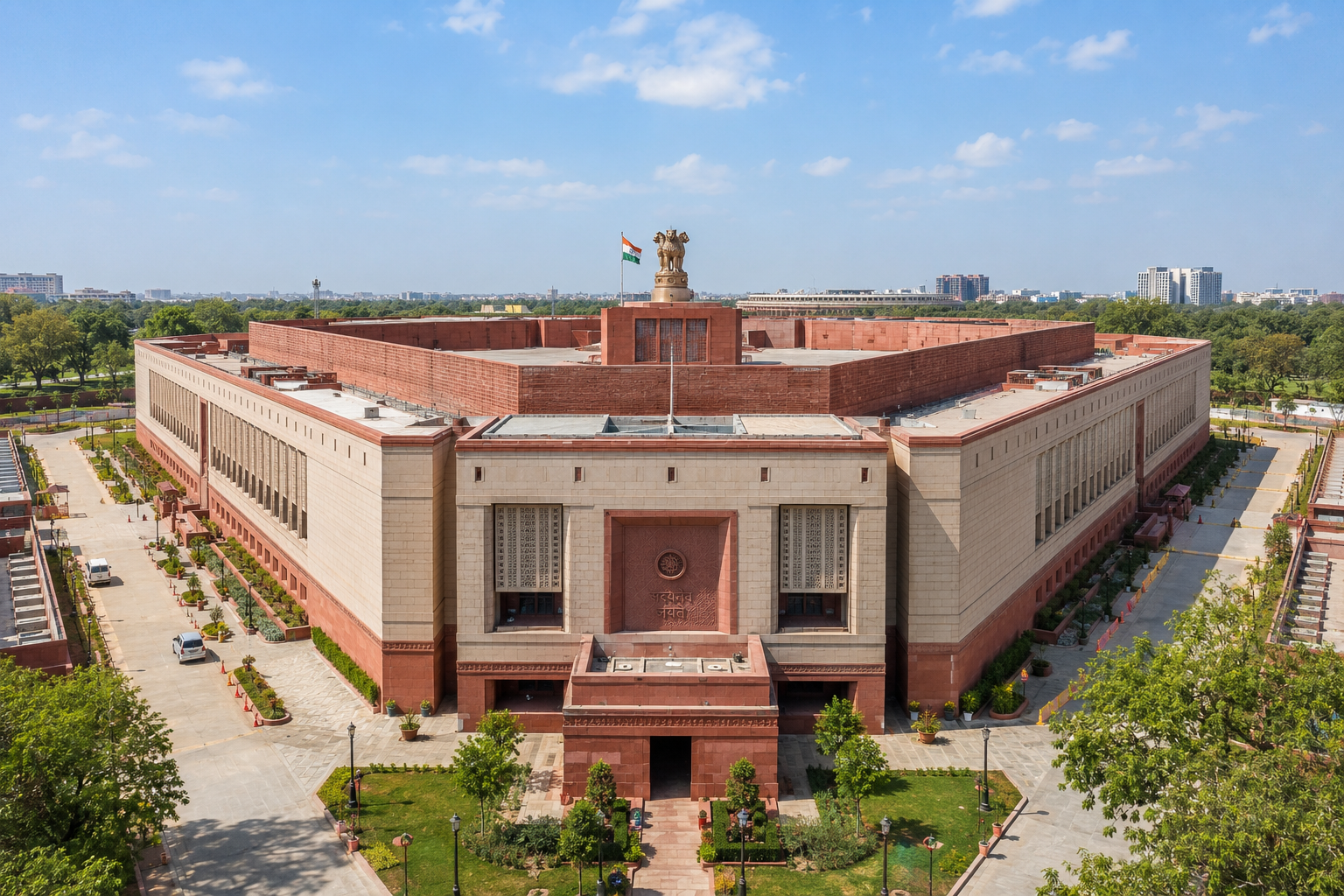
Fig. 6.1 — The new Parliament building (Sansad Bhavan) in New Delhi, featuring a distinctive triangular design
📖 A School Trip to the Parliament
The Grade 8 students from Nalanda Vidyalaya were on a school trip to Delhi. Usha, Sukhwinder, Anjali, John, and Farida were especially excited to visit the new Parliament building.
“It’s not square or round — it’s like a soft triangle!”
“The three-sided design reflects balance, inclusivity, and purpose.”
“It also uses green construction, cutting electricity use by 30 per cent.”
“Inside, walls are decorated with carvings — peacocks, lotuses, tribal art, temple patterns, and freedom fighters. It feels like a museum of India.”
“The Ashokan emblem! This new building houses so many ancient symbols!”
“Exactly — democracy must look ahead, but never forget its roots.”
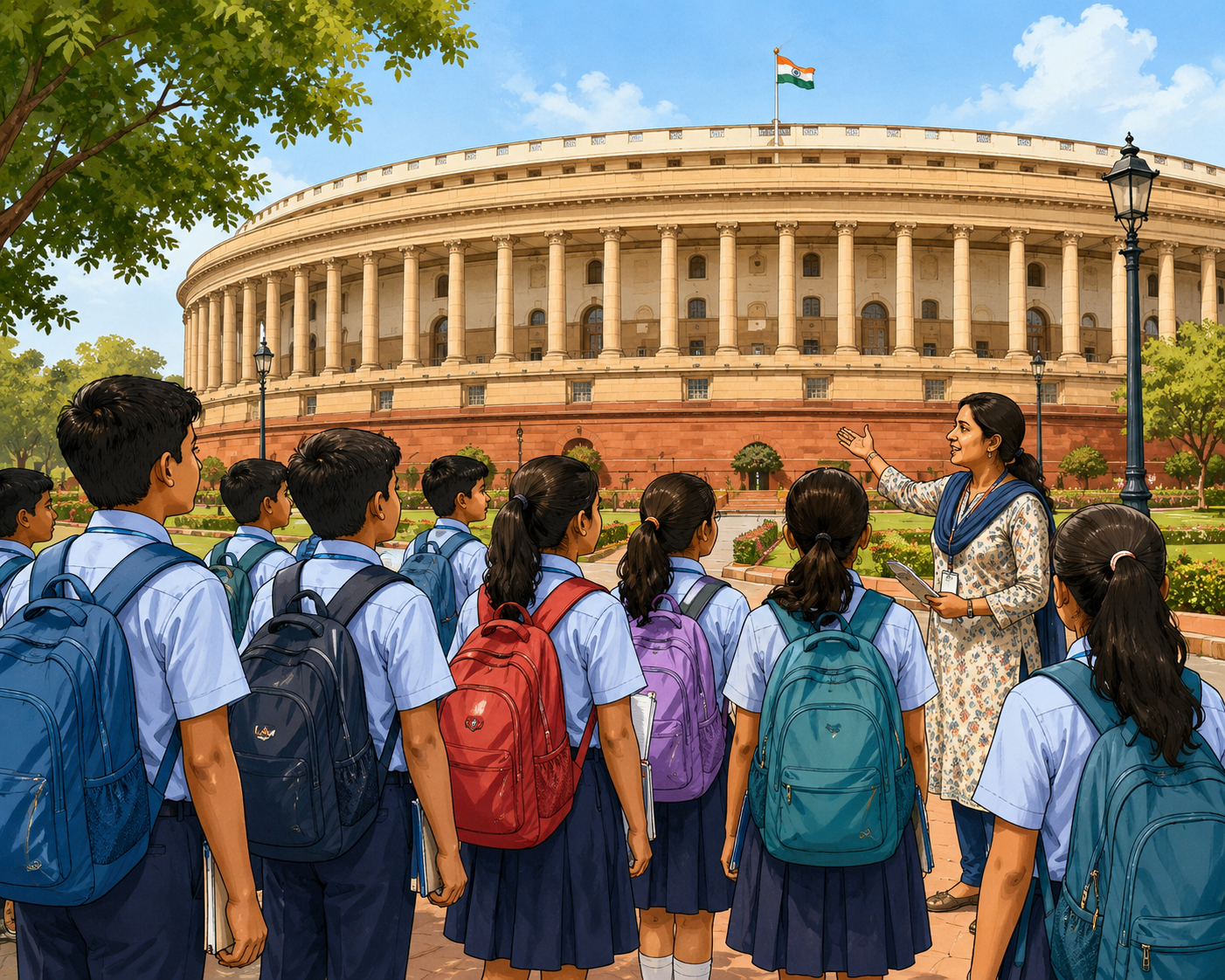
The students explore the new Parliament building during their Delhi trip
📜 Introduction
- India’s independence was achieved through great sacrifices after years of struggle against colonial rule. The citizens of a free country could now make decisions about their own governance.
- The first important step was the drafting of the Constitution of independent India.
- This document laid foundational principles including Universal Adult Franchise — guaranteeing all adult citizens the right to vote irrespective of social or economic background, gender, race, or religion.
- The people of India directly elect their representatives, who become members of the Lok Sabha. A majority group from among these elected representatives forms the government.
- The Parliament is the supreme legislative body — it makes laws for the country, comprises all elected representatives of the people, and controls and guides the work of the government.
- The government can therefore be seen as functioning with the people’s consent.
- There have been 17 Lok Sabhas since the first one in 1952. The 18th Lok Sabha was constituted in June 2024.
🧠 Check Your Understanding — Introduction
LOTS When was the 18th Lok Sabha constituted? How many Lok Sabhas have there been since the first one in 1952?
Show Answer
The 18th Lok Sabha was constituted in June 2024. There have been 17 Lok Sabhas since the first one was formed in 1952, making the 18th the most recent.
Medium What does it mean to say the government “functions with the people’s consent”? How does universal adult franchise connect to this idea?
Show Answer
It means the government derives its authority and legitimacy directly from the citizens who elected it — it cannot rule arbitrarily because its power comes from the people. Universal adult franchise connects directly: because every adult citizen (18+) can vote regardless of background, gender, race or religion, every citizen has a voice in choosing who governs them. This makes the government’s authority a reflection of the people’s collective consent, rather than something imposed on them.
HOTS The Parliament “controls and guides the work of the government.” How is this possible if the government itself is formed from the majority party within Parliament? Doesn’t this create a conflict of interest?
Show Answer
While the government (Executive) is drawn from the majority in Parliament, the Parliament as a whole — including the opposition — still exercises oversight through tools like the Question Hour, parliamentary committees, and debates. Even majority MPs can hold ministers accountable, and all bills must pass through Parliament, allowing debate and amendment. The conflict of interest is managed by parliamentary procedures, transparency requirements, and the threat of losing the next election — but this self-checking works best when the opposition is strong and the media and citizens stay engaged.
HOTS Why did the Constitution makers consider Universal Adult Franchise a “foundational principle” rather than just one rule among many? What would Indian democracy look like without it?
Show Answer
It is foundational because it is the source of legitimacy for the entire system — without it, no other democratic structure (Parliament, elections, accountability) would have meaning, since those in power would not genuinely represent the people. It ensures everyone’s voice counts equally, regardless of wealth, caste, gender or education. Without it, Indian democracy would resemble the pre-Independence period, where only 13% could vote — meaning decisions would be made by and for a small privileged class while the majority had no say.
🏛️ Composition of the Parliament of India
- The Indian Parliament is composed of the President and two houses:
- The Lok Sabha (House of the People / Lower House)
- The Rajya Sabha (Council of States / Upper House)
- This structure with two houses is called a ‘bicameral’ system (‘bi’ means two, ‘cameral’ means chamber/house).
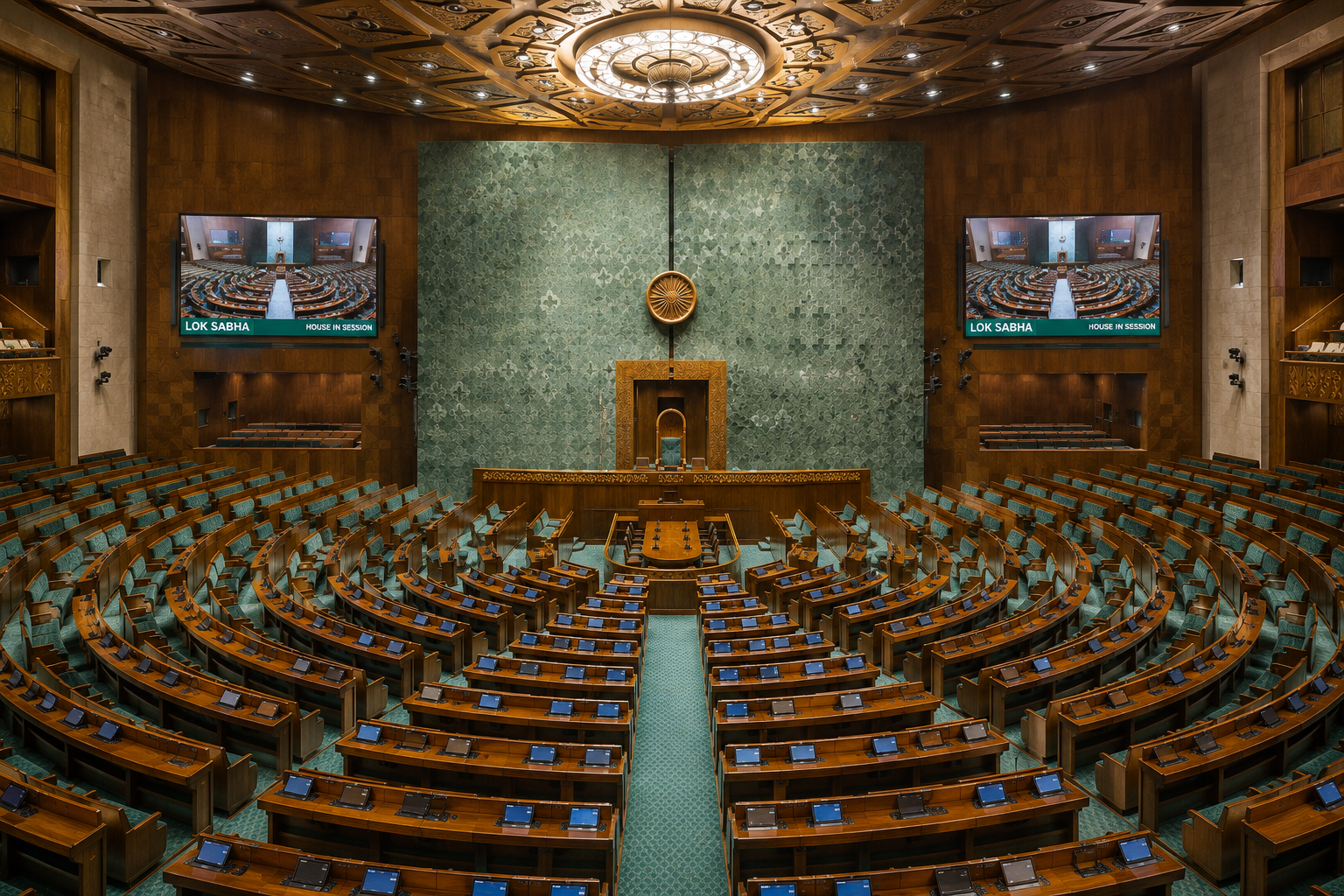
Fig. 6.4 — Lok Sabha Chambers in the new Parliament building
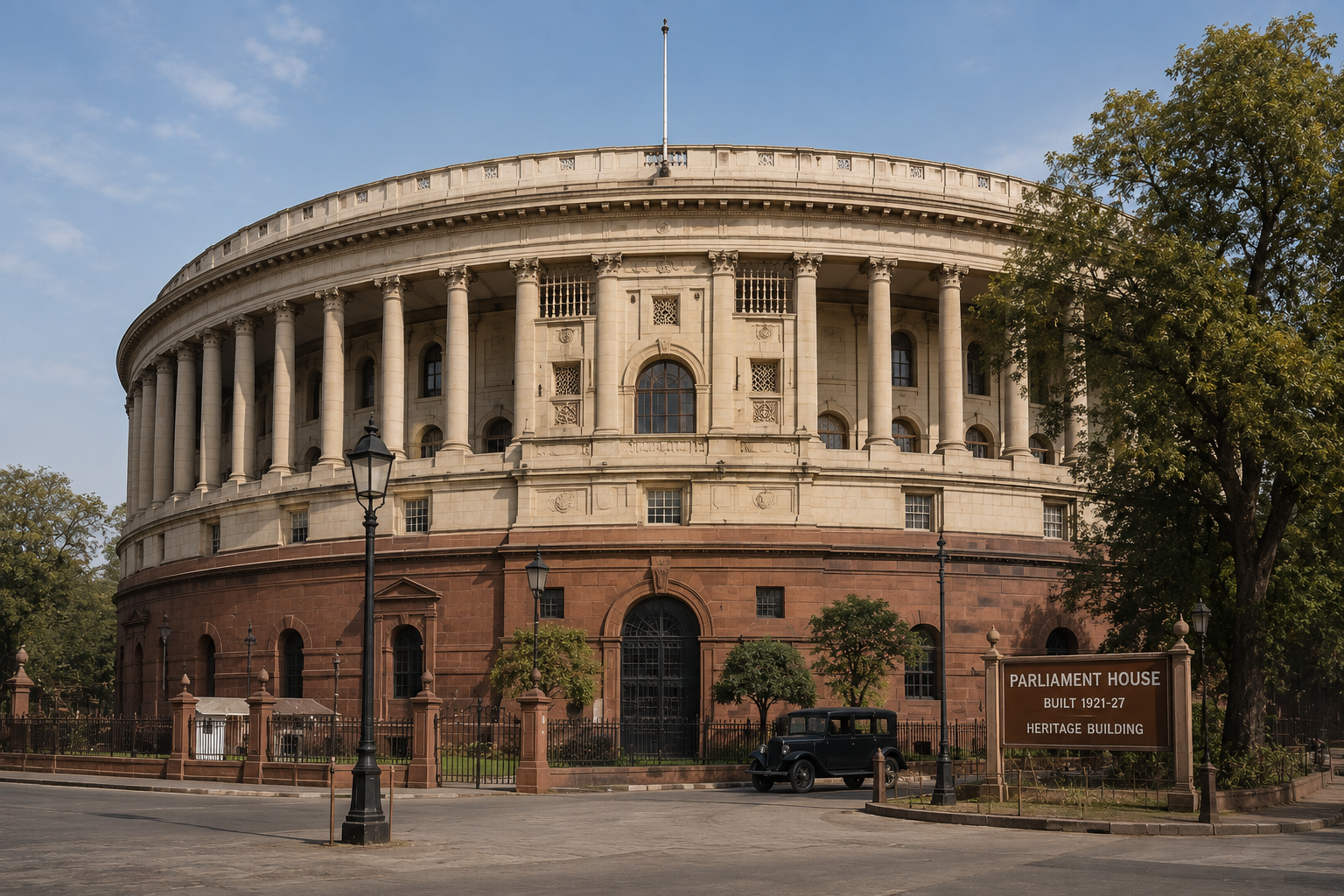
Fig. 6.2 — Our old Parliament (now called Samvidhan Sadan) was constructed in the 1920s. The Constituent Assembly met here, and it served as Parliament House for over seven decades.
💡 Let’s Remember
- The people of India choose their representatives for the Lok Sabha through direct election (based on universal adult suffrage).
- The maximum number of members of this House envisaged by the Constitution is 550.
- The MPs in the Rajya Sabha are elected indirectly by the electoral college (covered in the previous chapter).
- Both the number of Rajya Sabha seats and the number of Lok Sabha MPs are based on the population of each state.
⭐ Don’t Miss Out — Where Did Our System Come From?
- Several aspects of the Indian Constitution were drawn from other countries — Britain’s system inspired our Parliamentary democracy.
- Indian experiences also shaped it: practical experience through limited participation in British colonial governance; the memory of ancient republics (mahājanapadas); and the village panchayats where elders made collective decisions.
- Extensive discussions took place on whether India should have a bicameral system — a single directly elected House was felt to be inadequate for independent India.
- In the spirit of ‘federalism’, a Council of States — the Rajya Sabha — was felt to be needed.
- Federalism is a form of government where power is distributed between the centre, states, and local governments — balancing national unity with local interests.
🎙️ Function — Presiding Officers
- Each House of Parliament has a presiding officer to ensure debates are conducted in an orderly manner.
- In the Lok Sabha, members elect a Speaker, who conducts sessions, allows members to speak, maintains discipline, and ensures rules are followed.
- The Rajya Sabha is presided over by the Vice President of India, who acts as its chairperson.
⭐ Don’t Miss Out — The Sengol
- The Sengol, a gold-plated silver sceptre, was symbolically handed over to Pt. Jawaharlal Nehru, the first Prime Minister, on 14 August 1947 — marking the transfer of power.
- It is now placed near the Speaker’s chair in the new Lok Sabha.
- It served as a symbol of righteous and just rule, dating back to the Chola period — handed to new rulers as a reminder that power must be guided by dharma and righteousness. At its top sits Nandi, symbolising justice.
🔑 Key Term
Sceptre: A decorated rod carried by a king or queen at ceremonies as a symbol of their power.
⭐ Don’t Miss Out — Parliament in Many Languages
- To make discussions accessible to all, translation services are provided in multiple Indian languages.
- Previously, simultaneous interpretation was available in 12 languages: Hindi, English, Assamese, Bengali, Gujarati, Kannada, Malayalam, Marathi, Odia, Tamil, Punjabi, and Telugu.
- Recently, six more were added: Bodo, Dogri, Maithili, Manipuri, Urdu, and Sanskrit — with more expected in future.
- The ‘executive’ responsibility of Parliament (ensuring laws are implemented) is as important as its ‘legislative’ function (making laws).
- The Union Executive gives life to the legislative functions and power of Parliament. It consists of the President, the Vice President, and the Council of Ministers headed by the Prime Minister.
- The Council of Ministers is chosen from among the MPs of both houses and is collectively responsible to the Lok Sabha.
🧠 Check Your Understanding — Composition and Function
LOTS What does ‘bicameral’ mean? Name the two houses of the Indian Parliament.
Show Answer
‘Bicameral’ means having two houses or chambers (‘bi’ = two, ‘cameral’ = chamber). The two houses are the Lok Sabha (House of the People / Lower House) and the Rajya Sabha (Council of States / Upper House).
Medium Who presides over the Lok Sabha and who over the Rajya Sabha? How do these presiding officers differ in how they reach their position?
Show Answer
The Lok Sabha is presided over by the Speaker, elected by the members of the Lok Sabha itself. The Rajya Sabha is presided over by the Vice President of India, who holds this role by virtue of being Vice President (chosen through a separate national-level indirect election), not elected specifically by Rajya Sabha members.
HOTS India adopted a bicameral system “in the spirit of federalism” to create a Council of States. How does having a separate Rajya Sabha help protect the interests of smaller states?
Show Answer
In the Lok Sabha, seats are allocated by population — so larger states like Uttar Pradesh have far more MPs than smaller states like Sikkim, meaning bigger states could dominate if there were only one house. The Rajya Sabha gives every state a continuing voice through its MLAs’ indirect elections and, crucially, is a permanent body that cannot be dissolved — providing a stable, deliberative check on hasty decisions by the directly-elected Lok Sabha. This reflects the federal principle that regional interests should not be completely overridden by population numbers.
HOTS The Sengol symbolises that “power must be guided by dharma and righteousness.” Why place it in today’s Lok Sabha rather than in a museum?
Show Answer
Receiving the Sengol at Independence connected India’s new democratic leadership to an ancient Indian tradition of just governance. Placing it in today’s Lok Sabha (rather than a museum) keeps this reminder actively present for lawmakers — a daily, visible symbol urging elected representatives to govern with integrity and accountability, rather than treating it as a historical relic disconnected from present-day governance.
⚖️ Legislative Functions of the Parliament
- The Constitution lays down the key functions Parliament must fulfil, broadly classified under:
- 1. Constitutional functions
- 2. Lawmaking
- 3. Executive accountability
- 4. Financial accountability
1) Constitutional Function
💡 Let’s Remember
From your previous lessons on Democracy and Governance, name a few Constitutional functions of the Parliament. Did you list the election of President and Vice President? What about amendments to the Constitution? These are vital constitutional functions of the Parliament.
- The Parliament is directly entrusted with upholding the core values of the Indian Constitution, including:
- a. Enabling parliamentary democracy through universal adult suffrage
- b. Following the separation of powers between the legislature, executive, and judiciary
- c. Ensuring federalism
- d. Upholding Fundamental Rights and Directive Principles of State Policy by framing laws and policies
2) Lawmaking
- Among the primary responsibilities of the legislature is to make laws.
- The Constitution has laid out an elaborate and rigorous process for lawmaking.
- A law is generally brought into force through an instrument called an act.
- A bill — a draft of a proposed law — is introduced in Parliament and goes through a long journey before it becomes an act.
🔑 Key Term — Bill
Bill: A draft of a proposed law that needs to be approved by the parliament before it can be enacted into law.
📖 The Journey of the Right to Education (RTE) Act, 2009 — Told in Its Own Words
“Most people call me RTE. I came into existence in August 2009, though the idea began almost a century before.
My roots lie in the Directive Principles of State Policy of the Indian Constitution. Though the Constitution makers wanted me implemented within a decade after Independence, this didn’t happen, leaving countless children without access to education.
In the early 1990s, someone argued in court that I was inherently part of the Fundamental Rights — namely, the Right to Life — as education is important to lead a meaningful life. Parliamentary action began with the 86th Constitutional Amendment Act, 2002, which mandated — as Article 21A — that the state shall provide free and compulsory education to all children between the ages of 6 and 14 years.
Six years later, I was tabled as a bill in the Rajya Sabha. A committee studied me thoroughly and suggested modifications. The major debate concerned funding — new schools, infrastructure, and teachers for millions of children would be costly.
After the 2009 elections, the new government pursued the matter, and in August 2009, I was passed in the Lok Sabha and received the President’s assent, becoming an Act.
Today, I’ve enabled legal pathways for children to attend school, facilitated new school construction, and ensured free books and uniforms for children.”
From Bill to Act — The Process of Lawmaking (Fig. 6.8)
- Note: All bills may not be referred to Committees.
🔑 Key Terms
- Standing Committee: A permanent committee of MPs (members may change, but the committee as a structure remains) that scrutinises government activities, makes recommendations, and questions government actions.
- Reading: The origins are in the British Parliament — many MPs were illiterate, so a clerk read out the bill for discussion. Today MPs read the bill before discussions.
- Clause: Parts of a bill that explain specific details — e.g. RTE defines the age group to which it applies (6 to 14 years).
- Gazette: An official government publication that announces legal documents and official information.
🔍 Let’s Explore
Draw a small chart to show the process of how RTE became an act. What do you think the process would be if RTE had been tabled in the Lok Sabha instead of the Rajya Sabha?
Show Answer
The process would be almost the same — the bill would go through reading, committee scrutiny, clause-by-clause discussion, voting, then be sent to the Rajya Sabha (the other House) to repeat the process, and finally receive the President’s assent. The main difference is only the starting House. (For a Money Bill, however, it must start in the Lok Sabha.)
⭐ Don’t Miss Out — Money Bills
- Some bills must be tabled only in the Lok Sabha.
- One example is a ‘Money Bill’ — concerned with financial matters (taxation, government borrowing, etc.).
- It can be introduced only in the Lok Sabha — and its introduction requires the prior recommendation of the President.
🧠 Check Your Understanding — Lawmaking and the RTE Journey
LOTS In which House was the RTE Bill first tabled? In which year did it become an Act?
Show Answer
The RTE Bill was first tabled in the Rajya Sabha. It became an Act in August 2009, after being passed in the Lok Sabha and receiving the President’s assent.
Medium What is the difference between a ‘bill’ and an ‘act’? At what stage does a bill officially become an act?
Show Answer
A bill is a draft of a proposed law that has not yet been approved — still under discussion, and can be amended or rejected. An act is the final, legally binding law. A bill officially becomes an act after it is passed by both Houses of Parliament and receives the President’s assent — after this it is published in the Gazette, making it official.
HOTS The RTE’s roots lie in the Directive Principles, yet it took over 60 years. What does this delay tell us about lawmaking and translating constitutional ideals into law?
Show Answer
It shows that having a constitutional ideal does not automatically guarantee swift implementation — practical challenges like funding (schools, teachers, infrastructure for millions of children) can delay even widely supported goals for decades. It also shows the role of the judiciary — only after courts linked education to the Fundamental Right to Life in the 1990s did Parliament act through the 86th Amendment in 2002. Constitutional principles, judicial interpretation and parliamentary will must all align before a law comes into force — and the process, while thorough, can be slow.
HOTS Why must a ‘Money Bill’ be introduced only in the Lok Sabha? What does this tell us about the relative powers of the two Houses on financial matters?
Show Answer
Money Bills can only be introduced in the Lok Sabha because its members are directly elected by the people, making it more directly answerable to citizens about how their tax money is raised and spent. This reflects “no taxation without direct representation” — financial matters affecting every citizen should be controlled by those the people themselves elected, not by an indirectly elected body like the Rajya Sabha. On financial matters specifically, the Lok Sabha holds greater power than the Rajya Sabha.
🗣️ 3) Executive Accountability
- The Prime Minister and the Council of Ministers are part of the Union Executive. They:
- Are primarily responsible for implementing and enforcing laws and overseeing the effective running of government.
- Take decisions on the day-to-day functioning of the government based on the Constitution and its laws.
- Are answerable to the Lok Sabha through mechanisms like the Question Hour, which requires ministers to justify their actions and decisions.
- The Question Hour is typically the first hour of a Parliamentary session, where MPs can ask ministers questions about government policies and activities.
- It holds the Executive ‘accountable’ — meaning it must justify all actions and decisions.
- Special committees also hold meetings where ministries must explain their policies; these committees may include MPs from different political parties.
🎭 Parliament Isn’t Always Formal — Poetry and Humour
- Example 1 — Verse in Parliament: While presenting the Union Budget for 2025–26, Smt. Nirmala Sitharaman recited a verse from Tirukkural (an ancient Tamil treatise on ethics), meaning roughly: “Just as living beings live expecting rains, citizens live expecting good governance.” There was enthusiastic thumping of desks from the Treasury Benches.
- Example 2 — Humour in Parliament: In 2011, during a spirited Lok Sabha debate, Parliamentarian Sushma Swaraj quoted a poetic verse to criticise the government using the metaphor of a “looted caravan.” Then Prime Minister Dr. Manmohan Singh calmly replied with another poetic line, expressing humility about not being “worthy of your sight” but asking critics to instead judge his “zeal and perseverance.”
📋 A Standing Committee in Action
An extract from a report of the Standing Committee on Health and Family Welfare reviewed the co-location of Ayush facilities at Primary Health Centres, Community Health Centres, and District Hospitals. The Committee recommended that the Ministry of Ayush persuade States/UTs without a separate Department of Ayush to create one for better coordination. In its Action Taken response, the Ministry explained that Public Health is a state subject, so creating such departments is up to State/UT governments — though it has requested States to create separate Directorates. As of the report, a separate Ayush Directorate exists in 24 States/UTs.
🔍 Let’s Explore
Looking at the Standing Committee extract above: Who is reporting to whom? What is the subject reviewed? Identify the Committee’s recommendation. What is the government’s reply?
Show Answer
Who reports to whom: The Ministry of Ayush reports to (is answerable to) the Standing Committee on Health and Family Welfare, which is made up of MPs. Subject: the co-location of Ayush facilities at PHCs, CHCs and District Hospitals. Recommendation: that the Ministry persuade States/UTs without a separate Ayush Department to create one for better coordination. Government’s reply: Public Health is a state subject, so this is up to State/UT governments; the Ministry has requested them to create separate Directorates, and 24 States/UTs already have one.
💰 4) Financial Accountability
- The Parliament approves and monitors government expenditure through the annual budget.
- It examines the distribution of funds to different ministries.
- The government is expected to provide the necessary information to Parliament in a timely and accurate manner.
🔍 Let’s Explore
Why do you think Parliament keeps an eye on government expenditure? (Hint: Whose money does the government spend?)
Show Answer
The government spends public money — collected from citizens as taxes. Parliament, as the elected representative of the people, keeps watch to ensure this money is spent honestly, wisely and for the public good, and not wasted or misused. This protects taxpayers and ensures the government stays accountable for every rupee it spends.
🏛️ Executive Functions of Parliament
⭐ Don’t Miss Out
Part V of the Indian Constitution begins with Chapter I — The Executive — covering the roles of the President, Vice President, and Council of Ministers. It is only in Chapter II that the role and functions of Parliament are listed. Why might this be so?
1) The President
- The President is the Head of State and the nominal head of the Executive.
- The Prime Minister and the Council of Ministers are responsible for actually running the government.
- The President appoints the Prime Minister and other ministers, summons the Parliament, and gives assent to bills, among other functions.
- The Council of Ministers aids and advises the President.
- However, in specific circumstances, the President can exercise discretionary powers — particularly during political crises, like when no party holds a clear majority after a Lok Sabha election.
2) The Prime Minister and the Council of Ministers
- The Prime Minister is the de facto executive authority in India’s Parliamentary system.
- The President appoints the leader of the majority party or coalition in the Lok Sabha as the Prime Minister.
- The Prime Minister serves with the support of the majority of MPs in the Lok Sabha.
- Key functions: Leading the Council of Ministers • Advising the President • Coordinating the work of different ministries • Shaping national policies.
- The PM and Council of Ministers take decisions and run the government — they are collectively responsible to the Lok Sabha.
- Most bills that come to Parliament are initiated by the government.
- A permanent group of officials — called ‘civil servants’ (administrators or bureaucrats) — help implement laws and policies, working under the direction of ministers.
🔍 Let’s Explore
If the Executive is part of the Legislature, how do we say that there is separation of power? (Hint: revisit the section on legislature above)
Show Answer
Although ministers (the Executive) are drawn from Parliament (the Legislature), the two perform different roles: the Legislature as a whole makes laws and scrutinises the government, while the Executive implements them. The Legislature — especially the opposition, committees and the Question Hour — holds the Executive accountable, and the independent Judiciary checks both. So separation of powers is maintained through distinct functions and mutual checks and balances, even though membership overlaps.
⭐ Don’t Miss Out — Lal Bahadur Shastri’s Resignation
- In 1956, Railway Minister Lal Bahadur Shastri resigned after a train accident.
- Although he was not blamed for the accident, he believed a minister must take moral responsibility for anything that happens in their ministry.
- He offered his resignation to then PM Jawaharlal Nehru; Nehru declined at first, but Shastri insisted. His resignation was finally accepted — he later became Prime Minister himself.
Differences Between the Legislature and the Executive
| Aspect | Legislature | Executive |
|---|---|---|
| Composition | The Parliament of India — the supreme legislative body — composed of the President, the Lok Sabha and the Rajya Sabha | Composed of the President, the Vice-President, and the Council of Ministers headed by the Prime Minister |
| Main Role | Making laws and overseeing the work of the Executive | Enforcing the laws made by the Legislature |
| Bill Introduction | Can introduce some bills in Parliament | Most bills are introduced by the Executive in Parliament |
| Oversight | Keeps a check on Executive activities by asking questions and seeking explanations | Provides information and explanations to the Legislature on its decisions and actions |
| Advisory Role | — | Aids and advises the President on important matters, including calling sessions of Parliament |
| Financial Role | Sanctions all government-related expenses | Prepares and implements the budget approved by Parliament |
| Committee Engagement | Consults different Parliamentary committees | Can function independently in day-to-day matters; consults committees when required |
🧠 Check Your Understanding — Executive Accountability & Functions
LOTS What is the Question Hour? Who is held accountable through this mechanism?
Show Answer
The Question Hour is a period, typically the first hour of a Parliamentary session, where MPs can ask ministers questions about government policies and activities. It holds the Executive (ministers and the government) accountable, requiring them to justify their actions and decisions.
Medium What is the difference between the ‘nominal head’ and the ‘de facto executive authority’? Give the relevant title for each.
Show Answer
The nominal head is the official Head of State who holds the position formally but does not run day-to-day affairs — this is the President. The de facto (actual/real) executive authority genuinely makes governing decisions and runs the country — this is the Prime Minister, who leads the Council of Ministers and shapes national policy.
HOTS Lal Bahadur Shastri resigned in 1956 even though he was not personally blamed. What principle of governance does this illustrate, and why is it important for executive accountability?
Show Answer
It illustrates the principle of “ministerial responsibility” — a minister is morally and politically responsible for everything within their ministry, even if they did not personally cause the failure. This is important because it ensures accountability flows all the way up to the person in charge, preventing ministers from avoiding responsibility by blaming subordinates. It builds public trust that those in power take their duties seriously — strengthening the culture of accountability a healthy democracy depends on.
HOTS The Executive is largely made up of MPs who are themselves part of the Legislature. How does this overlapping membership create both a strength and a weakness in checks and balances?
Show Answer
Strength: Because ministers are also MPs, they remain directly accountable to Parliament (and ultimately voters) for their executive actions — the government cannot govern in isolation from elected representatives’ scrutiny, unlike in a fully separated presidential system. Weakness: Since the Executive is drawn from the majority party, that same majority may be reluctant to seriously challenge “their own” ministers, especially when party discipline (the “whip”) requires MPs to vote along party lines. This can weaken independent oversight, making the system rely on a strong opposition and free press for genuine accountability.
⚖️ The Judiciary — Role of Checks and Balances
What Does the Judiciary Do?
- The Judiciary is the branch of government responsible for interpreting and applying the laws of the land, including in disputes.
- It functions through a system of courts and plays a pivotal role in maintaining the democratic nature of society and governance.
- The Judiciary acts as the custodian of the Constitution, ensuring all branches of government operate within constitutional principles.
- It checks the functioning of society and government institutions by: interpreting laws, resolving disputes, and safeguarding fundamental rights.
- To ensure powers are used properly, the Judiciary checks that laws passed by Parliament have not violated the Constitutional framework.
- Similarly, if a violation occurs during implementation by the Executive, the Judiciary can step in.
- Just as Parliament functions through its Legislature and Executive arms, the Judiciary functions through its Courts.
- These are examples of the separation of powers and system of checks and balances — ensuring no one organ becomes too powerful.
🔍 Let’s Explore
- What might happen if one organ — Legislature, Executive, Judiciary — had all the power? How could it affect the rights of people?
- How does the Legislature question the actions of the Executive? How does the Judiciary make sure laws and government actions respect the Constitution?
- Do you think there might be ways in which the actions of the Judiciary itself are reviewed?
Show Answer
If one organ had all the power, it could misuse it freely — making unfair laws, enforcing them harshly, and judging its own actions, crushing people’s rights and freedoms (like a dictatorship). The Legislature questions the Executive through the Question Hour, debates and committees. The Judiciary reviews laws and actions against the Constitution and can strike down those that violate it. The Judiciary’s own actions can be reviewed too — through appeals to higher courts, review petitions, and ultimately constitutional amendments by Parliament — so even the Judiciary is not entirely unchecked.
- We will learn more about the Judiciary in a later chapter.
🗺️ Legislative and Executive Functions at the State Level
- The Union Government has a Parliament with legislative and executive functions. Similarly, each state has its own legislature and executive, called its ‘State Assembly’.
- Just as Parliament has MPs who make laws, there are MLAs who formulate laws on subjects in the ‘State List’ and the ‘Concurrent List’.
Union List, State List, and Concurrent List
- The Constitution has lists clarifying the areas on which the Union and State governments can exclusively legislate — the Union List and the State List.
- There is also a Concurrent List — subjects on which both can legislate.
- However, if the Union legislates on a Concurrent List subject, the state government is bound to follow it.
- In the case of RTE, the Act applies all over India even though education is in the Concurrent List.
Fig. 6.11 — Matters like education and environmental policy require collaboration between the union and states, exhibiting the interdependent nature of federalism.
Parallel Structure of Union and State Governments
| Feature | Union Government | State Government |
|---|---|---|
| Constitutional Head | The President of India, elected by an electoral college | Governor of the State, appointed by the President |
| Term of Office (Head) | 5 years | 5 years |
| Executive Head | Nominal head: President; de facto: Prime Minister | Nominal head: Governor; de facto: Chief Minister |
| Selection of Executive | Leader of majority party/coalition in Lok Sabha | Leader of majority party/coalition in Vidhan Sabha |
| Council of Ministers | Selected by Prime Minister | Selected by Chief Minister |
| Responsibility | Collectively responsible to Lok Sabha | Collectively responsible to Vidhan Sabha |
| Legislature Structure | Bicameral — Lok Sabha and Rajya Sabha | Unicameral (Vidhan Sabha) or bicameral (+ Vidhan Parishad) |
| Lower House | Lok Sabha (House of the People) | Vidhan Sabha (Legislative Assembly) |
| Upper House | Rajya Sabha (Council of States) | Vidhan Parishad (in some states only) |
| Term of Lower House | 5 years | 5 years |
| Presiding Officer (Lower House) | Speaker | Speaker |
| Legislative Powers | Union List and Concurrent List subjects | State List and Concurrent List subjects |
| Financial Powers | Money bills originate only in Lok Sabha | Money bills originate only in Vidhan Sabha |
Structure of State Legislatures
- Unlike the Centre, State legislatures can be ‘unicameral’ (one house) or ‘bicameral’ (two houses).
- The legislative assembly is called the Vidhan Sabha; the legislative council (upper house) is called the Vidhan Parishad.
- States with a bicameral system: Andhra Pradesh, Bihar, Karnataka, Maharashtra, Telangana, and Uttar Pradesh.
- The remaining states have a unicameral system.
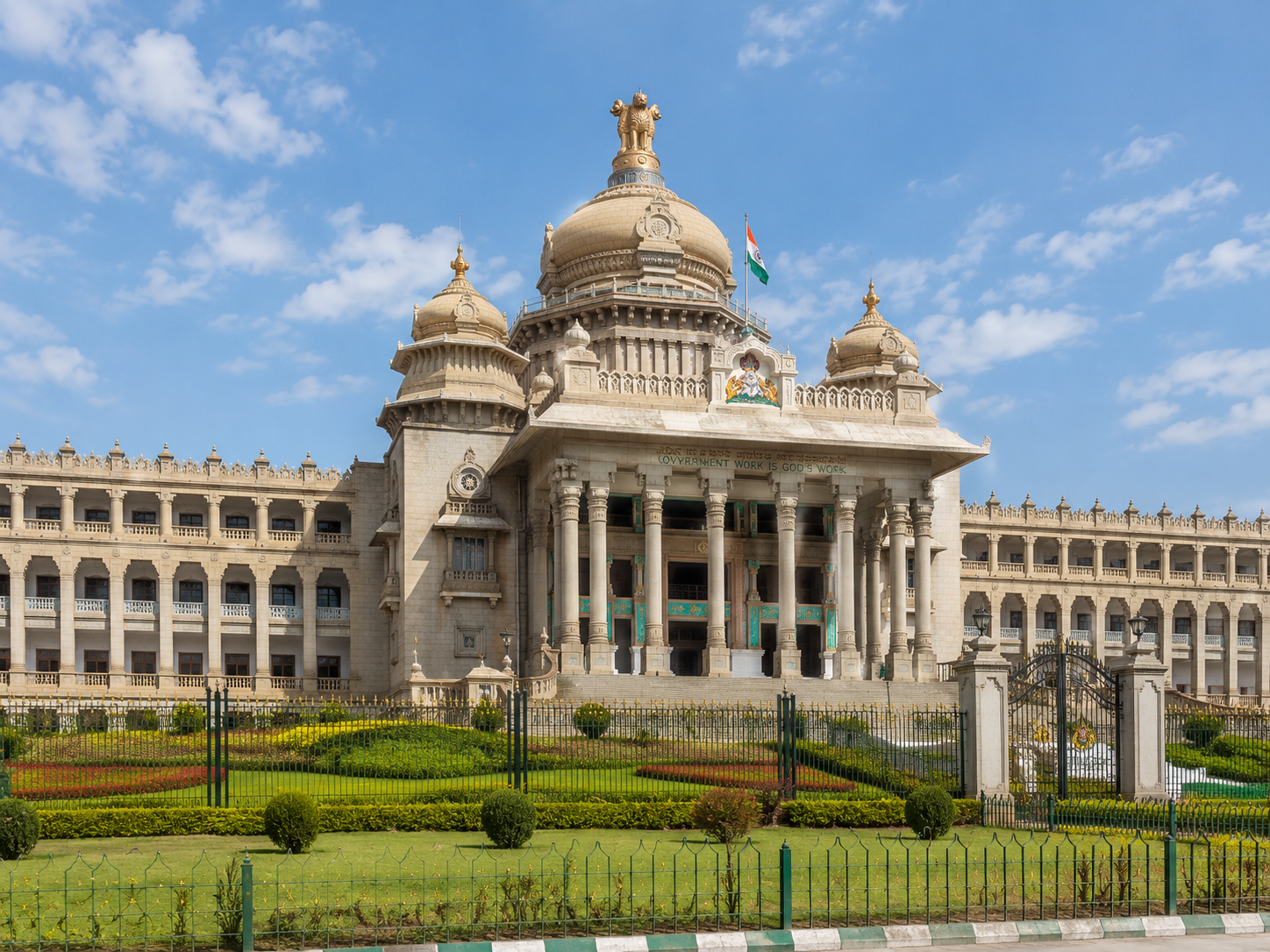
Fig. 6.12 — Vidhana Soudha houses the legislature in Karnataka. This building was envisioned by Kengal Hanumanthaiah, a freedom fighter, member of the Constituent Assembly, Chief Minister of Karnataka, and later a Member of Parliament.
🔍 Let’s Explore
What type of legislature does your state have — unicameral or bicameral?
Show Answer
Check whether your state is in the bicameral list (Andhra Pradesh, Bihar, Karnataka, Maharashtra, Telangana, Uttar Pradesh) — these have both a Vidhan Sabha and a Vidhan Parishad. All other states are unicameral, with only a Vidhan Sabha. (For example, Telangana and Andhra Pradesh are bicameral.)
🧠 Check Your Understanding — Judiciary & State Structures
LOTS What is the Vidhan Sabha called at the Union level? What is the Vidhan Parishad called at the Union level?
Show Answer
At the Union level, the equivalent of the Vidhan Sabha is the Lok Sabha (Lower House), and the equivalent of the Vidhan Parishad is the Rajya Sabha (Upper House).
Medium What is the Concurrent List? Give an example and explain what happens if the Union and a State disagree on that subject.
Show Answer
The Concurrent List contains subjects on which both the Union and State governments can make laws. An example is education (as seen with the RTE Act). If the Union legislates on a Concurrent List subject, the state government is bound to follow the Union law — meaning the Union’s law takes precedence in case of conflict, even though states normally also have law-making power on that subject.
HOTS Why was it necessary to create a third, separate Judiciary branch instead of letting the Legislature or Executive check themselves?
Show Answer
Self-policing creates a conflict of interest — if the Legislature or Executive could decide for themselves whether their own actions were constitutional, they would have every incentive to rule in their own favour, undermining the rule of law. An independent Judiciary, with no political stake in the outcome, can interpret the Constitution impartially and strike down laws or actions that violate it. This ensures a genuine system of checks and balances, where no single branch becomes too powerful or escapes accountability — protecting citizens’ rights even against the government itself.
HOTS Only six states have a bicameral legislature. What might be the advantages and disadvantages of having a Vidhan Parishad?
Show Answer
Advantages: A Vidhan Parishad provides a more deliberative, less politically volatile space for reviewing legislation, bringing in experienced individuals (sometimes nominated for expertise in fields like literature, science or social service) who might not win direct elections; it acts as a check against hasty decisions by the directly-elected Vidhan Sabha. Disadvantages: It adds cost and complexity, can be used to accommodate politicians who lost direct elections (raising legitimacy questions), and may slow lawmaking. This is likely why most states use a simpler unicameral system.
🚧 Challenges to the Effective Functioning of the Legislatures
- The Indian legislature (Parliament and State Assemblies) has the critical role of: enacting laws, overseeing administration, approving the budget, and providing a platform for discussing national policies, development plans, international relations and public grievances.
- However, it faces several challenges: regular absenteeism of members; non-cooperative conduct; reduced quality of debates; and disruptions of the Question Hour.
🔑 Key Term — Productivity
Productivity (Parliamentary context): Measured by the number of hours the Lok Sabha or Rajya Sabha actually functioned against the time it was scheduled to.
- The Parliament typically meets three times a year — these are called ‘sessions’: the Budget Session, Monsoon Session, and Winter Session.
- Each session has ‘sittings’, where Parliament deliberates on laws, discusses governance, and seeks explanations from the Executive.
- Usually, Parliament sits for 6 hours a day during sessions — extendable for urgent business. State Assemblies have similar schedules.
Declining Sittings Over Time
| Period of Lok Sabha | Sessions | Sittings |
|---|---|---|
| 1st Lok Sabha (1952–1957) | 14 | 677 |
| 2nd Lok Sabha (1957–1962) | 16 | 567 |
| 10th Lok Sabha (1991–1996) | 16 | 423 |
| 13th Lok Sabha (1999–2004) | 14 | 356 |
- The Parliament and State Assemblies were envisioned as spaces for thoughtful debates where laws are made in the interest of the people.
- When debates are disrupted, sessions cut short, and bills take years, it becomes a matter of concern.
- Concerns have been expressed that a substantial proportion of Lok Sabha representatives have criminal cases against them.
- Many sessions are marked by angry or biased debates that do not seriously address people’s issues.
- The media plays an important role in communicating the concerns of the electorate — including through political cartoons.
- Our democracy grows stronger when citizens stay informed and engaged — asking questions, sharing views, and participating in public discussions.
- Many young leaders and diverse voices are entering public life, and technology makes it easier to stay connected with governance. As future voters, your choices and participation will play a key role in strengthening Parliament and your state assembly.
💬 Don’t Miss Out — Atal Bihari Vajpayee’s Words
“Sarkaarein aayengi, jaayengi. Paartiyaan banengi, bigadengi. Lekin yeh desh rehna chaahiye, is desh ka loktantra amar rehna chaahiye.”
(Governments will come and go, parties will rise and fall. But the nation must endure, and its democracy must live on.)
📌 Before We Move On…
- India’s Parliamentary system ensures that power is shared, decisions are debated, and leaders are held accountable.
- The Legislature makes laws, the Executive implements them, and the Judiciary ensures they follow the Constitution.
- The Parliament represents the voice of the people and reflects the federal spirit of our democracy.
- Both at the Centre and in the states, structures are designed to balance representation, responsibility, and unity.
- Checks and balances between institutions help protect citizens’ rights and uphold democratic values.
- The functioning of Parliament needs to become more efficient and productive so that the country’s progress is not thwarted.
📝 Questions and Activities
1. Find out how many representatives from your state are in each House of the Parliament.
Show Answer
Activity: Look up your state’s number of Lok Sabha seats (based on population) and Rajya Sabha seats on the Parliament of India website. For example, Telangana has 17 Lok Sabha and 7 Rajya Sabha seats; Andhra Pradesh has 25 Lok Sabha and 11 Rajya Sabha seats. Find and note your own state’s figures.
2. What makes the Indian Parliament the “voice of the people”? How does it ensure that different opinions are heard?
Show Answer
Parliament is the “voice of the people” because its Lok Sabha members are directly elected by citizens through universal adult franchise, so they represent the people’s will. It ensures different opinions are heard through debates, the Question Hour, participation of opposition parties, parliamentary committees, and translation services in many languages — allowing representatives from all regions, parties and communities to express their views before laws are made.
3. Why do you think the Constitution made the Executive responsible to the Legislature?
Show Answer
The Constitution made the Executive responsible to the Legislature so that those who run the government (ministers) remain accountable to the elected representatives of the people. This prevents the Executive from becoming an unchecked, arbitrary power. Through mechanisms like the Question Hour and collective responsibility to the Lok Sabha, the people — via their representatives — can question, guide and, if necessary, remove a government that loses their confidence.
4. Why do you think we have chosen the system of bicameral legislature at the Union level?
Show Answer
India chose a bicameral system so that a single directly-elected House would not have unchecked power. The Rajya Sabha (Council of States) gives representation to the states in the spirit of federalism, provides a stable, permanent body that cannot be dissolved, and allows a second, more deliberative review of laws — acting as a check against hasty decisions by the Lok Sabha.
5. Try to track the journey of a recent bill passed by the Parliament.
Show Answer
Activity: Choose a recent bill (e.g. from the government’s PRS Legislative Research or Sansad websites). Note which House it was introduced in, whether it went to a committee, any major debates or disagreements, and how long it took from introduction to Presidential assent. Present your findings as a simple timeline like the RTE story in this chapter.
6. Choose a recent law and role-play the process (model Parliament).
Show Answer
Activity: Divide into teams — MPs debating in the Lok Sabha and Rajya Sabha, ministers answering questions, and the President giving assent. Pick a real bill, act out its introduction, reading, committee review, debate, voting in both Houses, and finally assent. This “model Parliament” skit helps you experience how a bill becomes a law.
7. The Women’s Reservation Bill, 2023, was passed with wide support. Why might it have taken over 25 years?
Show Answer
Despite wide support in principle, the bill took over 25 years because of disagreements over details — such as how reserved seats would be rotated among constituencies, and demands for sub-quotas for women from certain communities. Building consensus across many parties, managing political concerns of sitting MPs, and finding the right timing all delayed it — showing how even popular reforms can take long when the details are contested.
8. What impact does disruption of Parliament have on the quality of laws and public trust?
Show Answer
When Parliament is disrupted and does not function for its scheduled days, bills get passed with less debate and scrutiny, lowering the quality of laws and sometimes leaving flaws unaddressed. It also wastes public money and time, and damages people’s trust in their representatives — citizens feel their concerns are being ignored while politicians quarrel. This weakens the accountability and credibility of democracy itself.
9. Create ‘interest’ groups and list questions to ask your MP and/or MLA. How would these differ?
Show Answer
Activity: Form groups around interests (education, sports, environment, etc.). Questions to an MP would concern national or Concurrent List matters (national laws, central schemes, defence, foreign policy), while questions to an MLA would concern state and local matters (State List subjects like local roads, state schools, police, water supply). The difference reflects the different powers of the Union and State legislatures.
10. What is the role of the Judiciary in Indian democracy? What could happen without an independent judiciary?
Show Answer
The Judiciary interprets and applies laws, resolves disputes, safeguards fundamental rights, and acts as custodian of the Constitution — checking that the Legislature’s laws and the Executive’s actions do not violate it. Without an independent judiciary, the government could make and enforce unfair laws with no impartial check, citizens’ rights could be violated freely, and the powerful could escape accountability — turning democracy into arbitrary rule.
🧠 Final Review — Challenges & The Big Picture
LOTS What are the three sessions of Parliament called? How many hours a day does Parliament typically sit?
Show Answer
The three sessions are the Budget Session, Monsoon Session, and Winter Session. Parliament typically sits for 6 hours a day during sessions, though this can be extended for urgent business.
Medium Name three challenges to the effective functioning of legislatures. How does declining “productivity” affect Parliament?
Show Answer
Three challenges: (1) regular absenteeism; (2) non-cooperative/disruptive conduct; (3) disruptions of the Question Hour, which reduces executive accountability. Declining productivity means fewer hours are actually spent debating bills and policies versus scheduled time — as in the Rajya Sabha example, productivity fell from 78% (2004–14) to 65%, with some sessions as low as 6.80%. This means less time for thoughtful lawmaking and oversight, weakening the quality of governance.
HOTS “A substantial proportion of Lok Sabha representatives have criminal cases against them.” How might this affect public trust, and what role can voters play?
Show Answer
It can seriously undermine public trust, since lawmakers are expected to uphold and create laws yet some face legal scrutiny — creating a perception that the system tolerates questionable conduct. Voters can address it by: (1) researching candidates’ backgrounds (criminal records are publicly disclosed during nominations); (2) choosing not to vote for candidates with serious charges, even from a preferred party; (3) demanding transparency from parties in selecting candidates. This connects to the importance of an informed and vigilant voter.
HOTS How does Vajpayee’s statement relate to “checks and balances,” and why are disruptions a threat to this vision?
Show Answer
Vajpayee’s statement stresses that democratic institutions and values are larger than any single government or party — power is temporary, but the systems of accountability must stay strong. This relates to checks and balances: if one institution or party disrupts the functioning of others for political gain, democracy’s long-term health suffers. Parliamentary disruptions threaten this because when debates are blocked or sessions cut short, the Legislature fails in its core duty of scrutinising the Executive and making thoughtful laws — so checks and balances break down in practice, which is why citizen awareness and engagement are essential.