

On June 1, 2026, protesters were detained outside the Ministry of Education in New Delhi. Students held signs that asked a single question: “Why is Dharmendra Pradhan still the Education Minister?” Across India — in Hyderabad, Ranchi, Jaipur, Delhi, Lucknow — students, opposition workers and parents burned effigies of the same man. The Congress president said the buck stops at the top. Rahul Gandhi said he would not stop until Pradhan resigned. Arvind Kejriwal asked if India “desperately needed” new leadership. The Cockroach Janta Party gathered 22 million followers partly on the demand for his removal. And through all of it — the cancelled exam, the student suicides, the CBI investigation, the Supreme Court notices, the street protests — Dharmendra Pradhan remained in his chair. This is the story of why.
📋 What Happened — The Crisis That Should Have Cost Him His Job
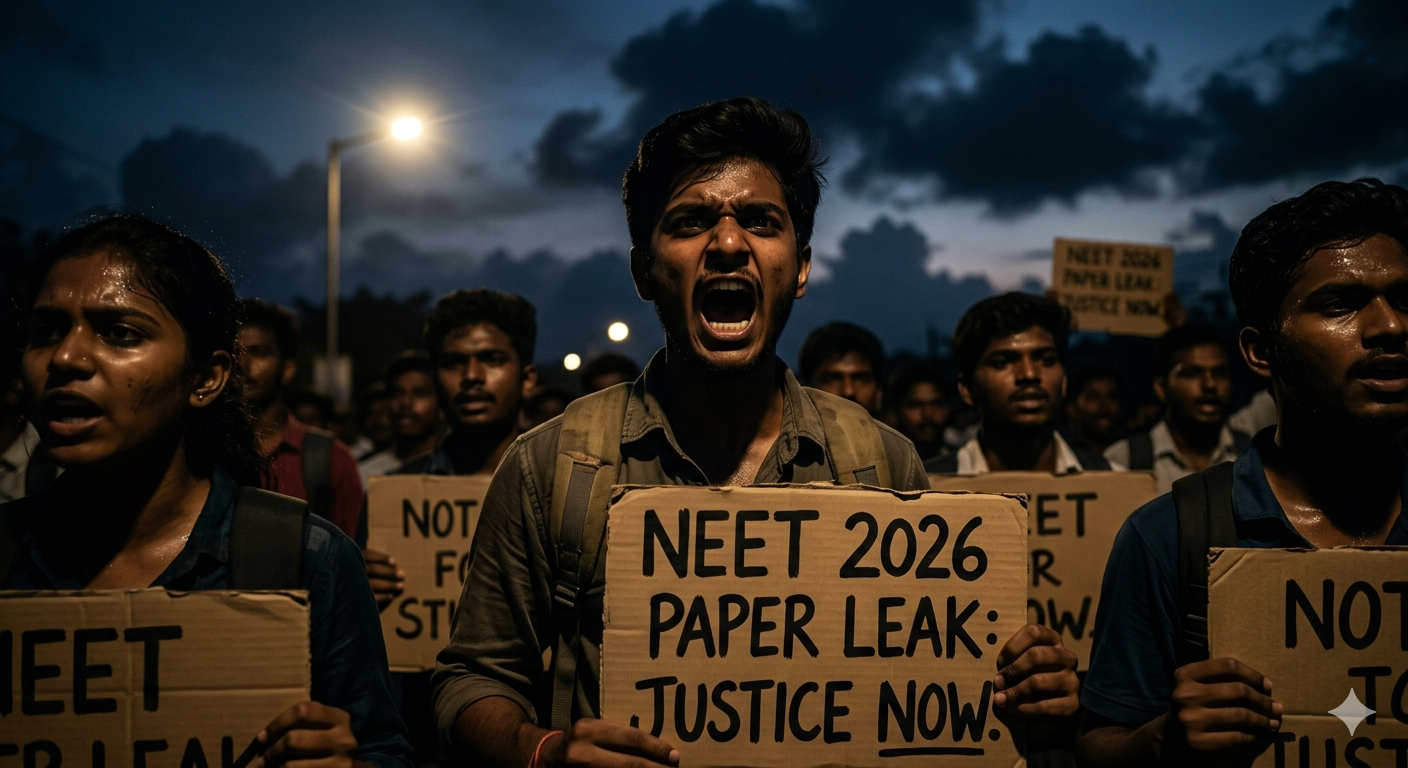
On May 3, 2026, over 22 lakh students — 2.2 million young Indians — sat for NEET UG 2026, India’s national medical entrance examination conducted by the National Testing Agency. These students had spent years preparing. Their families had sold land, taken loans, and worked extra jobs. All of it for this one exam.
Nine days later, on May 12, the NTA cancelled the entire exam. A coordinated paper leak had compromised the examination before it was even conducted. The NEET-UG exam was cancelled and rescheduled for June 21. The CBI launched an investigation. A key accused, Shubham Khairnar, was sent to judicial custody. And at least three students — Maithili Sonwane, 18, from Maharashtra; Pradeep Manich, 23, from Rajasthan; and Harsh Dubey from Uttar Pradesh — died by suicide in the aftermath of the cancellation, unable to bear the weight of starting over.
The CBI investigation revealed that the same criminal network had compromised NEET UG 2025 as well. Two consecutive years. The Supreme Court itself noted that “NTA hasn’t learned its lesson.” Students and opposition parties intensified criticism of the Centre’s handling of examinations, with members of the All India Students’ Association staging demonstrations outside the Ministry of Education demanding accountability for recurring examination irregularities.
Dharmendra Pradhan — as Union Education Minister — is the political head of the ministry that oversees the NTA. The NTA is his responsibility. The examination system is his responsibility. The students whose futures were destroyed are his responsibility.
And yet he did not resign. He was not removed. He remains in office today.
🗣️ Who Is Demanding His Resignation — And How Loudly
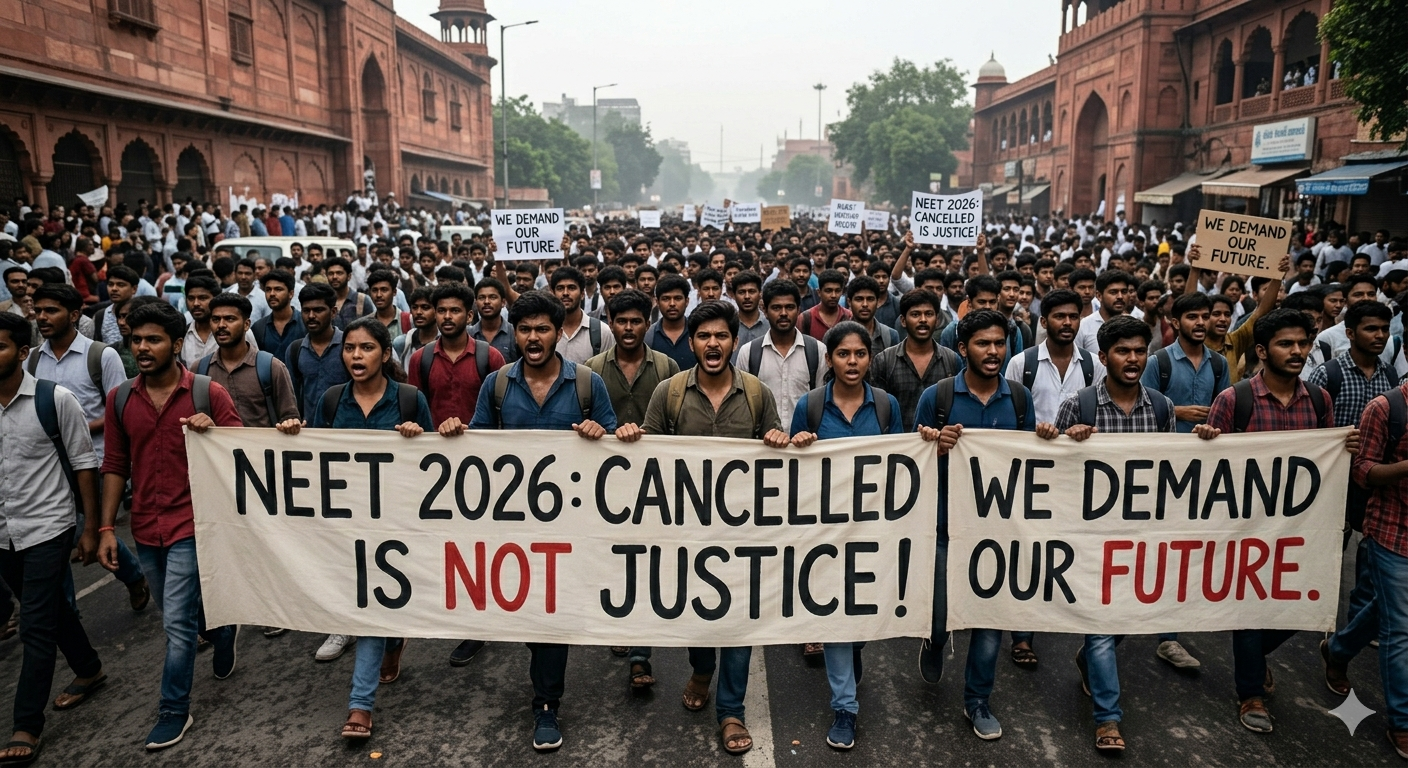
The demand for Dharmendra Pradhan’s resignation is not coming from one corner. It is coming from every direction simultaneously — and that breadth is significant.
Rahul Gandhi and Congress: Rahul Gandhi demanded Education Minister Dharmendra Pradhan’s resignation over the NEET controversy. He said the Congress would continue protesting until a foolproof anti-paper leak system is created. Gandhi accused the government of remaining silent while students protested. “Until Dharmendra Pradhan resigns and a foolproof system is established to prevent paper leaks like NEET, we will not stop,” Gandhi said. “Modi ji neither took responsibility, nor removed Dharmendra Pradhan, nor uttered a single word,” Gandhi added, accusing BJP state governments of “raining lathis” on student protesters.
Arvind Kejriwal and AAP: AAP national convener Arvind Kejriwal questioned the government’s competence, asking whether the country “desperately needed” new leadership on education. AAP has been consistently demanding Pradhan’s resignation since the 2024 NEET controversy and intensified those demands after the 2026 cancellation.
Students on the streets: Protesters outside the Ministry of Education said: “We were here protesting against the leak that has been happening. Why is the government not demanding the resignation of Union Minister Dharmendra Pradhan? We will not let this government play with our future.”
Abhijeet Dipke and the Cockroach Janta Party: The founder of the Cockroach Janta Party initiated a significant campaign calling for Pradhan’s resignation. “More than 22 lakh students’ futures were jeopardised due to systemic failures,” Dipke stated. He remarked that despite public outrage, there has been no significant accountability at higher levels of governance.
Parliamentary Standing Committee: The Parliamentary Standing Committee on Education met to discuss NEET and NTA issues. Chairman Digvijaya Singh said panel members across party lines were unanimous — “regardless of which party they belong to, all the members are unanimous in their stance.” When even parliamentary committee members from across party lines agree — that is a political signal of the highest order.
CPI(M) and Left parties: CPI(M)’s Polit Bureau demanded Pradhan’s resignation, saying the crisis is not merely the result of corruption but of “centralisation, commercialisation and communalisation” in the education sphere.
🛡️ Why Dharmendra Pradhan Is Not Resigning — The Real Reasons
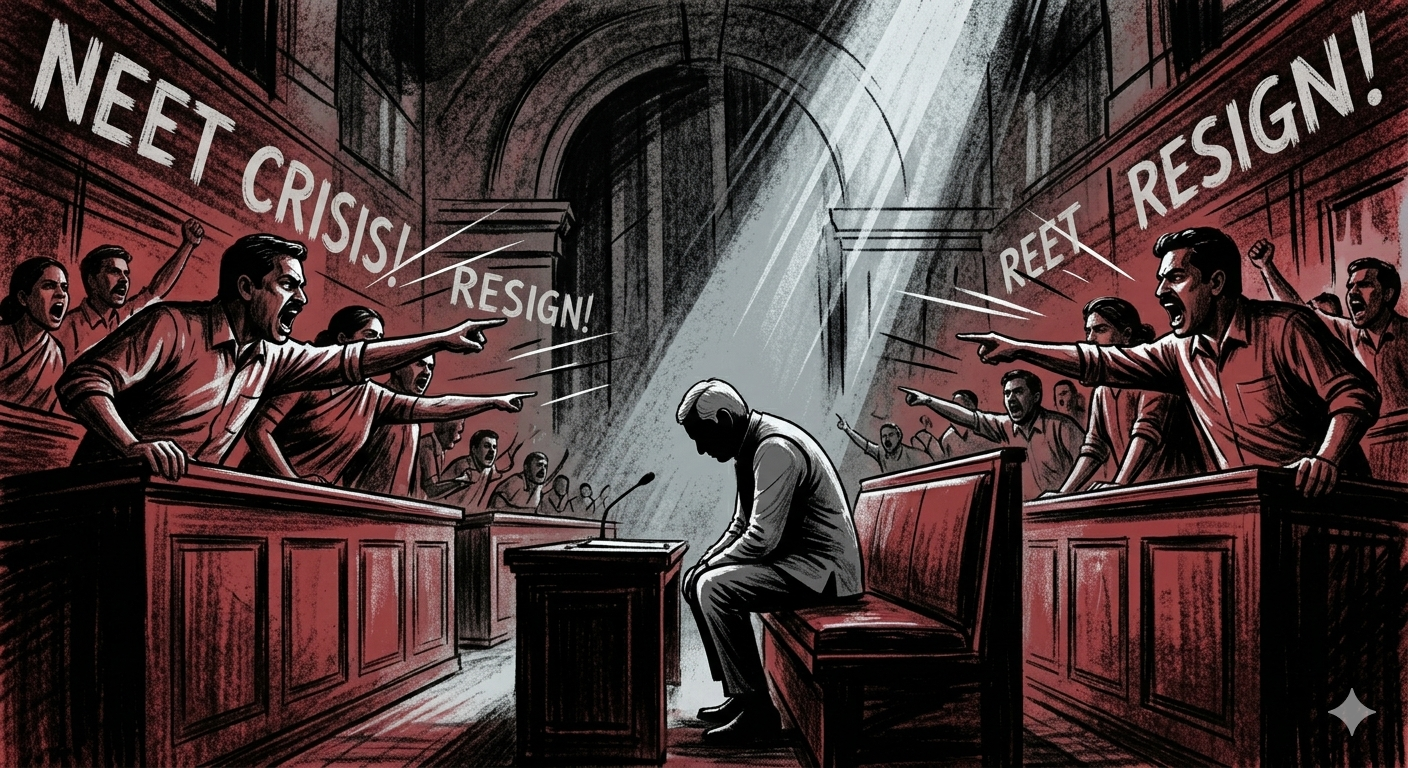
To understand why Pradhan has not resigned, you need to understand how Indian cabinet politics actually works — and what his resignation would actually mean.
Reason 1 — In India’s cabinet system, ministers resign when the Prime Minister asks them to. Not before.
India follows the Westminster model of cabinet government. Individual ministers serve at the pleasure of the Prime Minister. A minister does not resign simply because the opposition demands it — that would make governance impossible. A minister resigns when the Prime Minister loses confidence in them, or when a court orders it, or when the scandal becomes so politically damaging that keeping them becomes worse than removing them. None of these thresholds have yet been crossed for Pradhan.
Prime Minister Modi has not publicly called for Pradhan’s resignation. He has not publicly commented on the NEET crisis at all. Senior Congress leader Digvijaya Singh said: “If the paper is leaked under the PM’s watch, we will have to ask for the PM’s resignation.” That escalation — from demanding the minister’s resignation to demanding the PM’s — is exactly the political trap that Modi is trying to avoid. If he removes Pradhan, it implies the PM bears responsibility too.
Reason 2 — Removing Pradhan would be an admission of systemic failure — not just individual failure.
The NEET crisis is not new. It happened in 2024. Again in 2025. Again in 2026. Three consecutive years. If the government removes Pradhan now, it implicitly acknowledges that the ministry failed three times under his watch. Congress president Mallikarjun Kharge said the crisis showed “paper leaks, corruption, irregularities and education mafia has infiltrated the education system” — and that “the buck stops at the doorstep of the top echelons of the Modi government.” Removing Pradhan hands the opposition exactly the narrative they want.
Reason 3 — Pradhan is one of BJP’s most politically valuable assets in Odisha.
Dharmendra Pradhan is from Odisha — a state where the BJP has invested enormous political capital and recently made significant electoral gains. He is a senior RSS pracharak, a trusted Modi loyalist, and one of the most experienced ministers in the cabinet. Removing him sends a signal of political weakness in a state the BJP cannot afford to lose. In Indian coalition politics, the calculus of ministerial survival is never purely about the scandal — it is about what the removal costs the ruling party electorally.
Reason 4 — Pradhan has consistently denied personal responsibility and deflected blame.
Pradhan maintained that the NTA had conducted 240 examinations since its formation with over four crore fifty lakh students appearing, and that there was nothing to hide. By consistently blaming the NTA as an “autonomous body” and pointing to the CBI investigation as evidence that the government is taking action, Pradhan has created political space between himself and the scandal. He is the minister, but NTA is the agency — and bureaucratic distance is a politician’s oldest defence.
Reason 5 — The BJP’s political calculation: waiting it out works.
Indian political scandals follow a predictable cycle. Outrage peaks. Protests intensify. Then the news cycle moves on. The BJP’s political strategists have seen this cycle play out many times. They are betting that if they can ride out the immediate storm without a ministerial resignation, the political cost will be lower than the cost of the narrative that a resignation would create. ThePrint’s political analysis noted that keeping Pradhan raises the question: “Does PM Modi not trust his education minister to fix the problem?” — a political bind that Modi has created for himself.
⚖️ What Accountability Actually Looks Like in Indian Politics
The honest answer to “why won’t Pradhan resign” requires confronting an uncomfortable truth about Indian political culture: ministerial accountability in India is weak by design and weaker in practice.
In the United Kingdom — from whose Westminster model India inherited its parliamentary system — ministers have resigned over far less. The principle that a minister is accountable for their department — regardless of personal culpability — is embedded in British political culture even if imperfectly applied.
In India, that principle has never truly taken root. The culture of ministerial accountability has been replaced by a culture of ministerial survival — where the goal is to outlast the scandal, not to take responsibility for it. This is not unique to the BJP or to Pradhan. It is a systemic feature of Indian political culture that has persisted across governments and parties. But it is uniquely painful when the victims are 22 lakh students who had no recourse and in some cases, no tomorrow.
📊 The Re-NEET — Will It Fix Anything?
The government’s response to the 2026 cancellation has been to schedule a re-examination on June 21. Students who lost their exam due to the paper leak are being asked to prepare again, sit again, and trust again — the very system that failed them.
The re-NEET itself carries enormous risks. The same NTA that failed to secure the original examination is conducting the re-examination. The CBI investigation is still ongoing — raising the question of whether all members of the criminal network have been identified. If a second examination is compromised, it would be a political catastrophe that no amount of deflection could contain.
More fundamentally, a re-examination does not address the structural failures that enabled the leak. The Parliamentary Standing Committee’s unanimous finding across party lines is that the examination system needs fundamental reform — not a new date, but a new architecture. A re-examination conducted by the same institution with the same architecture is not a solution. It is a gamble.
🔮 What Should Actually Happen — The Real Accountability
Whether or not Dharmendra Pradhan resigns, India’s education examination crisis demands structural responses that go far beyond one minister’s tenure.
First, the NTA requires fundamental structural reform — not cosmetic changes. The NTA chief was sacked after the 2024 scandal. The institution continued failing. Sacking individuals without reforming systems produces no lasting change.
Second, the criminal networks behind paper leaks must be dismantled — not just prosecuted after each incident. The CBI has identified the same network operating across 2025 and 2026. Every node of it must be identified, prosecuted and imprisoned with deterrence severe enough that participation becomes catastrophically unfavourable.
Third, compensation and support for affected students is not optional — it is a moral obligation. Students who spent years and family savings preparing for NEET 2026 deserve more than a new exam date. They deserve acknowledgment, financial support and psychological care.
And fourth — ministerial accountability must mean something. If a minister oversees a system that fails in the same way in three consecutive years, resulting in student deaths, nationwide protests and a Supreme Court rebuke, that minister should answer for it. Not because the opposition demands it. But because accountability is what distinguishes a government that serves its people from one that merely survives them.
💔 The Children Who Cannot Wait for Politics to Sort Itself Out
Maithili Sonwane was 18 years old when she died. Pradeep Manich was 23. They are not political pawns. They were students who believed in a system that betrayed them.
Every day that passes without genuine accountability — not theatrical resignation demands, not press conferences, not tweets — is a day that tells every student currently preparing for Re-NEET 2026 that their future is less important than ministerial survival.
The question “why won’t Pradhan resign?” has political answers that are clear and unsurprising. But the question that matters more — “why has no one been held genuinely accountable for three consecutive years of examination failure?” — has answers that indict not just one minister, not just one government, but a political culture that has normalised the sacrifice of student futures on the altar of institutional self-preservation.
India’s students are not asking for sympathy. They are asking for a system that works. They are asking for an examination they can trust. They are asking for the basic social contract that every government owes its people: if you follow the rules, the rules will be fair.
Until that contract is honoured — with or without Dharmendra Pradhan’s resignation — India’s education crisis will not end. It will simply wait for the next scandal, the next cancellation, and the next generation of students whose futures are collateral damage in a system that has never truly been fixed.
❓ FAQs
Why is Dharmendra Pradhan being asked to resign?
As Union Education Minister, Pradhan is the political head of the ministry overseeing the NTA, which conducted NEET UG 2026. When the exam was cancelled due to a paper leak — the third consecutive year of NEET irregularities — opposition parties, students and civil society held him politically accountable for the systemic failure.
Has Pradhan offered to resign?
No. Pradhan has consistently denied personal responsibility, blamed the NTA as an autonomous body, pointed to the CBI in