

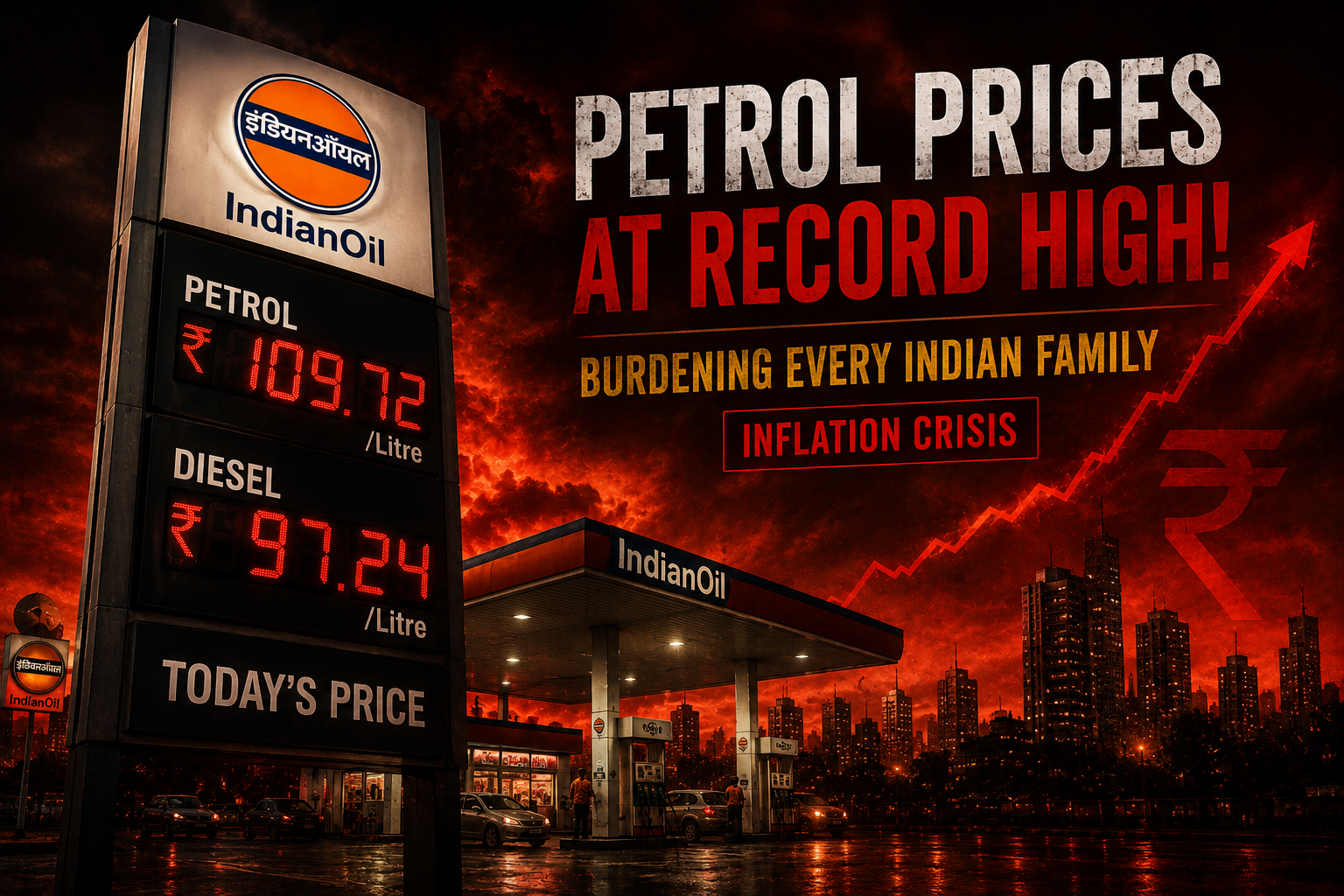
Global crude oil prices fell nearly 20% in May 2026. Brent crude dropped from a peak of nearly $126 per barrel to around $91. The Middle East ceasefire talks gave the world hope. Markets cheered. And then Indians woke up to the fourth petrol price hike in less than 11 days. Petrol crossed ₹111 per litre. Diesel crossed ₹97. The auto-rickshaw driver, the farmer, the middle-class family driving their child to school — all of them paying more, even as the world’s oil became cheaper. How is this possible? And more importantly — will it ever stop?
⛽ The Numbers That Don’t Add Up — Until You Understand the System
Let us be precise about what happened in 2026.
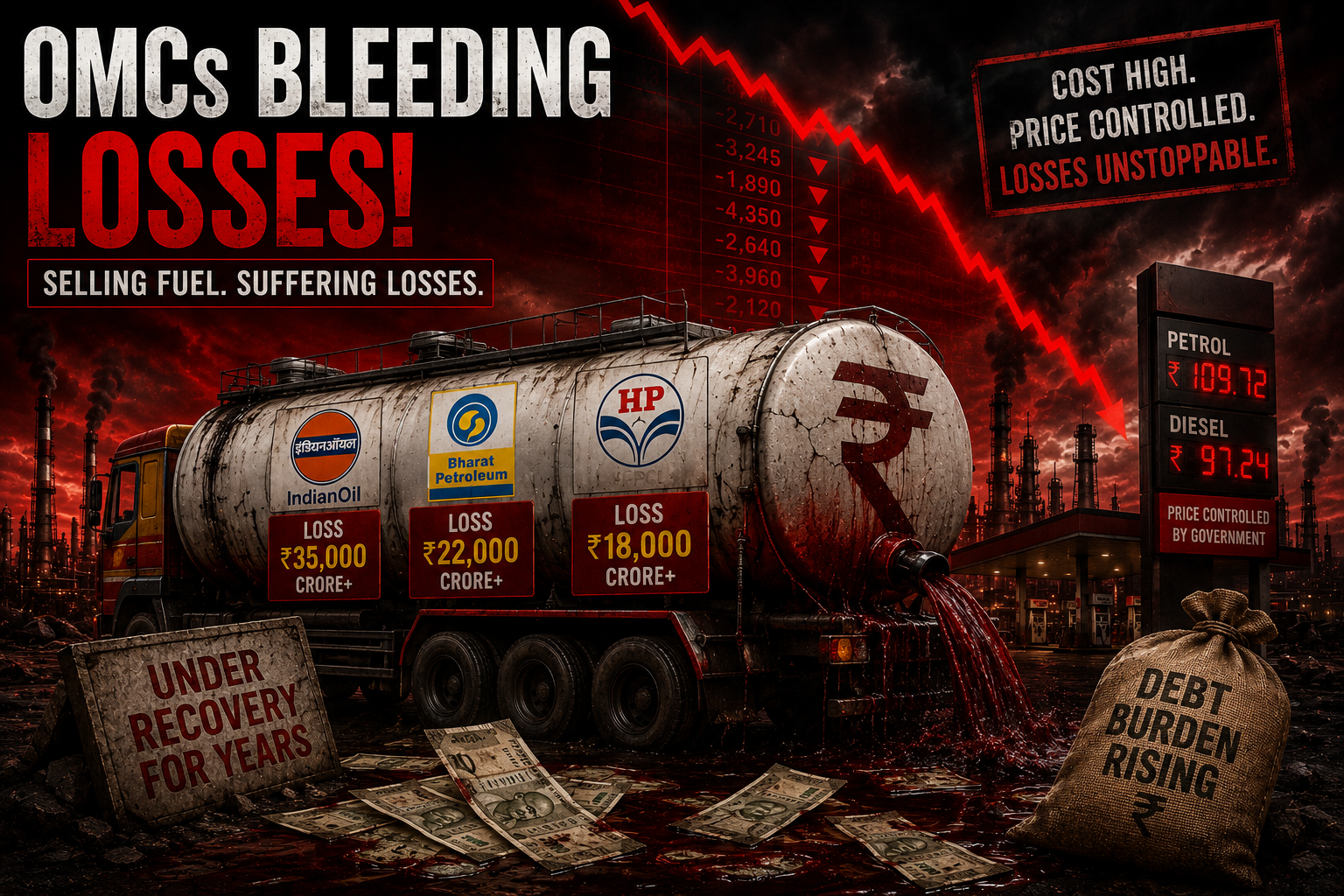
When the US-Iran conflict escalated in early 2026 and the Strait of Hormuz was disrupted, Brent crude surged from around $70 per barrel to nearly $126 per barrel — an 80% spike in weeks. For 76 days, India’s government held petrol and diesel prices frozen. It was absorbing the pain on behalf of consumers. Oil Marketing Companies — Indian Oil, BPCL, HPCL — were losing approximately ₹24 per litre on petrol and ₹30 per litre on diesel. Their combined losses reached ₹30,000 crore per month — nearly ₹1,000 crore every single day.
Then on May 15, May 19 and May 23, the government implemented phased price hikes. Petrol went up by a cumulative ₹4.74 per litre. Diesel rose ₹4.82 per litre. And then on May 25 came the fourth hike — petrol up another ₹2.61, diesel up ₹2.71. In less than 11 days, fuel prices rose by approximately ₹7.50 per litre.
But here is what the government did not loudly announce: by the time these hikes were implemented, global crude prices had already started falling. Brent dropped 17% in May alone — its sharpest monthly correction in years. By May 29, it was trading at around $91 per barrel. The hikes came after crude had already peaked and started falling.
So why did prices still go up? The answer requires understanding a system that has been deliberately kept complicated — because simplicity would make ordinary Indians too angry.
🧮 The Hidden Tax Bomb Inside Every Litre of Petrol
Here is the truth that the government never puts on a billboard.
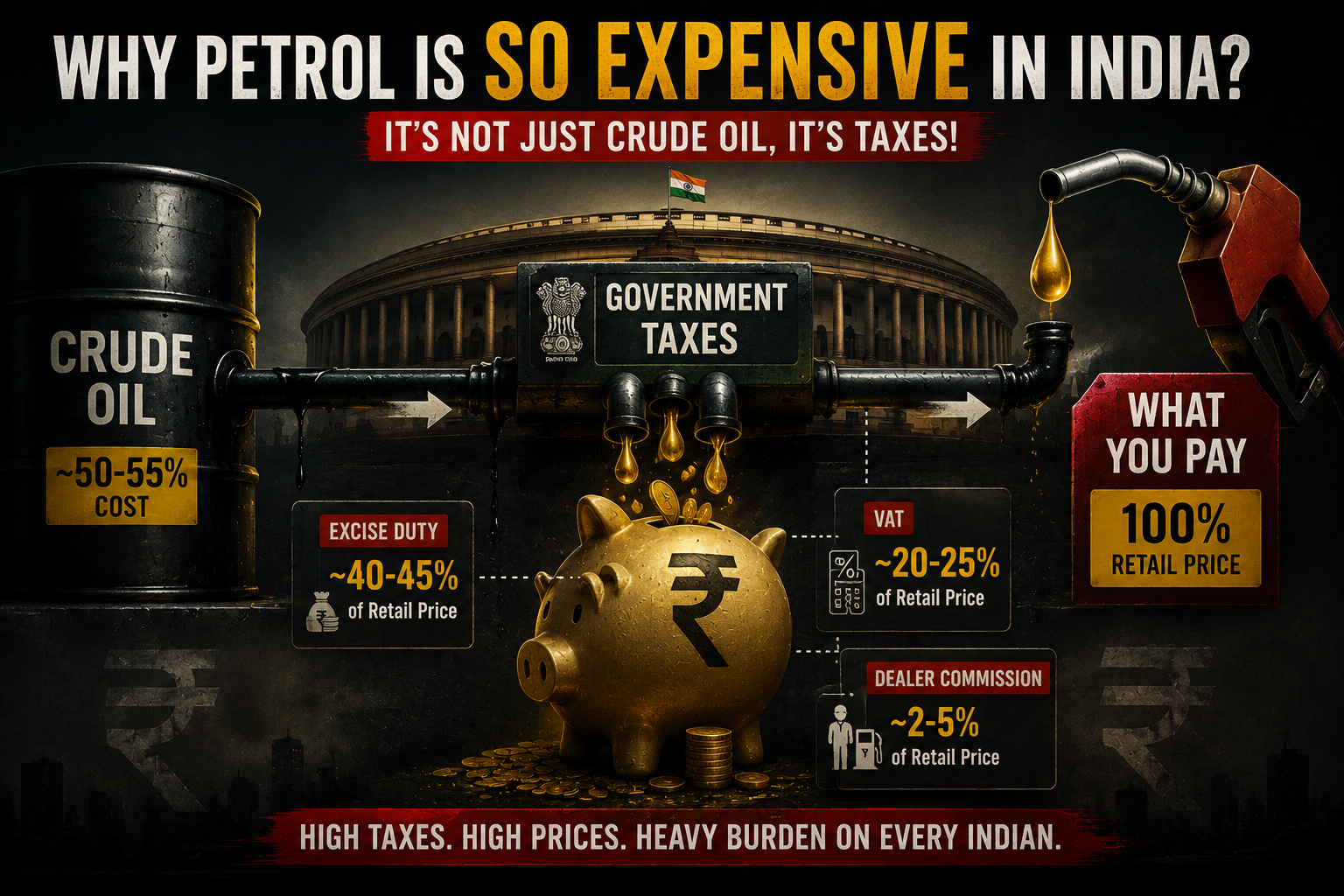
Of every ₹111 you pay at a petrol pump in India today, the actual cost of crude oil, refining and distribution is roughly ₹50. The remaining ₹61 — more than 55% of the price you pay — is tax. Government tax. Central excise duty alone is ₹21.90 per litre. Then state governments add their own Value Added Tax — which ranges from 25% to 32% depending on where you live. Andhra Pradesh charges the highest — 31% VAT plus additional cesses. Maharashtra adds 25% VAT plus ₹5.12 per litre extra for Mumbai.
And here is the most infuriating part: VAT is charged as a percentage of the price. So when the base price rises, the VAT amount also rises automatically. The government earns more money every time petrol becomes more expensive — without doing a single thing. It is a built-in revenue accelerator that grows every time you suffer.
Petrol and diesel remain deliberately outside the GST framework. Why? Because if they came under GST, the maximum tax rate would be capped at 28%. Right now, total taxes exceed 55%. Bringing fuel under GST would reduce government revenue by an estimated ₹1 lakh crore per year. Neither the central government nor any state government wants that. So the system stays exactly as it is — opaque, punishing, and profitable for the state.
🩸 The OMC Bleeding — India’s Oil Companies Are in Crisis
To understand why prices rise even when crude falls, you must understand what happened to India’s three state-run Oil Marketing Companies — Indian Oil Corporation, Bharat Petroleum and Hindustan Petroleum — during the 2026 oil shock.
These companies buy crude oil at international prices, refine it, and sell petrol and diesel at prices set or heavily influenced by the government. During the 76-day price freeze while crude was at $100-126 per barrel, they were selling fuel at a massive loss. Every litre of petrol sold was a loss of ₹18-24. Every litre of diesel was a loss of ₹30-35.
Multiply those losses by India’s daily fuel consumption — hundreds of millions of litres every day — and you get losses of ₹1,000 crore per day at the peak of the crisis. By April 2026, the combined under-recovery of India’s OMCs was estimated at ₹30,000 crore per month.
These are not abstract corporate losses. These are losses being carried by companies that have borrowed money, have employees, have supply chains, and have balance sheets that affect banks, investors and the broader economy. When OMCs bleed at this scale, they cut investment, delay maintenance, reduce hiring and eventually weaken the entire fuel supply infrastructure of the country.
So even as crude oil prices started falling in late May 2026, the OMCs were still sitting on accumulated losses from weeks of selling below cost. The price hikes were not about current crude prices. They were about recovering past losses. You were paying today for oil that was bought at peak prices weeks ago.
🌊 The Rupee Factor — The Hidden Multiplier
There is another reason why falling global crude prices do not automatically mean lower Indian petrol prices — the rupee.
India buys crude oil in US dollars. When the rupee is weak against the dollar, every barrel of oil costs more in rupee terms — even if the dollar price of crude stays the same or falls. In 2026, the rupee fell from around 84 per dollar to nearly 97. That is a 15% depreciation.
Here is what that means in practice: If crude oil costs $91 per barrel and the rupee is at 84, the cost in rupees is ₹7,644 per barrel. If crude oil costs the same $91 but the rupee has fallen to 97, the cost in rupees is ₹8,827 per barrel — ₹1,183 more, with zero change in the global price.
So India faces a double squeeze: when crude rises globally, import costs rise. But even when crude falls, a weakening rupee eats up the saving. Indian consumers get the worst of both worlds. The only scenario where prices genuinely and sustainably fall is when crude falls AND the rupee strengthens simultaneously — a combination that requires both geopolitical calm and strong economic fundamentals. Neither condition fully exists in India right now.
🏛️ The Political Economy of Pain — Who Benefits From High Fuel Prices?
This is the question that politicians of every party prefer not to answer honestly.
When crude oil prices fall globally and India’s petrol prices do not fall proportionately, the difference goes somewhere. It goes to the government — as excise duty revenue. Between 2014 and 2022, the central government raised excise duty on petrol from ₹9.48 per litre to over ₹32 per litre. It quietly doubled and tripled fuel taxes during periods of low crude prices, pocketing the savings that should have gone to consumers.
The government’s own data confirms this. In FY 2020-21, when crude oil collapsed during COVID to as low as $20 per barrel, the central government actually raised excise duty by ₹13 per litre on petrol and ₹16 per litre on diesel — collecting additional revenue of over ₹3.7 lakh crore that year from fuel taxes alone while consumers got minimal relief.
In March 2026, when the Middle East crisis pushed crude past $100, the government reduced the Special Additional Excise Duty on petrol from ₹13 to ₹3 per litre — a partial reversal. It was a concession extracted by crisis, not a gift. And in May 2026, even as prices were being hiked, the central government raised excise duty on petrol by ₹3 per litre and diesel by ₹10 per litre — quietly, in the same breath as consumer relief announcements.
The game is always the same. When crude is cheap, raise taxes — consumers don’t notice. When crude is expensive, cut taxes slightly — claim credit for relief. The net result over a decade: fuel taxes as a percentage of the retail price have gone up substantially, and the government has extracted enormous revenue from ordinary Indians who had no choice but to keep paying.
🔮 Will Prices Ever Come Down? The Honest Answer
Here is the honest analysis — not the optimistic press release version.
In the short term — some relief is possible. Global crude has already fallen 20% from its 2026 highs. Brent was trading around $91 per barrel on May 29. If the US-Iran ceasefire holds and the Strait of Hormuz reopens to normal shipping, crude could fall further — potentially to $75-80 per barrel. If the rupee stabilises or strengthens as geopolitical tensions ease, OMC losses would narrow. At that point, the government would come under political pressure to reduce prices — especially ahead of elections in several states.
In the medium term — the picture is complicated. OMCs need to recover their accumulated losses of tens of thousands of crores before they can contemplate price reductions. Even if crude falls to $80, prices may be held flat while OMCs rebuild their balance sheets. The Finance Ministry has signalled it cannot keep funding OMC losses indefinitely. The question is not just what crude costs today but what it cost over the last six months — and that average is still painfully high.
The structural problem — taxes will not fall easily. State governments across India — regardless of which party rules them — are addicted to fuel tax revenue. It funds roads, welfare schemes, salaries and subsidies. No state government will voluntarily cut VAT significantly. The central government has shown a consistent pattern of raising excise duty when crude is low. Unless there is extraordinary political pressure — election-driven or otherwise — the tax component of fuel prices will remain high regardless of what crude does.
The one real hope — GST inclusion. The Finance Minister has announced that states will be given the authority to decide on a GST rate for petrol and diesel. If petrol comes under GST at the maximum rate of 28%, the total tax burden could fall from over 55% to 28% — potentially reducing petrol prices by ₹30-40 per litre overnight. This would be the single biggest fuel price reform in India’s history. But it requires every state to agree to give up substantial revenue. The political negotiation required is enormous. It has been discussed for years and never happened. Whether the 2026 crisis is the moment that finally forces this change is the most important fuel-related question in India’s near future.
⚡ The Electric Vehicle Revolution — India’s Long Term Exit
There is one genuinely hopeful long-term trend in this story.
Prime Minister Modi, in a public address in Hyderabad in May 2026, urged Indians to use public transport and electric vehicles to reduce fuel dependence. India’s EV adoption is accelerating — electric two-wheelers and three-wheelers are growing rapidly. The government’s production-linked incentive for EV manufacturing, the expansion of charging infrastructure, and the falling cost of batteries are all moving in the right direction.
India imports over 85% of its crude oil. Every litre of petrol replaced by electricity generated from domestic sources — coal, solar, wind — reduces India’s vulnerability to Middle East crises, to dollar fluctuations, and to the whims of OPEC. India has 300 days of sunshine per year. Its solar energy potential is among the highest in the world. The long-term answer to India’s fuel price problem is not negotiating better with oil producers. It is building an economy that needs oil less.
But that transition takes years — possibly decades at scale. For the auto-rickshaw driver sitting at a petrol pump today, watching the meter tick past ₹500 for a tank fill, the long-term future offers cold comfort.
💔 The Bottom Line — A System Designed to Extract, Not Protect
India’s fuel pricing system is not designed primarily to protect consumers. It is designed primarily to generate government revenue while managing political optics.
When crude is cheap, taxes rise silently. When crude is expensive, taxes fall partially and loudly. The net result across cycles is that the government always wins and the consumer always pays more than they should in a transparent, market-linked system.
The 2026 crisis has been painful for ordinary Indians in ways that go beyond the petrol pump. Higher fuel prices raise the cost of transporting every good — vegetables, medicines, building materials, manufactured products. Inflation rises. The Reserve Bank of India keeps interest rates high to control that inflation. Higher rates make home loans, business loans and car loans more expensive. The auto-rickshaw driver’s suffering ripples through the entire economy.
Petrol at ₹111. Diesel at ₹97. A rupee at 97 per dollar. Crude oil falling globally. And prices in India still rising.
You are not misunderstanding the system. The system is working exactly as designed — just not in your favour.
The only question that remains is when enough Indians understand this clearly enough to demand it change.