

In 2020, India made the most ambitious decision about its children’s future in 34 years. The National Education Policy 2020 — NEP 2020 — replaced an education framework that had been governing Indian schools and universities since 1986. A framework designed for a different India, a different economy, and a different world. NEP 2020 promises to transform how 26.5 crore Indian students learn, what they learn, and why they learn it. Six years later, the changes are visible — but so are the challenges. This is everything every Indian parent, student and teacher needs to know about NEP 2020.
📜 What Is NEP 2020 — And Why Was It Needed?
The National Education Policy 2020 is India’s third national education policy — after the policies of 1968 and 1986. Approved by the Union Cabinet on July 29, 2020, NEP 2020 replaced the National Policy on Education 1986 — a 34-year-old framework that was built for an India that no longer exists.
The 1986 policy was designed for an industrial economy where most jobs required specific, narrow skills learned through fixed academic streams. In 2020, India faces a completely different reality — an economy being transformed by artificial intelligence, automation, and globalisation, where the most valuable skills are creativity, critical thinking, adaptability, and the ability to learn continuously throughout a career.
The vision of NEP 2020 is captured in five words: Access, Equity, Quality, Affordability, and Accountability. It aims to create an education system that reaches every child, treats every child fairly, produces genuine learning rather than examination performance, does not price families out of quality education, and holds institutions accountable for outcomes rather than just inputs.
🏗️ The Biggest Change — From 10+2 to 5+3+3+4
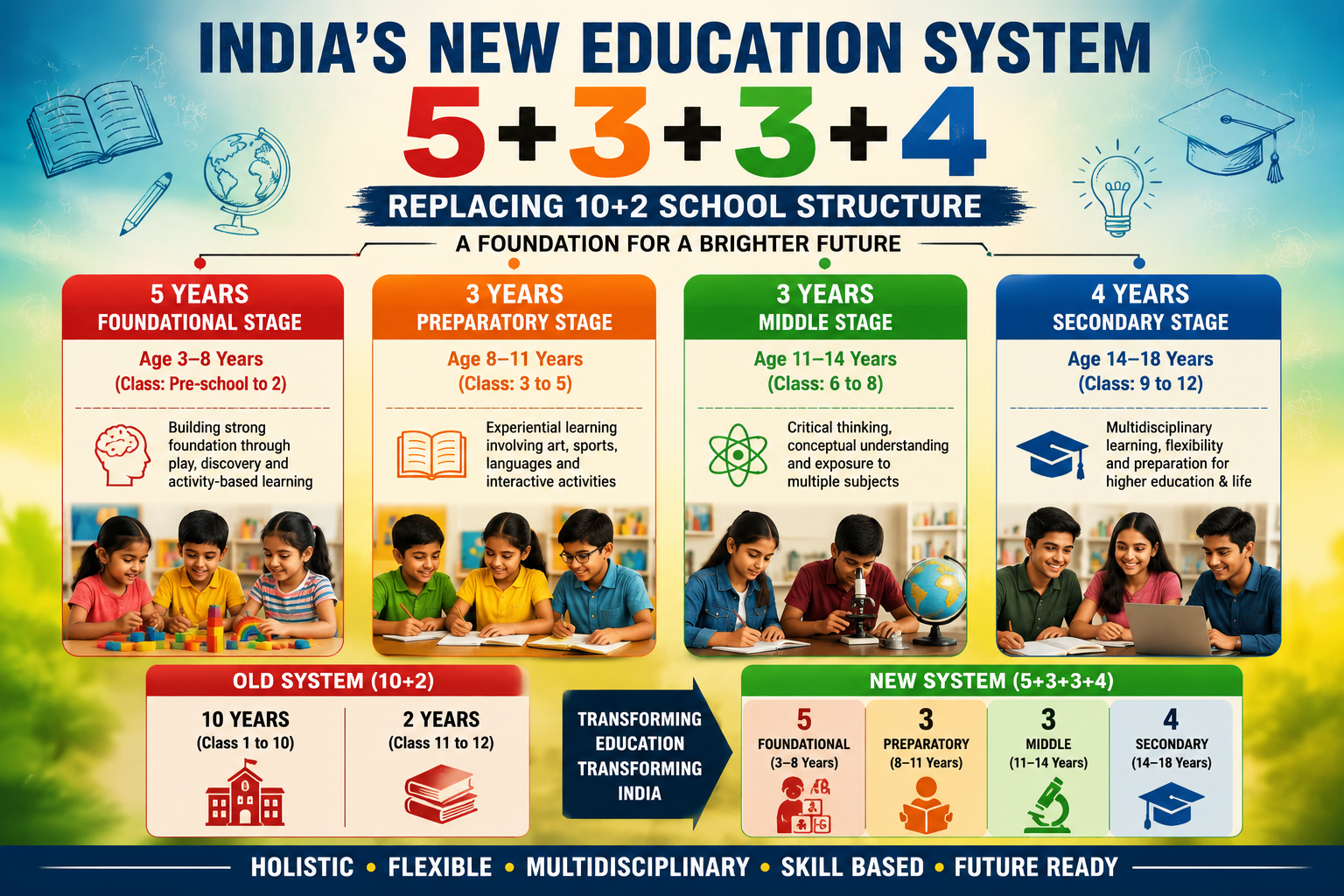
The most visible and fundamental change in NEP 2020 is the replacement of the old 10+2 school structure with a new 5+3+3+4 structure that covers children from age 3 to age 18.
- Foundational Stage — 5 years (Ages 3-8): Pre-primary and Classes 1-2. Emphasis on play-based and activity-driven learning. This is the most critical stage for cognitive development — NEP recognises that learning before age 8 shapes a child’s entire educational trajectory.
- Preparatory Stage — 3 years (Ages 8-11): Classes 3-5. Focus on foundational literacy, numeracy, and experiential learning. Children begin structured subject learning but through discovery and activity rather than rote memorisation.
- Middle Stage — 3 years (Ages 11-14): Classes 6-8. Introduction of subject-based learning and critical thinking. Vocational education begins here — coding, agriculture, local crafts, and practical skills are integrated.
- Secondary Stage — 4 years (Ages 14-18): Classes 9-12. Greater flexibility, multidisciplinary studies, and career exploration. Students can choose subjects across streams — a Science student can study History, an Arts student can study Mathematics.
The elimination of rigid stream separation after Class 10 is revolutionary. Under the old system, a student who chose Science in Class 11 could not easily study Economics or History alongside Physics. NEP 2020 ends this artificial separation — recognising that the best engineers understand society, the best doctors understand economics, and the best leaders understand everything.
🎓 What NEP 2020 Changes in Higher Education
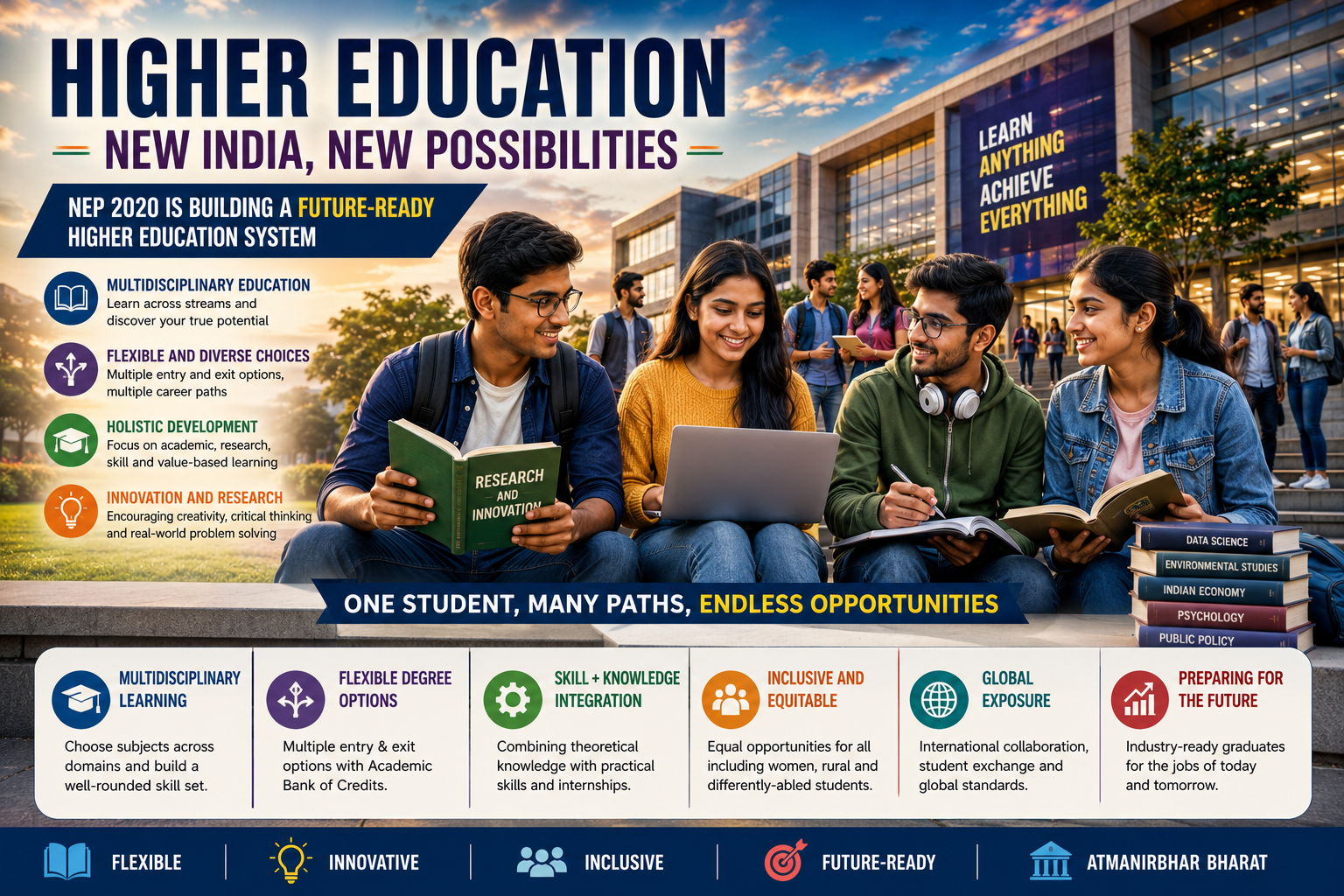
The changes in higher education under NEP 2020 are equally significant — and directly affect every student currently in or preparing to enter college.
Four-year undergraduate degree with multiple exit options: Under the old system, a three-year Bachelor’s degree was the standard. Under NEP 2020, the standard Bachelor’s degree is four years — but students can exit at different points with different qualifications. Exit after one year gets a Certificate. Exit after two years gets a Diploma. Exit after three years gets a Bachelor’s degree. Complete four years and get a Bachelor’s with Research. This flexibility means a student who needs to leave college for financial reasons does not leave empty-handed — they carry a recognised qualification.
Academic Bank of Credits: NEP 2020 introduces the Academic Bank of Credits — a digital storehouse where students can deposit credits earned from different institutions and programmes and use them toward a degree. A student can study at one university for two years, take a break, study at another institution, and combine credits toward a single qualification. This portability is completely new to Indian higher education.
Multidisciplinary Education and Research Universities (MERUs): NEP envisions the creation of world-class multidisciplinary universities — modelled on MIT and Oxford — where engineering students study philosophy, medical students study economics, and law students study computer science. The goal is to increase India’s Gross Enrolment Ratio in higher education from 26.3% to 50% by 2035.
Replacement of UGC, AICTE, and NCTE: NEP 2020 proposes replacing the University Grants Commission (UGC), the All India Council for Technical Education (AICTE), and the National Council for Teacher Education (NCTE) with a single Higher Education Commission of India (HECI) — a unified regulatory body that eliminates the bureaucratic fragmentation that has hampered Indian higher education for decades.
🌍 The Mother Tongue Revolution — Teaching in Indian Languages
One of the most significant and most debated changes in NEP 2020 is the emphasis on mother tongue as the medium of instruction in the foundational years.
NEP 2020 implements local language as a medium of instruction for children in the early years. This will help them understand concepts and enhance their confidence. The policy recommends that wherever possible, the medium of instruction until at least Grade 5 — and preferably Grade 8 — should be the home language or mother tongue.
The reasoning is solid and backed by research. A child who learns to read, write and understand mathematical concepts in their mother tongue builds stronger cognitive foundations than a child who must simultaneously learn a new language and new concepts. Once the foundation is built, transition to English or other languages happens more effectively.
For Indian Sign Language — NEP 2020 has introduced ISL as a subject for the first time, with over one thousand ISL videos and talking books developed. This is a landmark recognition of Deaf students’ rights to education in their own language.
📊 5 Years of NEP 2020 — What Has Actually Changed
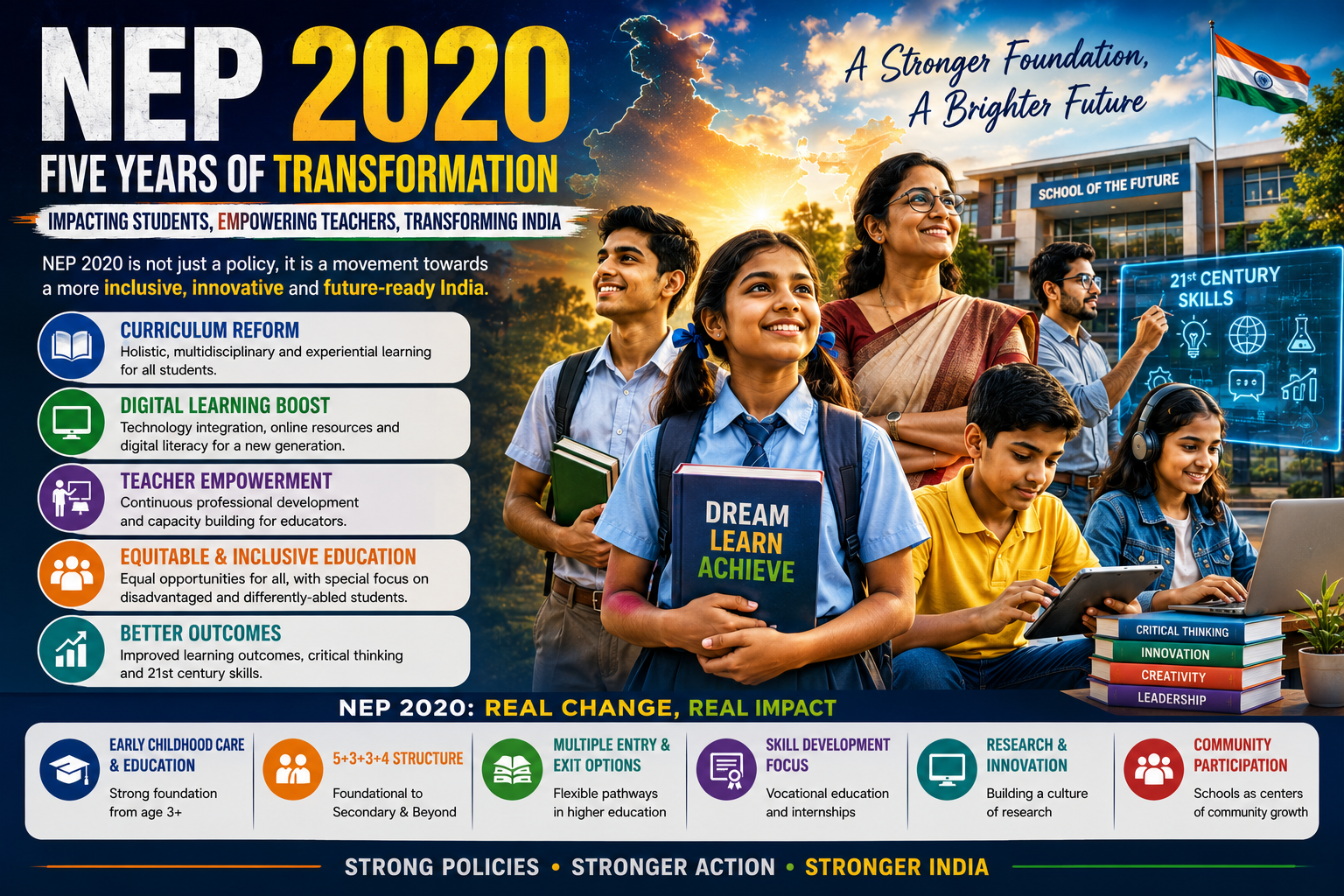
NEP 2020 completed five years on July 29, 2025. The impact over these five years is becoming visible across every stage of learning through meaningful reforms. Here is what has actually been implemented:
NIPUN Bharat: The National Initiative for Proficiency in Reading with Understanding and Numeracy — launched to ensure that every child in India achieves basic reading and arithmetic proficiency by Grade 3. Initiatives like NIPUN Bharat and Vidya Pravesh have benefitted over 4.2 crore students across 8.9 lakh schools.
National Curriculum Framework 2023: India’s new school curriculum framework was released in 2023 — the first update since 2005. It is aligned with NEP 2020’s vision of competency-based learning, reduced syllabus burden, and experiential education.
Flexible undergraduate degrees: Multiple universities including central universities and IITs have begun implementing the four-year undergraduate programme with multiple exit options.
Vocational education integration: Coding, artificial intelligence, and vocational skills have been introduced from middle school level in hundreds of schools across the country.
PARAKH: The Performance Assessment, Review, and Analysis of Knowledge for Holistic Development — India’s new national assessment body — has been established to move away from high-stakes board examinations toward continuous, formative assessment.
⚠️ The Challenges — What NEP 2020 Has Not Yet Solved
Honest assessment of NEP 2020 requires acknowledging the significant implementation gaps that remain five years after its announcement.
Teacher training — the biggest gap: NEP 2020 envisions teachers who facilitate discovery learning, manage multidisciplinary classrooms, and assess students through continuous evaluation rather than annual examinations. But most of India’s 8.5 million teachers were trained under the old system — for rote teaching, fixed streams, and examination-based assessment. Retraining at this scale requires resources and time that the implementation has not yet fully provided.
Infrastructure inequality: NEP 2020’s vision of play-based foundational learning requires space, materials, and trained early childhood educators. In government schools across rural India — where student-teacher ratios can exceed 80:1 and basic infrastructure like toilets and drinking water is still not universal — implementing NEP’s vision faces structural barriers that policy documents alone cannot remove.
State implementation varies enormously: Education is a concurrent subject in India — both central and state governments have responsibilities. States like Karnataka, Maharashtra, and Tamil Nadu have implemented significant NEP reforms. Others have moved more slowly. The result is that NEP 2020’s impact on a child depends heavily on which state they happen to live in.
The medium of instruction debate: The emphasis on mother tongue teaching has created genuine concern among parents — particularly urban, English-medium school parents — that their children will be disadvantaged in a globally competitive environment if English instruction is reduced. This tension between educational research (which supports mother tongue instruction) and parental aspiration (which strongly favours English) is one that NEP has not yet fully resolved.
🔮 What NEP 2020 Means for Your Child
If you are a parent of a child currently in school — here is what NEP 2020 means practically for your family:
- Less rote learning, more understanding: The curriculum is being redesigned to reduce content burden and increase depth. Your child should be learning fewer topics more thoroughly rather than memorising more topics superficially.
- No fixed streams after Class 10: Your child will not be forced to choose between Science, Commerce and Arts at age 15. They can combine subjects freely — study Physics with Economics, or Mathematics with Music.
- Vocational skills from Class 6: Your child will get exposure to coding, agriculture, local crafts, and practical skills from middle school — building real-world capabilities alongside academic knowledge.
- Multiple chances to succeed: Assessment reform means your child will not be judged entirely on one annual examination. Continuous assessment reduces the pressure of single high-stakes tests.
- Flexible higher education: When your child reaches college, they will have the option to exit with a qualification after each year — reducing the risk of dropping out without any recognised credential.
🎯 The Bottom Line — Is NEP 2020 Working?
NEP 2020 is India’s most ambitious educational reform in a generation. Its vision — of holistic, flexible, multidisciplinary, mother-tongue-friendly, skill-integrated education that reaches every child — is correct. The research behind most of its recommendations is sound. The problems it identifies in Indian education are real.
But vision and implementation are two different things. Five years in, NEP 2020 has made genuine progress in some areas — NIPUN Bharat, curriculum reform, flexible undergraduate degrees — while facing serious implementation gaps in teacher training, infrastructure, and state-level execution.
The honest verdict: NEP 2020 is the right policy for the right problems. Whether it transforms Indian education or becomes another ambitious document that changes less than it promised depends on the next five years of implementation — particularly on teacher training, infrastructure investment, and genuine assessment reform at scale.
For India’s 26.5 crore students, the stakes could not be higher. Their ability to compete, contribute, and thrive in the 21st century depends on whether the promise of NEP 2020 becomes the reality of Indian classrooms. That work is still very much in progress. For more on how AI is transforming Indian education alongside NEP 2020, read our complete guide on AI for Students in India 2026 and AI for Teachers in India 2026.
❓ FAQs
What is NEP 2020 in simple words?
NEP 2020 is India’s new National Education Policy announced in July 2020. It replaces the 1986 education policy and changes how Indian schools and colleges work — introducing a new 5+3+3+4 school structure, flexible subject choices, mother tongue instruction, vocational education from Class 6, and four-year undergraduate degrees with multiple exit options.
What is the 5+3+3+4 structure in NEP 2020?
The 5+3+3+4 structure replaces the old 10+2 system. It covers children from age 3 to 18 in four stages: Foundational (5 years, ages 3-8), Preparatory (3 years, ages 8-11), Middle (3 years, ages 11-14), and Secondary (4 years, ages 14-18). Each stage is designed around the developmental needs of children at that age.
Does NEP 2020 remove the Science/Commerce/Arts stream division?
Yes. NEP 2020 ends the rigid separation of Science, Commerce and Arts after Class 10. Students in Classes 11 and 12 will be able to choose subjects freely across all streams — a Science student can study History, an Arts student can study Mathematics, without being restricted to a single stream.
What is the Academic Bank of Credits in NEP 2020?
The Academic Bank of Credits is a digital system where students can store credits earned from different colleges, universities, and online courses. These credits can be combined toward a degree — allowing students to study at multiple institutions, take breaks, and still work toward a unified qualification.
Will NEP 2020 make Hindi compulsory?
No. NEP 2020 does not make Hindi compulsory. The three-language formula recommends that students learn three languages — but states and students have flexibility in choosing which languages. Mother tongue ins