

They said he would be arrested at the airport. He was not. They said the protest would be blocked. It was not. They said 22 million Instagram followers would not show up in real life. They were wrong. On June 6, 2026, Abhijeet Dipke landed in Delhi, walked out of the airport after a tense confrontation with police, and led thousands of young Indians to Jantar Mantar in one of the most dramatic days in recent Indian democratic history. Here is the complete story of what actually happened — minute by minute.
✈️ The Airport Drama — What Really Happened
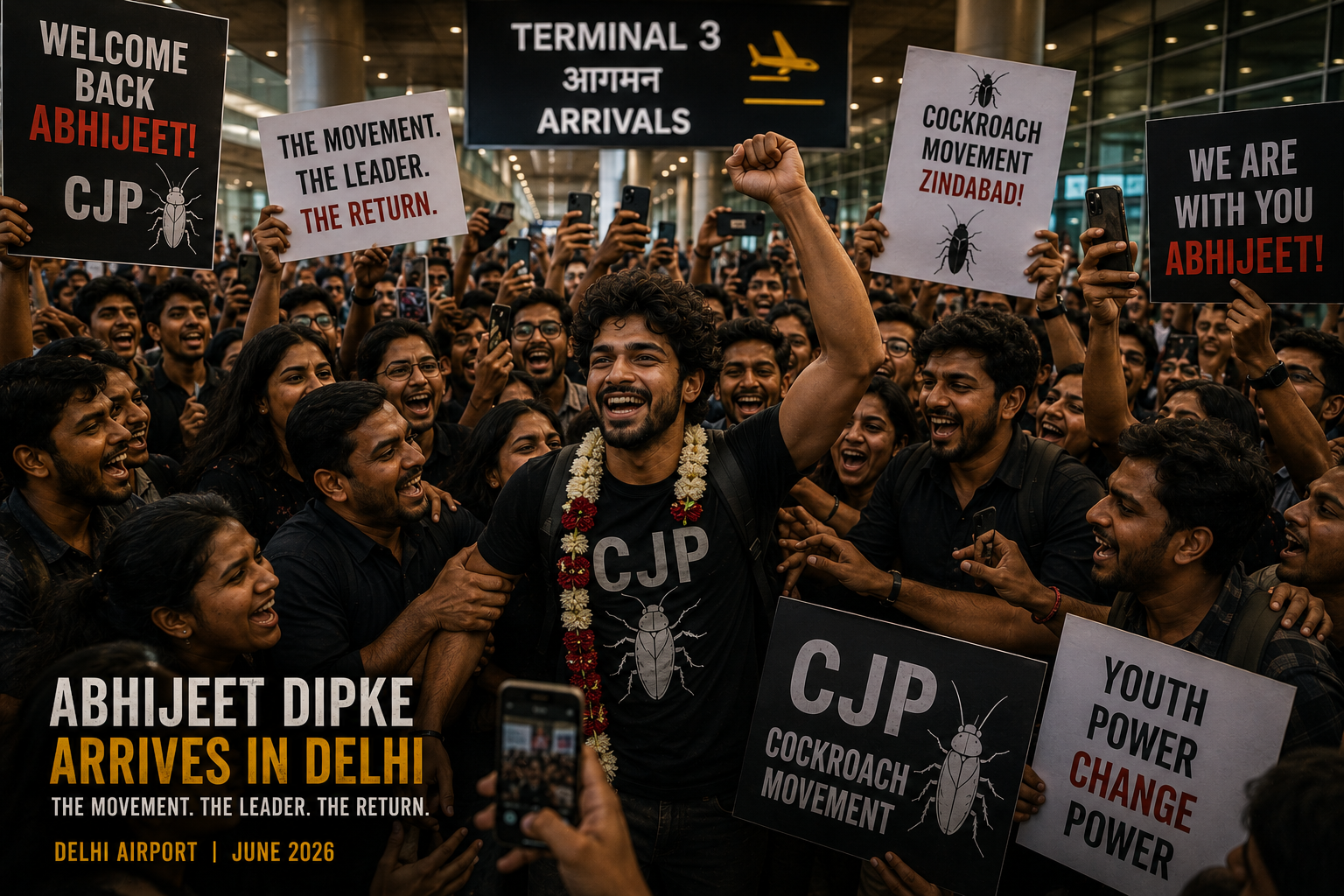
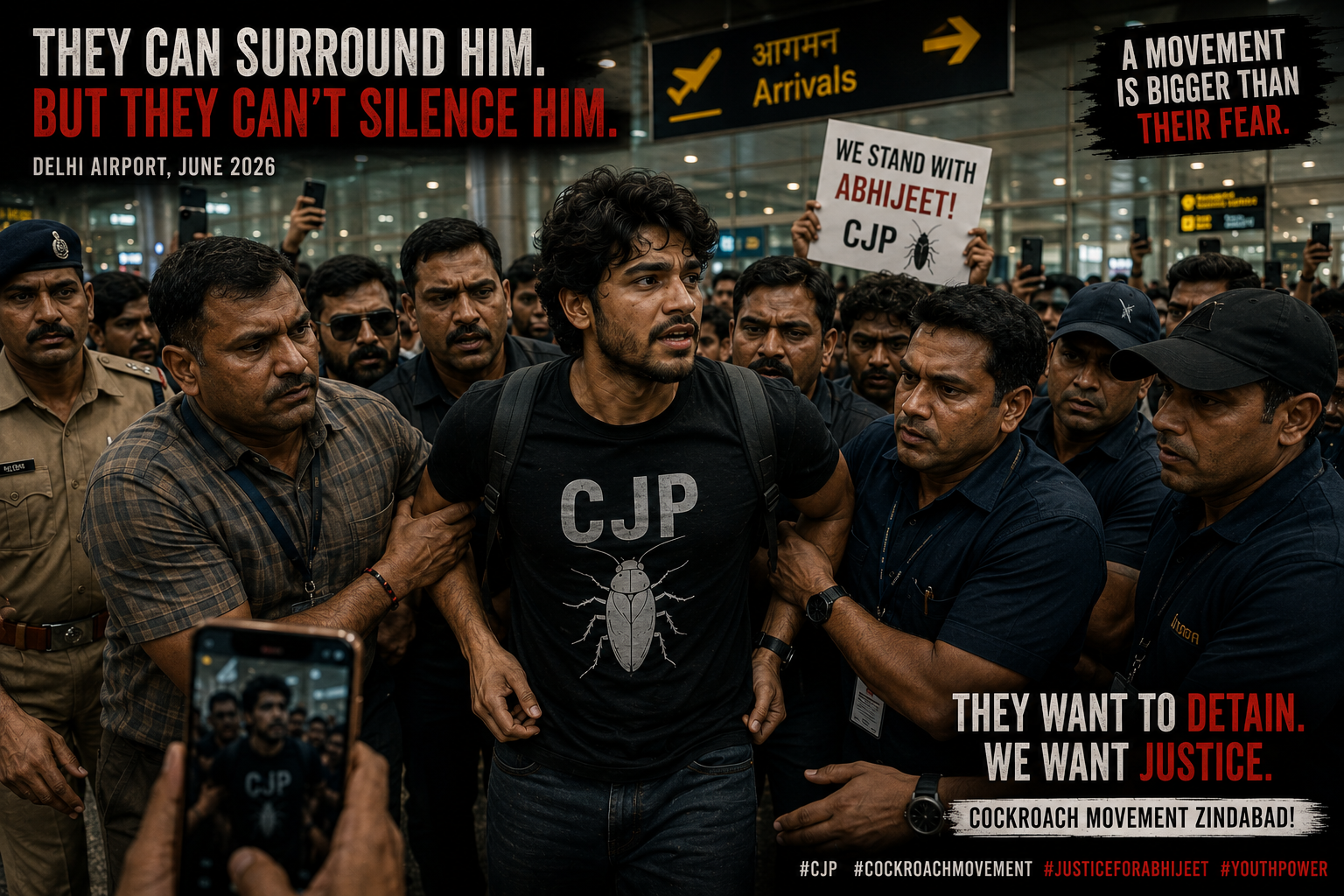
Abhijeet Dipke landed at Indira Gandhi International Airport in Delhi on the morning of June 6, 2026. He cleared immigration. And then — before he could reach the arrival exit — something happened that his supporters watching the live feed on Instagram would spend the next hour in panic over.
22 million followers watched. They waited. They feared the worst. Some called it an illegal detention. Others said it was standard immigration procedure. The government said nothing officially.
And then — Dipke walked out of the airport. On his own feet. Not handcuffed. Not under arrest. Not deported. He walked out, looked at the crowd of supporters waiting for him, and raised his fist.
The cockroaches had not been crushed. The protest was on.
🚔 Delhi Police Grants Permission — The Surprise Decision
What happened next was perhaps more surprising than the airport drama.
This was unexpected. The Delhi High Court had heard a plea against the protest. Security had been beefed up around Jantar Mantar. Every indication before June 6 suggested the government would use every legal tool available to prevent or limit the assembly.
Instead, the police granted permission. The protest would happen — legally, constitutionally, peacefully — exactly as Dipke had promised it would.
The government had made its calculation. Arresting Dipke at the airport would have handed the CJP a martyrdom narrative worth more than any protest. Blocking Jantar Mantar would have been the same. The smarter play — the democratic play — was to let the protest happen and let its size and substance speak for itself.
🪳 Jantar Mantar — The Cockroaches Arrive
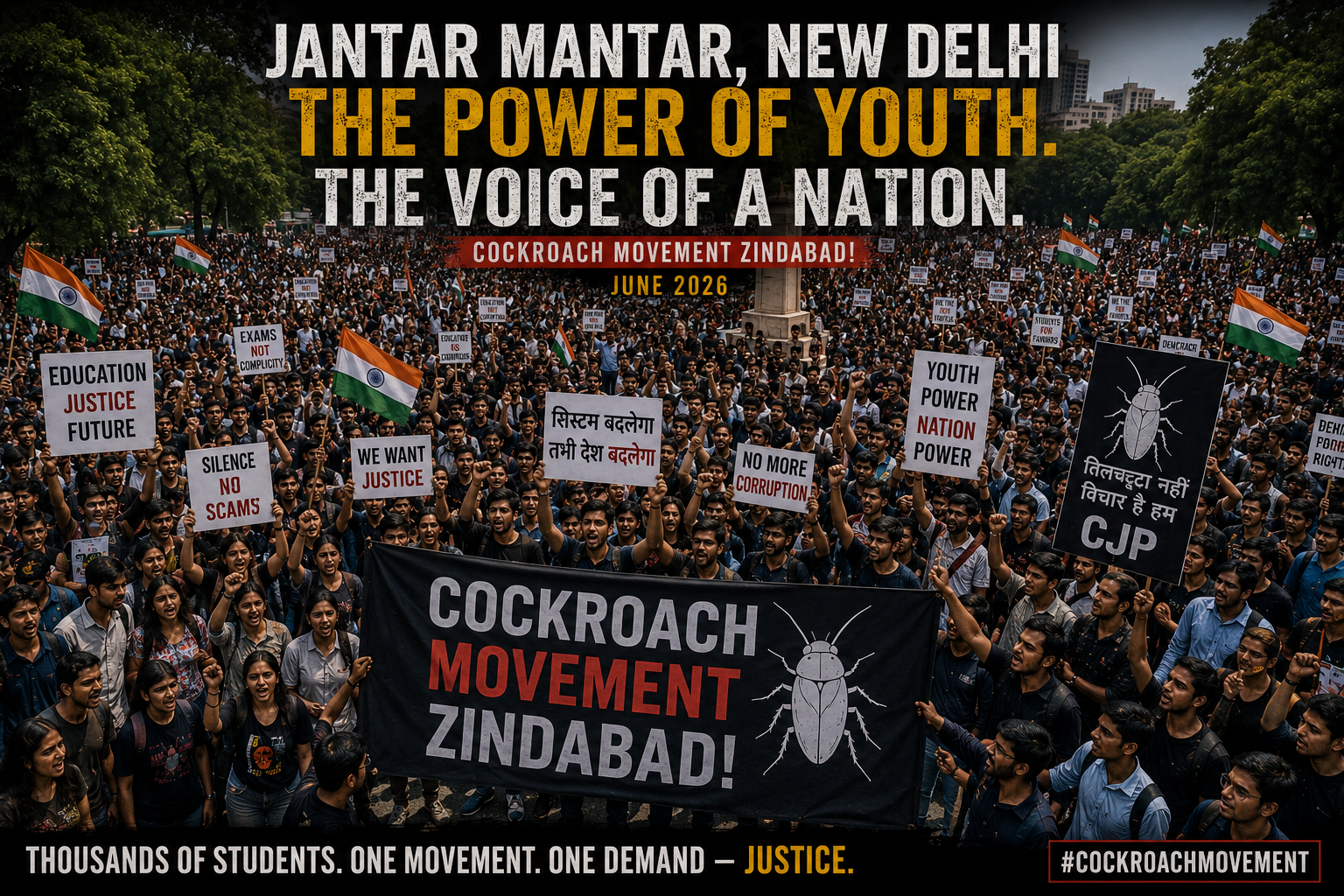
From the airport, Dipke and his supporters made their way to Jantar Mantar — India’s designated democratic protest ground, a few hundred metres from Parliament. What they found there was proof that social media followers can indeed become street protesters.
Students from Delhi universities. Young professionals. Parents of NEET candidates. Teachers. First-time protesters who had never attended a political rally in their lives. They came carrying handmade placards. They wore cockroach costumes. They chanted “Cockroaches aa rahe hain, Dharmendra Pradhan jaa rahe hain” — the cockroaches are coming, Dharmendra Pradhan is leaving.
The slogan captured everything about this movement — its humour, its anger, its refusal to be taken entirely seriously by itself while taking its demands entirely seriously. It is the signature tone of a generation that grew up on the internet: satirical on the surface, genuine underneath.
Dipke addressed the crowd. He spoke about the students who had died by suicide after NEET was cancelled. He spoke about the Education Minister who remains in office despite three consecutive years of examination failure. He spoke about the mainstream media that had not covered the movement adequately — and noted the irony of standing at Jantar Mantar proving that 22 million followers are not just numbers on a screen.
“We are not going anywhere,” he told the crowd. “The cockroaches are back. And we will not stop until accountability arrives.”
For more background on the CJP movement and what led to this moment, read our earlier analysis: The Cockroach Janta Party Story That Indian Media Does Not Want You to Read.
📺 The Media Question — Who Covered It and Who Did Not
As thousands gathered at Jantar Mantar, the media coverage split along now-familiar lines.
Independent journalists and citizen reporters streamed live from the protest on YouTube and Instagram. The Wire, The Federal, Newslaundry, and other independent outlets covered the protest seriously. International media — Reuters, Al Jazeera — filed reports on the day’s events.
Several mainstream television channels — the ones that run prime-time political debates every night — gave the protest minimal coverage or framed it primarily as a law and order question rather than a democratic expression question. The contrast between the coverage and the scale of the event on the ground was itself a story — one that the movement’s supporters noted and amplified immediately on social media.
This is the new information ecosystem of Indian democracy in 2026. The traditional gatekeepers of public information — television channels and print newspapers — no longer control what people know about a major political event. A 22 million follower Instagram account and a network of citizen journalists on YouTube can document a protest in real time and reach more people than a prime-time television broadcast.
⚖️ What the Government’s Response Reveals
The government’s decision to allow the protest — after the airport drama, after the High Court plea, after days of security buildup — was itself a significant political signal.
It suggests that someone in the BJP’s political machinery understood the calculus correctly: arresting Dipke or blocking the protest would have been politically more costly than permitting it. A peaceful protest that happens and concludes is a manageable political event. A martyred protest leader generates months of political ammunition for the opposition and international attention that the government would prefer to avoid.
But allowing the protest does not mean conceding to its demands. Education Minister Dharmendra Pradhan has not resigned. There has been no formal government response to the CJP’s demands following the protest. The Re-NEET examination remains scheduled for June 21. The structural problems in India’s examination system that the movement is protesting remain unaddressed.
The government’s calculation appears to be: let them protest, let the crowds gather, let the speeches happen, and then let the news cycle move on. Whether that calculation proves correct depends entirely on whether the CJP movement can maintain pressure beyond one dramatic day at Jantar Mantar.
🔮 What Comes Next — The CJP’s Biggest Challenge
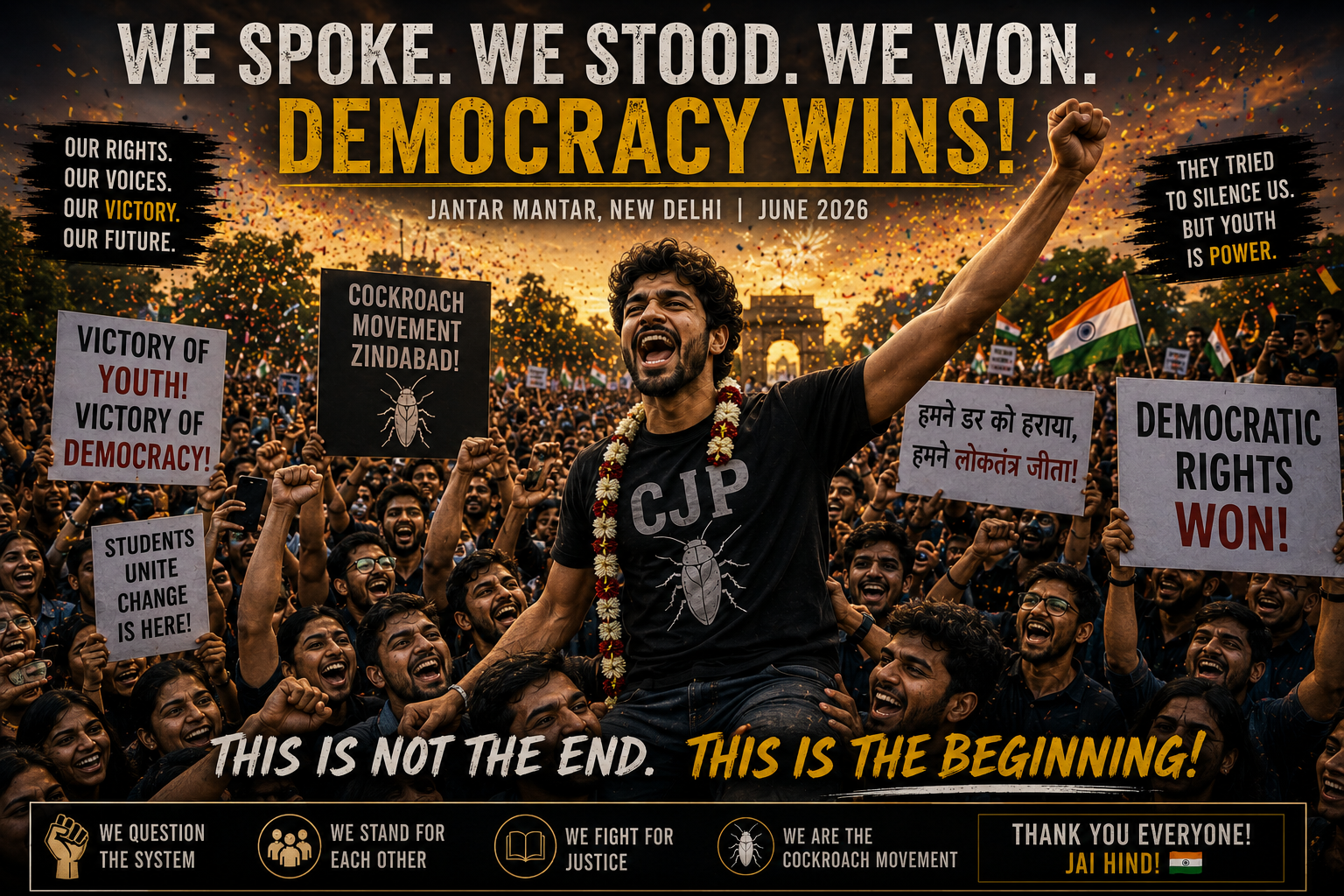
June 6 was a success for the Cockroach Janta Party by any reasonable measure. Dipke was not arrested. The protest happened. Thousands attended. The movement trended across social media. International media filed reports. India’s government was forced to respond — even if only by granting permission and staying silent on the substance.
But the hardest part of any protest movement comes the day after the protest. When the crowds go home. When the social media trending fades. When the television cameras move to the next story. What remains is the real test of whether a movement has staying power or whether it was a remarkable moment that history files under “interesting but ultimately inconsequential.”
The CJP’s concrete next steps will define which category June 6 falls into:
- Will the movement formally register as a political party with the Election Commission?
- Will it contest local body elections to build grassroots credibility?
- Will it maintain consistent pressure on the NEET issue through the Re-NEET on June 21?
- Will it expand beyond Delhi to Tamil Nadu, Maharashtra, Andhra Pradesh, West Bengal — states with their own student populations and examination grievances?
- Will Dipke stay in India as he promised — or will the pressures of sustained political organising prove harder than a dramatic airport arrival?
These are not rhetorical questions. They are the exact questions that will determine whether the CJP becomes a footnote or a chapter in the story of Indian democracy.
💔 The Students Who Started This — Never Forget
In the drama of the airport standoff, the Jantar Mantar crowds, the government’s permission, and the social media trending — it is easy to lose sight of why any of this started.
Maithili Sonwane was 18 years old. She died by suicide after NEET 2026 was cancelled. Pradeep Manich was 23 — a labourer’s son who had spent years in a rented room in Sikar preparing for his dream of becoming a doctor. He is gone. Harsh Dubey from Uttar Pradesh had scored 627 marks in 2024 — missing a government medical seat by 6 points. After the 2026 cancellation, he could not go on.
These are not statistics. These are the real reason Dipke got on a plane. The real reason thousands came to Jantar Mantar. The real reason this movement will not quietly disappear after one dramatic day.
The cockroaches came to Delhi on June 6 not for social media fame. They came because three young Indians are dead who should be alive — and no one in power has been held accountable for it.
That demand — simple, reasonable, constitutional — is not going away. Regardless of what happens to the CJP as a political organisation, that demand will outlast every news cycle, every government reshuffle, and every attempt to move on.
The cockroach does not die easily. And neither does accountability.
❓ FAQs
Was Abhijeet Dipke arrested at Delhi airport on June 6?
No. Dipke was surrounded by 10-15 officers in plain clothes and uniform after clearing immigration, and supporters temporarily lost contact with him. However, he subsequently walked out of the airport on his own — not under arrest. He then proceeded to lead the protest at Jantar Mantar.
Did the CJP protest at Jantar Mantar happen on June 6?
Yes. Delhi Police granted permission for the protest at Jantar Mantar. Thousands of protesters gathered, Dipke addressed the crowd, and the protest concluded peacefully.
Did Dharmendra Pradhan resign after the protest?
No. As of June 6, 2026, Dharmendra Pradhan remains Education Minister. The government has not formally responded to the CJP’s demands following the protest. The Re-NEET examination remains scheduled for June 21.
Why did police surround Dipke at the airport?
The government has not officially explained what happened during the approximately one hour that Dipke was with officers after clearing immigration. Dipke subsequently emerged from the airport without being formally arrested or charged, and the protest proceeded normally with police permission.
What are the CJP’s next steps after the Jantar Mantar protest?
The CJP has not formally announced its next steps as of June 6. Key questions include whether the movement will register as a political party, contest local body elections, and maintain pressure on the NEET accountability issue through the Re-NEET on June 21.
📚 Sources
- NewsX — Was Abhijeet Dipke Taken to Undisclosed Location Before Reaching Jantar Mantar?
- Wikipedia — Cockroach Janta Party
- The Federal — Abhijeet Dipke: Ready for Arrest, Will Stay Here
- CBS News — Rapid Rise of Cockroach Janta Party
- Foreign Policy — India’s Cockroach Movement Taps Into Youth Discontent