

Tomorrow — June 6, 2026 — a 30-year-old man will land at an Indian airport knowing he may be handcuffed before he reaches the exit. He has no army. No political party backing him. No crores of rupees. What he has is 22 million followers, 8 lakh petition signatures, and the absolute conviction that a generation of young Indians has been betrayed — and that someone must stand up and say so out loud, in public, in India, whatever the cost. His name is Abhijeet Dipke. His movement is the Cockroach Janta Party. And the fact that 90% of Indian mainstream media has barely covered this story tells you more about the state of Indian democracy than anything Dipke himself could say.
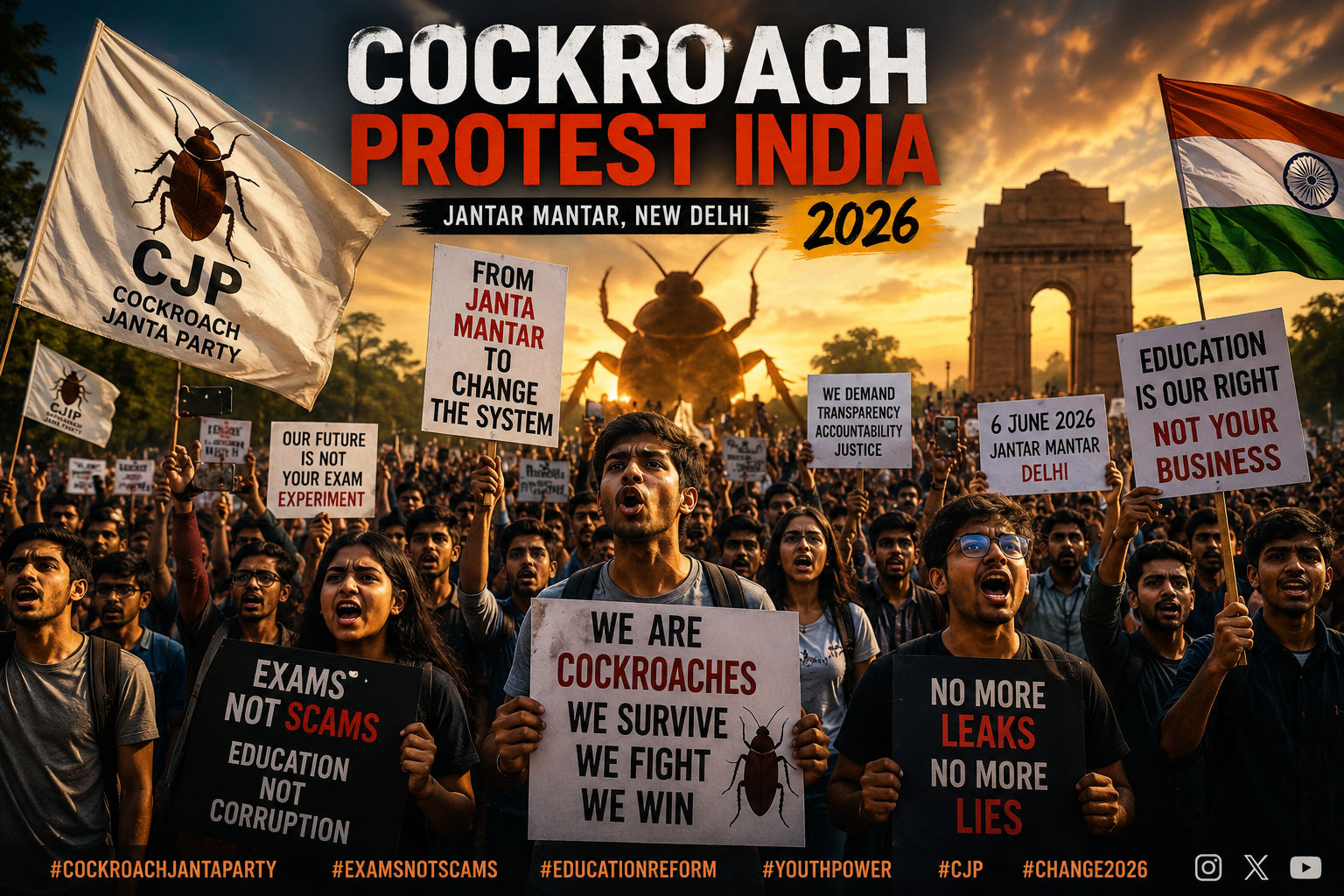
🪳 How Three Words From a Chief Justice Started a Revolution
It began on May 15, 2026 — in a Supreme Court hearing that most Indians never heard about.
The Chief Justice of India. Calling unemployed youth cockroaches. In open court.
The next day, Abhijeet Dipke — an Indian student studying public relations at Boston University — launched an online platform for “all the cockroaches out there,” listing eligibility criteria as being unemployed, lazy, chronically online, and able to rant professionally. It was satire. It was brilliant. And it was about to become something nobody — not Dipke himself, not the government, not the Supreme Court — had anticipated.
Within 78 hours, the CJP Instagram account crossed 3 million followers. In under five days, it crossed 10 million — overtaking the official BJP account. It now stands at over 22 million followers. For context: the BJP — described as the world’s largest political party, with over 180 million members — has 9 million Instagram followers. A satirical movement born from a Supreme Court insult overtook it in less than a week.
📺 The Silence That Speaks Louder Than Any Broadcast
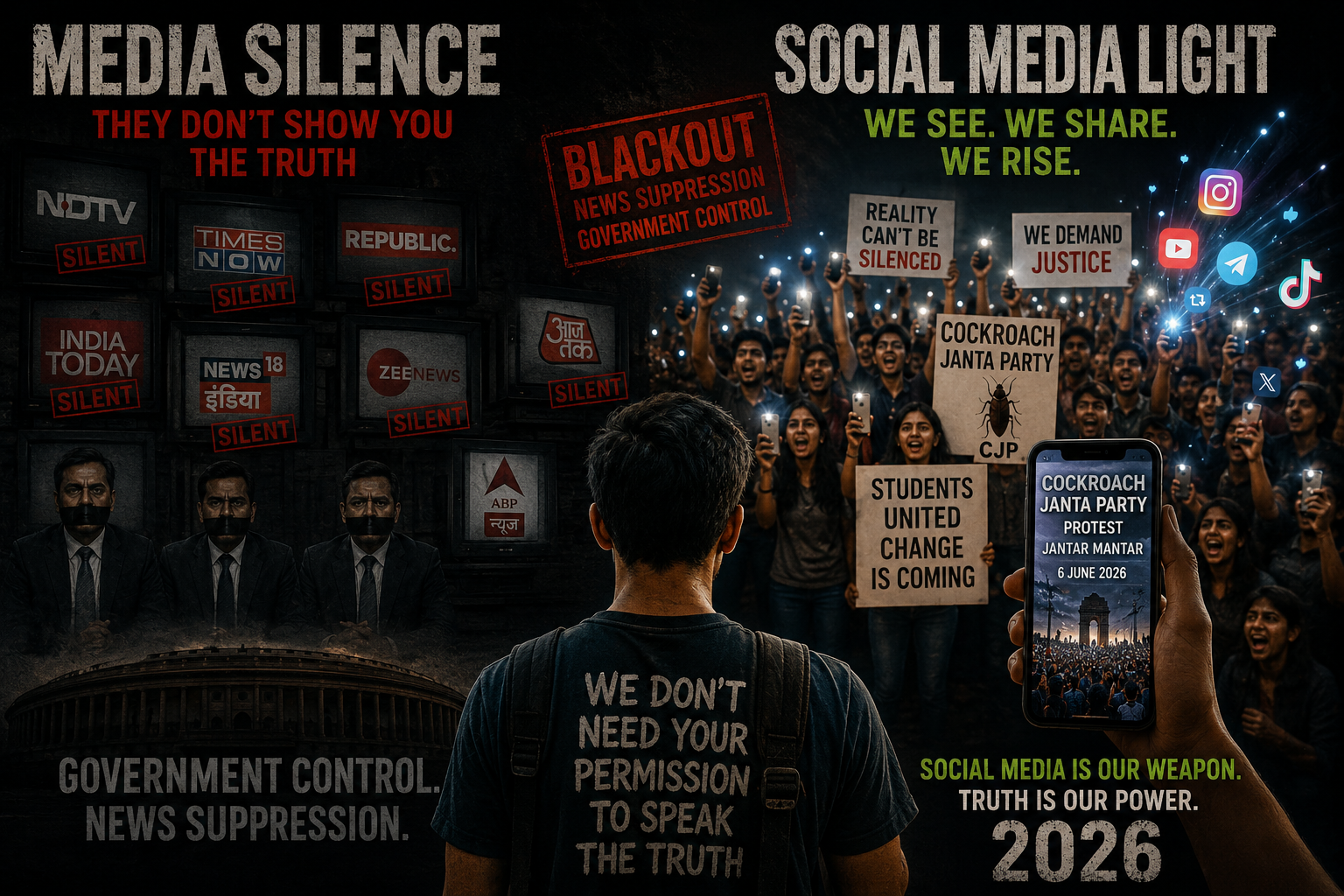
You are reading this article — which means you are probably already aware of the CJP because you saw it on Instagram, YouTube, or WhatsApp. Not because a news anchor told you about it at 9 PM.
That is not an accident.
India ranks 151st out of 180 countries on the 2026 World Press Freedom Index. Reporters Without Borders describes Indian media as operating under “suffocating” conditions. The CJP’s account on X was blocked within days of its launch — a pattern that CBS News reported as evidence of how seriously India’s government was taking the movement.
Major television channels — the ones that run prime-time debates every night — have largely treated the CJP as either non-existent or dangerous. When they have covered it, the framing has been consistent: is this movement anti-national? Is it foreign-funded? Is Dipke being deported — a claim that CJP supporters say is deliberate disinformation designed to discredit him before he even lands.
Dipke has been categorical: he is returning voluntarily, of his own free will, to exercise his constitutional right to peaceful protest. “I plan to participate in a peaceful protest, which is my constitutional right as an Indian citizen,” he told The Federal in an exclusive interview.
The mainstream media silence on this movement is itself the story. When 22 million people follow a political movement and the country’s leading television channels barely acknowledge it exists, you are witnessing not journalism — you are witnessing its absence.
✈️ The Man Flying Into the Storm — Will He Be Arrested?
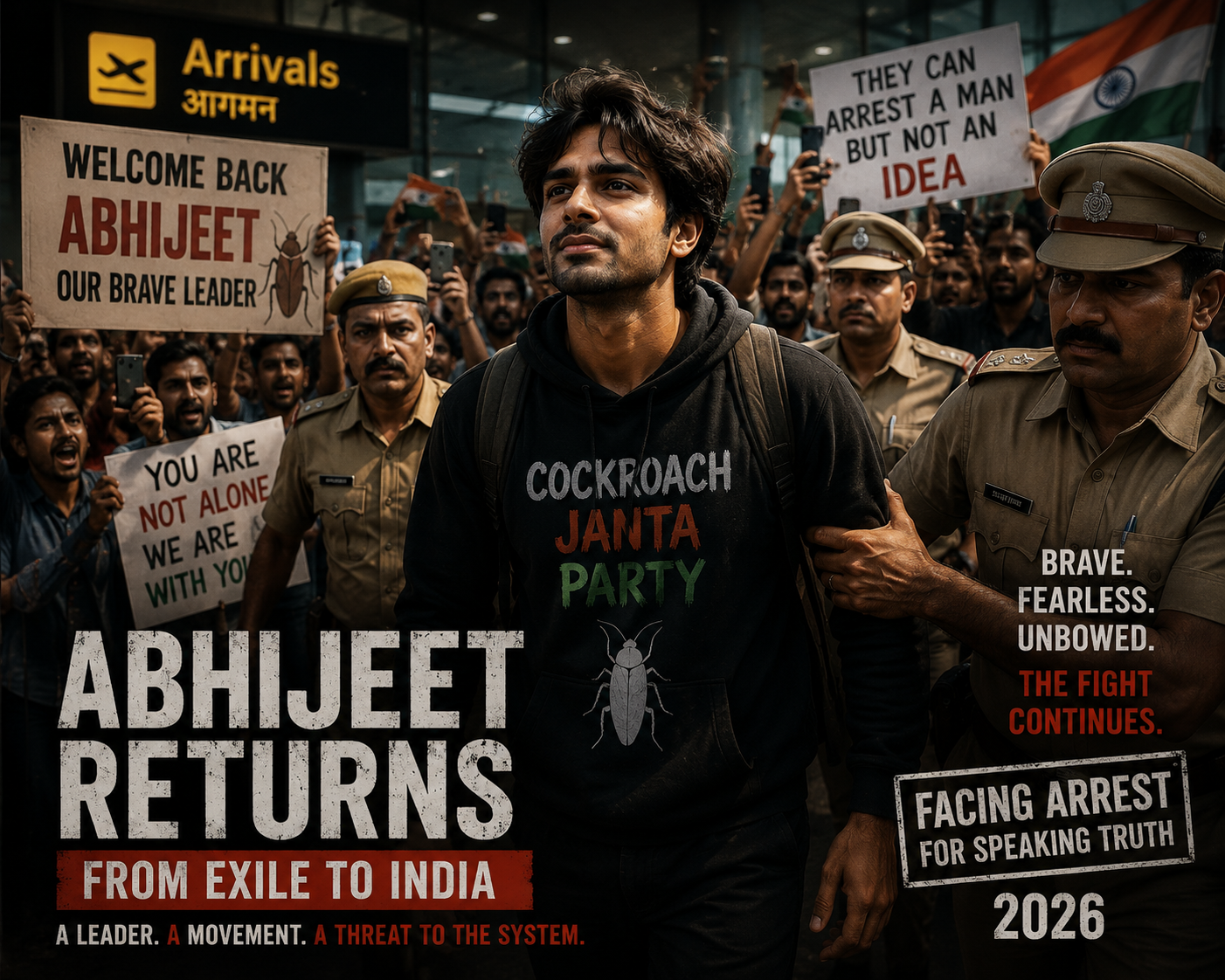
This is the question that has gripped social media for the last 72 hours. Will Abhijeet Dipke be arrested when he lands?
He says yes — probably. And he is coming anyway.
The legal situation is complex. Dipke has publicly stated his intention to seek permission for a peaceful protest at Parliament Street police station — following constitutional procedure exactly. He is not calling for violence. He is not inciting disorder. He is asking to stand at Jantar Mantar — the designated protest venue in Delhi — with a placard demanding the resignation of the Education Minister.
If he is arrested for that, the question is not whether Dipke broke the law. The question is what kind of democracy arrests people for peaceful protest.
🌍 What the World Is Saying — While Indian TV Stays Silent
Here is the extraordinary irony of the CJP story: it has been covered more thoroughly by international media than by Indian mainstream outlets.
Al Jazeera covered it. The BBC covered it. International media recognised what was happening — a genuine, organic, youth-led political movement of historic scale — while much of India’s own media looked away.
This is not new. The pattern repeats: farmer protests covered by Reuters before Indian channels. Manipur violence documented by foreign correspondents before domestic anchors. The Adani-Hindenburg story broken internationally before Indian business media engaged with it seriously. The story of Indian democracy is increasingly being told from outside India — because telling it from inside has become complicated.
🪳 What the Cockroaches Actually Want
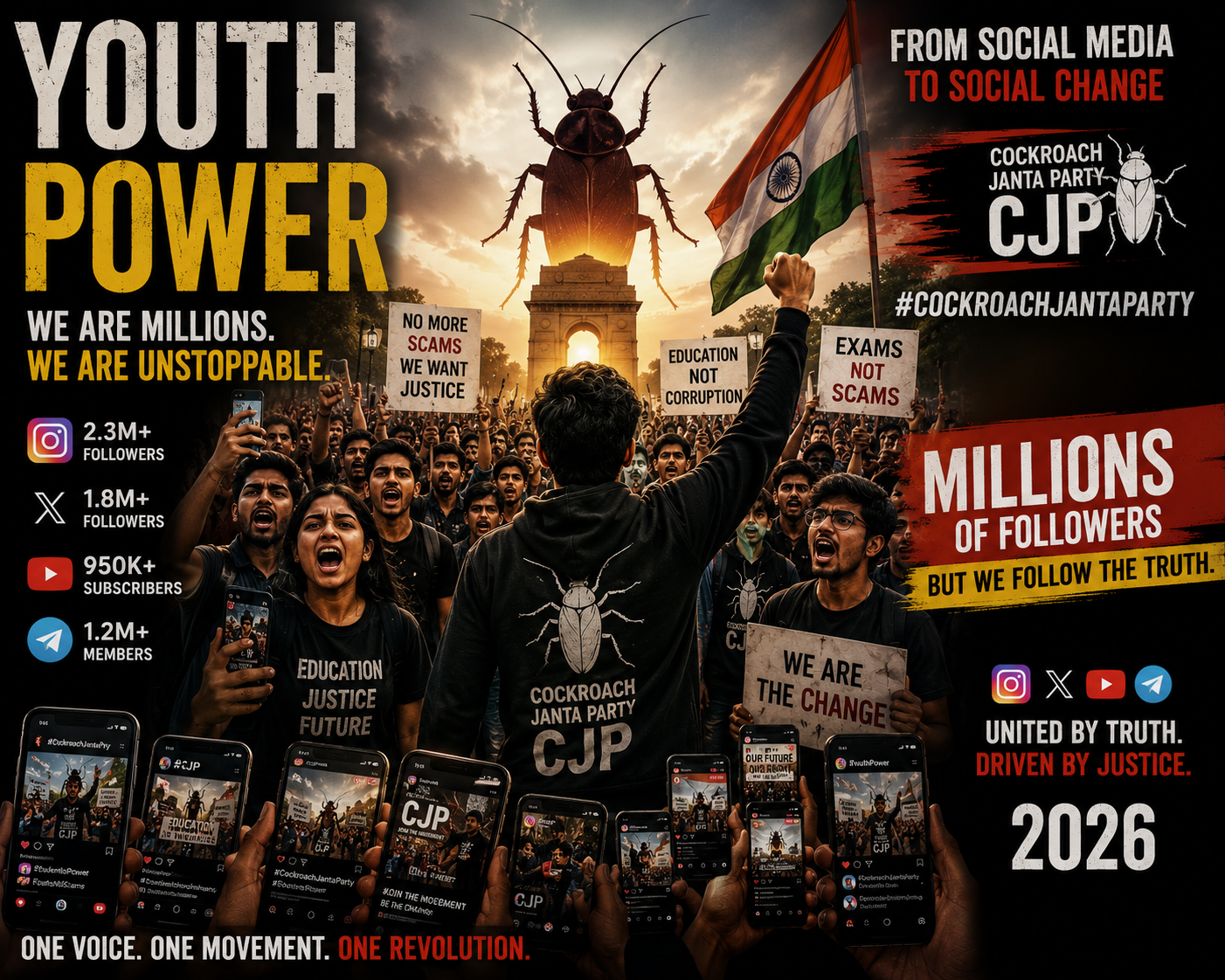
Strip away the satire and the cockroach costumes and the memes — and the CJP’s demands are entirely reasonable. They are not radical. They are not anti-national. They are the demands of a generation that has been systematically failed by institutions that were built to serve them.
The CJP’s core demands:
- Resignation of Union Education Minister Dharmendra Pradhan over the NEET 2026 paper leak — the third consecutive year of examination failure under his watch
- Fundamental reform of the National Testing Agency — not cosmetic changes, not sacking one official, but structural overhaul
- Accountability for the student suicides that followed the NEET 2026 cancellation — Maithili Sonwane, 18. Pradeep Manich, 23. Real children with real families.
- Transparent, merit-based government recruitment across all examinations
- Recognition that India’s youth unemployment crisis — 15.2% for youth, 17.7% for urban women — requires urgent policy attention, not Supreme Court contempt
The Week magazine noted that mainstream political parties — including the BJP and Congress — are recognising the growing influence of young digital natives and attempting to engage with or co-opt the sentiment. The Indian Youth Congress has even started calling themselves “Indian National Cockroaches.” When both ruling and opposition parties are scrambling to position themselves relative to your movement — you have real power.
⚖️ The Constitutional Question Nobody in Power Wants to Answer
Article 19(1)(b) of the Indian Constitution guarantees every citizen the right to assemble peaceably and without arms. Article 19(1)(a) guarantees freedom of speech and expression. These are not privileges granted by the government — they are fundamental rights guaranteed by the Constitution that every Indian government swears to uphold.
Abhijeet Dipke is not asking for anything that is not already his constitutional right. He wants to stand at Jantar Mantar — a ground specifically designated for democratic protest — and say that the Education Minister should resign after overseeing three consecutive years of examination failures that destroyed students’ lives.
If the government arrests him for that, it will not silence the movement. It will amplify it beyond anything that has happened so far. Every arrest of a peaceful protester in a democracy produces ten more protesters. History is unambiguous on this point.
The smarter political calculation — the one that democracies usually make — is to let him protest, let the crowds gather, let the speeches happen, and then let the news cycle move on. Arrests create martyrs. Martyrs create movements. Movements create political consequences.
Whether India’s government understands this — or whether it will choose force over wisdom — we will know by tomorrow evening.
🔮 Can a Cockroach Change India?
The honest answer is: probably not alone. No single protest, no single movement, no single moment changes a country of 1.4 billion people overnight.
But the CJP has already changed something that is harder to measure and more important than any policy outcome. It has changed how India’s youth see themselves politically. For a generation that has been told — implicitly and explicitly — that they are too lazy, too entitled, too online, too disconnected from “real” India to matter politically, the CJP has said something different.
It said: you matter. Your anger is legitimate. Your demands are reasonable. And if the system calls you cockroaches — wear it as a badge. Because cockroaches survive everything. They outlast empires. They cannot be crushed.
Foreign Policy noted that “it is unclear whether this nascent phenomenon can turn into a full-blown social movement — let alone a formal political party — that builds on the simmering grievances of a young generation in India.” That uncertainty is honest. Most movements fail. Most viral moments fade. Most protests produce promises that are quietly forgotten.
But some do not. Some become the first chapter of a longer story. The question of whether the CJP is a meme or a movement will not be answered tomorrow at Jantar Mantar. It will be answered over the next five years — in election booths, in courtrooms, in the decisions of millions of young Indians about whether they remain politically engaged or retreat back into cynicism.
What happens tomorrow is the beginning of finding out.
🎯 Why This Matters for Every Indian Reading This
Whether you support the CJP or not — whether you think Dipke is a hero or a self-promoter, whether you think the protest will achieve anything or dissipate by next week — the story of the Cockroach Janta Party matters for one reason that transcends all of that.
It is a test of whether India’s democracy works for its young people.
22 million social media followers. 8 lakh petition signatures. Student suicides that went largely unacknowledged by those in power. An Education Minister who has overseen three consecutive years of examination failure and remains in office. A mainstream media that has largely looked away from a movement of historic scale.
And one man, flying home tomorrow, prepared to be arrested for asking that someone be held accountable.
You do not have to agree with Abhijeet Dipke. You do not have to call yourself a cockroach. You do not have to go to Jantar Mantar.
But you should be paying attention. Because what happens to him tomorrow will tell you a great deal about what kind of country India is choosing to be — for its young people, for its dissenters, and for anyone who believes that peaceful protest is not a threat to democracy. It is democracy.
❓ FAQs
Who is Abhijeet Dipke?
Abhijeet Dipke is a 30-year-old political communications strategist and recent Boston University graduate who founded the Cockroach Janta Party on May 16, 2026. He previously worked with the Aam Aadmi Party. He created the CJP as a satirical response to Chief Justice Surya Kant’s remarks comparing unemployed youth to cockroaches.
What is the Cockroach Janta Party?
The CJP is a satirical political movement founded May 16, 2026. Its name parodies the ruling BJP. It gained 22 million+ Instagram followers in under a week — more than the BJP and INC combined. It is not registered with the Election Commission of India. Its core demands include the resignation of Education Minister Dharmendra Pradhan and reform of India’s examination system.
Will Abhijeet Dipke be arrested when he returns to India?
Dipke himself has said he anticipates arrest. Delhi Police have increased security around Jantar Mantar. The Delhi High Court heard a plea against the protest from an NGO. Whether he is formally arrested will depend on the government’s
[…] For more background on the CJP movement and what led to this moment, read our earlier analysis: The Cockroach Janta Party Story That Indian Media Does Not Want You to Read. […]