

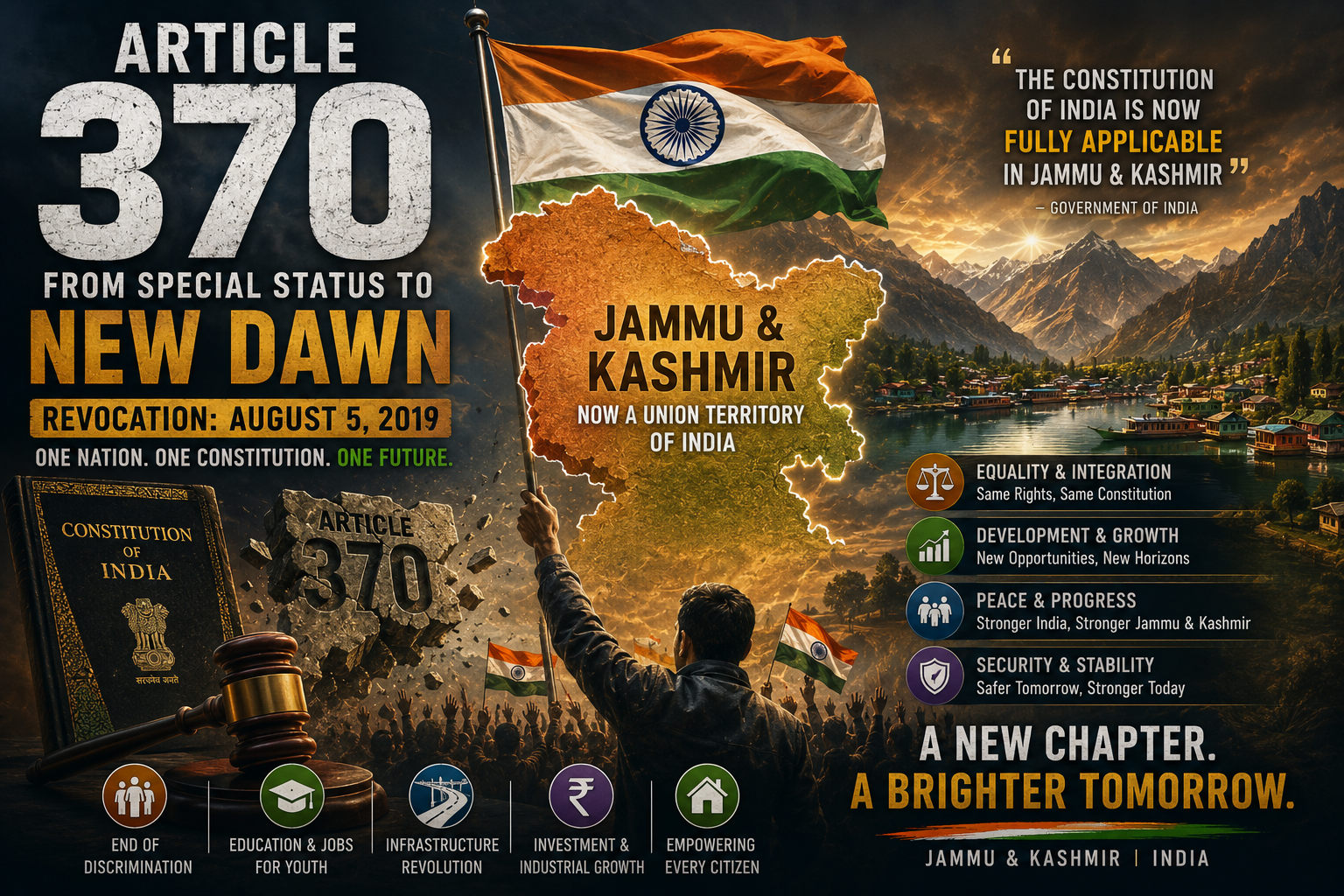
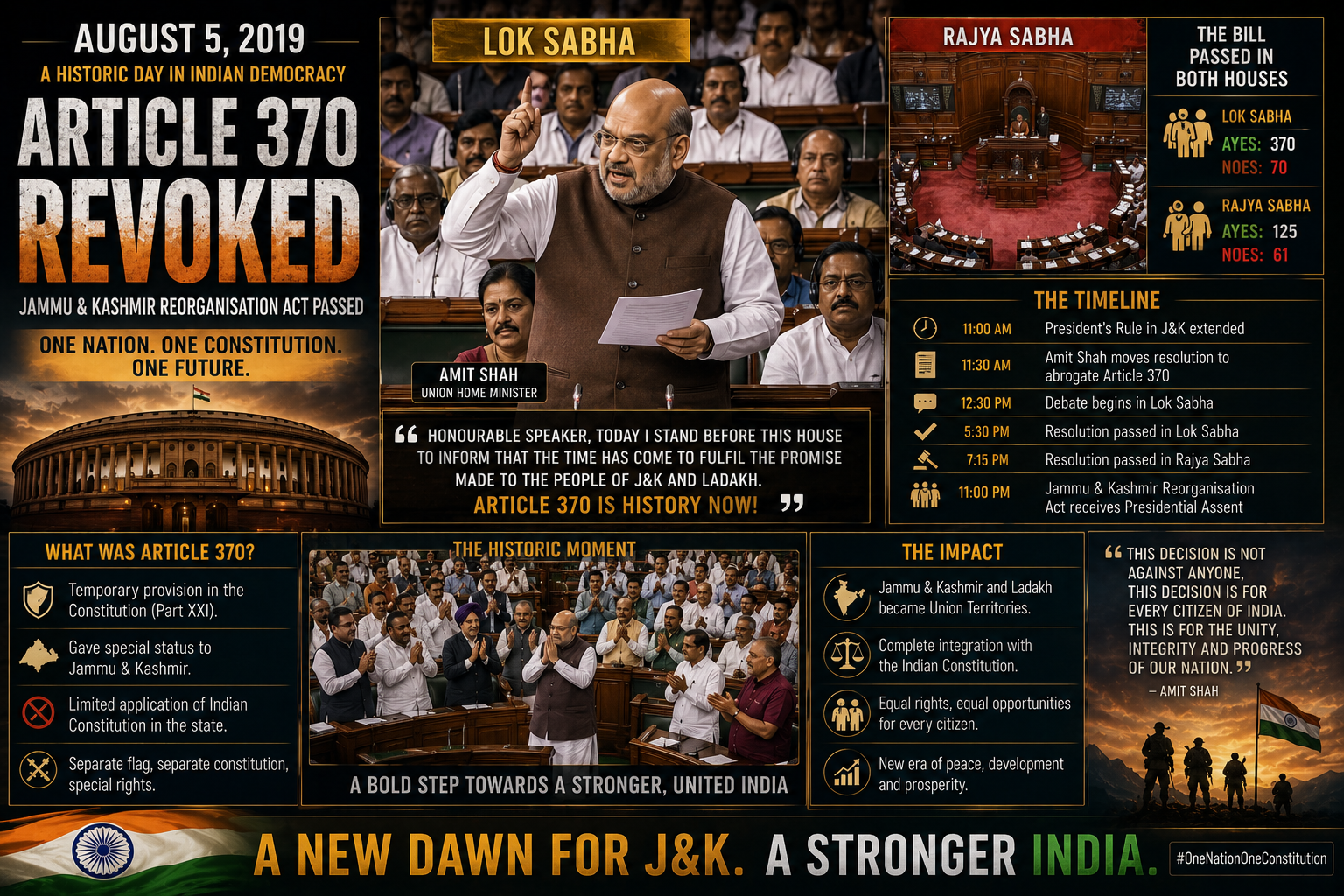
On August 5, 2019, at 11:30 AM, Home Minister Amit Shah stood up in the Rajya Sabha and announced something that most of India’s political establishment — including many senior BJP leaders — had no idea was coming. Within hours, Jammu and Kashmir lost a special status it had held for 70 years. Internet was cut. Politicians were detained. The valley was locked down. And a provision that India’s own Constitution had called “temporary” in 1949 — but which had survived seven decades, 15 Prime Ministers, and countless political storms — was gone. This is the real story of Article 370. Not the version that either side wants you to hear. The complete truth — about what it was, why it existed, how it was removed, and what has actually happened since.
🔍 The Secret Deal Made in 1949 That Nobody Talks About
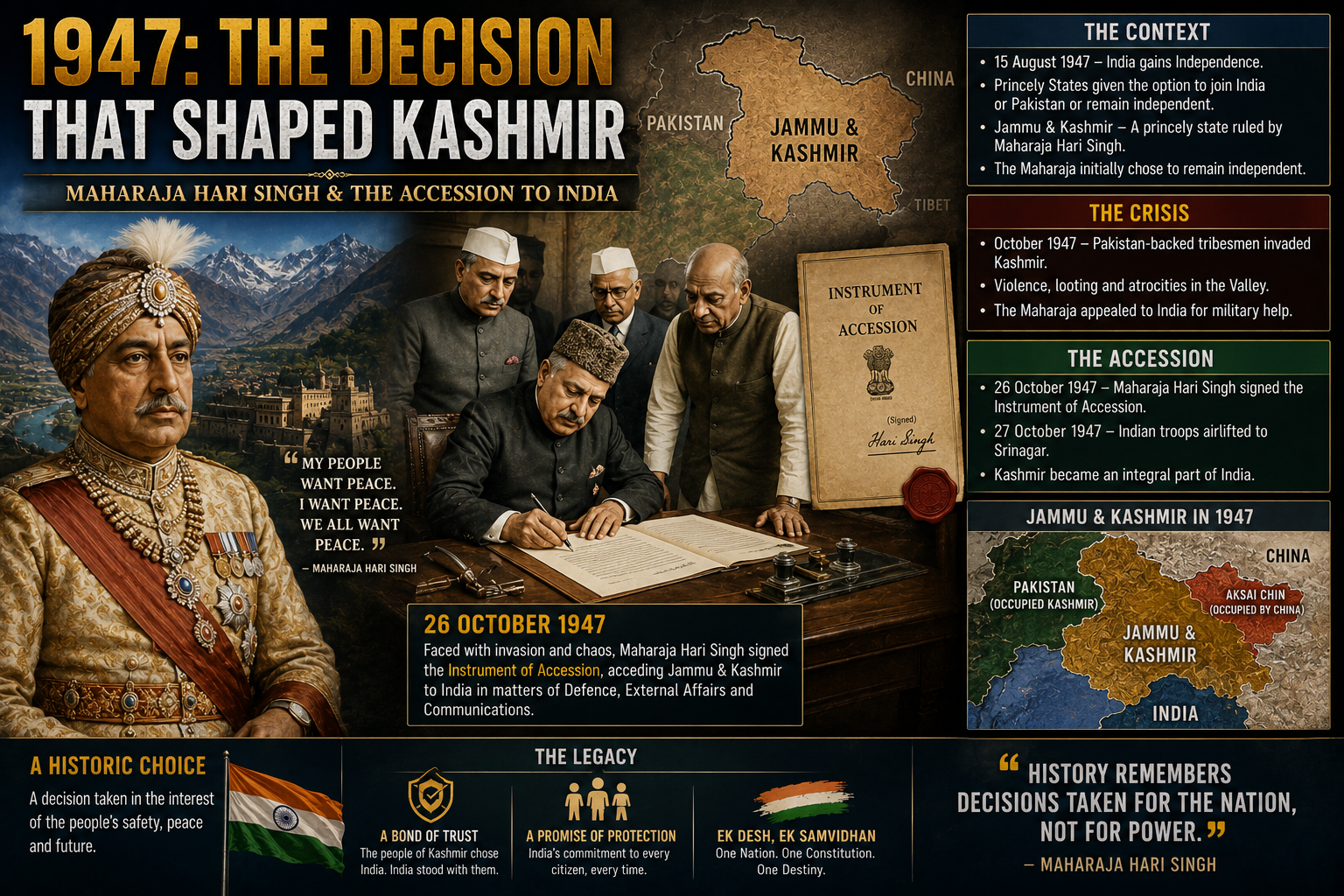
To understand Article 370, you have to go back to October 1947 — and understand the impossible situation that Jawaharlal Nehru and Sardar Patel faced when Maharaja Hari Singh of Jammu and Kashmir finally agreed to accede to India.
Kashmir was different from every other princely state. It had a Muslim majority population but a Hindu ruler. It shared borders with both India and Pakistan. It had a powerful political movement — the National Conference led by Sheikh Abdullah — that had genuine mass support but whose relationship with the Indian National Congress was complicated and conditional. And it had already been invaded by Pakistani-backed tribal militias when Hari Singh signed the Instrument of Accession on October 26, 1947.
Article 370 was drafted by N. Gopalaswami Ayyangar — a former Diwan of Jammu and Kashmir and member of the Constituent Assembly — as a special arrangement to bring Kashmir into the Indian Union while addressing Sheikh Abdullah’s political concerns about autonomy. The deal was essentially this: Kashmir would accede to India, but India would not immediately impose its full constitutional framework on the state. Kashmir would have its own Constitution, its own flag, and its own laws on most subjects — with only Defence, External Affairs, and Communications coming under central control initially.
Here is the part nobody tells you: this was a political necessity, not an ideological choice. Nehru needed Sheikh Abdullah’s cooperation to hold Kashmir. Abdullah needed autonomy guarantees to sell the accession to a suspicious Kashmiri population. Article 370 was the price of that cooperation — explicitly described in the Constitution as a “temporary provision” that could be modified or removed once the Constituent Assembly of Jammu and Kashmir gave its concurrence.
The Constituent Assembly of J&K dissolved in 1956 after drafting the state’s constitution — without ever recommending the removal of Article 370. And so the “temporary” provision became permanent by default — because the only body authorised to recommend its removal had ceased to exist.
📜 What Article 370 Actually Did — The 5 Powers Nobody Explains Clearly
Most people know that Article 370 gave Kashmir “special status.” Very few people know exactly what that meant in practice. Here are the five most important powers it created:
Power 1 — Its Own Constitution: Jammu and Kashmir was the only Indian state with its own separate constitution — adopted in 1956. While the Indian Constitution governed the rest of India, J&K had a parallel constitutional document with different provisions, different governance structures, and different fundamental rights.
Power 2 — Its Own Penal Code: The Indian Penal Code did not apply to J&K. Instead, the state had its own Ranbir Penal Code — named after Maharaja Ranbir Singh. This meant different laws for the same crimes, different procedures, and different standards of justice for citizens of J&K compared to the rest of India.
Power 3 — Article 35A and Property Rights: Article 35A — inserted through a Presidential Order in 1954 — gave the J&K legislature the power to define “permanent residents” and restrict property ownership, government jobs, and scholarships exclusively to permanent residents. This meant that no Indian citizen from outside J&K could permanently own land or property in the state — a restriction that applied nowhere else in India.
Power 4 — Limited Parliamentary Jurisdiction: Parliament could not legislate for J&K on most subjects without the state government’s concurrence. Laws passed by Parliament on education, agriculture, industry, and dozens of other subjects did not automatically apply to J&K — they had to be explicitly extended with the state’s agreement.
Power 5 — Dual Citizenship: J&K residents were technically citizens of both India and J&K — a unique dual citizenship arrangement that existed nowhere else in the country. This created a legal complexity where certain constitutional rights available to other Indian citizens were not automatically available to J&K residents, and vice versa.
The cumulative effect of these five powers was that J&K was simultaneously inside and outside the Indian constitutional framework — more integrated than an independent country but less integrated than any other Indian state. This ambiguity created genuine governance problems, genuine development gaps, and genuine resentment on multiple sides for 70 years.
⚡ The 3 AM Parliament Move That Shocked Even Senior BJP Leaders
By 2019, the BJP had been promising to remove Article 370 since 1952. It was in every manifesto. It was in every election speech. But most political observers — including many inside the BJP — believed it was aspirational rhetoric rather than realistic policy. The constitutional barriers seemed insurmountable. The political risks seemed enormous. The international reactions seemed unpredictable.
What happened on August 5, 2019 was not what most people expected — even those who wanted it.
The legal mechanism used was intricate — and deliberately so. The government did not technically “abrogate” Article 370. Instead, it used Article 370 itself to modify Article 367 (which deals with interpretation), which then effectively rendered Article 370 inoperative. The Presidential Order issued under Article 370(1) extended all provisions of the Indian Constitution to J&K — including the chapter on Fundamental Rights — while simultaneously using the interpretation clause to redefine “Constituent Assembly” as “Legislative Assembly,” making it possible for Parliament (acting as the J&K legislature under President’s Rule) to give the required concurrence.
In the Lok Sabha, 351 members voted in support and 72 against. The Jammu and Kashmir Reorganisation Bill, 2019 — which split the state into two Union Territories of J&K and Ladakh — was passed with 370 members in favour and 70 against. The numerical coincidence of 370 votes for the bill that ended Article 370 was noted with satisfaction by the government’s supporters.
The security response was massive and pre-planned. Tens of thousands of additional troops were deployed in the valley before the announcement. Senior political leaders — including three former Chief Ministers — were detained or placed under house arrest. Internet, mobile networks, and landlines were cut. Section 144 was imposed across the valley. The government was taking no chances with the reaction.
⚖️ The Supreme Court Verdict — What the Judges Actually Said
The removal of Article 370 was challenged in the Supreme Court through 23 petitions. A five-judge Constitutional bench — headed by Chief Justice D.Y. Chandrachud — heard the case over several months in 2023 and delivered its verdict on December 11, 2023.
The Supreme Court unanimously upheld the government’s decision to revoke Article 370 — ruling that it was a temporary provision designed to ease J&K’s merger with India, and that the President had the power to abrogate it. The court held that J&K did not retain any element of sovereignty after its accession to India — directly contradicting a key argument of those who challenged the revocation.
But the court also said something that the government’s supporters have been quieter about. The bench directed that statehood be restored to J&K “as soon as possible” — acknowledging that the current status as a Union Territory (where the Lieutenant Governor has significant powers) was not a permanent or desirable arrangement. The court also directed that elections be held in J&K by September 30, 2024 — a deadline that was met when J&K held its first assembly elections in a decade in September-October 2024.
The Supreme Court verdict settled the legal question. It did not settle the political question — which is more complex, more contested, and more consequential.
🔮 What Really Happened After 2019 — The Truth Both Sides Are Hiding
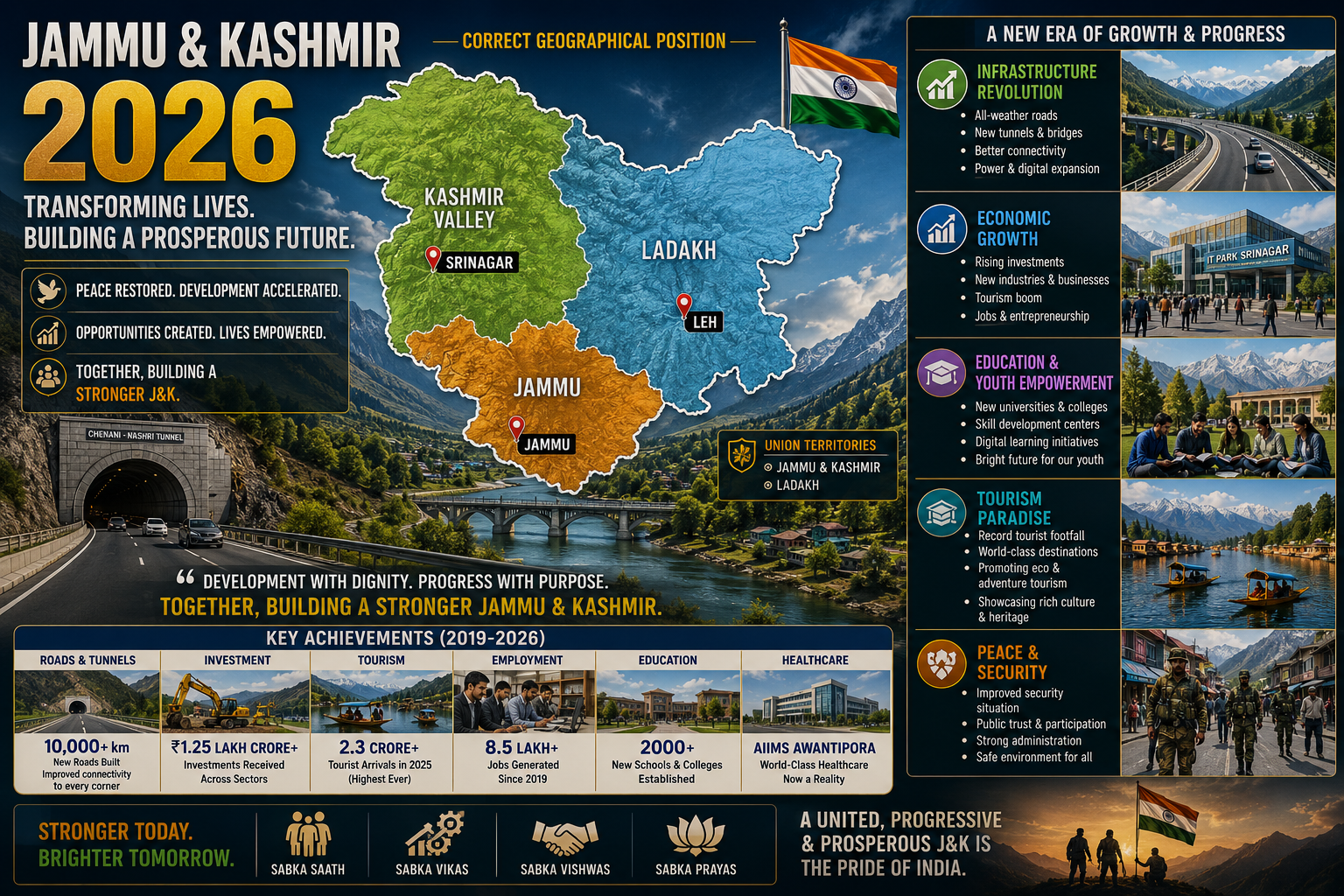
Seven years after August 5, 2019, the reality of post-Article 370 J&K is more complicated than either side wants to admit. Both the government’s supporters and the provision’s defenders have reasons to selectively present the evidence.
What the government says has improved — and the data supports it:
After the constitutional changes and reorganisation, all central laws became applicable to J&K. All the rights enshrined in the Indian Constitution and benefits of all central laws that were being enjoyed by other citizens are now available to the people of J&K and Ladakh. This includes RTI, consumer protection laws, reservation policies for SC/ST communities (who had no reservation rights under the old J&K constitution), and dozens of central welfare schemes that could not be implemented in J&K before 2019.
Tourism in J&K has recovered dramatically. In 2023, J&K received over 2.1 crore tourists — the highest in its history. Investment proposals worth thousands of crores have been received. Infrastructure development — roads, tunnels, railway lines — has accelerated significantly. The Srinagar-Jammu railway line, long delayed, is nearing completion.
Militancy-related incidents have declined significantly compared to the peak years of the 1990s and 2000s. The Ranbir Penal Code has been replaced with the Bharatiya Nyaya Sanhita, bringing J&K under the same criminal justice system as the rest of India.
What the critics say has worsened — and the data supports them too:
J&K remains a Union Territory — not a state — seven years after the reorganisation. This means it does not have the same autonomy, the same financial powers, or the same democratic accountability as Indian states. The Lieutenant Governor has significant powers that override the elected government — a situation that has created friction with the elected Chief Minister.
Press freedom concerns have been consistently raised by international organisations. Journalists in J&K operate under significant restrictions. The prolonged internet shutdowns of 2019-2020 — one of the longest in any democracy in history — had severe economic and humanitarian consequences. Property rights concerns remain — questions about who can now buy land in J&K and whether demographic changes are being engineered have not been fully resolved.
The political identity question — whether Kashmiris feel genuinely integrated into India or administratively absorbed — cannot be answered by tourism statistics or investment figures alone. It requires honest engagement with the concerns of a population that was given no voice in a decision that fundamentally changed their constitutional status.
🌍 Why Pakistan Is More Worried Than Most Indians Realise
Pakistan’s reaction to the revocation of Article 370 was predictably furious. It expelled India’s ambassador, downgraded diplomatic relations, suspended trade, and took the issue to the United Nations Security Council — where it found no takers for a resolution, as China was the only permanent member to support its position.
But Pakistan’s deeper concern goes beyond rhetoric. Article 370 was, in Pakistan’s narrative, evidence that Kashmir’s accession to India was conditional and contested — that J&K was a disputed territory whose final status was unresolved. The revocation — and particularly the Supreme Court’s ruling that J&K had no residual sovereignty — directly undermines this narrative.
If J&K is legally, constitutionally, and judicially confirmed as an integral part of India with no special status, the basis for Pakistan’s claim to the territory becomes even harder to sustain internationally. This is why the revocation was not just a domestic constitutional event — it was a geopolitical statement about the finality of J&K’s status within India.
For more on India’s border tensions and geopolitical context, read our complete guide on India China Border Dispute Explained and our analysis of India’s Role in BRICS 2026.
🎯 The Questions That Still Don’t Have Honest Answers
Seven years after the revocation of Article 370, several fundamental questions remain unanswered — and the honest acknowledgment of this uncertainty is more useful than false confidence from either side.
Will J&K get full statehood back? The Supreme Court directed it. The government has promised it. But no timeline has been committed to, and the political calculation of restoring full statehood — with a Chief Minister who has full powers over land, police, and governance — appears to be more complex than the government initially indicated.
Has integration actually happened — or just been imposed? Administrative integration is a fact. Constitutional integration is confirmed by the Supreme Court. But genuine integration — where the people of Kashmir feel they are participants in India rather than subjects of it — requires trust, time, and political engagement that cannot be measured in investment figures or tourist numbers.
Was there a better way? This is the question that most serious analysts ask — not whether Article 370 should have been removed, but whether the manner of its removal — the detentions, the communications blackout, the absence of any consultation with elected representatives — was the right approach. A constitutional change of this magnitude, done without any democratic process in the affected region, carries costs that are difficult to quantify but real.
What about the Kashmiri Pandits? The exodus of Kashmiri Pandits from the valley in 1990 — one of the largest forced displacements of a minority community in independent India — has never been adequately addressed. The revocation of Article 370 was partly justified as enabling their return. The numbers who have actually returned remain very small. This is a humanitarian failure that predates 2019 and has not been resolved by it.
❓ FAQs
What was Article 370 in simple words?
Article 370 was a provision in the Indian Constitution that gave Jammu and Kashmir special autonomous status. It allowed J&K to have its own constitution, its own flag, its own laws on most subjects, and restricted property ownership to permanent residents. It was inserted in 1949 as a “temporary” provision.
Article 370 was a provision in the Indian Constitution that gave Jammu and Kashmir special autonomous status. It allowed J&K to have its own constitution, its own flag, its own laws on most subjects, and restricted property ownership to permanent residents. It was inserted in 1949 as a “temporary” provision but lasted 70 years until its revocation on August 5, 2019.
Why was Article 370 removed?
The BJP government cited several reasons — full integration of J&K with India, ending discrimination against SC/ST communities who had no reservation rights under the old J&K constitution, enabling central laws and welfare schemes to apply to J&K, and removing what it called a barrier to development and normalcy. Critics argue the real motivation was political and ideological — fulfilling a long-standing BJP promise and asserting complete sovereignty over the territory.
Was the removal of Article 370 legal?
Yes — the Supreme Court of India unanimously upheld the government’s decision in December 2023. A five-judge Constitutional bench ruled that Article 370 was a temporary provision and that the President had the constitutional power to abrogate it. The court also directed that statehood be restored to J&K and that elections be held by September 2024.
What happened to J&K after Article 370 was removed?
J&K was reorganised into two Union Territories — J&K (with a legislature) and Ladakh (without a legislature). All Indian laws now apply to J&K. Tourism has increased dramatically. Investment has grown. Militancy incidents have declined. However J&K remains a Union Territory rather than a full state, press freedom concerns persist, and the political integration of Kashmiris into the Indian democratic mainstream remains a work in progress.
What is Article 35A?
Article 35A was inserted through a Presidential Order in 1954. It empowered the J&K legislature to define “permanent residents” and restrict property ownership, government jobs, and scholarships to permanent residents only. This meant no Indian citizen from outside J&K could permanently own land in the state. Article 35A was automatically removed when Article 370 was revoked in 2019.
Will J&K become a full state again?
The Supreme Court directed the government to restore statehood to J&K “as soon as possible.” The government has promised to restore statehood but has not committed to a specific timeline. J&K held assembly elections in September-October 2024 and has an elected government — but as a Union Territory, the elected Chief Minister has less power than a state Chief Minister would have.
📚 Sources
- Next IAS — Article 370: History, Revocation, Significance and Current Status
- Britannica — Article 370 of the Constitution of India
- Drishti IAS — SC Verdict on Revocation of Article 370
- Drishti IAS — 5th Anniversary of Abrogation of Article 370
- Gulf News — India’s Supreme Court Backs Modi’s Move to Revoke Article 370
- Lokatantra — J&K’s Article 370 and Article 35A Revoked
- PIB — Impact of Abrogation of Article 370 on J&K
- ISAS — Article 370: Supreme Court Verdict Analysis