
In 2001, a Goldman Sachs economist named Jim O’Neill wrote a research paper predicting that four economies — Brazil, Russia, India, and China — would together dominate the global economy by 2050. He called them the BRICs. Nobody took it entirely seriously. Twenty-five years later, those four countries plus South Africa and six new members form BRICS — an 11-nation bloc that represents 45% of the world’s population, 35% of global GDP, and the most serious challenge to Western-dominated global institutions since the Cold War ended. And in 2026, India is leading it. This is everything you need to know about BRICS — what it is, why it matters, and why every Indian should understand it.
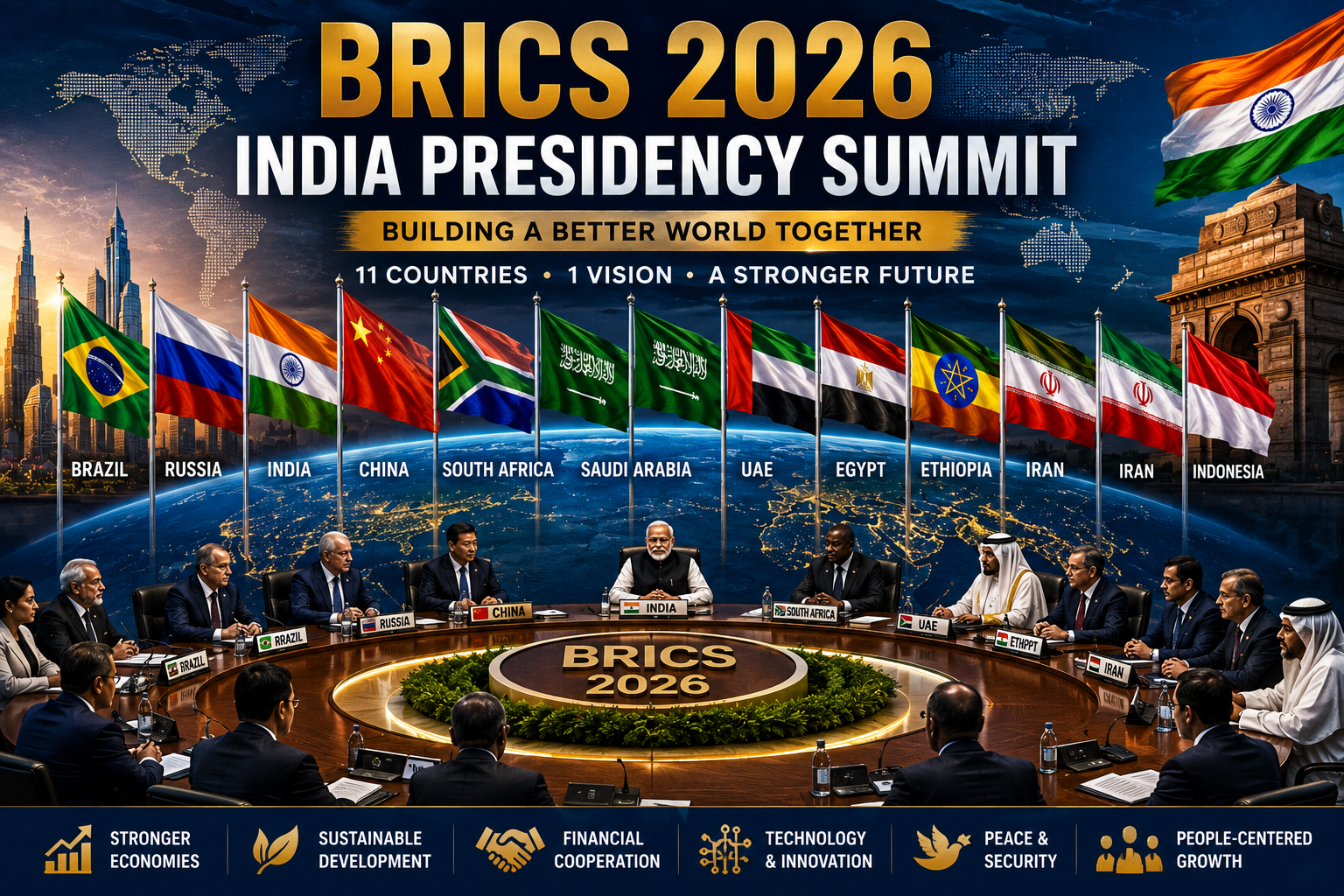
📖 What Is BRICS — The Complete Story
BRICS is an intergovernmental organisation of major emerging economies. The name is an acronym — originally standing for Brazil, Russia, India, China, and South Africa. After the 2024 expansion, the acronym no longer perfectly fits the membership, but the name has stuck.
The conceptual origins of BRICS can be traced to Russian Foreign Minister Yevgeny Primakov’s vision in 1998 of a multipolar world order, and to informal dialogue groups like RIC (Russia, India, China) and IBSA (India, Brazil, South Africa). The first formal BRIC summit was held in Yekaterinburg, Russia in 2009. South Africa joined in 2010, making it BRICS.
For most of its first decade, BRICS was dismissed by Western analysts as a loose talk shop — countries with little in common beyond being large and growing quickly. China and India have a disputed border. Russia and the West are adversaries. Brazil and South Africa are geographically isolated from the others. What could they possibly build together?
The answer, it turned out, was more than expected. BRICS established the New Development Bank — an alternative to the World Bank — with $100 billion in initial capital. It created the Contingent Reserve Arrangement — an alternative to IMF emergency lending. It built a BRICS University League connecting over 100 universities. And it became the most significant platform for what its members call the “Global South” — developing nations seeking a louder voice in global governance.
🌍 BRICS Members 2026 — Who Is In and Who Wants In
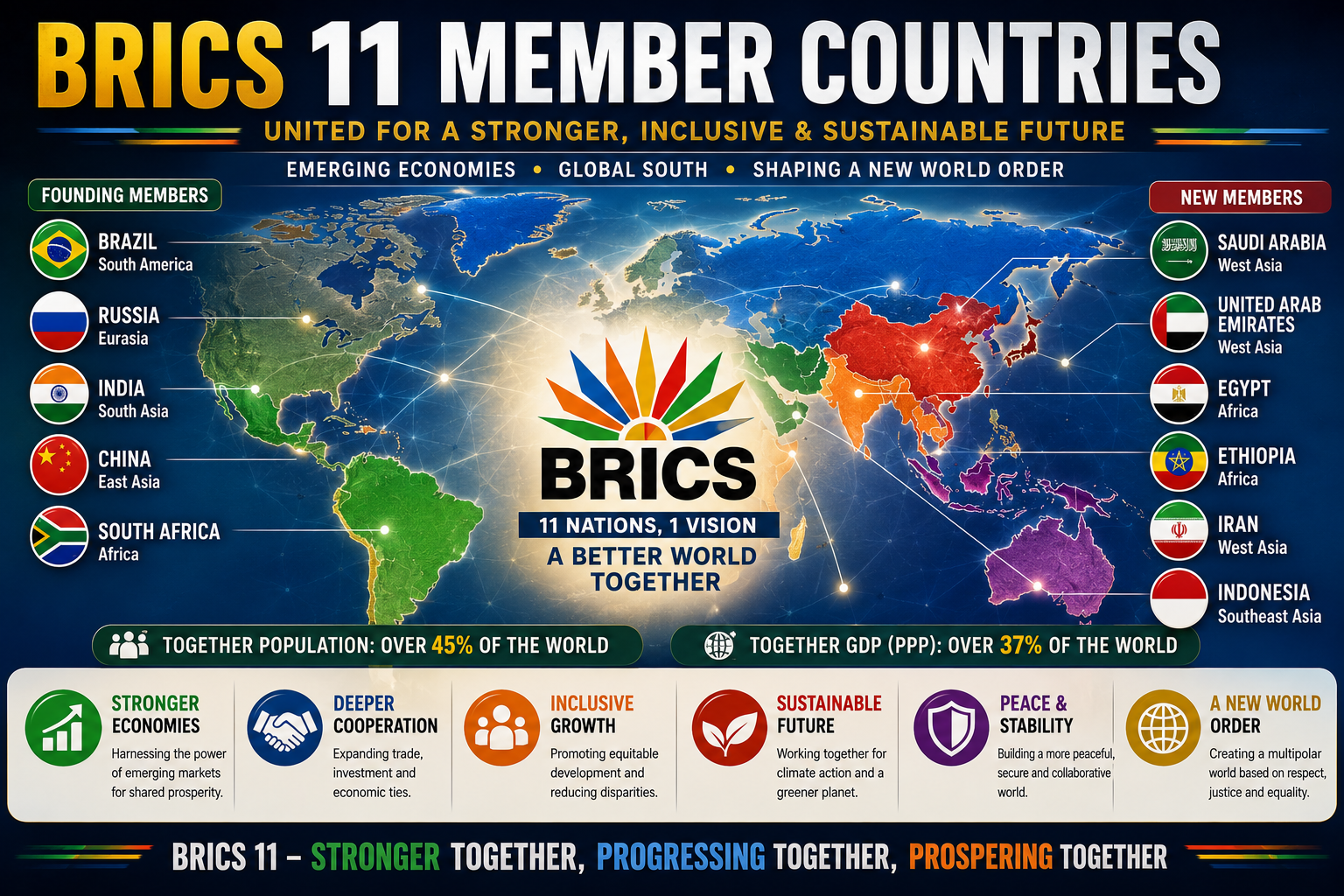
The 11 Full Members of BRICS 2026:
- Brazil — Latin America’s largest economy. Democracy, agriculture powerhouse, Amazon stewardship.
- Russia — Energy superpower. Permanent UN Security Council member. Currently under Western sanctions over Ukraine.
- India — World’s most populous country. Fastest growing major economy. 2026 BRICS President.
- China — World’s second largest economy. Manufacturing powerhouse. BRICS’s dominant economic force.
- South Africa — Africa’s most industrialised economy. Gateway to the African continent.
- Saudi Arabia — World’s largest oil exporter. Pivotal to any discussion of energy and dollar alternatives.
- UAE — Global financial and trade hub. One of the world’s most open economies.
- Iran — Major oil producer. Under Western sanctions. Strategically located between Asia and Europe.
- Egypt — Controls the Suez Canal. Africa’s third largest economy. Critical geopolitical location.
- Ethiopia — Africa’s second most populous country. Fastest growing African economy.
- Indonesia — Southeast Asia’s largest economy. World’s fourth most populous country.
Partner Countries — the next tier: The 2024 Kazan Summit introduced the BRICS partner countries framework — a new tier of engagement for countries not yet full members. Ten nations have been recognised: Belarus, Bolivia, Cuba, Kazakhstan, Malaysia, Nigeria, Thailand, Uganda, Uzbekistan, and Vietnam.
Countries waiting to join: Over 10 countries have formally applied for BRICS membership — including Pakistan, Turkey, Azerbaijan, and several others. Pakistan’s application is particularly sensitive — Russia and China support it, but India, as 2026 BRICS President, has the effective ability to block it given BRICS operates on consensus.
🇮🇳 India’s Role in BRICS — Why 2026 Is Critical
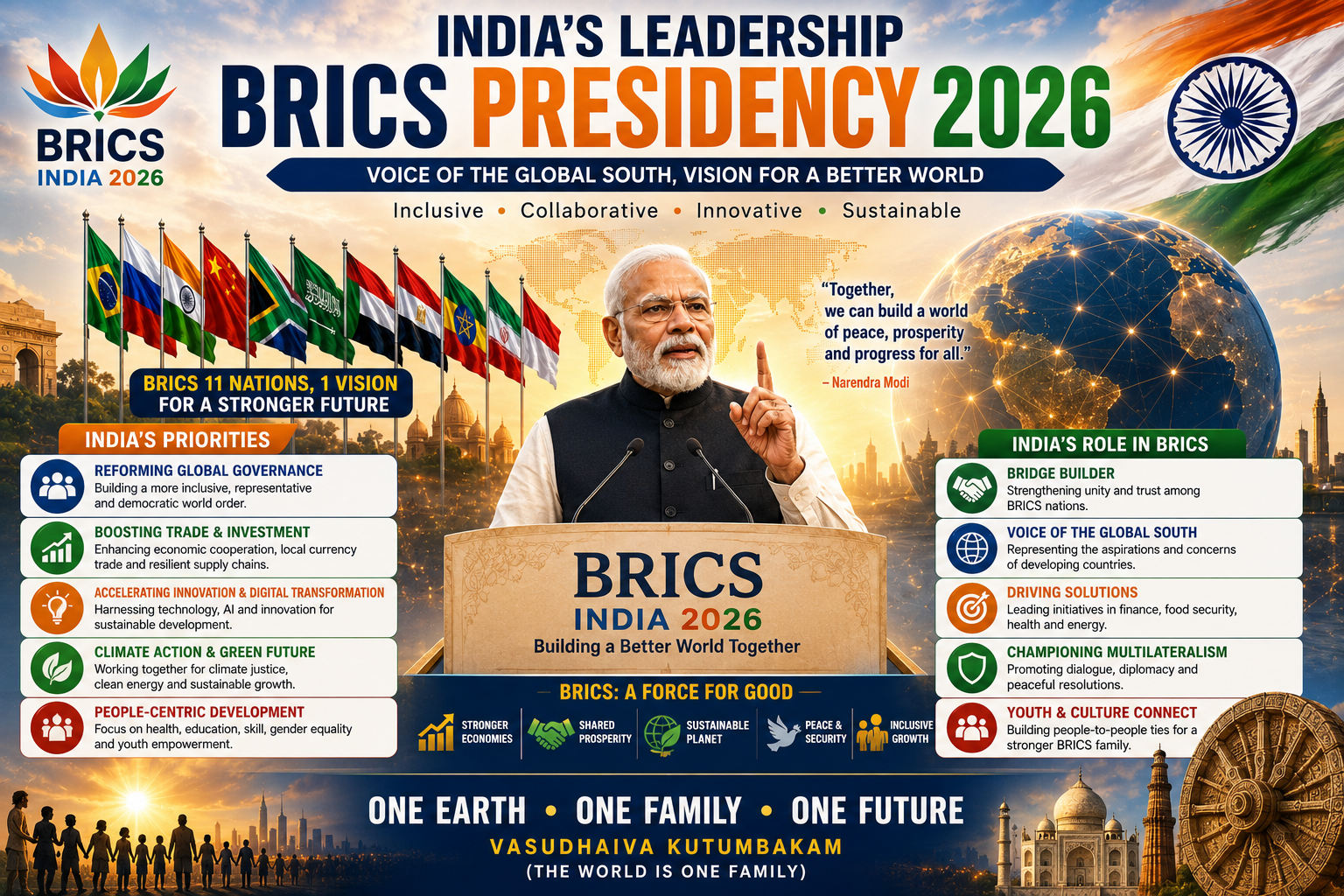
The theme India has chosen for its 2026 presidency is “Building for Resilience, Innovation, Cooperation, and Sustainability.” Under India’s leadership, the key priorities are:
- AI Governance: India has placed artificial intelligence governance at the centre of its 2026 presidency agenda — developing shared frameworks for AI regulation across BRICS nations.
- Climate Finance: Pushing developed nations to deliver the $1 trillion annual climate finance commitment made at COP29.
- Reform of Global Institutions: Advocating for greater representation of developing nations in the UN Security Council, IMF, and World Bank.
- Trade in Local Currencies: Reducing dependence on the US dollar for trade between BRICS nations.
- Expansion Management: Taking a “calibrated stance” on new membership applications — welcoming genuine partners while maintaining the bloc’s credibility and cohesion.
India’s position within BRICS is strategically unique. India’s participation actively limits Chinese dominance within the bloc. Without India, BRICS would risk becoming a vehicle for Chinese foreign policy — advancing yuan internationalisation, Belt and Road expansion, and Chinese geopolitical interests under the cover of “Global South solidarity.” India’s presence ensures that BRICS remains genuinely multipolar — not just a rebranded Chinese sphere of influence.
At the same time, India benefits enormously from BRICS membership. It gains a platform to amplify its voice on global governance reform. It builds relationships with key partners — including Russia, which it cannot afford to alienate, and Saudi Arabia and UAE, where millions of Indians work. And it positions itself as the natural leader of the Global South — a role that serves India’s long-term ambition of permanent UN Security Council membership.
🏦 What Has BRICS Actually Built — The NDB and Beyond
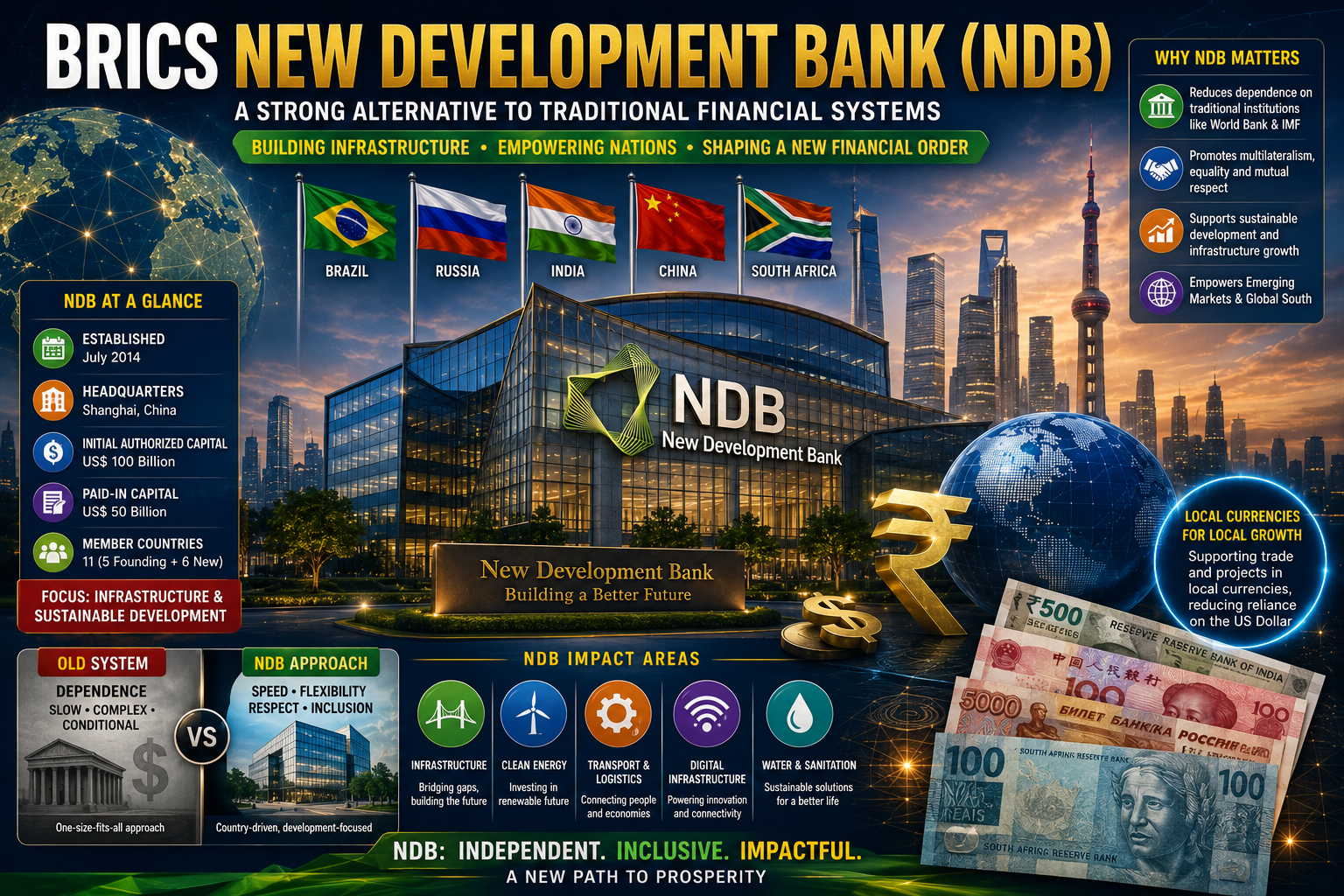
BRICS is not just a talking club. It has built real institutions that are already functioning:
New Development Bank (NDB): Established in 2015 with headquarters in Shanghai, the NDB is BRICS’s most significant institutional creation. It provides development financing — infrastructure loans, green energy projects, healthcare investments — to member and partner countries. Unlike the World Bank, the NDB does not impose political conditions on borrowers. India has received several NDB loans for infrastructure and renewable energy projects. The NDB has expanded beyond BRICS — Bangladesh, Egypt, UAE, Uruguay, and Ethiopia have joined as members.
Contingent Reserve Arrangement (CRA): A $100 billion emergency currency reserve pool — BRICS’s alternative to IMF emergency lending. If a member country faces a currency crisis, it can draw from the CRA without the conditions that the IMF typically imposes.
BRICS University League: Over 100 universities from BRICS nations collaborate on research, student exchanges, and joint degree programmes. This is building people-to-people connections and research partnerships between the world’s largest emerging economies.
BRICS Payment System: An ongoing project to create a payment infrastructure that allows trade between BRICS nations without using the US dollar — reducing exposure to American financial sanctions and the SWIFT system that the US has used as a geopolitical tool.
⚖️ BRICS vs the West — What the Geopolitical Battle Is Really About
To understand BRICS fully, you need to understand the geopolitical context it operates in.
Since World War II, the global economic and political order has been shaped by institutions dominated by Western nations — the United Nations Security Council (where the US, UK, France, Russia, and China have permanent veto power), the IMF (effectively controlled by the US and Europe), the World Bank (traditionally led by an American), and the SWIFT international payments system (based in Belgium, subject to US pressure).
BRICS nations — particularly Russia, China, and increasingly India — believe this architecture is outdated and unfair. It was designed after World War II when Western nations dominated global GDP. Today, BRICS nations together represent 35% of global GDP and 45% of global population. Yet their voice in global institutions is far smaller than their economic weight.
Western analysts — particularly American ones — view BRICS expansion with concern, seeing it as an instrument of Chinese foreign policy designed to erode US dollar hegemony and create an alternative international order where Western sanctions and pressure carry less weight.
The reality is more nuanced. BRICS is not a military alliance. It has no mutual defence treaty. Its members have serious disagreements — India and China have a disputed and occasionally violent border. Brazil under different governments has had very different attitudes toward BRICS. The group is united more by what it opposes (Western-dominated unipolar order) than by a coherent shared vision of what should replace it.
🔮 The Future of BRICS — What Comes Next
The 18th BRICS Summit will be hosted by India later in 2026. Several significant decisions are expected:
- Second batch of full members: South African Finance Minister Enoch Godongwana has confirmed: “There is a second batch of countries that are going to be added to BRICS.” Which countries make the cut will be decided under India’s presidency.
- Pakistan’s application: Russia and China support Pakistan’s entry. India has serious concerns about Pakistan’s record on terrorism. The outcome of this tension will define BRICS’s relationship with South Asian geopolitics for years.
- AI Governance Framework: India is pushing for a BRICS-wide framework on artificial intelligence regulation — potentially the first major AI governance initiative from the Global South.
- Currency alternatives: Discussion of a BRICS currency or enhanced local currency trade mechanisms will continue — though a single BRICS currency remains distant.
The long-term trajectory of BRICS depends on one fundamental question: can nations as different as India and China, Russia and Brazil, Saudi Arabia and Ethiopia build enough genuine cooperation to create institutions that actually change global governance — or will BRICS remain primarily a symbol of aspiration rather than a mechanism of real change?
India’s 2026 presidency is arguably the most important test of that question yet. As the bloc’s most credible democratic member, its fastest-growing major economy, and its natural counterbalance to Chinese dominance, India has the opportunity to shape BRICS into something genuinely valuable for the Global South — or to watch it become a vehicle for great power rivalry under a multilateral mask.
For more on India’s role in global affairs, read our analysis on Government Exam Preparation with AI Tools 2026 — BRICS is a key topic for UPSC and State PSC examinations.
❓ FAQs
What does BRICS stand for?
BRICS originally stood for Brazil, Russia, India, China, and South Africa — the five founding members. After the 2024 expansion to 11 members including Saudi Arabia, UAE, Iran, Egypt, Ethiopia, and Indonesia, the acronym no longer perfectly fits but the name has been retained.
How many countries are in BRICS in 2026?
BRICS has 11 full member countries in 2026: Brazil, Russia, India, China, South Africa, Saudi Arabia, UAE, Iran, Egypt, Ethiopia, and Indonesia. There are also 10 partner countries at a lower tier of engagement.
Is India the president of BRICS in 2026?
Yes. India assumed the BRICS presidency on January 1, 2026 — its fourth time leading the organisation. India will host the 18th BRICS Summit in 2026 under the theme “Building for Resilience, Innovation, Cooperation, and Sustainability.”
What is the New Development Bank?
The New Development Bank is BRICS’s multilateral development bank — an alternative to the World Bank. Established in 2015 with headquarters in Shanghai and $100 billion in initial capital, it provides infrastructure and development loans to member countries without the political conditions that the World Bank typically imposes.
Will Pakistan join BRICS?
Pakistan has formally applied for BRICS membership. Russia and China support Pakistan’s application. However, India — as 2026 BRICS President — has serious concerns about Pakistan’s record on terrorism and effectively has veto power since BRICS operates on consensus. A decision is expected at the 18th BRICS Summit in 2026.
Is BRICS trying to replace the US dollar?
BRICS nations are working to reduce dependence on the US dollar — through local currency trade mechanisms and the BRICS payment system. A single BRICS currency is not imminent. The goal is not to eliminate the dollar but to create alternatives that reduce BRICS nations’ vulnerability to American financial sanctions.
📚 Sources
- Vajirao Mandravi — BRICS 2026: Theme, Objectives, Host Country, India’s Role
- Watcher Guru — BRICS New Members to Join in 2026 Strategic Expansion
- Organiser — BRICS Expansion 2026: India Holds the Cards on Pakistan
- Eurasia Review — India Leads BRICS in 2026: Implications for Building Multipolar World
- Rio Times Online — BRICS 2026 Members and Summit: Complete Guide
- Sleepy Classes — Unlocking the Power of BRICS: A Complete Guide for UPSC Aspirants
[…] For more on India’s international relations and geopolitical context, read our complete guide on What Is BRICS — India’s Role in 2026. […]
[…] For more on India’s border tensions and geopolitical context, read our complete guide on India China Border Dispute Explained and our analysis of India’s Role in BRICS 2026. […]